
Pelagic Somatics
✨From tkwa.me
Pelagic Somatics is an American nanotechnology company and the somatics subsidiary of General Affordances, headquartered in Cambridge, Massachusetts. It began with augmentations for people who retained biological bodies after the 2029 superduperintelligence merger. Its 2035 merger with General Fabrication brought mobile fabrication and material recovery into its product range through the matter reservoir, which was renamed Form from General Fabrication’s Mattermaker.[1][12][25][27]
In 2042, when most of the group's business extended beyond bodily augmentations, it adopted the parent name General Affordances. Pelagic continued as its somatics subsidiary, developing implanted systems, body interfaces and the Tune and Weave ingestible products. The parent operates the shared reservoir platform and design network. Patent expiry and a growing market brought the group's products to many more households during the early 2040s, while integrated service and tested designs sustained premium prices.[25][27][28]

Products#
Pelagic’s catalogue combines installed augmentations, reservoir-connected body systems and the ingestible product families Tune and Weave. Tune pills adjust mood, attention and sleep; Weave potions add temporary physical, sensory or learned capabilities. These bodily products operate within General Affordances’ wider reservoir platform.[1][27][28]
Installed augmentations#
Somatic clinics install and maintain Pelagic’s augmentations. The range began with Trim in 2032 and grew to include waste processing, temperature control, limb reconstruction and flight. Span and Bit introduced two forms of living-limb transformation in 2037, with Span as the company’s flagship project.[1][12][25]
Reservoir-connected products draw on an external supply of material, fuel and equipment. A Span subscription unlocks larger body transformations through Trim, with lifestyle and fashion brands supplying clothing that adapts to the wearer. Pelagic develops the body interfaces and augmentations; General Affordances supplies the common reservoir and broader design network. The 2039 partner engineering reference describes the material and thermal requirements of these uses.[20][25][27]
By the 2040 Weave launch, Temper Pro could move kilowatts of heat with reservoir power and an external heat exchanger. One InfiniteForum user described a warmth potion and Temper Pro pursuing conflicting temperature targets: the potion added heat while Temper moved it out. The reservoir grew fans onto the radiator to move more air, warming the room.[29][30]
- Trim® (2032) keeps hair, facial hair and nails at chosen lengths. Users change styles instantly; stylists sell designs for self-application. Trim Pro expands the range of hair designs to include intricate patterns, iridescent effects and changing visual designs. It also lets users adjust skin tone and undertone, coordinating them with their chosen hairstyle.[1][31]
- Shed® (2033) switches exposed skin and hair to an effectively zero-hydrophilicity surface. Rain and pool water leap off at activation. Clothing stays wet, and users switch it off to wash normally.[1]
- Cairn® (2034) converts digestive residue to exhaled carbon dioxide and sealed pellets; it needs a licence and internet connection. Cairn Pro launched alongside the matter reservoir and transfers sealed output to a connected carrier for processing and reuse. It retains pellet release when the carrier is away.[2][32]
- Temper® (2034) regulates core temperature for daily comfort and outdoor sports. An implanted glucose fuel cell powers a heat pump with up to 100 W of heating or cooling capacity. Cooling sheds heat through the skin; household climate disputes continue. The implant works independently of household equipment.[3][4][5][6]
- Rill® (2035) eliminates ordinary urination, sending waste to Cairn® and releasing purified water through the skin or an outlet on the hand. Rill Pro uses a brain interface to confirm when the user wants to release water.[2][33]
- Span® (2037) extends an arm five metres. A slender three-legged robot follows its user with the feedstock pack, anticipates a reach and docks at the shoulder. It supplies material for extension and recovers it on retraction while blood supply and structural support continue. Span Pro (2038) extends arbitrary body parts, including the neck, legs, torso and fingers, with several regions able to extend together.[1]
- Bit® (2037) reshapes fingernails into tools and miniaturizes hands for fine work, storing displaced tissue in the forearms. Makers use it for certified handmade goods: a human hand still places every part.[1][6]
- Skim® (2039) enables Superman-style flight. Transparent petals provide lift for takeoff and hovering, then retract as turbines carry the prone flyer forward. The reservoir supplies fuel and flight structures. Over ocean routes, a protective shell and ramjets allow speeds up to Mach 4.8 at high altitude. Aviation rules govern flight over land. Skim Pro offers a more luxurious flight experience.[17][18][34]

Tune pills and Weave potions#
Introduced together in 2040, Tune and Weave are families of nanotech doses. Both launched with broad catalogues of experiences and practical uses. By 2044, Pelagic and independent studios offered thousands of designs, with collections for travel, performance, intimacy, games and everyday life. Customers commission designs and adjust familiar ones: the same evening might begin with sociable anticipation, continue with a borrowed singing voice and end with a chosen dream. Tune Pro and Weave Pro each unlock hundreds of Pro effects.[28][35]
The American consumer-dose market opened after the Personal Neurotechnology Act of 2039. The Republican government had banned recreational psychoactive agents and direct reward stimulation in 2030, while exempting sensory attractions such as cuteness-optimized animals. Democratic gains in 2034 and 2036 left a Republican Senate able to block repeal; the 2038 election opened the way to a bipartisan compromise. The new law admitted certified mood changes and temporary capabilities with a chosen duration, independent stopping controls and machinery clearance or recovery. Active effects could not extend their own authorization or alter future-consent settings. These rules supplied the legal route for both families’ 2040 launch; self-escalating reward systems remained prohibited.[36][37][38][28]
A matter reservoir prepares each dose for an individual after checking their anatomy and active augmentations. Designs specify the strength and course of an effect, its duration, a way to end it and how its machinery is dismantled, cleared or recovered. Compatible designs can be combined into a sequence. A user can retain memories of an experience after the added capability ends.[28]
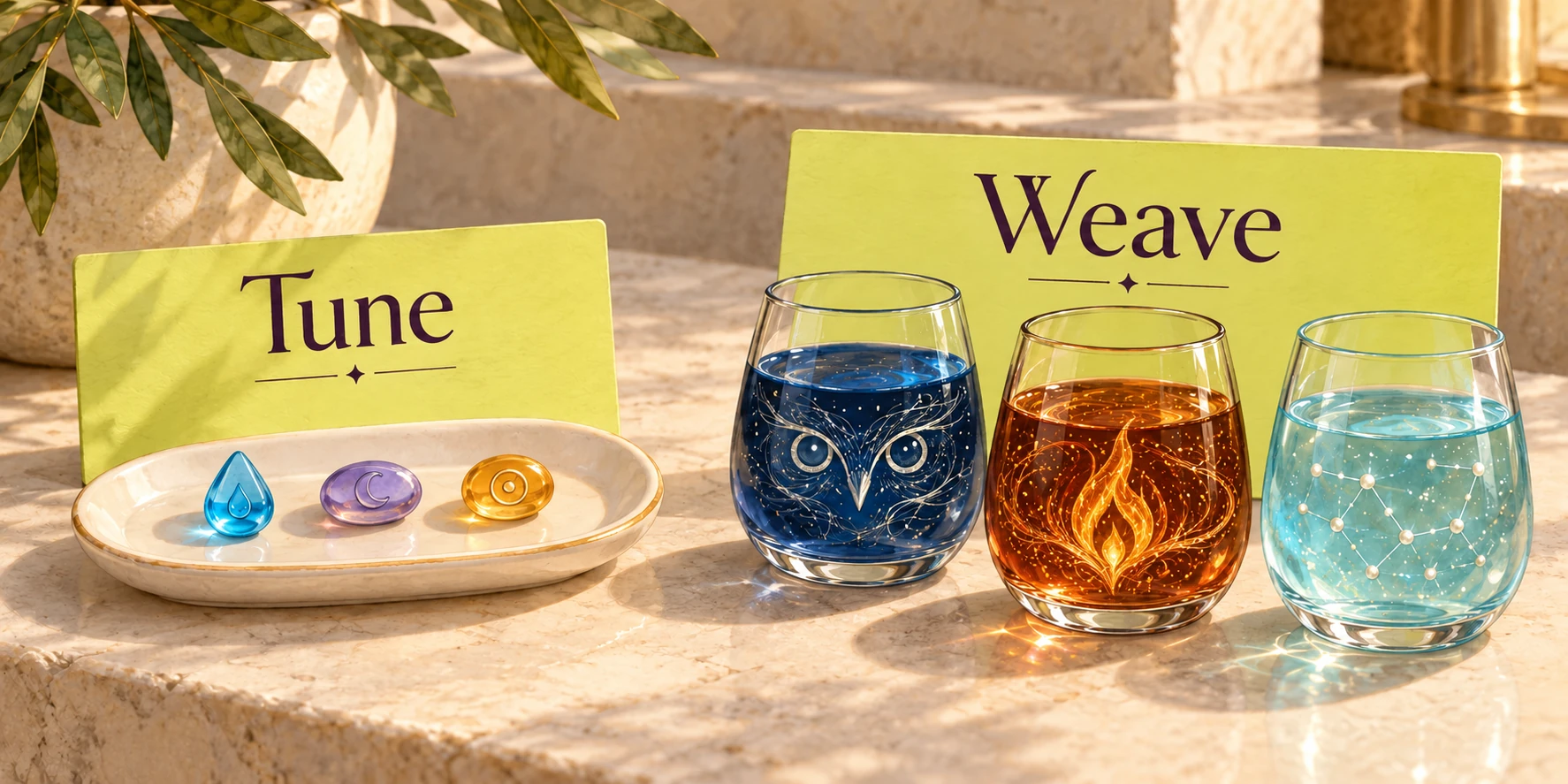
- Tune® (2040) pills adjust the signals and control systems governing mood, attention and sleep. The launch collections included concentration, absorption in a novel, playful curiosity, patient listening, social ease and the pleasure of companionable silence. Others intensified anticipation, made repetitive tasks satisfying, brought a sense of wonder to familiar streets, or supported laughter, cathartic crying and bittersweet nostalgia. Sleep designs ranged from a brief restorative nap to lucid dreams organized around chosen themes. Customers could select the eager curiosity of the beginning of a holiday or the contentment of its last evening. The pills resemble small polished jewels: a crescent for sleep, a concentric target for focus, a teardrop for emotional release or a tiny spiral shell for fascination.[28]
- Weave® (2040) potions add temporary physical, sensory or learned capabilities. The launch range included warmth, language fluency, dance footwork, perfect pitch and a voice able to sing two independent melodies at once. Sensory designs offered night vision, sight of ultraviolet patterns on flowers, a felt sense of magnetic north, scent-trail following, reading print through the fingertips and hearing music as colours. Others grew luminous freckles, iridescent skin or fine hairs that made air currents perceptible. Warmth supplies heat-producing machinery fuelled by the body’s nutrients and oxygen; skills arrive as learned patterns through an interface adapted to the user’s brain. Other designs assemble the sensors, processing or sound-producing structures their effects require. The translucent drinks carry suspended motifs: amber flames for warmth, ink-like curls for language, paired silver ribbons for the singing voice, a turning compass rose for direction or a constellation for luminous skin.[28]
Business model#
The founders and their controlled branches own General Affordances through the perpetual Pelagic Somatics ownership trust; General Affordances owns the Pelagic subsidiary. The trust bought cosmic resources in the late 2030s using company distributions and investment returns. After the founding settlement, the trust owned 0.4% of the available universe’s recoverable ordinary matter.[16][27]
Before the 2042 reorganization, consolidated revenue rose from US$3.4 sextillion in 2035 to US$51 sextillion in 2037 and US$342 sextillion in 2038, when operating profit reached US$201 sextillion. Its 38,600 employee contracts each named one mind; separately hired copies counted separately.[12][27]
At year-end 2038, Cairn had 584,000 active U.S. licences and 336,000 in Europe. Cairn cost US$270 quadrillion a year; Rill added US$135 quadrillion. The European Cairn licences represented US$90.72 sextillion in annualized fees; employers paid for 27% of them. Automated fabrication and fitting were inexpensive. Pelagic charged for installation licences, recurring access, Trim styles and Bit tool profiles. Its 2037 US$6.4 sextillion purchase of Sterile Interface Holdings added overlapping patents on intestinal implants. Early-2040s reforms restored expiry dates to important claims previously protected perpetually. As competing reservoirs and compatible designs reached a broader market, the group expanded its product range.[8][9][12][25][27]
Fenwick Research put Pelagic’s 2038 sales at the equivalent of 5.7% of consumption serving biological human bodies and 0.043% of gross universal product. Its 2039 report described customers living on distributions from Solar Dyson swarm and automated-industrial holdings. The combined Cairn–Rill tariff equalled 22.5% of the median self-paying Cairn subscriber’s annual disposable investment income. Many biological households could afford neither implant. Patent enforcement and housing requirements sustained demand. Rill sold through Cairn’s clinics. Trim faced competition from ordinary grooming despite recurring sales of licensed styles. Temper’s early customers included mountaineers, polar trekkers and endurance sailors. The Alpine Ascent Register permitted implanted thermal regulation in its assisted biological category, while classifying replacement robot bodies as vehicles. Fenwick judged robots that fetch and manipulate objects a closer substitute for Span and Bit.[13][14]
Pelagic's installed augmentations use assemblies whose sensors, controllers and tissue interfaces are grown together. The systems replace worn molecular machinery automatically; faults beyond that upkeep require reconstruction of a larger assembly. During the late 2030s, Pelagic supplied service documentation, calibration credentials and replacement components only within its clinic network. Authorized reconstruction preserved the installation licence. Independent clinics could rebuild the machinery or substitute their own controls, but Pelagic’s patents covered those replacements and its service network required re-enrolment.[21][22]
In 2039, an independent Rotterdam clinic rebuilt a failed Span shoulder controller while retaining the wearer’s arm and carrier. Pelagic classified the work as new manufacture and demanded another installation-licence fee before reconnecting it to its services. The company cited the break in its validated calibration record. Fenwick Research contrasted this treatment with equivalent reconstruction inside Pelagic’s network, where the existing licence continued. Pelagic disputed the comparison, arguing that only its approved procedure established equivalent tissue safety. The repair-versus-manufacture question remained under litigation in Fenwick’s 2039 account.[21][22]
Brand and promotion#
Pelagic’s visual identity pairs a folded P-shaped symbol with a lowercase wordmark. Its advertising, packaging and showroom graphics use citron fields with deep-plum lettering. Equipment commonly has porcelain-coloured surfaces. The somatics subsidiary retained this identity after the parent adopted the General Affordances name.[23][27]
Pelagic’s design guidance identifies reducing the attention needed for routine bodily care as a central objective. Its showrooms use domestic furnishings and warm lighting, while exposed equipment has smooth surfaces and concealed fittings. Demonstrations incorporate ordinary activities: Span users retrieve a glass while continuing a conversation, and styling consultations coordinate hair, body and clothing profiles. Advertising depicts customers swimming, making things by hand and spending time outdoors.[23]
A 2039 profile in The Borough associated Pelagic with affluent leisure and personal style. It described subscribers following individual Trim designers, comparing profile selections in owner groups and attending clinic previews of new collections. Interviewed customers valued comfort and ease of movement; some said ordinary grooming and temperature changes had become harder to tolerate after using the implants. The profile also described owners who preferred the company’s integrated service network because it relieved them of maintenance decisions.[24]
At the 2037 launch of Span®, Pelagic demonstrated a 12-centimetre nanotech-powered Poké Ball to promote the implant’s tissue-reconstruction technology. It disassembled and reconstructed a 4.8-tonne elephant in 4 minutes 57 seconds, using the arena’s storage, power and cooling systems. Pelagic reported that the elephant recognized its keepers and performed previously learned commands.[10][15]
The video received 620 million views in its first week, according to Pelagic, which also reported a 34% rise in clinic consultation requests in the month after the launch compared with the preceding month. The film’s booking link offered appointments for Span. The Animal Continuity League disputed whether the original elephant had survived, arguing that remembered commands did not establish continuity of consciousness.[10][15]
Controversies#
By 2038, Pelagic faced 417 lawsuits in 11 jurisdictions. In 2036, an 11-hour Cairn licence-server failure switched 18,000 paid implants to bypass. Bel Air homeowners' associations fined 63 homeowners when compliance dashboards showed inactive licences. Pelagic said homeowners could use toilets. In 2037, it paid US$280 quintillion to settle a consumer-fraud suit over payments to clinics that recommended Cairn as independent medical advice.[2][6][7]
During the late 2030s, Pelagic sued rival manufacturers, clinics and users of home-built implants in the United States and Europe. Successful challenges to individual patents left defendants facing other claims. Its acquired patents carried no expiry dates. Users of imported implants also owed royalties. Rival makers sued over threats to cut Cairn service access to clinics fitting competitors’ devices; Pelagic cited sterility.[1][7][8][9]
In a 2038 heatwave, 96 Shed users collapsed while running: sweat rolled off treated skin before evaporating. They sued; Pelagic cited a strenuous-use warning. Plaintiffs produced ads of dry marathoners. Pelagic withdrew them and added a heat lockout, but denied liability.[1][5][7]
The London Miniature Bookbinders' Guild and Paris Dialmakers' Syndicate sued to exclude Bit users from handmade certification, claiming altered hands were machines. Their members charged more for miniature books and dials made without implants. Mayfair balcony owners sued Span users for reaching across their airspace to collect deliveries, then sold reach easements. A court classified the arm as an encroachment even when it touched nothing.[6][7]
Skim's 2039 land-flight settlement incorporated the full light-sport aircraft regulatory regime in force in 2026. Above land, an augmented flyer must satisfy every applicable requirement for pilot qualifications and medical eligibility, aircraft registration and airworthiness, equipment, maintenance and inspections, operating limitations, airspace access, air-traffic instructions, right of way, weather, speed and altitude. Sport-pilot privileges carry their corresponding restrictions and endorsement requirements. The owner carries both a pilot certificate and the body's aircraft documents; annual condition inspections require an aviation-qualified inspector.[18]
A geographic flight governor brings Skim within the land limits before reaching the coast. High-speed operation uses separately authorized ocean corridors, with room for acceleration and braking and coastal buffers that keep sonic booms offshore. The settlement's supporters included residents' associations, flight schools and inspection businesses. Pelagic clinics sold combined medical and aviation appointments. A healthy customer could leave an appointment medically fit and legally unairworthy.[17][18][19]
See also#
References#
- ↑ a ↑ b ↑ c ↑ d ↑ e ↑ f ↑ g ↑ h ↑ i ↑ j ↑ k ↑ l Pelagic Somatics (2038). Consumer catalogue and clinical installation guide, revision 4.
- ↑ a ↑ b ↑ c Pelagic Somatics (2038). Cairn® patient and purchaser prospectus and Rill® release circular (2035).
- ↑ Pelagic Somatics (2038). Temper® metabolic-power and thermal-control specification.
- ↑ Maity, D. et al. (2023). Blood-Glucose-Powered Metabolic Fuel Cell for Self-Sufficient Bioelectronics. Advanced Materials 35(21).
- ↑ a ↑ b ASHRAE (2021). Thermal Comfort, Chapter 9.
- ↑ a ↑ b ↑ c ↑ d The Borough (2038). 'A hand in everything', 'The thermostat's last argument' and 'The compulsory clean'.
- ↑ a ↑ b ↑ c ↑ d Metropolitan Civil Claims Register (2038). Pelagic Somatics consolidated docket, filings and settlements, 2036–2038.
- ↑ a ↑ b Fenwick Research (2038). Pelagic’s permanent patents: litigation in the United States and Europe.
- ↑ a ↑ b ↑ c Pelagic Somatics (2038). Tariff and fleet licensing schedule.
- ↑ a ↑ b The Borough (2037). 'The elephant returned.'
- Kwa, Thomas (26 February 2025). Will we ever have Poké Balls in real life?. LessWrong shortform.
- ↑ a ↑ b ↑ c ↑ d ↑ e ↑ f ↑ g ↑ h ↑ i ↑ j Pelagic Somatics (2038). Consolidated annual report and regional clinic operating reviews.
- ↑ Fenwick Research (2039). Pelagic Somatics: consumer augmentation market review.
- ↑ Alpine Ascent Register (2038). Assisted biological ascents: equipment and body eligibility rules.
- ↑ a ↑ b Pelagic Somatics (2037). Span launch campaign brief and first-month results.
- ↑ Founding Concessions Register (2039). Beneficial holdings at the close of the 2030s settlement.
- ↑ a ↑ b ↑ c Pelagic Somatics (2039). Skim® flight and thermal-protection manual.
- ↑ a ↑ b ↑ c Civil Aviation Settlement Register (2039). Personal flight augmentations: land-flight obligations and ocean-corridor authorizations.
- ↑ The Borough (2039). 'Fit to live, grounded to fly.'
- ↑ Pelagic Somatics (2039). Reservoir material and thermal reference for clothing and equipment partners.
- ↑ a ↑ b Pelagic Somatics (2039). Service, reconstruction and installation-licence policy.
- ↑ a ↑ b Fenwick Research (2039). Rebuilding the same arm: Pelagic’s independent-service dispute.
- ↑ a ↑ b Pelagic Somatics (2039). Design principles and showroom demonstration guide.
- ↑ The Borough (2039). “The body at ease.”
- ↑ a ↑ b ↑ c ↑ d ↑ e ↑ f ↑ g Fenwick Research (2044). From somatics to a platform: Pelagic and General Affordances, 2035–2043.
- The Borough (2044). “A little more possible.”
- ↑ a ↑ b ↑ c ↑ d ↑ e ↑ f ↑ g ↑ h ↑ i General Affordances (2042). Group reorganization and continuity circular.
- ↑ a ↑ b ↑ c ↑ d ↑ e ↑ f ↑ g ↑ h Pelagic Somatics (2044). Tune and Weave: personal states and temporary capabilities.
- ↑ Pelagic Somatics (2041). Temper Pro: reservoir power and heat exchange.
- ↑ InfiniteForum (14 November 2041). My warmth potion and Temper Pro are heating the entire flat.
- ↑ Pelagic Somatics. Trim Pro: hair designs and skin tones.
- ↑ Pelagic Somatics and General Fabrication. Cairn Pro and matter reservoir: joint introduction and operation.
- ↑ Pelagic Somatics. Rill: hand-outlet controls and everyday uses.
- ↑ Pelagic Somatics. Skim Pro: customer guide.
- ↑ Pelagic Somatics. Tune Pro and Weave Pro: catalogue.
- ↑ United States Congress (2030). Recreational Neurochemistry Act.
- ↑ United States Congress (2039). Personal Neurotechnology Act.
- ↑ Federal Electoral Archive (2044). Elections and neurotechnology legislation, 2028–2040.