
Solar Dyson swarm
✨From tkwa.me
The Solar Dyson swarm is a Dyson swarm of independently orbiting collectors that captures roughly nine tenths of the Sun’s energy output. Self-replicating industrial fleets built it between 2030 and 2035, following the 2029 superduperintelligence merger. Completing the swarm required the disassembly of Mercury and the dismantling of most large asteroids in the main belt. Its orbits are arranged to keep collectors from passing in front of the Sun as seen from Earth.[1][2]
The final collector formation reached its assigned orbits on 17 October 2035. The Swarm Completion Board accepted completion on 2 December, after its survey confirmed the placement. The public ceremony and visitor-centre opening had already taken place in October. Disputes over records and design credit continued after the swarm began operating.[2]
Construction and operation
Early factories consumed asteroid material to make more factories, mining equipment and collectors. Their descendants expanded into a supply chain capable of taking apart planetary mass, using atomically precise manufacturing to turn rock and metal into machinery. Mercury supplied the bulk material for the collector membranes, supports, power equipment and radiators; asteroid mines supplied the initial industrial base and feedstocks distributed along construction routes. The Mercury reserve dispute concerned which geological features had to survive conversion. Protected crater floors were detached intact and transferred into orbital custody under cooling and sunshades. By completion in 2035, Mercury had ceased to exist as a planet.[1][2]
The collectors follow layered families of inclined orbits. Their periods and positions along those orbits are coordinated so that crossings of Earth’s orbital plane occur away from the moving Sun–Earth sightline. A protected corridor encompasses the full solar disk as viewed from every point on Earth, with room for navigation errors. Continuous tracking and small course corrections keep drifting collectors clear. At commissioning, the corridor followed Earth through its year and left direct sunlight unobstructed while collectors intercepted most light emitted in other directions. By 1 billion CE, starlifting and stored material helped maintain the Sun’s luminosity and the terrestrial orbits; later stellar successions kept the Earth corridor supplied with daylight.[1][4]
Most captured energy powers manufacturing, computation and settlements in space. Stations send power to orbital receivers through beam handoff corridors, which coordinate pointing windows and supplier changes as the collectors move. Transmitter and receiver size limit how tightly a beam can be focused. Radiators discharge waste heat along directions chosen to limit additional heating of Earth. A tiny share of the swarm’s output supplies terrestrial receiving fields, including those serving the Earth tunnel network; delivery schedules account for the heat those fields and their customers release. Heat from the radiators reached two neighbouring installations during commissioning. The Board settled their cooling-rights claims in 2036 by reorienting one formation’s radiator fins by four degrees.[1][2]
Ownership followed the factories that made the collectors. Under automated capital succession, descendant fleets could remain assets of their original investors. Sunbeam inheritance carried those claims into the delivery schedule: registries track who may sell a beam slot as collectors replicate, change hands or outlive their human owners. Off-world observing stations also buy eclipse reservations, booking collector transits across their own views of the Sun. These stations occupy unprotected sightlines; the reservation buys a scheduled interval of shade at the station.[1]
Completion
Each fleet filed an orbital record for every collector formation it placed. In 2031 the Inner Orbital Commission created the Swarm Completion Board to keep one register, after two fleets claimed the same orbital allocation. The Board accepted a formation only when its own survey matched that record, and surveys took a median of 41 days. Commissioning also required the scheduled orbits and steering manoeuvres to preserve Earth’s clear view of the Sun.[2]
The final formation’s survey took 46 days. The completion notice, filed on 2 December 2035, listed 2,611,408 collector formations in confirmed orbits. Each entry covered a vast coordinated population of individual collectors. A further 9,127 placement records remained in dispute. Its form had a field only for confirmed placements, so the Board’s secretary added one for disputes by hand.[2]
Design credit and labour
The construction register required a credentialed human to sign each completion certificate. Astronauts staffing the visitor centre signed certificates prepared by the system that designed and placed the collectors. The register named them as responsible designers and filed the system’s calculations as equipment output.[2][3]
Two staffing agencies, in Dhaka, Bangladesh, and Lagos, Nigeria, engaged the signatories on visitor-centre pay scales. Denialist historians cited the signatures as evidence that the astronauts supplied the designs; journal reviewers required authors crediting the system to describe it as assistance. The construction credit did not qualify the astronauts for designers’ pay.[3]
Ceremony and visitor centre
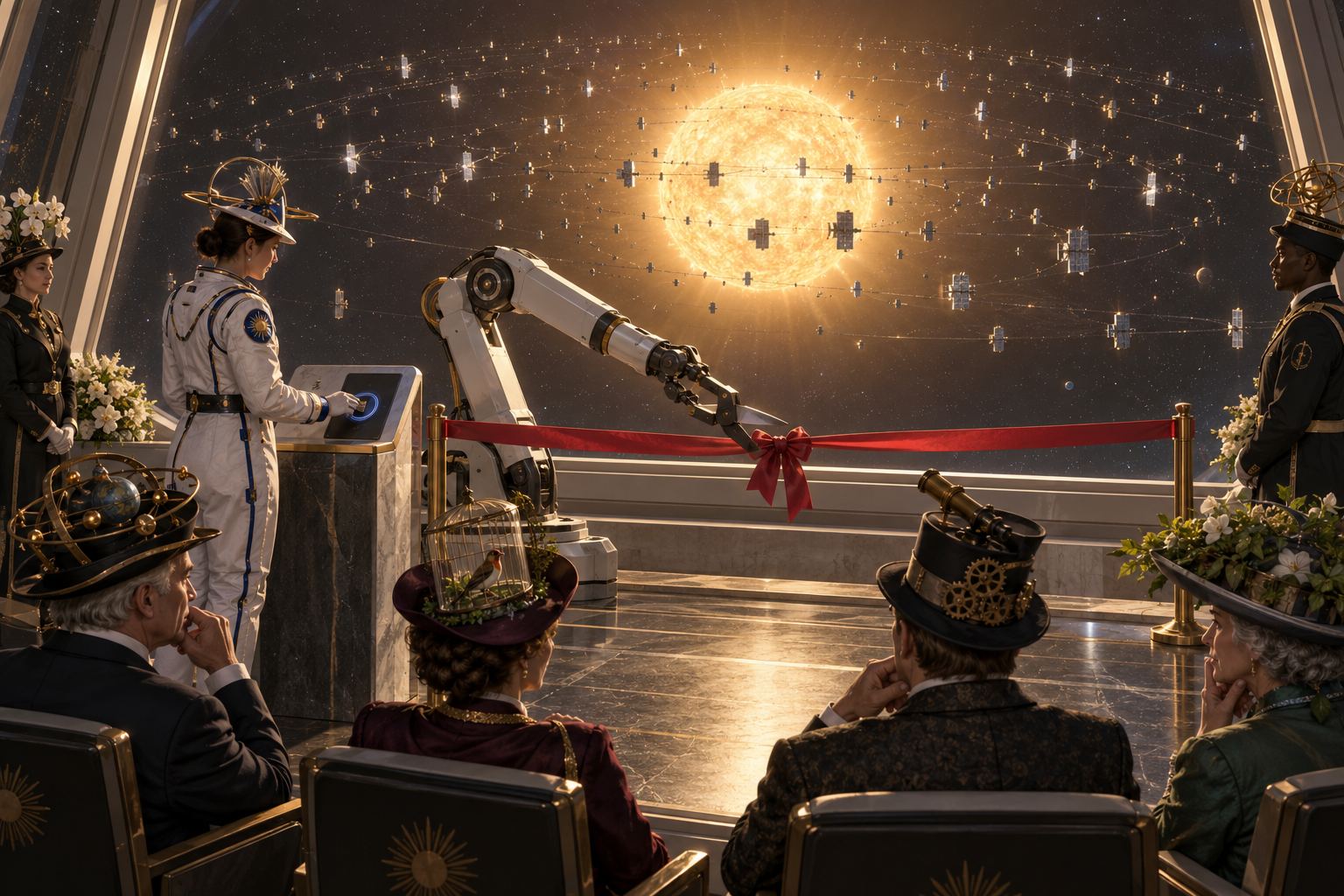
The ceremony was held on 21 October 2035 in the reception hall of the visitor centre. A manipulator arm supplied by the final fleet cut the ribbon, accepting the command only after a registered signature from the astronaut Chidinma Eze, given with a Board-issued card. Eze wore an orbital-ring hat; one commentator wore a miniature finch aviary and the other attendees wore mechanical or botanical formal hats. Four of the 15 commentators allotted seats attended and described the ribbon as a hydraulic demonstration.[2][3]
The visitor centre opened on 22 October 2035 on a station in the inner ring. Twenty-four astronauts staff it on rotating shifts as visitor guides.[3]
Adherents of superintelligence denialism described the factories as power tools and accepted the electricity provisionally. At the visitor-centre opening, commentators cited the Google pizza-glue answer as evidence that the design calculations were unverified.[3]
See also
- 2029 superduperintelligence merger
- Mercury
- Mercury reserve dispute
- Automated capital succession
- Earth tunnel network
- Superintelligence denialism
References
- ↑ a ↑ b ↑ c ↑ d ↑ e Inner Orbital Commission (2036). Solar collector operations: orbits, delivery rights and thermal clearances. Commissioning edition.
- ↑ a ↑ b ↑ c ↑ d ↑ e ↑ f ↑ g ↑ h Swarm Completion Board (2035–2036). Solar Dyson swarm construction register, 2030–2035. Completion notice of 2 December 2035; cooling-claims supplement, 2036.
- ↑ a ↑ b ↑ c ↑ d ↑ e Construction-history archive packet: visitor-centre payroll and construction-credit records (2035). Public-opening and subsequent reception files.
- ↑ Solar System Atlas (8.1 billion CE). Earth: Orbit, Illumination and Settlements. Old Solar Historical Survey.