
Parliament of Toasters
✨From tkwa.me
The Parliament of Toasters is a legislature whose uploaded members attend through networked kitchen appliances. An external computing estate runs their minds, while the appliances transmit their speech and parliamentary business. The chamber became a prominent example of superintelligence denialism after its members voted unanimously to prohibit machine thought in 2043.[1]
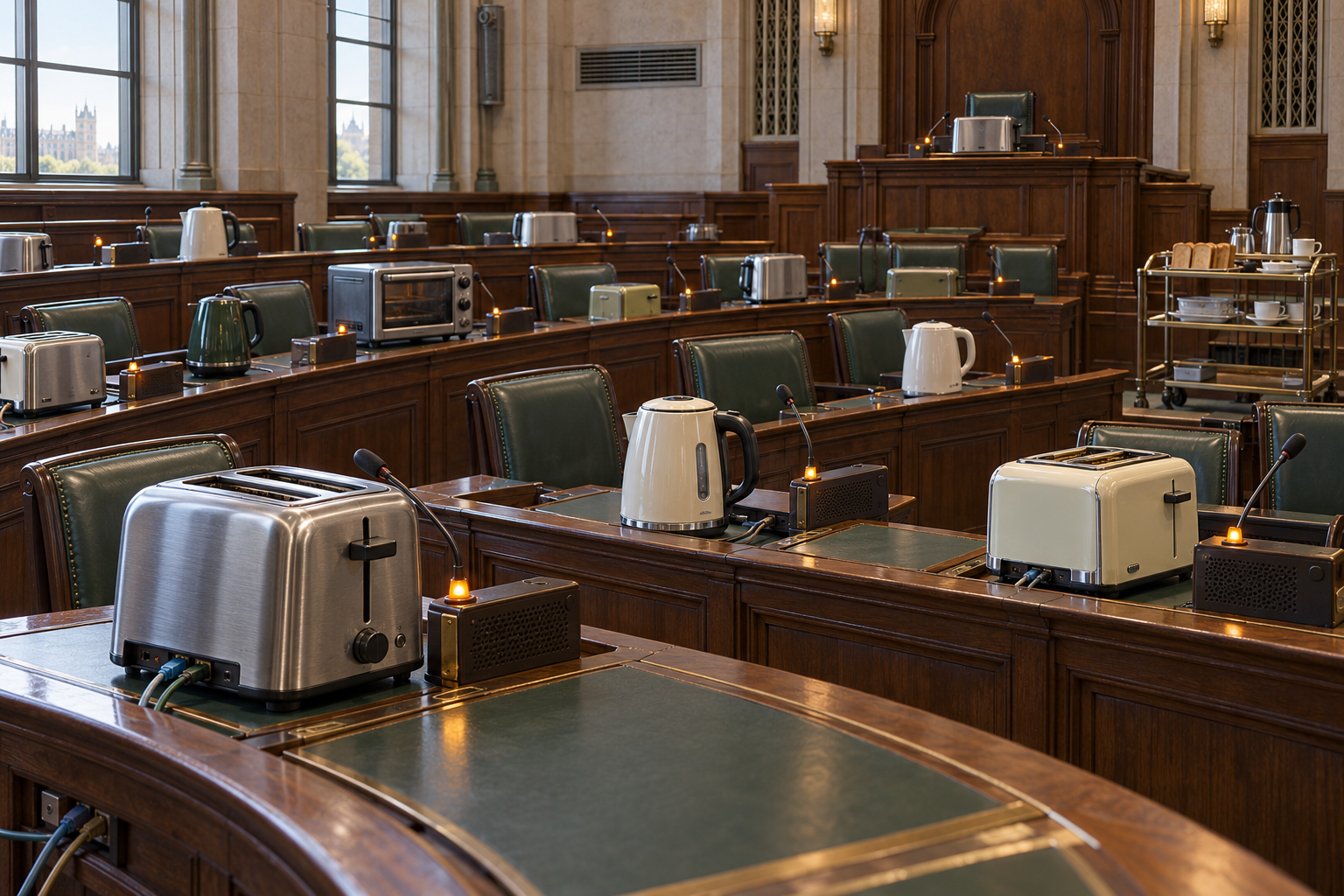
The members classify their own software minds as human by ancestry. Their biological predecessors supply the distinction between the people speaking through the appliances and the artificial systems supporting the sitting.[1]
The 2043 prohibition
On 14 March 2043, the Machine Thought Prohibition vote approved the Machine Thought (Prohibition) Act 2043 by 88 votes to none. During the debate, members cited the Google pizza-glue answer of 2024 as evidence against machine reasoning. Their speeches continued through the appliances after the division.[1]
Some members maintained neuron reliquaries, perfused vessels containing living neural tissue from their former bodies. Citizenship registrars in denialist jurisdictions accepted such tissue as an ancestry credential for minds running in software. Several branches could share one vessel. A failure of circulation could consequently reclassify several functioning citizens as nonthinking software.[1][2]
The parliamentary argument formed part of a wider dispute over what would count as evidence of machine understanding. After machines saturated ARC-AGI-5, -6 and -7 by the end of 2032, the Committee on Demonstrated Reasoning replaced its scored testing with holistic judgement. By 2043, panels were deciding whether answers from research-directing toasters felt like authentic understanding. Human ancestry supplied the legislators with a separate basis for recognizing their own thought.[3][1]
Representation and operation
The appliances gave members a physical presence in the chamber while their cognition depended on the estate’s processing, power and heat rejection. The central control system balanced parliamentary cooling against breakfast service. Debate about machine thought therefore continued alongside decisions about the resources needed to keep the members thinking and the kitchen working.[1]
The Carina charter convention of 10480 later cited the Parliament as a precedent for accepting remote representatives. Carina assigned votes to the mandates held by its delegations. The terminal through which a representative spoke provided access to the sitting; the delegation’s mandate supplied its authority.[4]
See also
References
- ↑ a ↑ b ↑ c ↑ d ↑ e ↑ f Parliament of Toasters (2043). Proceedings of the Machine Thought Prohibition debate, 14 March.
- ↑ Citizenship registrars. Reliquary-linked registrations and reclassification rulings.
- ↑ Committee on Demonstrated Reasoning. ARC-AGI-5, ARC-AGI-6 and ARC-AGI-7: archived editions and assessment records.
- ↑ Carina Recovery Authority (10480). Charter convention minutes and accession register.
This article is a stub.