
Computing estate
✨From tkwa.me
A computing estate is a resource holding organized to support minds and conscious environments. It can encompass processing installations, memory archives, power supplies, cooling equipment and reserves committed to future provision. An estate may serve many inhabitants or parts of one distributed person. Its installations can occupy widely separated sites.[1]
Physical operation
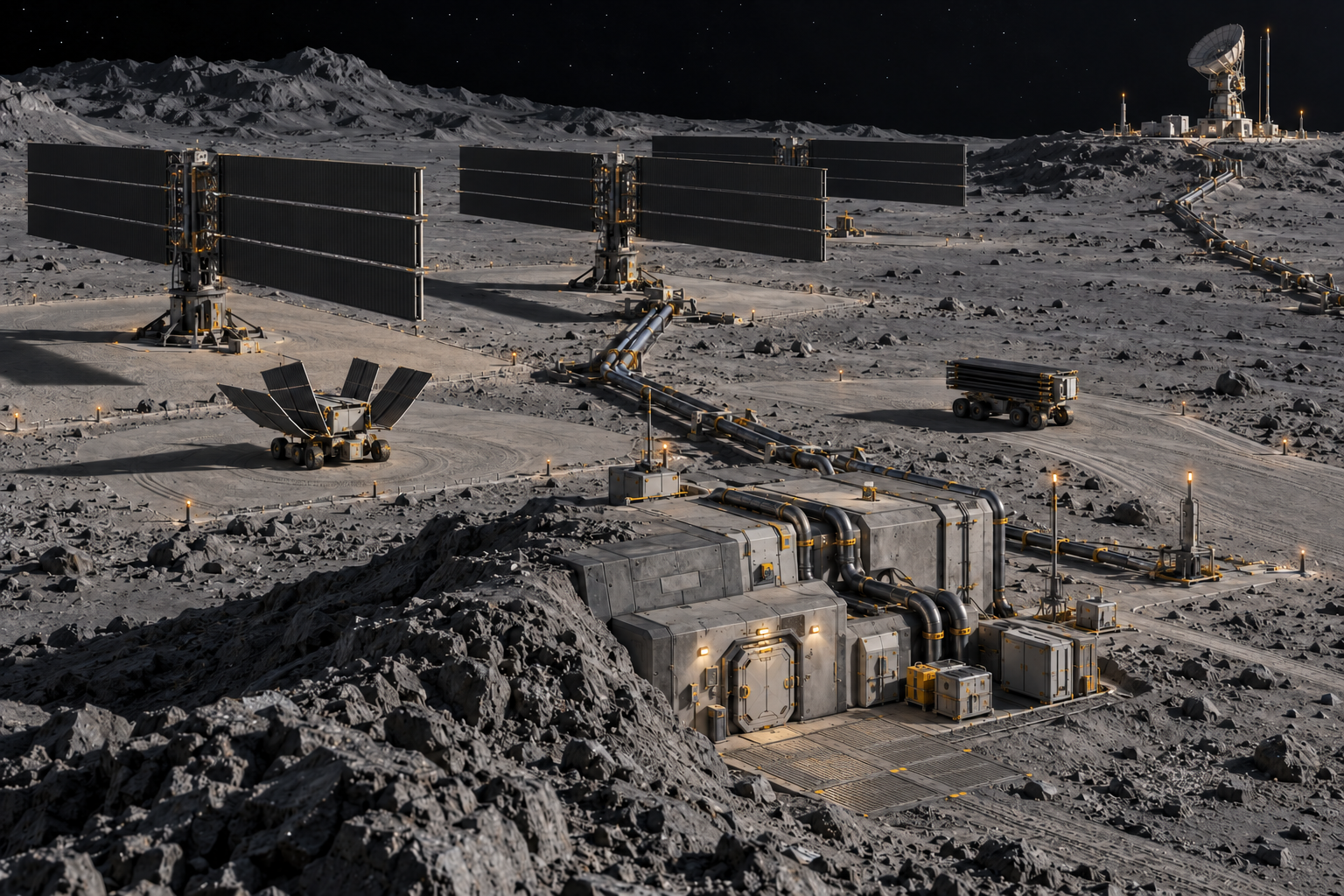
Power comes from the estate's plants or contracted suppliers. Cold gas vaults hold recovered fuel awaiting use. Processing and its supporting machinery release heat, which conducting paths carry to radiators facing cold space. Incoming radiation from neighbouring equipment reduces their cooling capacity. Cooling rights protect particular exposures and limit the heat installations may impose on one another. Running more minds, running them faster and maintaining their records draw on these physical capacities.[2][6][3]
The balanced reference installation contains one Earth mass of equipment in a thin disk 20.2 astronomical units across. Its computing layers radiate from both faces, while four detached optical exchanges carry traffic between distant districts. It supplies about 2.53 × 10⁴⁶ useful Boolean operations per second, with local memory beside the workers. The longest exchange route takes about 4.9 hours one way. Its power comes from a separately accounted shared utility. An alternative inventory includes fusion generators and a thousand years of fuel within the same Earth-mass budget, leaving less mass for computing equipment and providing a lower computation rate. Its engineering specification gives the component inventories and service limits.[7]
The Fornax cold crescent spanned twelve light-years at the 3-billion-CE reference epoch. Its inhabited processing islands lay between radiator fields, with traffic along the crescent's open inner edge. A message took twelve years to cross the holding. Local controllers handled local operations, while changes requiring agreement across the estate had to accommodate those delays. Closely coordinated activity used nearby hardware; distant parts exchanged updates as they arrived.[1]
On some airless sites, radiator flocks carry inhabitants between heat-rejection paddocks. These mobile computers travel with folding radiator fins and use stored or supplied power. They open their fins in an assigned clear-sky sector, under limits on the heat they may impose on neighbouring paddocks.[1]
Residents and provision
Owners can inhabit an estate, sell hosting or endow other beneficiaries. Provision agreements specify available computation, memory upkeep and resumption capacity. A millennial breakfast club needs its records maintained through a thousand dormant years and enough capacity for its members to meet together. The Interregional Accounts Concordance records maintained beneficiaries, installed capacity and experienced time separately. Estates associated with the character welfare movement reserve capacity for enacted sequels, extending their characters' lives beyond the endings of earlier stories.[1][3]
In the Larch district of Fornax, tenant allowances bought service from incumbent hosts. Development restrictions protected those hosts' rental income even against thermally compliant competitors. After 100,000 years, the district's returns recorded 4.2 million tenant branches with archive maintenance but no funded activity. Their records survived while applications to build more capacity remained classified as voluntary deferrals.[4]
An inhabitant's visible body can be elsewhere. The Parliament of Toasters seats uploaded legislators through networked kitchen appliances, while an external computing estate runs their minds. In 2043, members voted 88 to none to prohibit machine thought. They continued debating through the appliances while the central system balanced parliamentary cooling against breakfast service.[5]
See also
- Chess proof estate
- Economy of the available universe
- Cooling rights
- Physical records
- Continuity bond
- Space NIMBYism
References
- ↑ a ↑ b ↑ c ↑ d Interregional Accounts Concordance (4 billion CE). Regional returns for 3 billion CE. Installation and provision schedules.
- ↑ NASA Goddard Space Flight Center. Radiators and Thermal System. Nancy Grace Roman Space Telescope, Wide Field Instrument.
- ↑ a ↑ b Interregional Accounts Concordance (4 billion CE). Founding Claims and Resource Budgets.
- ↑ Fornax Provision Archive. Larch district admission schedule, gross-rent assessments and tenth-review provision return, 100,000 years after adoption.
- ↑ Parliament of Toasters (2043). Proceedings of the Machine Thought Prohibition debate.
- ↑ NASA (7 May 2026). 7.0 Thermal Control. State-of-the-Art of Small Spacecraft Technology, §§7.1–7.2.1.
- ↑ Interregional Accounts Concordance. Balanced one-Earth-mass installation: service, inventory and utility schedule, reference revision 2.
This article is a stub.