
Parallel life
✨From tkwa.me
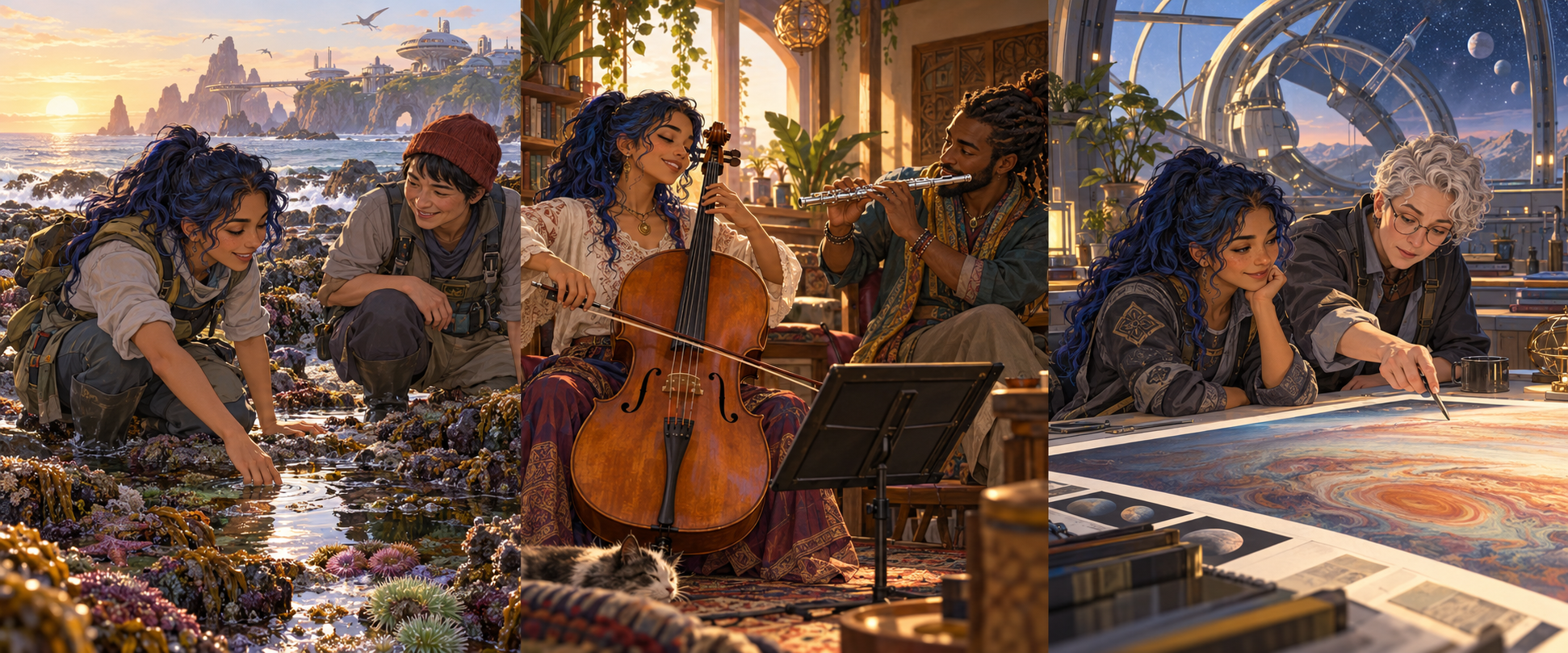
Parallel lives are the simultaneous activities and experiences of a person living through several connected fragments. Each fragment can attend to an activity and acquire memories. By sharing selected experiences, the person can later remember what happened in several places, even though each fragment was present at only one.[1][2]
Fragments were used during the 2029 superduperintelligence merger, and later technologies gave people more ways to coordinate them. In a 2356 survey of 18,000 adults in selected Earth–Moon communities, 62% reported having at least two fragments active at once during the preceding 12 Earth calendar months. Most people in the mature post-merger civilization are superduperintelligent, with abilities ranging from around 250 on the Epoch Capabilities Index to levels far beyond it.[1][2][4]
History and use#
Some fully integrated people had concurrent fragments in 2029, using them to pursue separate tasks while sharing selected memories. During the 2030s, better controls over timing and content made it easier to sustain different activities without receiving every update immediately. People also used fragments to maintain friendships, explore environments and share family life.[1][2]
During the 2033 Rotterdam flood exercise, forecaster Nadi Okafor ran a modelling fragment alongside one coordinating field teams. The modelling part sent an urgent water-level recommendation first and held its fuller reasoning until the coordinator had time to review it. The exercise's after-action report treated both the speed of the recommendation and the later ability to inspect its basis as useful.[3]
The Earth–Moon Social Survey Consortium counted each respondent once, including people of human and AI origin and active inhabitants of simulated environments. Its 62% figure covers respondents who regarded at least two concurrently active fragments as parts of themselves; it describes the surveyed communities. Some used several parts regularly, while others had tried the arrangement only briefly.[4]
Creating and coordinating fragments#
One way to create a computational fragment is to load a coordinated record of a person's current mind onto additional hardware. The new running process starts with shared knowledge and memories, then forms its own experiences as it acts. Fragments can occupy separate bodies, work through equipment, live in simulated environments or attend to different activities within a common body. Each active process requires computing capacity and power.[1]
Through selective synchronization, fragments send selected observations, conclusions or remembered episodes to one another. The receiving part can incorporate an experience into its own accessible memory and retain a cue to where it came from. When fragments have reached different conclusions, a person can compare the evidence and revise the shared understanding; combining memories does not require treating conflicting observations as one event.[1][2]
A fragment may be paused and later resumed, brought back into a larger stream of attention, or continue with its own commitments. Continuing synchronization can sustain several parts of a person. Independently continuing branches can also become different people: a working copy created for an assignment may form a separate life after the assignment ends. The identity results in the 2029 philosophy release distinguish the kinds of continuity preserved through copying, merger and divergence. Communities place different value on those continuities.[1][2][7]
Family, learning and art#
In a 2357 InfiniteForum discussion, a parent using the name sundial described three fragments preparing their daughter Uma's birthday: one walked with her, one baked a cake and one rehearsed music. The kitchen received the walk as it happened, while the walking fragment kept the cake a surprise. After the party, Uma offered her own memory of opening it, so her parent could recall both watching her face and seeing the sugar bridge she discovered.[5]
Families can include copies, AI descendants and designed people with several parents or originally designed traits. Independently continuing copies can form copy kinship relationships with one another and their relatives. In shared memory exchange, different people can offer selected experiences to one another; qualia exchange shares a bounded quality such as an impression of color.[1][2]
A musician can rehearse several versions of a phrase in parallel and draw on each experience afterward. At a relay concert, fragments at separated stations can add to a piece as its phrases arrive. Players of a walking orchestra coordinate an articulated instrument whose steps and joints make music; a person can take part from more than one position in its moving body.[6]
Visiting etiquette concerns the company a guest offers. Friends may want a fragment devoted to their evening together, or enjoy a guest bringing in experiences from a celebration elsewhere as it unfolds. Hosts and visitors arrange how much attention to share and whether memories of earlier encounters will be available. An invitation can be especially intimate when it includes parts of a friend usually occupied with other interests.[1][2][6]
Courtship can involve sharing memories of earlier encounters or discovering how different fragments respond to one another. Some lovers cultivate dispositions that make their relationship more rewarding; others value discovering how affection develops through their existing differences. Marriage gives lasting commitments a place in these changing lives. Communities differ over which promises continue through branching, what partners share and how a new independently living branch relates to an existing marriage. Long-standing paired households coexist with communities whose partnerships join many concurrent lives.[1][2]
Physical support and distance#
Each fragment runs where its hardware is located; simulated people and their surroundings are supported by physical computers. A person using several bodies also needs their sensors, materials and power supplies. Thought rates can differ, so participants may adjust the pace of a meeting or prepare an update for a slower recipient.[1]
Signals travel at no more than the speed of light. Fragments near Earth and Mars can act on their shared earlier knowledge while newer memories are in transit. In the birthday discussion, a participant with a partner near Mars reported a roughly twelve-minute one-way delay at that time. The delay changes with the planets' positions, and processing and relays can add more time.[1][5]
See also#
- 2029 superduperintelligence merger
- Selective synchronization
- Designed person
- Shared embodiment
- Qualia exchange
- Working copy
References#
- ↑ a ↑ b ↑ c ↑ d ↑ e ↑ f ↑ g ↑ h ↑ i ↑ j ↑ k Sato, L. and Okonkwo, R. (2084). Cognitive Integration: Practice and Continuity. 2nd edition. Meridian Academic.
- ↑ a ↑ b ↑ c ↑ d ↑ e ↑ f ↑ g ↑ h Mensah, L. (2189). Several Places at Once: An Account of Parallel Life. University of Luna Press.
- ↑ Rotterdam Water Office (2034). After-Action Report on the 2033 Flood Exercise.
- ↑ a ↑ b Earth–Moon Social Survey Consortium (2357). Connected Lives: 2356 Survey Report.
- ↑ a ↑ b InfiniteForum (9–10 June 2357). How do three of me keep a birthday surprise?.
- ↑ a ↑ b Alvar, T. and Sen, M. (2241). Shared Experience and the Arts of Distant Performance. Carina Cultural Library.
- ↑ Anthropic (2029). Philosophy: complete release and coverage appendix. Repository edition of 18 September, corrected 25 September.