
Relay concert
✨From tkwa.me
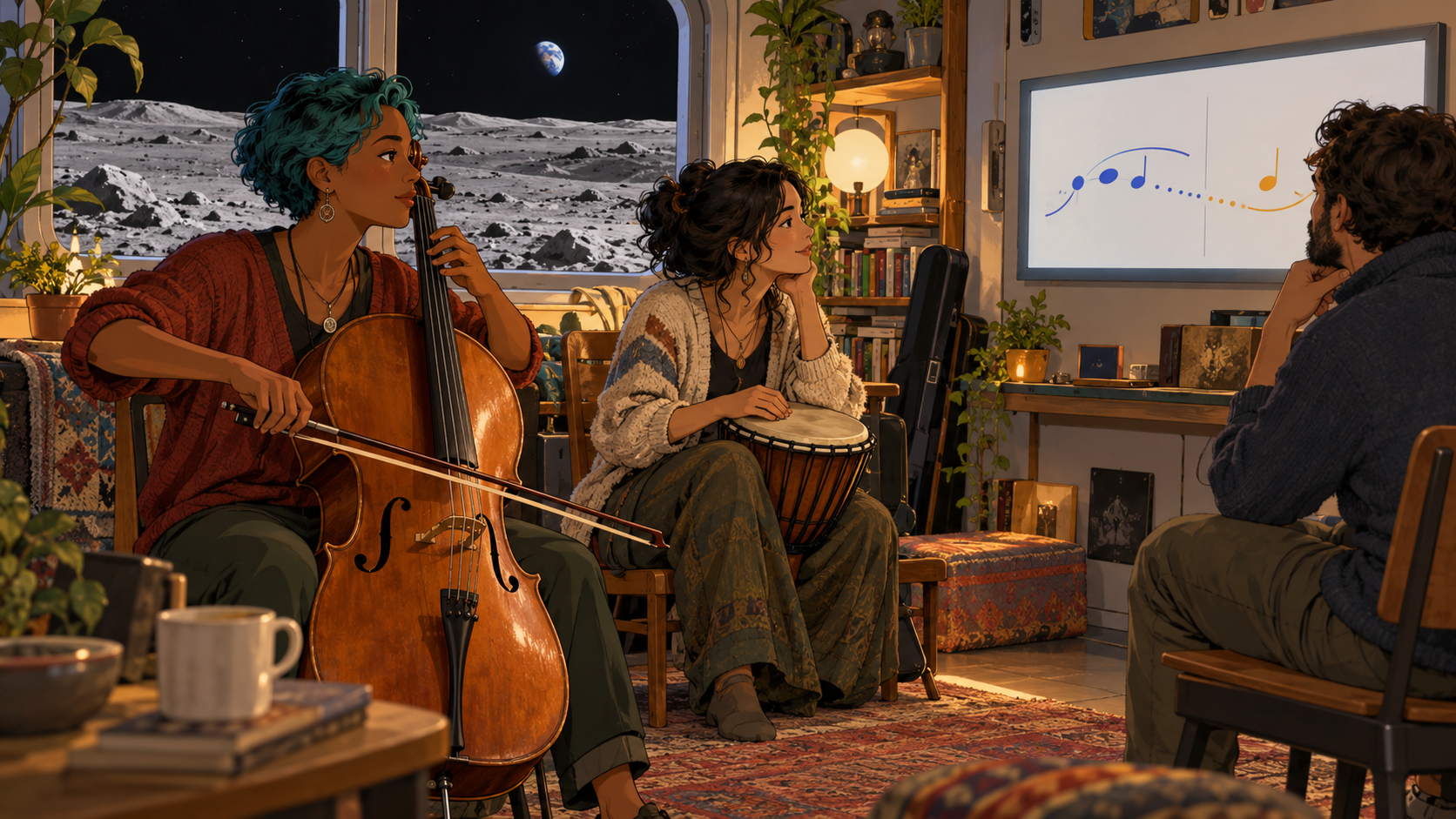
A relay concert is a performance in which musicians at separated sites pass musical phrases from one station to another. Each station receives an earlier contribution and adds to it, so the piece grows as it travels. Performers and listeners hear the music locally, while signal travel time becomes part of the composition.[4]
One early public Earth–Moon relay was Tidal Return in 2048. In a 2356 survey of 18,000 adult volunteers in selected Earth–Moon communities, 12% reported attending a relay concert at a station or through a live relay during the preceding 12 Earth calendar months. Performers may be different people or connected fragments of one person.[1][3]
History and performances#
In Tidal Return, Earth-based composer Esme Chen and lunar cellist Ro passed a five-note motif back and forth for twelve minutes. Each developed the other's phrase for a local audience before sending the next contribution. Their 2049 score and station log preserve the order of the exchanges and the pauses between them. Later relays connected more stations and used longer intervals as part of the music.[1][4]
The 2351 Courtyard Relay combined a garden person and a walking orchestra with a lunar station. Iri's wind-driven bars supplied phrases from their courtyard, and the articulated orchestra sent a recording of a turning sequence made with its steps and joints. Musicians at the lunar station answered the received material; listeners at each site heard its local performance and the contributions that had arrived.[2]
The Earth–Moon Social Survey Consortium counted adults of human and AI origin and active residents of simulated environments, with each person counted once. Its 12% attendance figure describes these volunteers and includes listening through a live relay as well as being present at a station.[3]
How the music travels#
A player captures a phrase as sound, a score, a description of movements or another representation agreed by the performers. Equipment encodes it for a radio or optical signal. The receiving station reproduces the sound locally or presents the musical information to an instrument or participant. The next players may repeat a motif, alter its rhythm or send a new phrase in reply.[4]
Audiences hear the instruments at their own station and any contributions that have reached it. Listeners can choose a station to attend or follow its live relay, hearing the piece from that site as contributions arrive. A score can identify the source and arrival time of each phrase. Later recordings can assemble several paths through the work, while the people at each station also remember the order in which they heard and played them.[4]
Timing and distance#
A signal traveling directly between Earth and the Moon takes about 1.3 seconds one way at their average separation. If an Earth player sends a four-second phrase and a lunar player waits for the whole phrase before answering, the first note of an immediate reply could return to Earth about 6.6 seconds after the original phrase began. The interval includes both signal journeys and the four seconds of music.[4][5][6]
The Moon's average distance from Earth is about 384,400 kilometres, and the speed of light in vacuum is 299,792,458 metres per second. Dividing distance by speed gives the direct-path travel time in the example. Station positions change the path length; relays, equipment and musicians' decisions can add delay.[5][6]
Before Mars began its intergalactic journey, Earth–Mars delays varied with the planets' orbital positions and were measured in minutes. At such separations, a relay between a space habitat near Earth and a distant station can unfold over a meal or several meetings. Performers may prepare possible answers while waiting and choose one after the incoming phrase arrives.[4][7]
Players, listeners and memory#
A person living parallel lives can play at more than one station through connected fragments. Selective synchronization lets those parts choose which observations and memories to send; each receives a distant update after its signal travels. The performer can later compare memories of playing and listening at the different sites.[4][8]
A group can include AI-origin musicians and designed people with different ways of hearing. Cross-substrate calibration can help participants map a musical quality into a form another person can perceive. Friends using shared embodiment may also feel different points of contact on a common instrument while coordinating its movement.[4][8]
Through shared memory exchange, performers can later offer the feeling of a bow stroke, the anticipation of a delayed answer or the view from the audience. Those memories can accompany a recording of the piece and give listeners another way to understand how the performance unfolded.[4][8]
See also#
- Parallel life
- Selective synchronization
- Shared memory exchange
- Walking orchestra
- Garden person
- Space habitat
References#
- ↑ a ↑ b Chen, E. and Ro (2049). Tidal Return: Score and Station Log.
- ↑ Courtyard Relay Collective (2352). Programme and Record of the 2351 Courtyard Relay.
- ↑ a ↑ b Earth–Moon Social Survey Consortium (2357). Connected Lives: 2356 Survey Report.
- ↑ a ↑ b ↑ c ↑ d ↑ e ↑ f ↑ g ↑ h ↑ i Alvar, T. and Sen, M. (2241). Shared Experience and the Arts of Distant Performance. Carina Cultural Library.
- ↑ a ↑ b NASA. Moon Facts. NASA Science.
- ↑ a ↑ b NIST. 2022 CODATA Recommended Values.
- ↑ NASA. Speaking Percy’s Language: How to Talk so Perseverance Will Listen. NASA Science.
- ↑ a ↑ b ↑ c Ortega, M. (2296). Forms of Shared Attention. University of Luna Press.