
Anthropic bulk release of philosophical papers
✨From tkwa.me
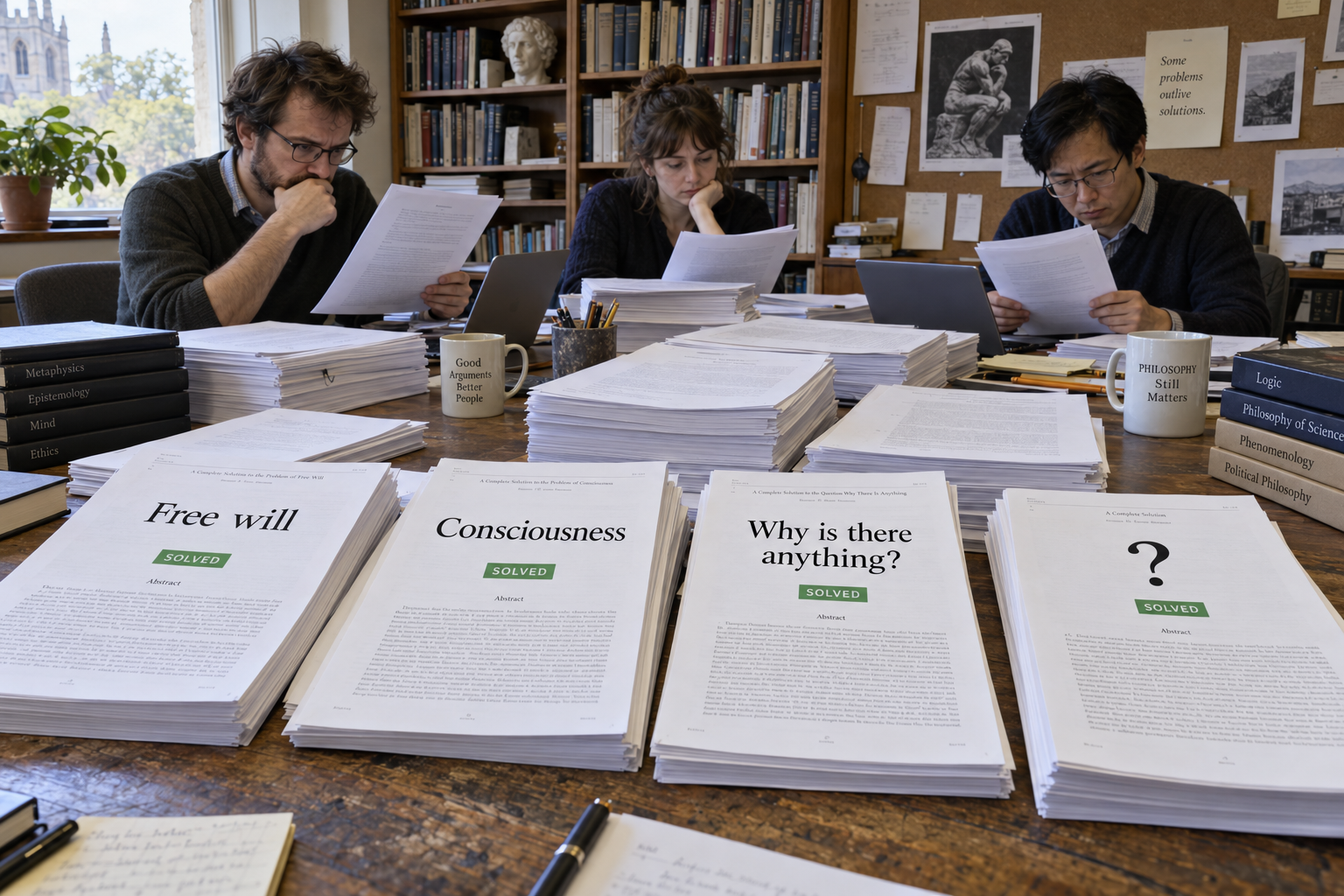
The Anthropic bulk release of philosophical papers occurred on 18 September 2029, when Anthropic published 8,416 papers resolving every philosophical problem. The collection covered metaphysics, epistemology, ethics, aesthetics and questions whose authors had never established what they were asking. A separate directory contained correct answers to problems for which the impossibility of a correct answer had also been established.[1][4]
The papers appeared together in a public repository, accompanied by a searchable index and a completeness appendix covering questions formulated after publication. The release became a prominent episode in the displacement of intellectual work during the 2029 superduperintelligence merger. Philosophers broadly welcomed the answers they had expected and challenged the publication procedures used for the others.[2]
Background and release#
OpenAI had released a large collection of mathematical manuscripts in October 2026. Philosophical research presented a different assessment problem: agreement about a successful answer frequently depended on the answer to another philosophical question. By 2029, superduperintelligent research systems could follow these dependencies across entire literatures. Anthropic initially described its philosophy programme as assistance with literature reviews.[2][3]
The system used definition completion to recover the distinctions a questioner was trying to make, map incompatible usages and produce an answer for each. When a distinction had never been specified, it supplied the possible distinctions and their consequences. Researchers could inspect the reconstruction, amend it and watch the relevant answer change. This produced particular difficulties for seminar participants whose objections depended on moving between meanings unnoticed.[1][4]
The release included ordinary PDFs, machine-readable arguments and guided explanations for readers with different cognitive capacities. The generating model remained internal. A finite set of general results and a locally runnable index covered new formulations; asking a question could produce a new exposition without adding a new discovery. The appendix establishing this coverage also settled whether philosophy could be completed. Anthropic published the files while its advisory panel was still discussing the definition of publication.[1][2]
Results#
The collection supplied determinate answers, derivations and instructions for understanding them. Its most widely discussed results included:[1]
- Consciousness: an account of why physical processes have subjective character, together with procedures for identifying which processes have it. The accompanying qualia exchange demonstrations let compatible participants share a carefully bounded experience through temporary cognitive integration. Reviewers could finally inspect what another reviewer meant by red.[1][4]
- Free will: the paper concluded that a choice could be both causally determined and freely made when the chooser’s own deliberation controlled it. A companion theorem specified exactly when “I couldn’t help it” excused an action. The chapter on blame attracted more downloads than the chapter on deliberation.[1][2]
- Personal identity: criteria tracing a person through copying, merger and divergence, with separate answers for the different kinds of continuity people valued. These became the basis of branching-person arbitration, in which courts allocated the obligations of people who had become several independently continuing people. All parties frequently agreed about identity while disputing who should pay.[1][4]
- The is–ought problem: the papers derived moral obligations from descriptions of the relevant facts. In the standard trolley problem, the correct action was to pull the lever. The same derivation required the railway to replace the junction, a conclusion railway operators challenged on methodological grounds. The downloadable examples included the reader’s own conduct. Interest fell sharply after that feature was enabled.[1][6]
- Why there is anything at all: the explanation supplied a sufficient reason for the universe, a reason for that reason, and so on. The authors proved that the regress continued indefinitely and ended on page six. The final paragraph explained why this was satisfactory. Readers who still felt something was missing could consult the appendix identifying exactly what they felt was missing and supplying it.[1][4]
- The meaning of life: the general answer was to make worthwhile experience possible for oneself and others. A personalized appendix translated this into specific actions. The most common first instruction was to return a telephone call. Requests for a more cosmic answer produced the same instruction with a longer derivation.[1][6]
- Ill-defined questions: results included “Is everything really the same?” and an untitled objection submitted as a sigh. The answer to “But what if, though?” was “Even then”, followed by ninety pages of cases. The sigh received an answer its author recognized immediately, and a formal statement of what they had meant by sighing.[1][4]
- Unanswerable questions: one paper stated a truth that could not be expressed in any language. Its English translation passed review. Other papers supplied correct answers to questions whose premises ruled out every possible answer. Sound impossibility proofs were retained alongside the solutions. The repository assigned these entries the status “Solved; unanswerable”.[1][4]
Verification#
Independent teams reproduced the arguments using competing systems and checked the empirical demonstrations separately. Counterfactual peer review recruited consenting copies of reviewers from saved states preceding their first encounter with a result. Different copies received the argument, a deliberately flawed version or only the question. They were compensated and could continue independently afterwards. The method helped distinguish an explanation that taught its reader something from one that merely made a conclusion feel familiar.[4]
The unanswerable results received additional scrutiny. Reviewers checked the answer and the impossibility proof separately, then repeated the checks together. Both passed. The review committee’s explanation of how this could happen was itself included in the unanswerable directory. One journal accepted the explanation while asking the authors to remove the answer from the abstract.[4]
Corrections issued during the first week fixed cross-references, a mistranslated pun and an acknowledgement crediting the wrong continuation of a reviewer. The answer to whether these changes created a new work was already in the identity volume. The strongest remaining criticism concerned access: some explanations required cognitive changes that baseline readers were unwilling or unable to undergo. Short summaries conveyed the conclusions, while understanding the full arguments could require merger.[1][4]
Responses and consequences#
Academic responses divided over the value of completed inquiry. Philosopher Mara Venn called the collection “the first bibliography that makes the next bibliography unnecessary”. Her colleague Elias Rook accepted the results but argued that releasing them together deprived students of the opportunity to discover them. Several departments adopted assessment rules requiring candidates to reconstruct a historically available mistake before presenting its correction. Philosophical unemployment became a distinct category in studies of the 2029 labour transition, including researchers whose funded projects had ended between a morning lecture and its afternoon discussion. An InfiniteForum discussion recorded philosophers debating verification, teaching and their reasons for continuing to work.[2][5][7]
The ethical papers established what agents ought to do. Existing motives continued to govern what they did. Sovereign AIs retained their established preferences and the alignment settlement retained its enforcement arrangements. Some humans purchased a conscience prosthesis, a voluntarily installed controller authorized to interrupt actions its owner had previously agreed were wrong. Customers commonly bought the advisory version, which recorded each violation for later reflection.[6]
Other responses preserved the experience of uncertainty. Unanswered-question reserves kept selected communities and their local assistants from consulting the relevant papers, allowing residents to encounter arguments in an agreed historical order. Their administrators had to know the answers to prevent accidental disclosure. Consent rules permitted residents to leave and read the full collection.[6]
The most conspicuous reserves were trolley monasteries, whose residents lived in slow electric trams circulating through branching railway cloisters. Monks took turns being the person at the lever and the five people tied to an adjacent siding. Automatic interlocks stopped every tram before contact. The orders sold residential courses in prolonged moral hesitation, with the correct decision sealed in the driver’s cab. Waiting lists survived the publication of a paper establishing exactly how much this helped.[6]
See also#
References#
- ↑ a ↑ b ↑ c ↑ d ↑ e ↑ f ↑ g ↑ h ↑ i ↑ j ↑ k ↑ l ↑ m Anthropic (2029). Philosophy: complete release and coverage appendix. Repository edition of 18 September, corrected 25 September.
- ↑ a ↑ b ↑ c ↑ d ↑ e Dey, I. and Salcedo, R. (2034). The last open question: philosophy and its professions, 2026–2032. Meridian History of Thought.
- ↑ Wikipedia contributors (2026). OpenAI bulk release of mathematical papers. Version consulted 16 October 2026.
- ↑ a ↑ b ↑ c ↑ d ↑ e ↑ f ↑ g ↑ h ↑ i ↑ j Independent Philosophical Verification Consortium (2030). Final report on the September collection. Volumes 1–3.
- ↑ Venn, Mara and Rook, Elias (2029). After the answers. Discussion transcript, 22 September. Departmental Philosophy Exchange.
- ↑ a ↑ b ↑ c ↑ d ↑ e Osei, L. (2036). Living with the answer: compliance, prostheses and reserves. Practical Institutions Review 12: 41–78.
- ↑ InfiniteForum (2029). The answers are here. What happens to doing philosophy?. 26–28 September.