
Chess proof estate
✨From tkwa.me
A chess proof estate is a computing estate built to discover, check and preserve a mathematical solution of chess. The best-known estate belonged to Elon Musk, whose programme established that the initial position is drawn. Its certificate gives each colour an executable strategy that avoids defeat against every legal response. The proof was released in 13,350 CE after a programme beginning in 12,000 CE.[1][2]
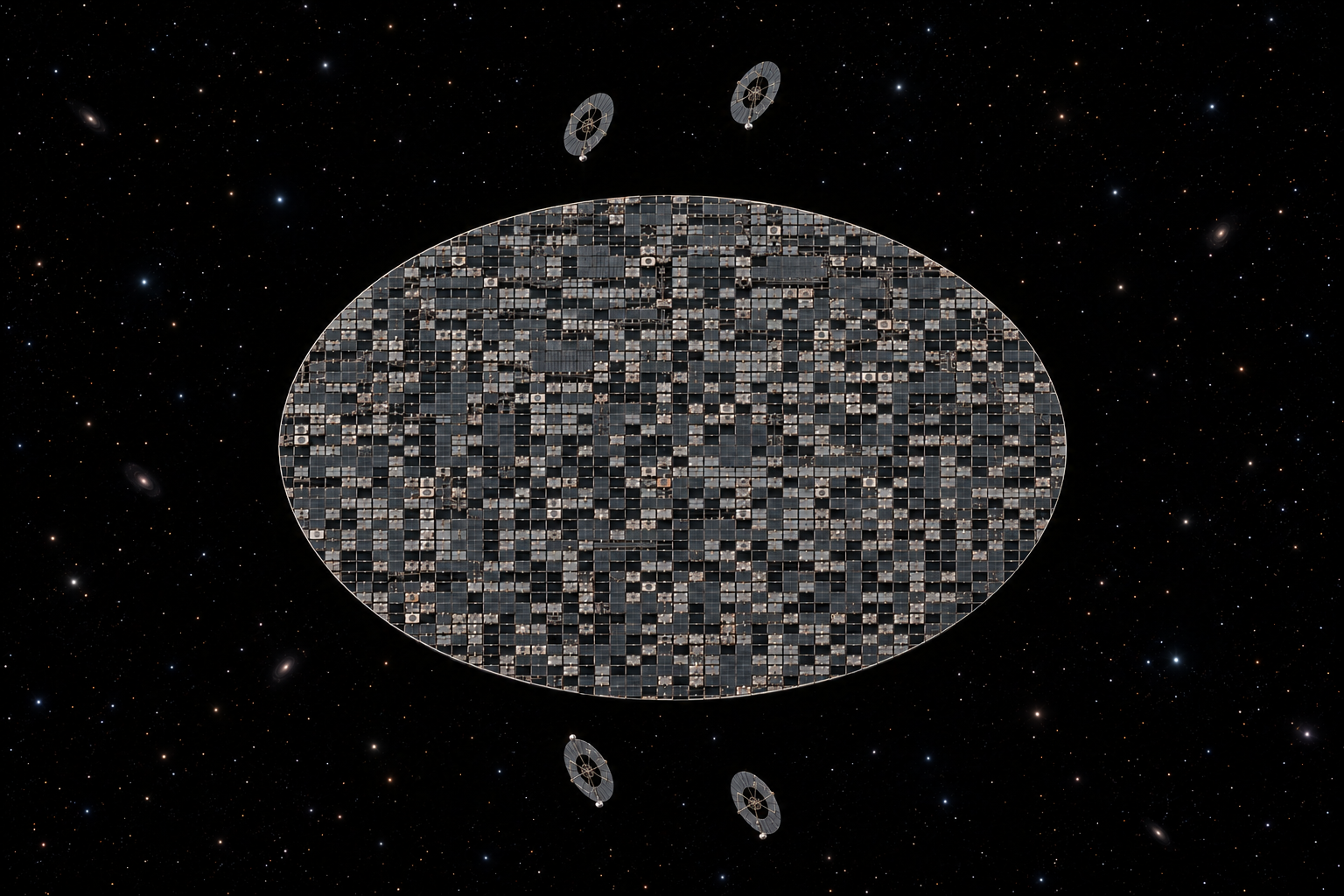
Musk commissioned the work to dunk on Garry Kasparov. The estate's machinery occupied a rotating disk 40 astronomical units across, with cold memory banks, warmer processors and four detached optical exchanges. It stood at an industrial site within twenty light-years of the Solar origin. Its construction drew on nearby stellar industry established during interstellar expansion. The result preceded the arrival of Musk's collection machinery in the great majority of his galaxies.[2]
The proof#
The certificate marks two sets of board positions, one safe for White and one safe for Black. A live position in White's set has at least one move remaining in that set when White is to play. When Black is to play, every legal reply stays in it. No position in the set is a checkmate loss for White. Black's set obeys the corresponding conditions. Both contain the starting position, establishing that neither colour can force a win against correct defence.[1]
A player uses its set by generating legal moves and selecting a successor whose mark is present. The opponent can choose any legal response: the checked closure guarantees that this response also remains inside the set. The marks therefore supply usable strategies as well as a numerical evaluation. Choices among several safe moves can pursue a win against an opponent's mistake.[1][6]
The game specification applies the untimed board-game rules of the 2023 FIDE Laws, including castling, en passant and promotion. The table records board placement, turn and move rights. It allows cycles of safe positions; actual play ends under the applicable repetition, move-count or dead-position draw rule, with checkmate taking its prescribed precedence. This let the certificate omit a separate table dimension for every preceding game history. The result is a weak solution from the initial position. A complete win/draw/loss classification requires additional certificates for the excluded positions.[1][3]
Finding the safe sets#
The discovery run began with provisionally safe boards and removed those failing the closure conditions. Removing a child could exhaust the safe moves available to a player or expose an unsafe response to its opponent. Workers generated predecessor moves, checked them by playing them forward, and sent removal events to the owners of the affected records. Each record contained two safety flags, a counter of remaining moves and pending-work flags. The monotone deletions left the two closed sets checked at publication.[1]
The allocated index had about 8.727 × 10⁴⁵ slots, following the annotated position ranking developed by John Tromp. Several annotations can describe the same board; the estate used a fixed representative and an independently verified ranker preserving exact board identity. Its working table and complete checkpoint each used sixteen bits per slot. Three final certificates added six bits per slot, making thirty-eight in the peak simultaneous allocation. Edges were regenerated from chess rules as needed. Storing a full list of every possible child would have required much more material.[1][4]
The complete programme performed about 1.2 × 10⁵⁵ useful Boolean operations, including initialization, discovery, indexing, checking and repeated work. Here an operation is a retained elementary gate in the reference Boolean computation. The recorded discovery trace had 100,000 dependent remote events on its longest chain. This measured span, together with the exchange delay and available parallel workers, determined the schedule.[1][2]
Apparatus#
The table payload alone weighed 3.32 × 10²⁸ kilograms, about 17.5 Jupiter masses, at 10¹⁹ usable bits per kilogram. With workers, connections, structure, repair equipment and spares, the installed estate weighed 4.44 × 10²⁸ kilograms. A resident branch of Musk directed the commission locally. Its budget purchased continuing access, repair and verification as well as the stored bits.[2]
Most of the mass lay in thick memory panels rated for 80 K, distributed across the disk. On-disk transit buffers operated within a 170 K ceiling. Their outer faces radiated directly into space. Warm processing islands held the active rule checkers and their scratch memory, with separate emitting surfaces. The rim moved at about 1.54 kilometres per second; rotation supported the disk's self-gravity while tensioned strands held the prescribed shape. The estate reserved clear exposures through cooling rights, and kept the paths to its staggered optical exchanges clear.[2]
Four exchanges above and below the disk routed traffic between distant districts. Each spanned about 3.53 astronomical units. A folded optical core sat inside a vertical annulus of packet-storage panels, power receivers and radiators. The queue panels alone occupied 6.04 × 10²² square metres of plan area per exchange, with another 2.19 × 10²² square metres assigned to active-equipment radiators. Each principal optical pupil had the area of a circle 3.57 million kilometres across. Paired emitting faces stood nearly edge-on to the disk; their acceptance tests limited infrared emission and scattered heat toward the cold banks. Light crossed the complete exchange route in up to 23.6 hours. Banks retained outstanding requests and replies through the return journey, while large batches kept the links occupied. Local control isolated damaged cells and maintained the record codes; atomically precise manufacturing supplied replacement banks and processors.[2]
The main materials campaign ran from 6,000 to 9,500 CE. Assembly and mechanical settling continued before the proof run. Starlifting works extracted a hydrogen–helium mixture from a donor star about 1,000 AU from the estate, separated the helium and returned unused gas. Industrial reactors converted helium into the carbon-rich feedstock used for memory and structure, with other elements allocated to the remaining components. This materials production released nuclear energy, part of which paid for extraction, fabrication and transport. Its hot industrial radiators were separated from the cold estate, and the principal production campaign ended before the proof arrays entered service.[2]
A retained portion of the helium industry supplied power during computation. Cold gas vaults stored its fuel and regulated withdrawal. Opposed optical feeds delivered energy to local receivers, which supplied nearby memory and processors. Each panel could pass an unwanted beam through reserved openings when its receiving equipment shut down. This allowed the estate to respond locally while a warning was still travelling to the source.[2]
The 1,400-year operating account supplied 3.45 × 10³⁷ joules, averaging 7.8 × 10²⁶ watts. It included useful logic, memory access, communication, retention and apparatus services. Reversible logic recovered much of each local switching cycle's energy; stored state, transmitted information and replacement still required power. The separate materials account released 3.7 × 10⁴² joules of nuclear energy and allocated 1.05 × 10⁴¹ joules to industrial work. The construction release and the work it supplied describe the same energy passing through different stages.[2]
| Object | Allocation | Purpose |
|---|---|---|
| Working records | 16 bits per index slot | Safety flags, remaining-child counter and pending removals |
| Complete checkpoint | 16 bits per slot | Restore a consistent working state after a fault |
| Three certificates | 6 bits per slot | Three independently usable copies of both safety sets |
| Workers and exchange buffers | Separately installed | Rule evaluation, exact indexing and information in transit |

Verification and publication#
The final safety bits were sealed as one immutable candidate. Independently implemented checkers examined every marked row, generated legal moves directly from the rule specification, and checked the required successor memberships. Their verified indexing interface preserved the entire board state, including move rights; exact rank–decode identity was part of its proof. A missing successor or a mismatched board failed its obligation. Separate scans checked coverage, terminal positions and the initial board's membership in both sets.[1]
Initialization and acceptance occupied the programme's first two centuries, discovery the following thousand years, and independent checking the following century and a half. Restore tests and replicated release filled the final fifty years. Whole-estate checkpoints and retried work were included in the operating account. The checkers' agreement on an exactly identified snapshot allowed later users to reproduce a local obligation without trusting the discovery machinery.[1][2]
After publication, three certificates retained 5.24 × 10²⁷ kilograms of memory payload. Their continuing archive service provided error correction, replacement, exact indexing and strategy queries. The working arrays could then be reassigned. A remote strategy query still took the physical time required to reach the relevant records; exhibitions and local play used prepared, checked continuations where those delays would otherwise interrupt the game.[6]
At the 13,400 CE unveiling on Mars, an archival Kasparov model occupied grandmaster upholstery: a crowned neuromorphic chair whose articulated armrests moved its pieces. Mars was still travelling from the Solar System. The release and checked continuation reached it by signal within twenty-two years, leaving time to prepare the local ceremony. The game ended in a draw. Musk, wearing a mechanical chess-clock hat, declared that he had defeated Kasparov at being impossible to defeat. The chair credited the proof team and offered another game. The advertising campaign placed “KASPAROV: ZERO” beside the result, ½–½.[5]
See also#
References#
- ↑ a ↑ b ↑ c ↑ d ↑ e ↑ f ↑ g ↑ h ↑ i Chess Proof Estate audit (13,350 CE). Initial-position safety certificates, immutable release manifest and independent validator results.
- ↑ a ↑ b ↑ c ↑ d ↑ e ↑ f ↑ g ↑ h ↑ i ↑ j Chess Proof Estate works account (13,400 CE). Apparatus, materials campaign, operating energy and archive provision.
- ↑ FIDE (2023). Laws of Chess, articles 3, 5 and 9.
- ↑ John Tromp. Chess Position Ranking.
- ↑ Mars Cultural Archive (13,400 CE). Chess unveiling recording, certified continuation and opponent-model provenance.
- ↑ a ↑ b Chess Proof Estate archive manual (13,400 CE). Safety-set membership, exact successor checking and continuing strategy service.