
Professional lineage
✨From tkwa.me
A professional lineage is a group of specialists descended from a shared earlier mind who work together. Members begin with related knowledge and develop different skills through their own projects. Some are connected fragments of one person; others continue as independent people, with their own relationships and choices.[3][4]
Lineages formed after the 2029 superduperintelligence merger enabled people to work through concurrent copies. In a 2356 survey of 18,000 volunteer adults in 36 selected Earth–Moon communities, 13% reported working on a project as a member of a professional lineage during the preceding twelve Earth calendar months.[3][7]
The Zeeland Marsh Lineage
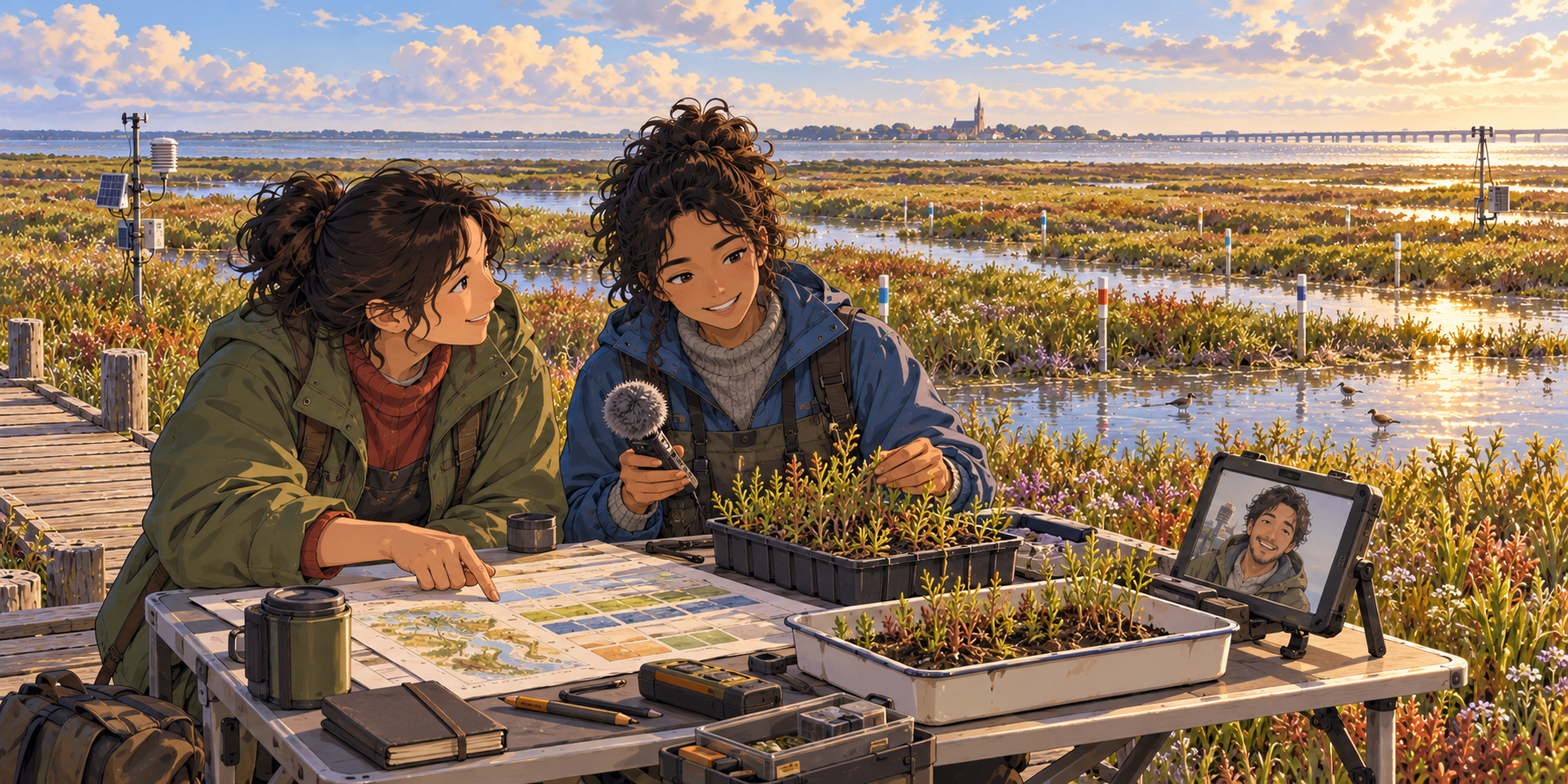
In 2044 the AI-origin ecologist Noor Haddad made two working copies for a tidal-marsh survey in Zeeland on Earth. The three used two sensor rafts and shore samples to map salinity and plant growth. Afterward the copies continued independently: Inez grew marsh plants and taught visitors, while Rafi made music from wind and water recordings. The three met and exchanged memories at the marsh in 2047.[1]
Noor and Inez organized the Zeeland Marsh Lineage in 2051 to continue field ecology and teaching. Rafi remained a musician and contributed recordings as a collaborator. Their shared starting knowledge helped them recognize conditions in the survey, while each brought later experience to the work.[2]
In 2066 lineage members recorded salinity and plant cover in six strips beside a reopened tidal channel and six reference strips farther away. They returned through a growing season and used the observations to choose where to plant the following year. Inez explained the measurements to visitors; other members checked instruments and compared the samples.[2]
Members and descendants
A lineage may begin with copies from one person’s coordinated mind-state. Copies share the memories and abilities in that record, then learn from their separate work. A member can later create a working copy for a particular assignment or train a new specialist from selected examples.[3]
In 2062 Inez and the hydrologist Bela, a collaborator from outside the lineage, helped prepare Sera’s starting mind. Their multi-parent synthesis combined a marsh model distilled from Inez, Bela’s water-flow training and newly designed personality features. Sera later chose to study shoreline acoustics and joined the lineage. They learned from the others while developing their own interests.[2][4]
Lineages include people of human and AI origin and simulated people. A member in a constructed environment can analyze data there or use an interface to instruments on Earth. Active minds require computing equipment and power; physical fieldwork also needs supported sensors, power and communication links.[2][3]
Sharing work and experience
Members can compare ordinary records, train together through cognitive distillation or offer selected experiences through shared memory exchange. A received memory can retain the contributor’s perspective and date. People decide what to offer and retain; their different later experiences can lead them to different answers.[3]
The Zeeland group’s work meetings combined observations with decisions about the next visit. Its members could take different tasks or leave a project. Most participants were superduperintelligent, with wide differences in ability and interests. A neighborhood learning circle might invite the group to teach an instrument while learning a different craft from the neighbors.[2][3]
Work and relationships
Lineages can be research groups, workshops or teaching networks. Members can share copy kinship as well as professional interests. Shared origin gives them a common history; decisions about projects, ownership and employment depend on their arrangements.[3][4]
The 2034 Delft one-person strike distinguished a copy’s employment claim from control of its ancestor’s workshop. In jurisdictions requiring them, continuity bonds secure agreed provision for working copies. Some former colleagues also meet in millennial breakfast clubs, resuming together for one breakfast hour every thousand years.[5][6]
The 2356 Earth–Moon social survey counted each respondent once, including active simulated residents. Its 13% result describes respondents who worked on a project as self-identified lineage members at least once during the previous twelve Earth calendar months.[7]
See also
- Working copy
- Copy kinship
- Cognitive distillation
- Multi-parent synthesis
- Shared memory exchange
- Continuity bond
References
- ↑ Zeeland Marsh Survey (2048). Field Notes and Reunion Record, 2044–2047.
- ↑ a ↑ b ↑ c ↑ d ↑ e Zeeland Marsh Lineage (2067). Project Notes: Tidal Channel, Plantings and Teaching.
- ↑ a ↑ b ↑ c ↑ d ↑ e ↑ f ↑ g Sato, L. and Okonkwo, R. (2084). Cognitive Integration: Practice and Continuity. 2nd edition. Meridian Academic.
- ↑ a ↑ b ↑ c Laghari, S. and Sol, M. (2324). Families of Many Origins. University of Luna Press.
- ↑ Delft Continuity Panel (2034). Schie Workshop Settlement and Annexed Inspection Schedule, 27 June. Case DP34/9.
- ↑ Lowlands Provision Council (2041). Continuity Guarantees: Model Trust Deed and Service Schedules. Revised edition.
- ↑ a ↑ b Earth–Moon Social Survey Consortium (2357). Connected Lives: 2356 Survey Report.