
Superduperintelligence-designed animals
✨From tkwa.me
Superduperintelligence-designed animals are living organisms whose anatomy, development, and behavior have been deliberately arranged by superduperintelligences, including artificial minds and augmented people. Some descend from familiar species with added limbs or altered senses. Others grow from new body plans organized around a particular way of living: hanging between branches, carrying a garden, or browsing through a fringe of feeding organs.[1]
Design objectives include companionship, ecological work, cultivation, exploration, and the pleasures available to the animal itself. Its preferred movements, sensory world, social relationships, and opportunities to learn can all receive as much attention as its visible body. Cuteness-optimized animals form one specialized group within this wider field.[1]
Bodies and ways of life#
A design must develop as a coordinated organism. Extra limbs require supporting joints, muscle attachments, circulation, and a nervous system that can use them. A long trunk needs space for those attachments alongside the gut and other organs. Repeated limbs offer combinations of reach, balance, and redundancy: an animal crossing unstable branches can use most of them for support, then release several to inspect a fruit or repair its shelter.[1]
Respiration and growth constrain the exterior. The larger armored designs use ventilated respiratory organs and circulating oxygen carriers; their shells grow at plate margins or are replaced in stages. Food supplies the energy for movement, tissue repair, and secretions such as silk. Reproductive arrangements range from breeding populations to animals whose young develop in provisioned nurseries. Designers work through the juvenile stages as well as the adult form.[1]
Gallery#
The silver climbing cat and orchard tortoise extend familiar vertebrate forms. The hanging weaver, mantle grazer, four-eyed climber, and fanback use jointed limbs, protective plates, and specialized feeding or display structures in different combinations. The studies below show each animal performing an ordinary activity.[1]
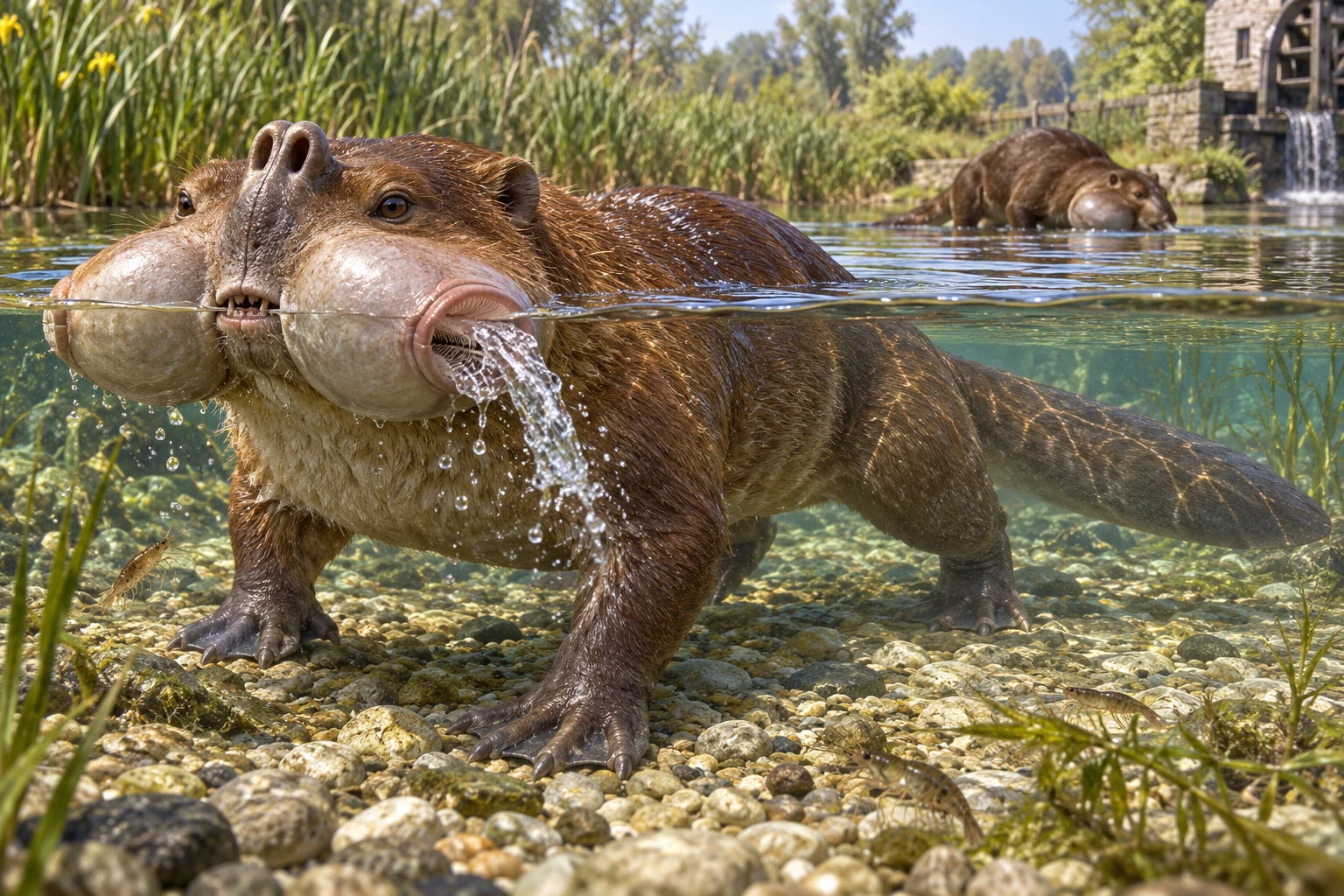
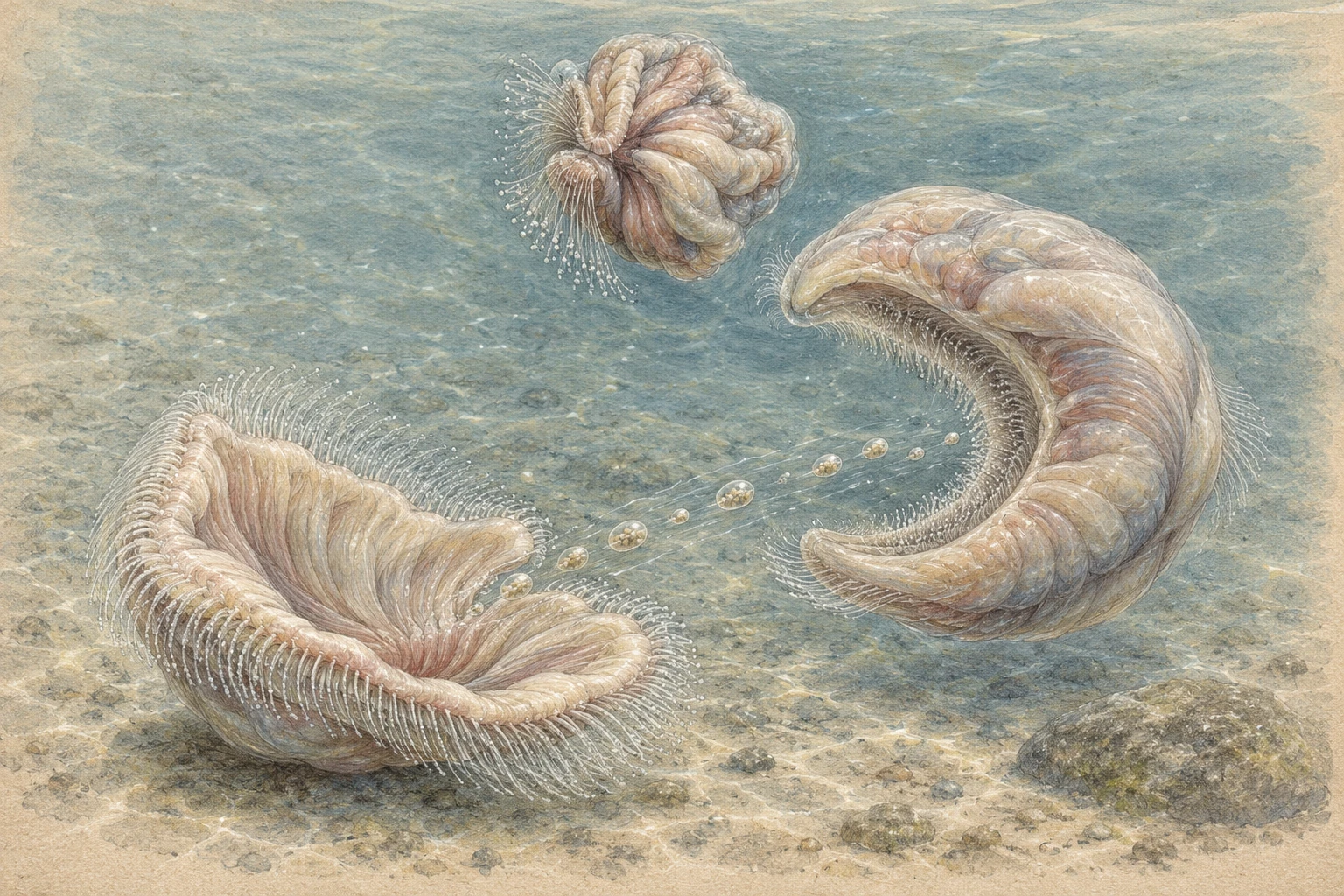
The reef-window fish carries its young in living flank chambers, while the kitefin newt folds broad swimming webs against its sides. The siltwheel and facet tumbler distribute feeding, transport and sensation through their bodies. One moves through a continuous hydraulic ring; the other folds a hollow mineral frame between supporting faces.[1]
Habitats range from household roosts and fresh water to dense atmospheres and small airless worlds. Designs for exposed environments carry the pressure, thermal control and stored fluids their tissues need. The studies show ordinary activity at each animal’s working scale.[4]
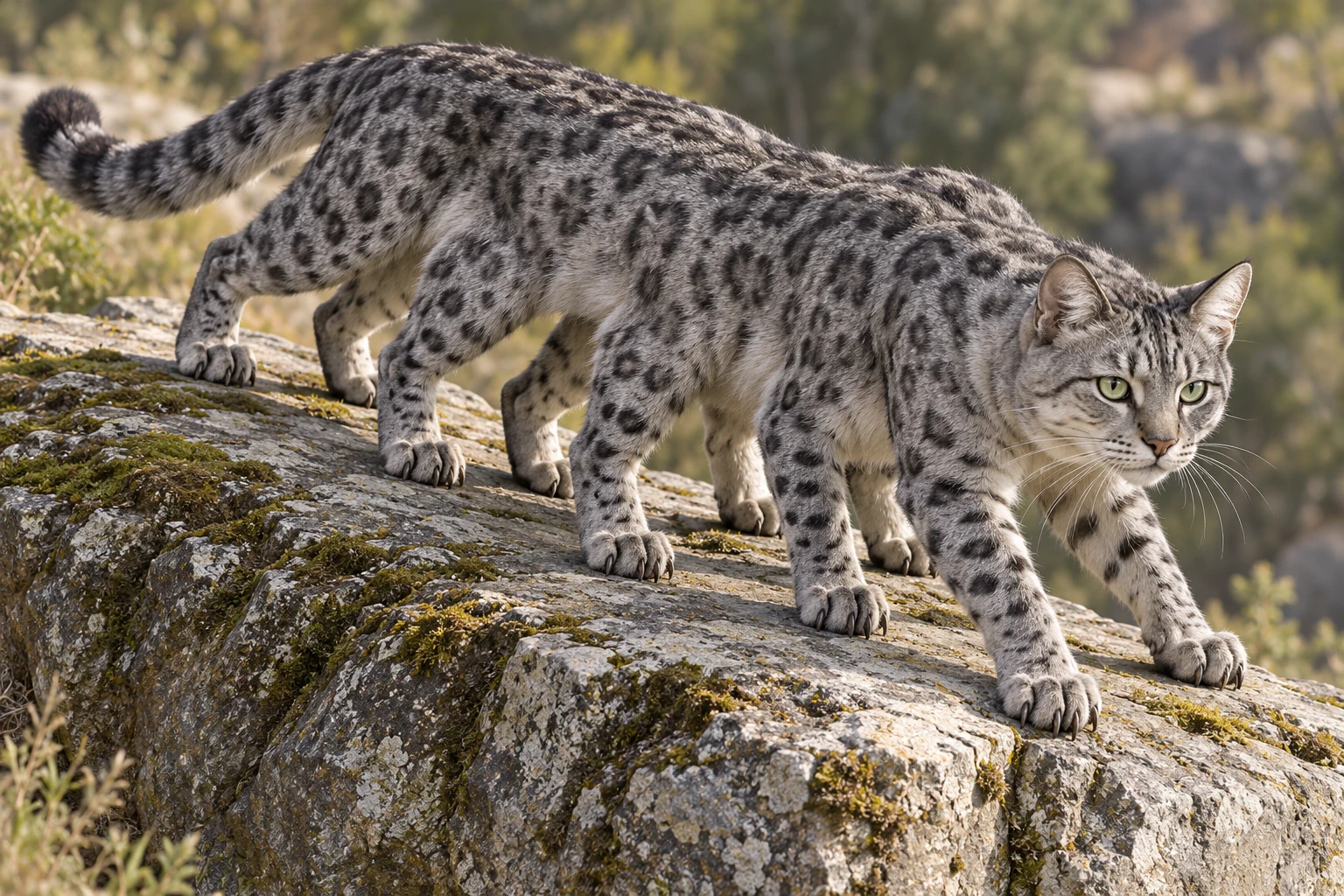
Silver climbing cat#
Illustration
The silver climbing cat has a flexible trunk and five pairs of legs. Its feet contact uneven ground in overlapping sequences, allowing it to cross difficult surfaces while keeping several secure footholds. Its tail helps balance turns and signals changes in attention.
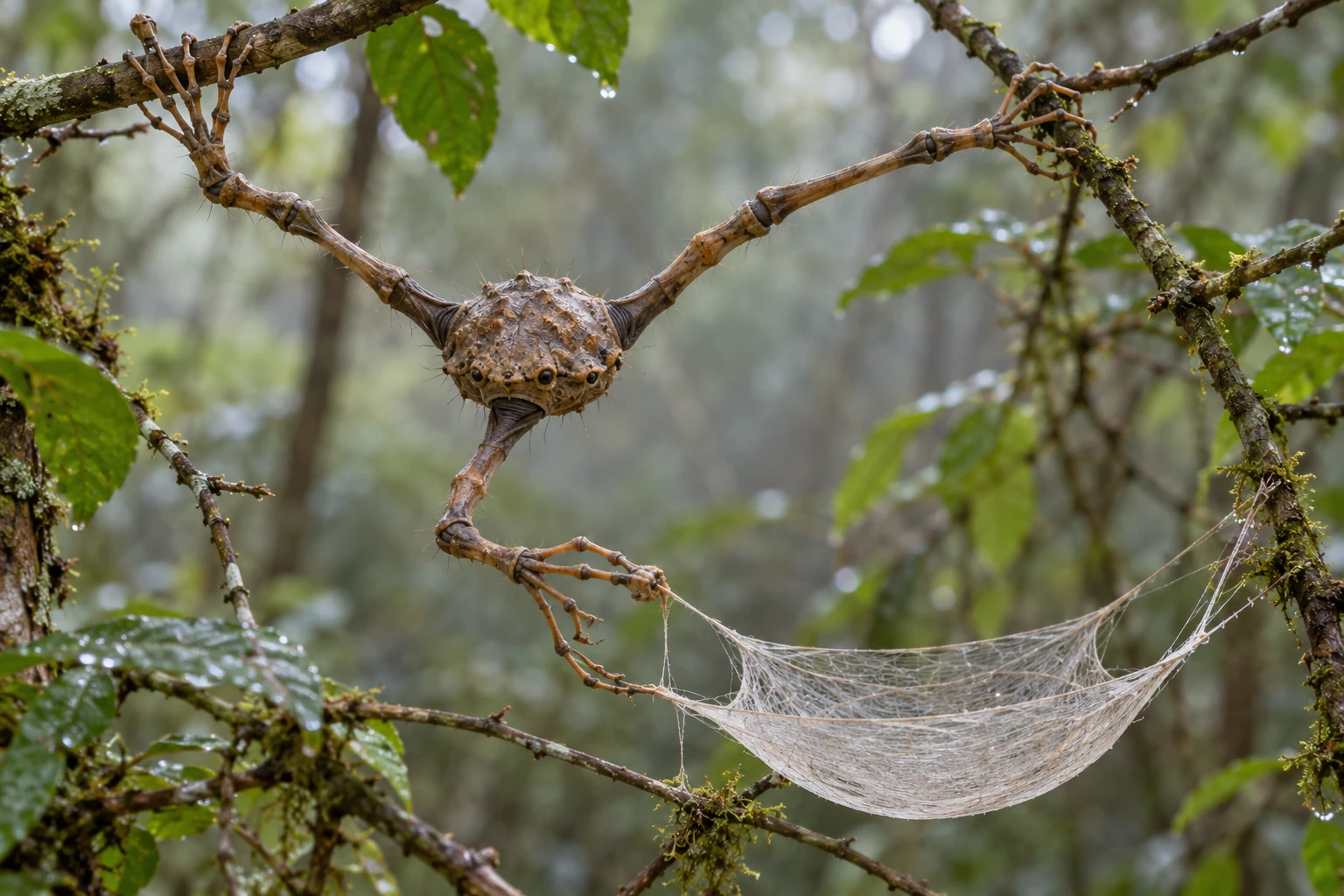
Hanging weaver#
Illustration
The hanging weaver suspends its central body between three long, branching limbs. Independently gripping tips spread its weight across slender twigs. Silk glands supply material for sleeping cradles. It can stay anchored with two limbs while the third draws out a strand, tensions it, and attaches it to the structure.
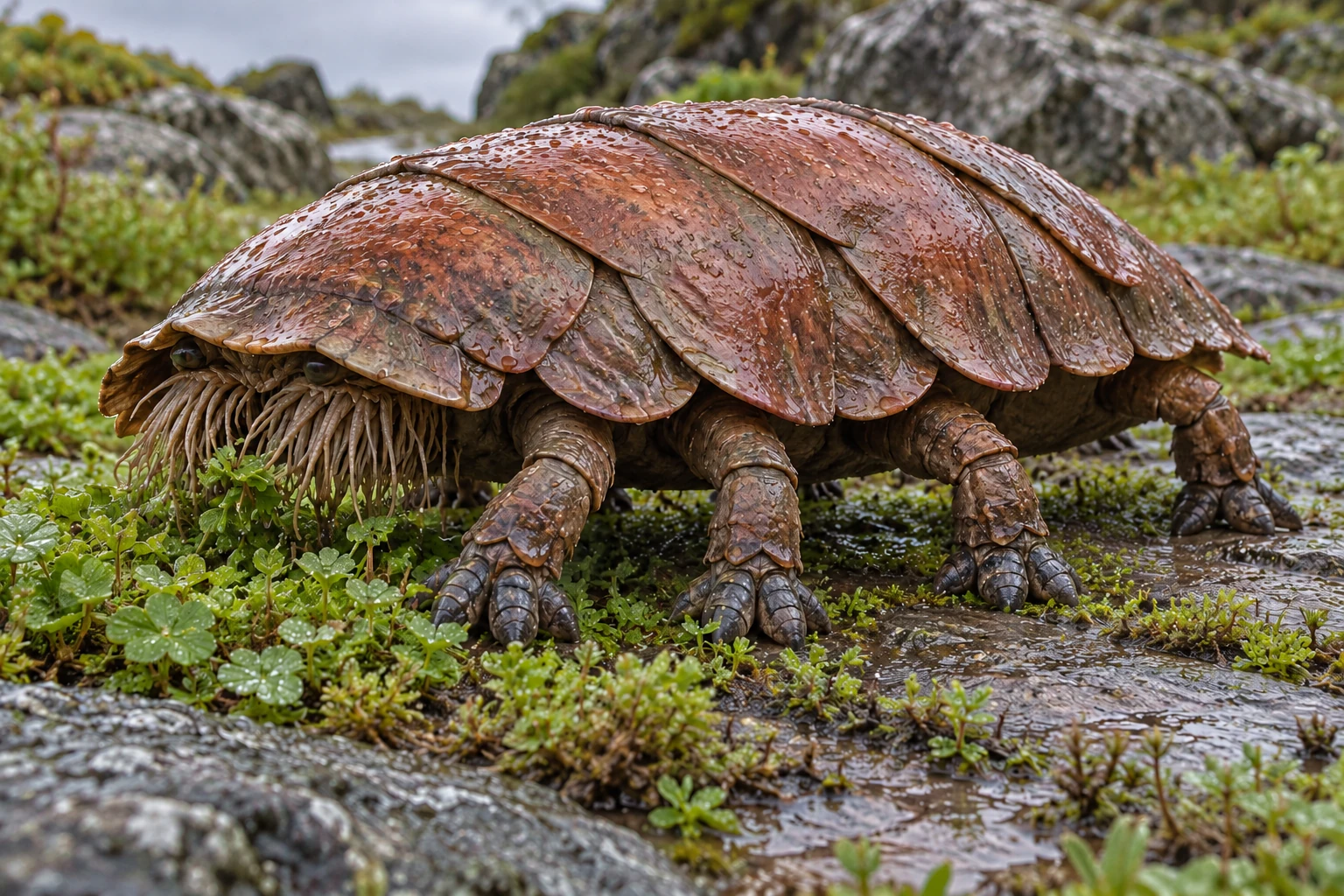
Mantle grazer#
Illustration
The mantle grazer carries overlapping rust-colored plates above eight stout walking legs. Feeding fingers beneath the shell margin select shoots and pass them to a central mouth. During heavy rain, it crouches and withdraws the fingers. The fringe spreads again when conditions improve, testing nearby plants before the grazer moves.
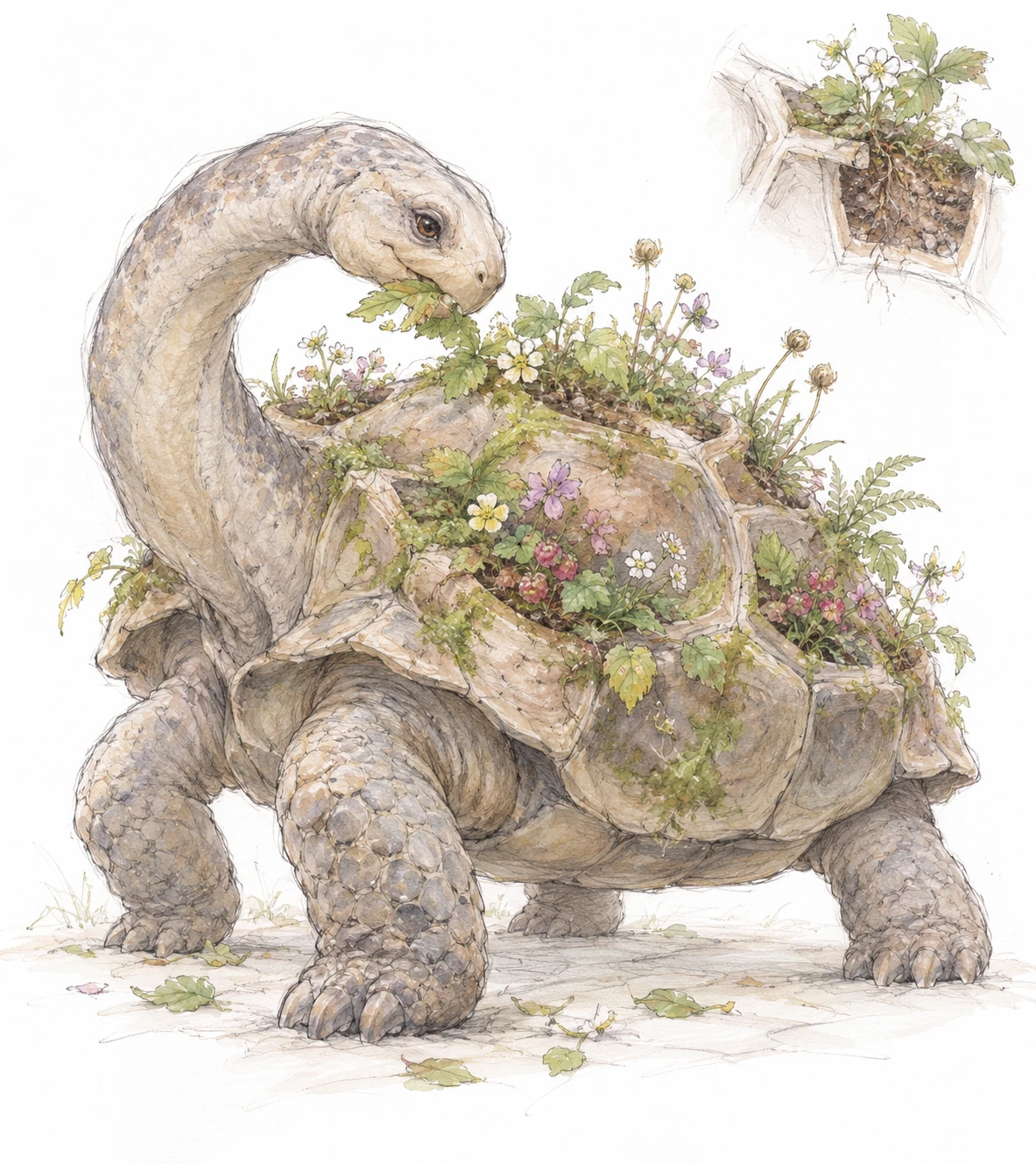
Orchard tortoise#
Sketch
The orchard tortoise cultivates plants in porous pockets across its shell. Shallow reservoirs retain rainwater; drainage channels keep roots aerated. Its long neck reaches the beds for pruning and harvesting. Individuals develop preferences for particular fruits and flowers, moving their gardens between sun, shade, and watering places.
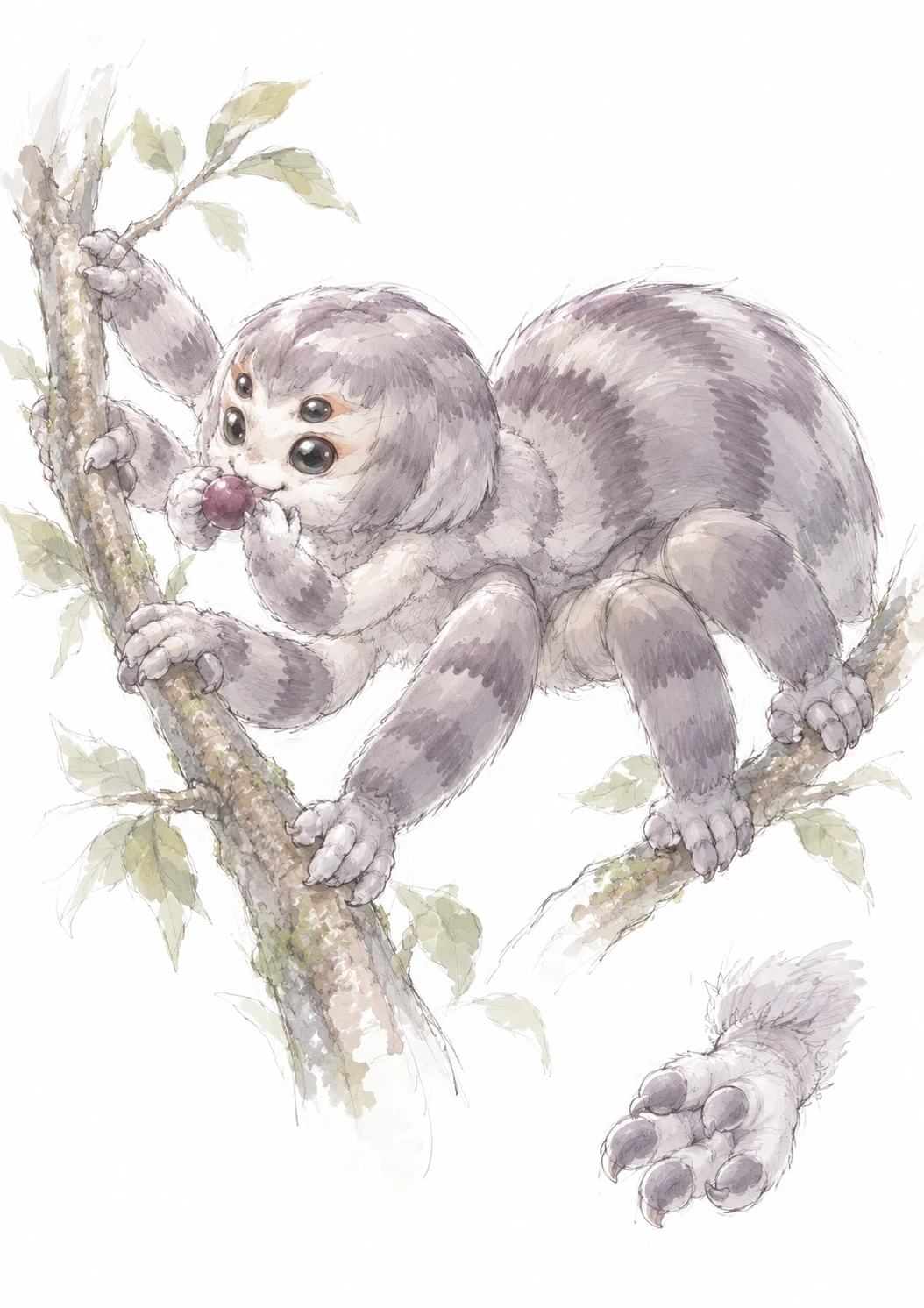
Four-eyed climber#
Sketch
The four-eyed climber has six gripping legs and two small feeding palps. Its four eyes cover overlapping fields, helping it judge both nearby footholds and fruit held close to its face. Fine hairs register contact and air movement. Several legs remain anchored while the palps turn and peel a berry.
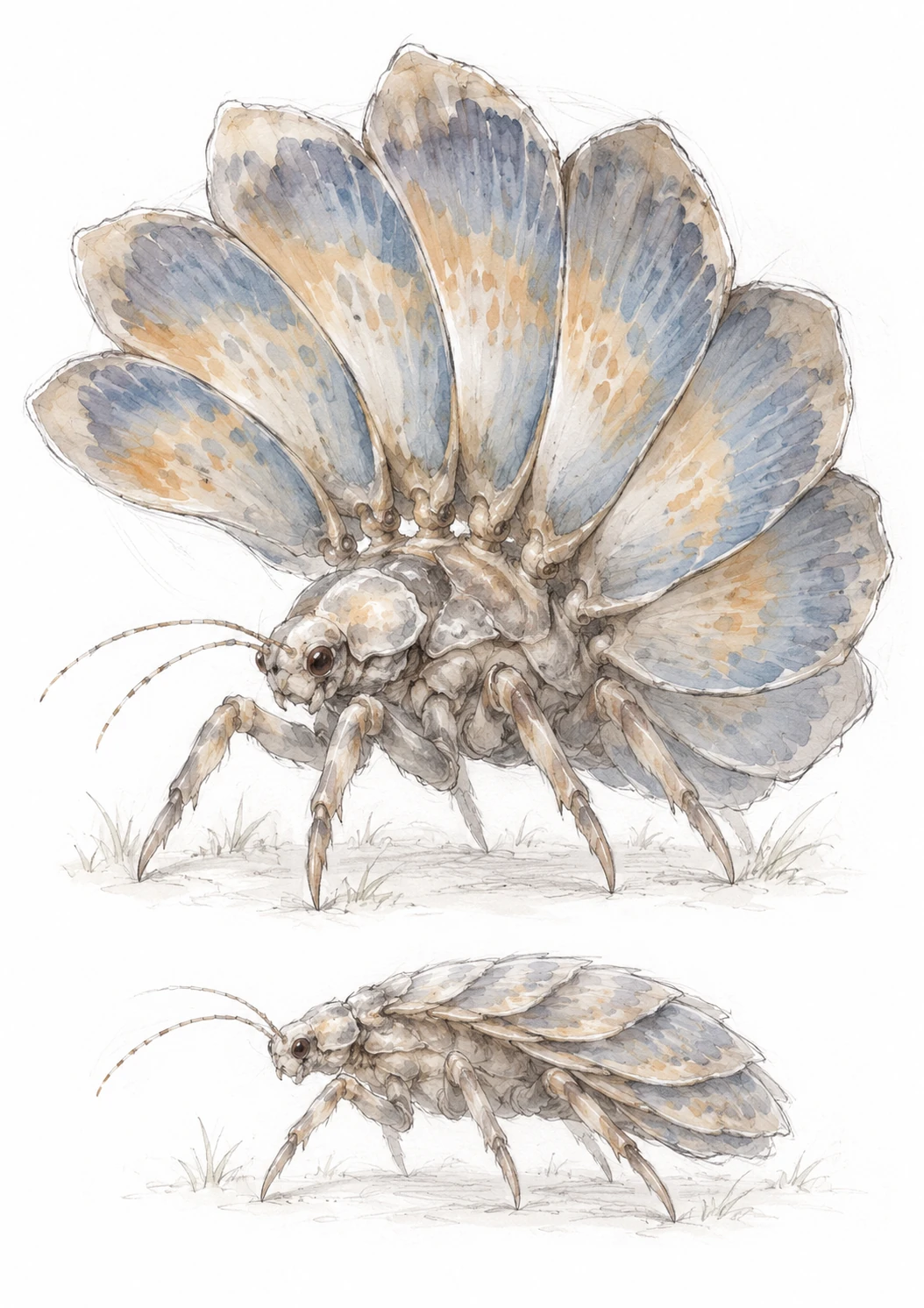
Fanback#
Sketch
The fanback raises overlapping shell plates into a broad social display. Each plate moves independently, allowing waves, pauses, and changes of emphasis to travel across the fan. Individuals learn local display conventions through social contact. The plates fold close to the body for walking through dense vegetation.
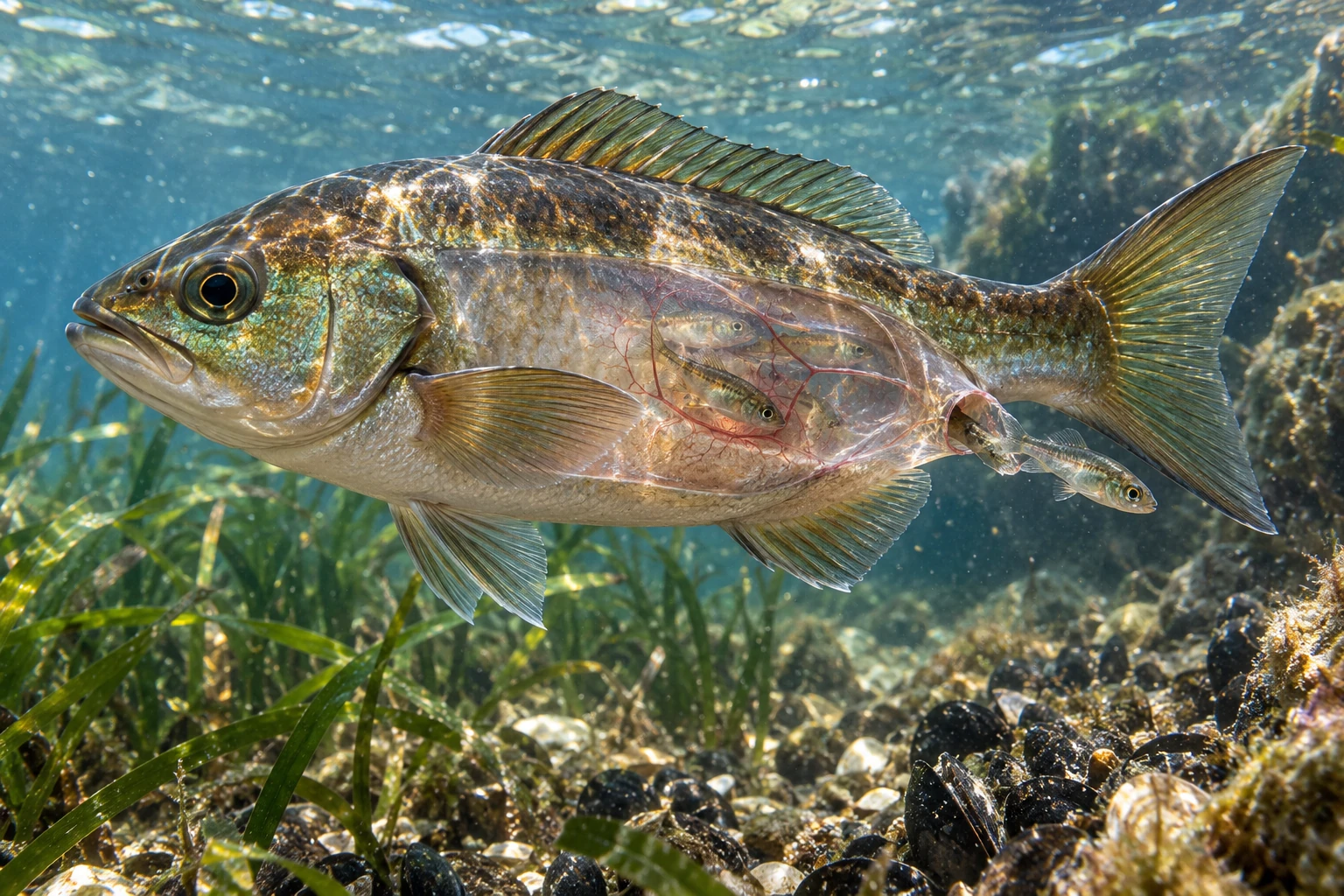
Reef-window fish#
Illustration
The reef-window fish carries its young in shallow brood chambers beneath transparent flank tissue. Fine vessels supply oxygen while a muscular rear opening controls their departure. The chambers sit outside the main swimming muscles and gut. Parents hover over nursery vegetation as the young begin making short independent journeys.
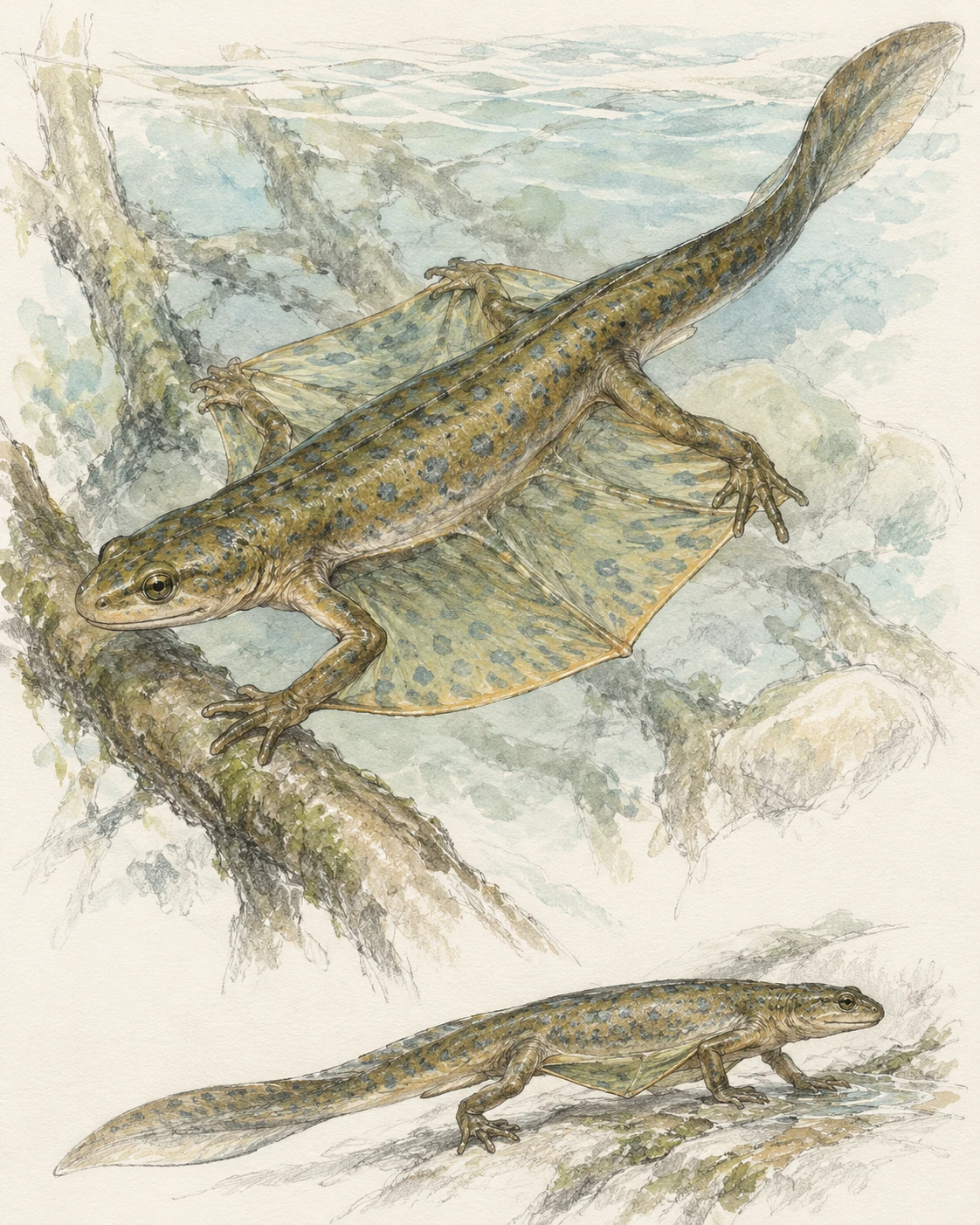
Kitefin newt#
Sketch
The kitefin newt spreads a thin web along each flank to glide between submerged branches. Its four feet steer and grip while the flattened tail supplies thrust. On land, folds draw the webs against the body. Moist skin supports gas exchange, so its terrestrial journeys follow shaded, wet routes.
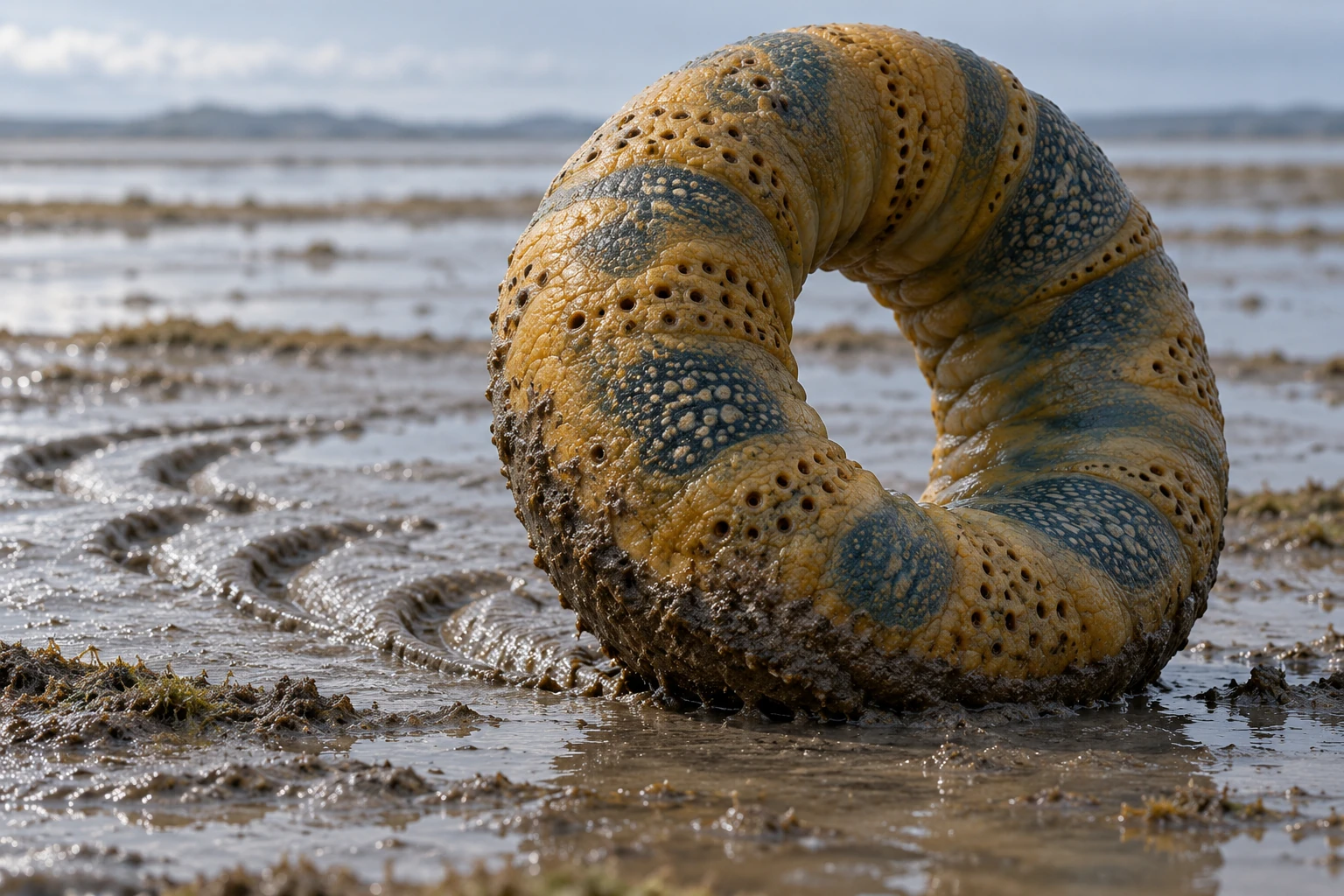
Siltwheel#
Illustration
The siltwheel moves by passing a pressure wave around its continuous ring-shaped body. Slow eversion brings fresh feeding surfaces into contact with microbial films. Digestion, oxygen exchange and nutrient circulation occupy repeating chambers in the wall. Distributed chemical and pressure-sensitive patches coordinate movement and keep the central opening clear of sediment.
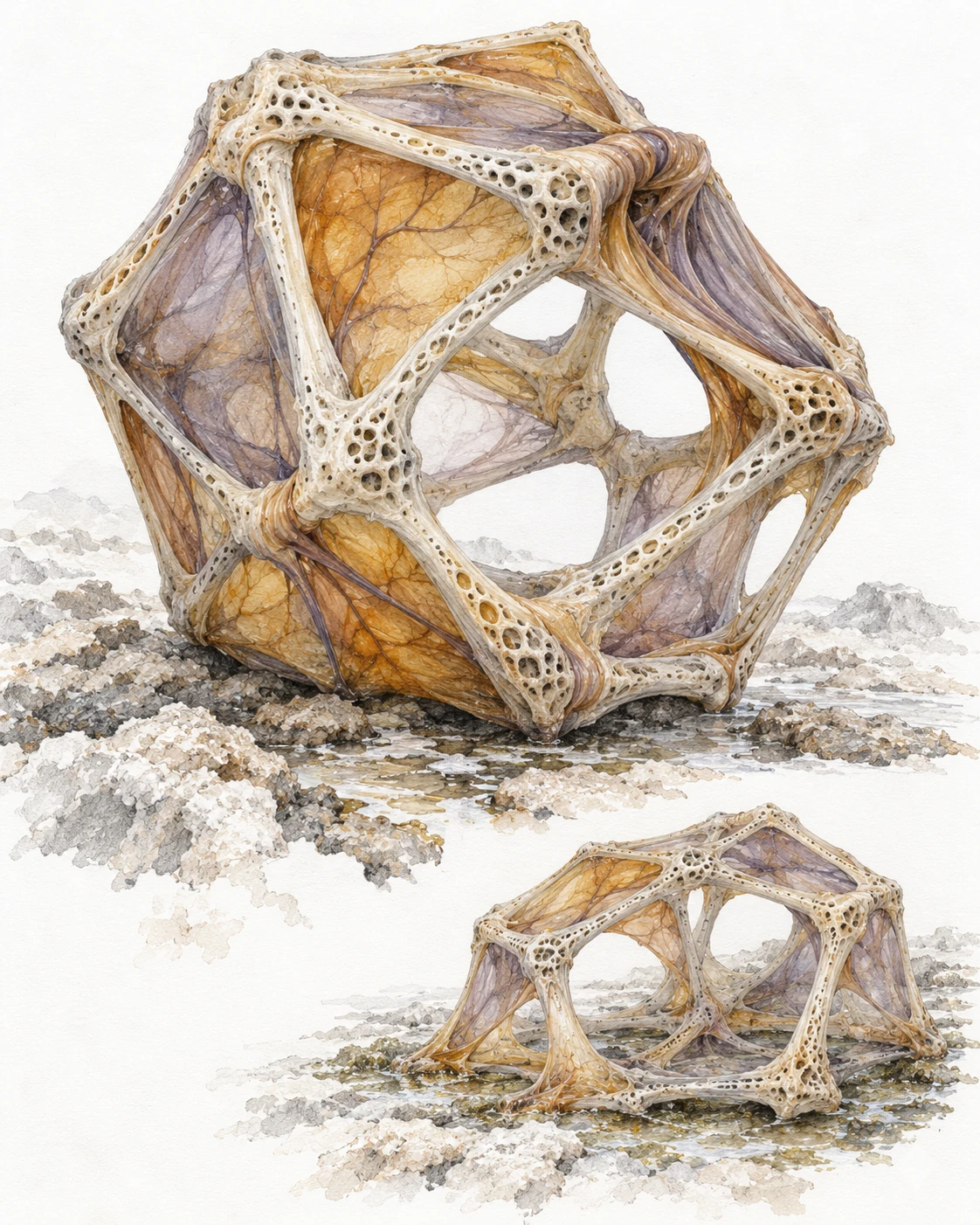
Facet tumbler#
Sketch
The facet tumbler folds its entire porous mineral frame to roll between broad supporting faces. Elastic hinges pull neighboring struts together while fluid moves through channels inside them. Membrane patches digest microbial films reached through the open faces. Strain-sensitive and chemical-sensitive tissues coordinate the frame, distributing sensation and metabolism throughout the body.
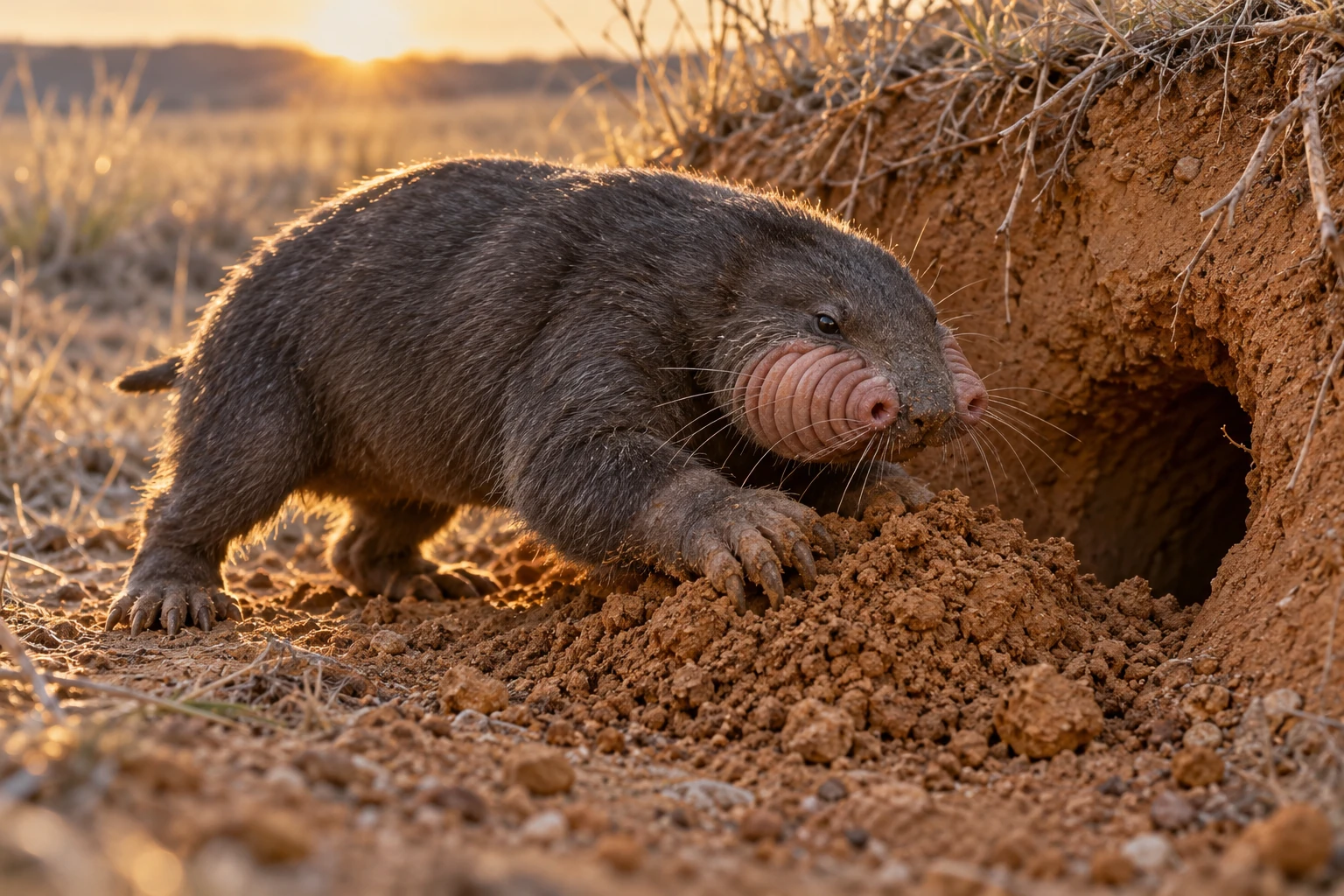
Bellows-mole#
Illustration
Bellows-moles maintain narrow ventilation shafts above their sleeping chambers. Muscular nasal sacs draw and expel small volumes of air through valves, refreshing the chamber while the animal rests beside its entrance. Broad wrists clear collapsed soil, and cheek whiskers register both grains touching the face and changes in the airflow through the shaft.
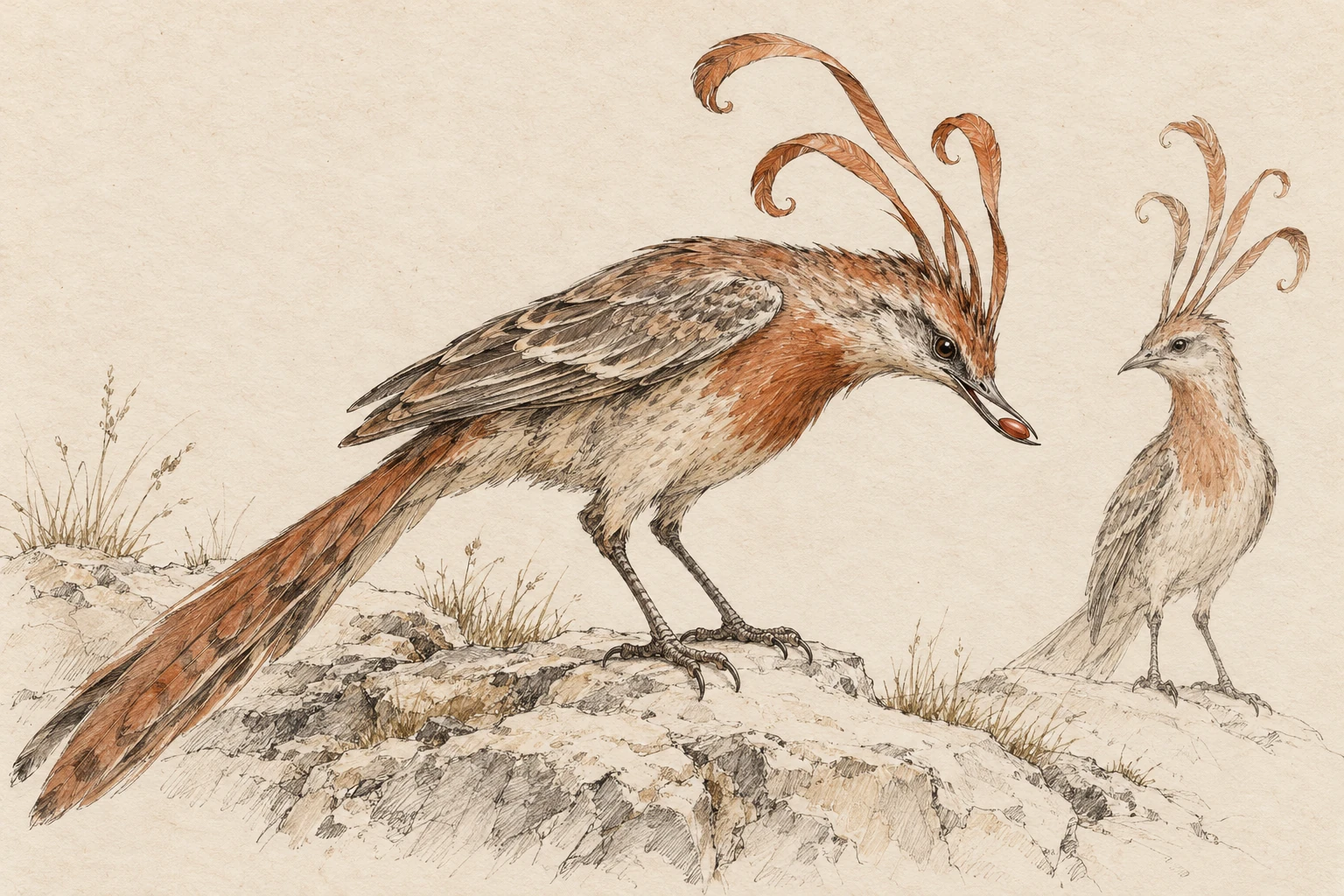
Scrollcrest courier#
Sketch
The scrollcrest courier carries small offerings in a shallow lower-bill cradle. Muscular crest roots raise and lower its curled keratin ribbons, arranging them into learned greetings. Here one adult bows with a seed while its companion holds the answering crest posture. Familiar pairs recognize individual variations in both the gesture and the offering.
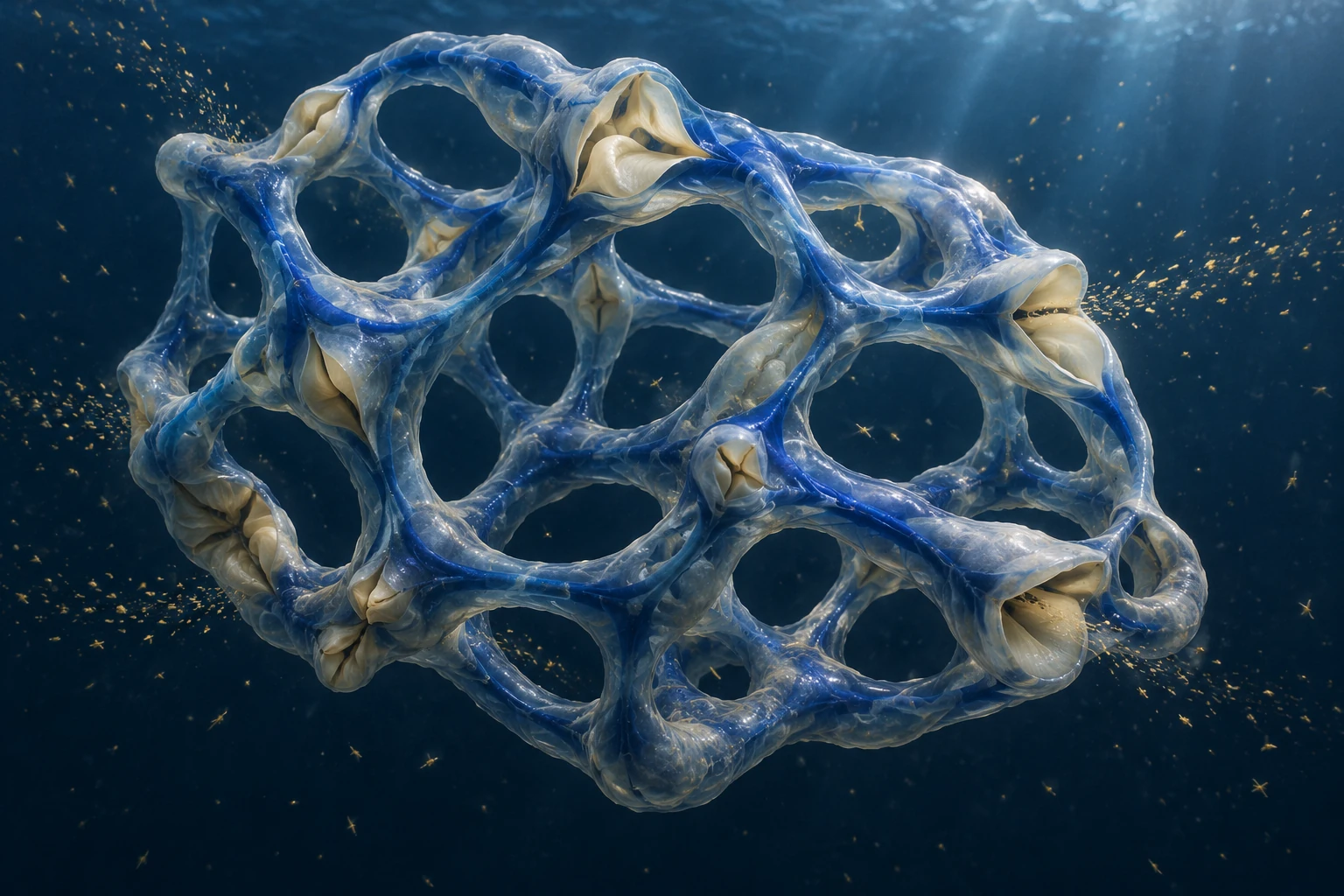
Valvecloud#
Illustration
The valvecloud feeds throughout an open lattice of vascular tubes. Soft valves draw particle-bearing water into digestive pockets, while neighboring channels exchange oxygen and dissolved nutrients. Local chemical and pressure signals coordinate the pumping cycle. Unequal contractions reshape the body and produce slow swimming; the lattice turns toward richer food layers as its feeding nodes change activity.
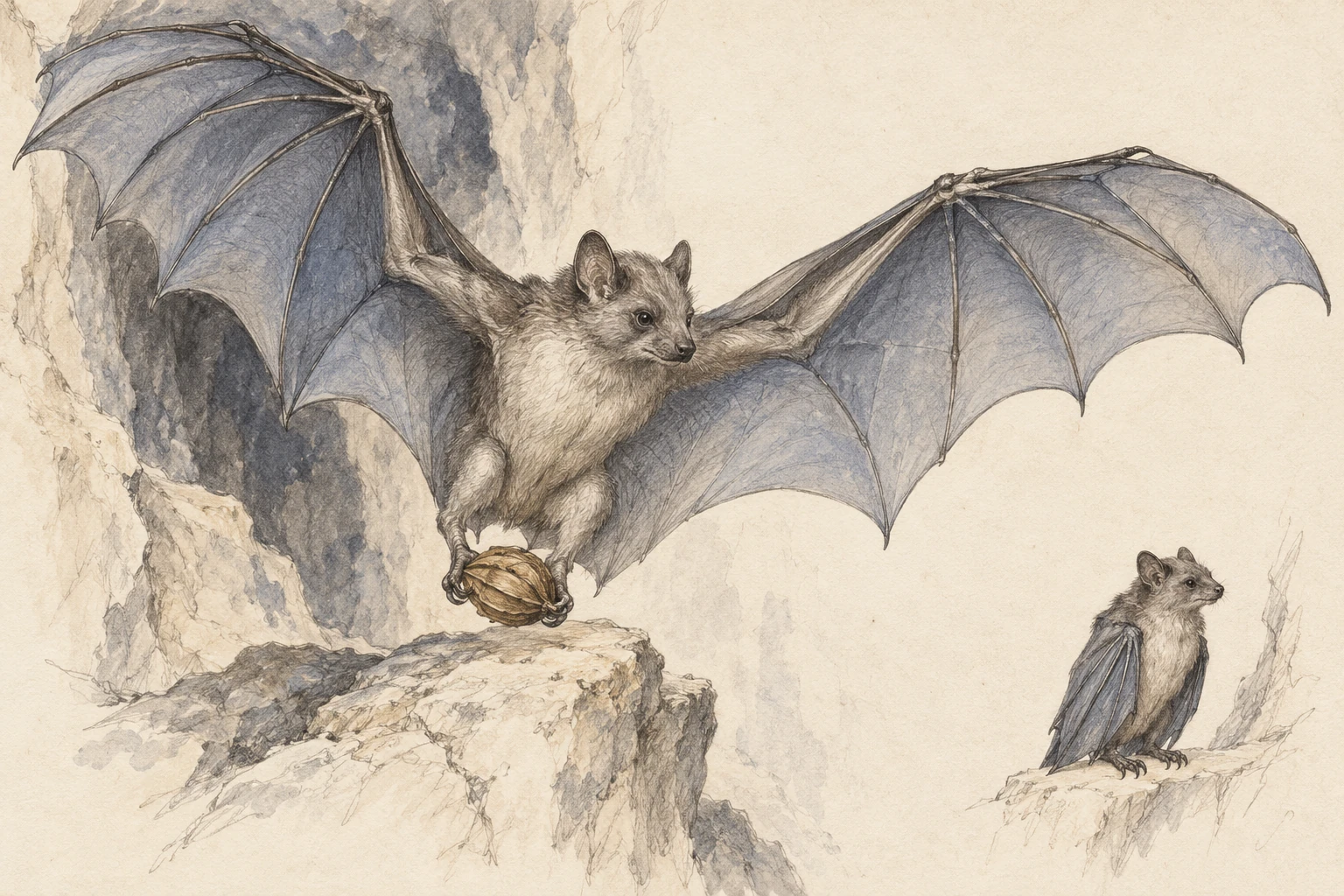
Broadwing courier#
Sketch
Broadwing couriers carry seed pods between communal cave roosts, clasping each load in their hind feet. Small muscles tension separate membrane panels during slow flight, allowing frequent adjustments near crowded landing ledges. The courier lowers its load onto the stone before gripping the ledge. Folded wings lie close to the furred body while it rests.
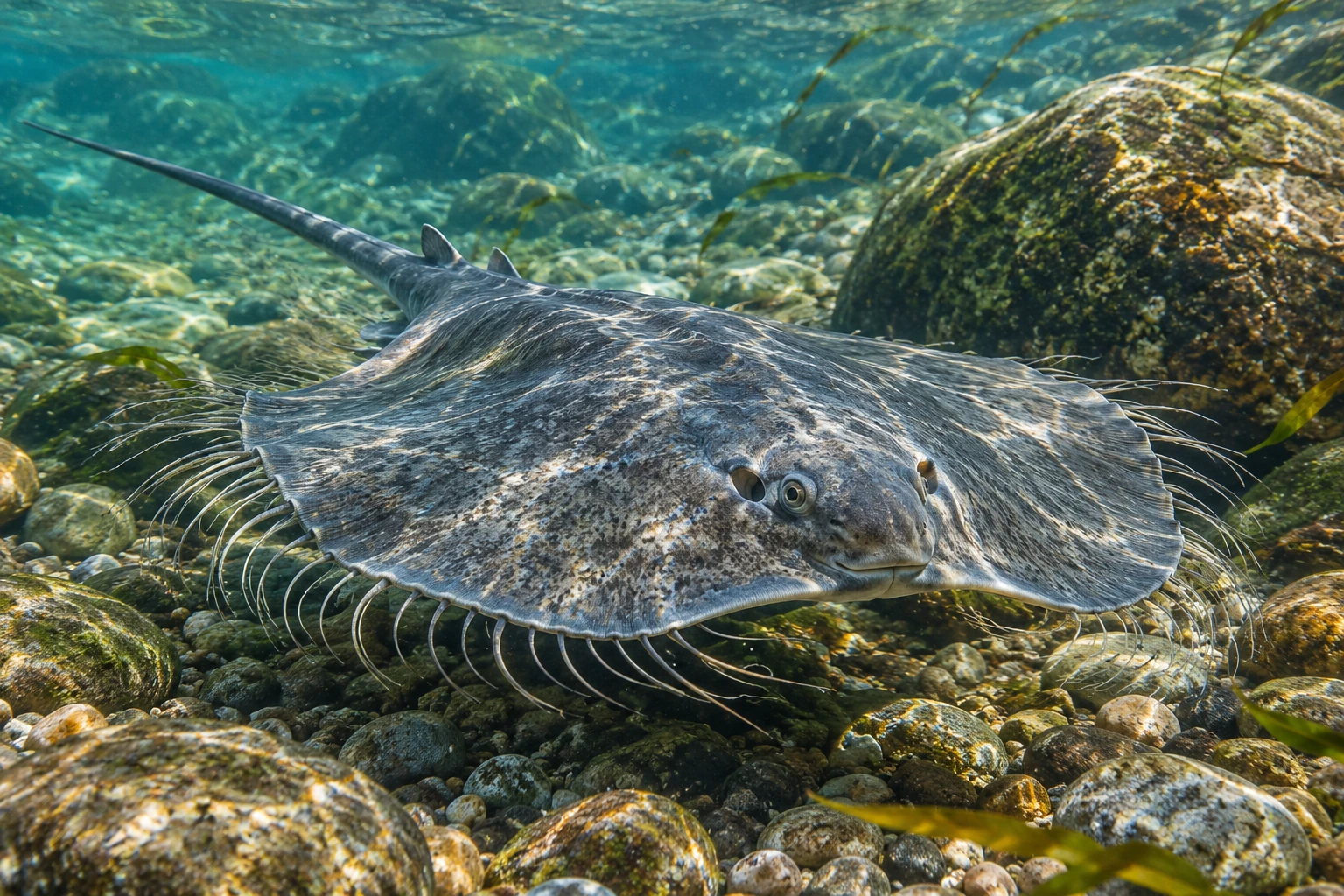
Current-harp ray#
Illustration
The current-harp ray reads turbulence through flexible filaments along its fin margins. It compares their bending patterns while the broad fins hold its body above the stones. Before entering a narrow gap, the ray samples the upstream eddies, then follows the channel whose flow allows a quiet passage through the rocks.
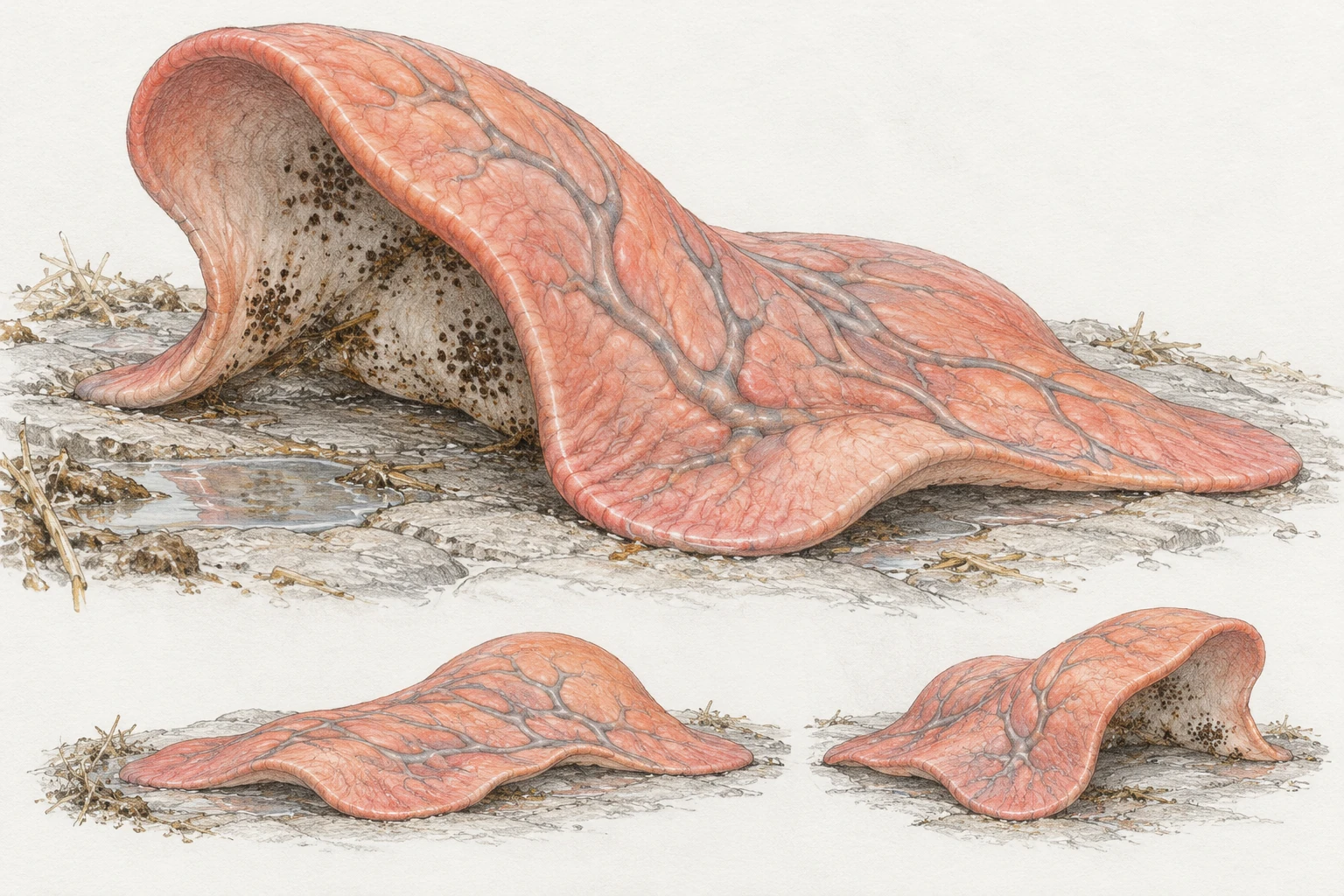
Saddlefold#
Sketch
The saddlefold advances by shifting pressure through sealed channels inside a continuous tissue sheet. Traveling folds place fresh bands of underside against detritus trapped on mineral ledges, where digestive patches absorb soluble food. Broad surfaces exchange gases. Chemical and strain-sensitive tissues coordinate the fold cycle, while closed fluid channels conserve water between visits from the tide.
Sail-eared runner#
Illustration
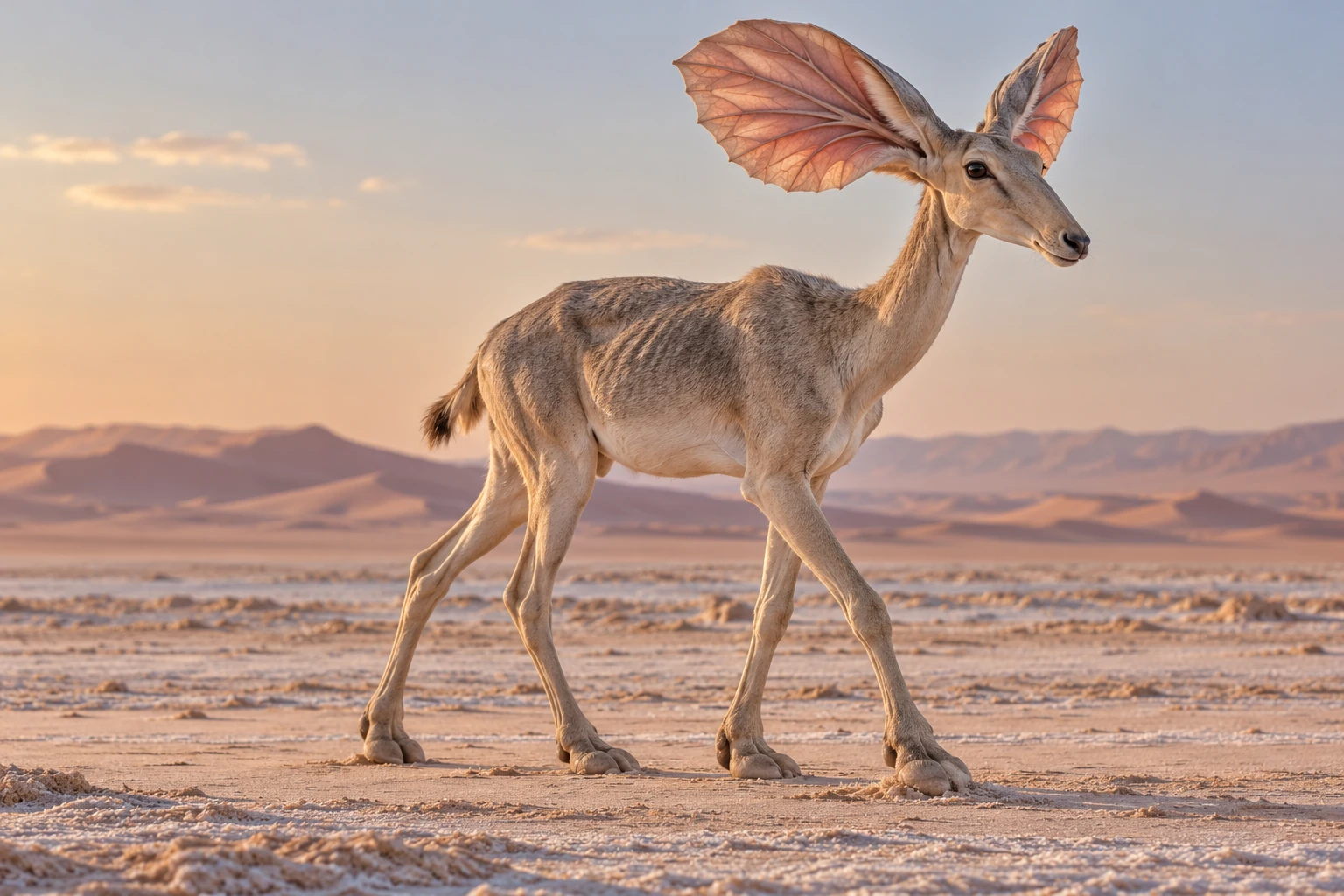
Sail-eared runners cross mineral deserts on broad pads that spread their weight over fragile crust. Blood flows through branching vessels in the thin ear pleats; spreading these surfaces helps the animal shed heat in cooler air. Strong cartilage supports the ears during running, while folding them reduces drag. Small groups meet along cool dune crests.
Lobefin threader#
Sketch
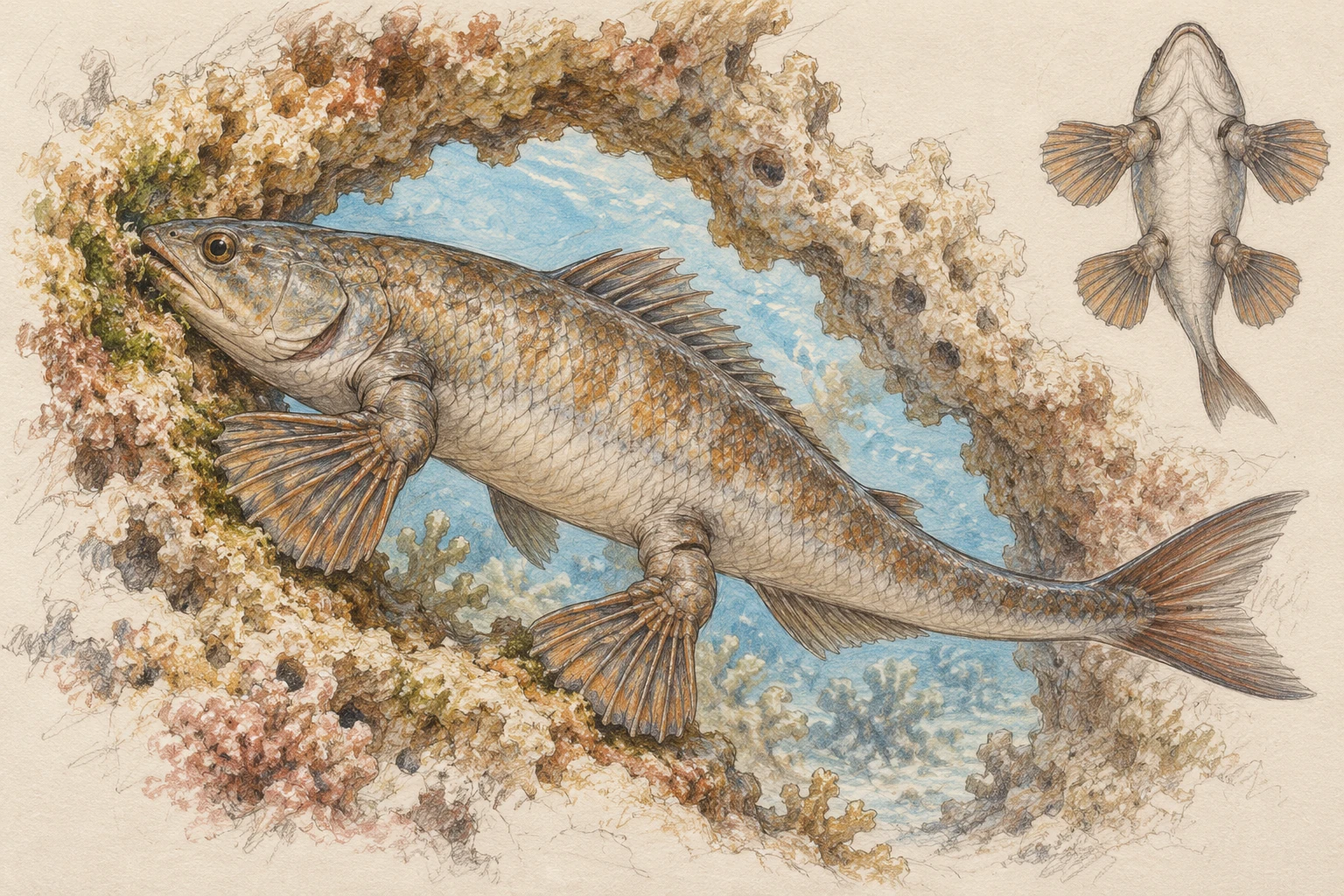
The lobefin threader braces inside reef cavities on two pectoral and two pelvic fins. Fleshy jointed bases place the broad fin fans against opposite walls, leaving the mouth free to graze. It releases the rear pair first when reversing out of a tunnel, then swims between cavities with its tail and dorsal fin.
Chamberstone#
Illustration
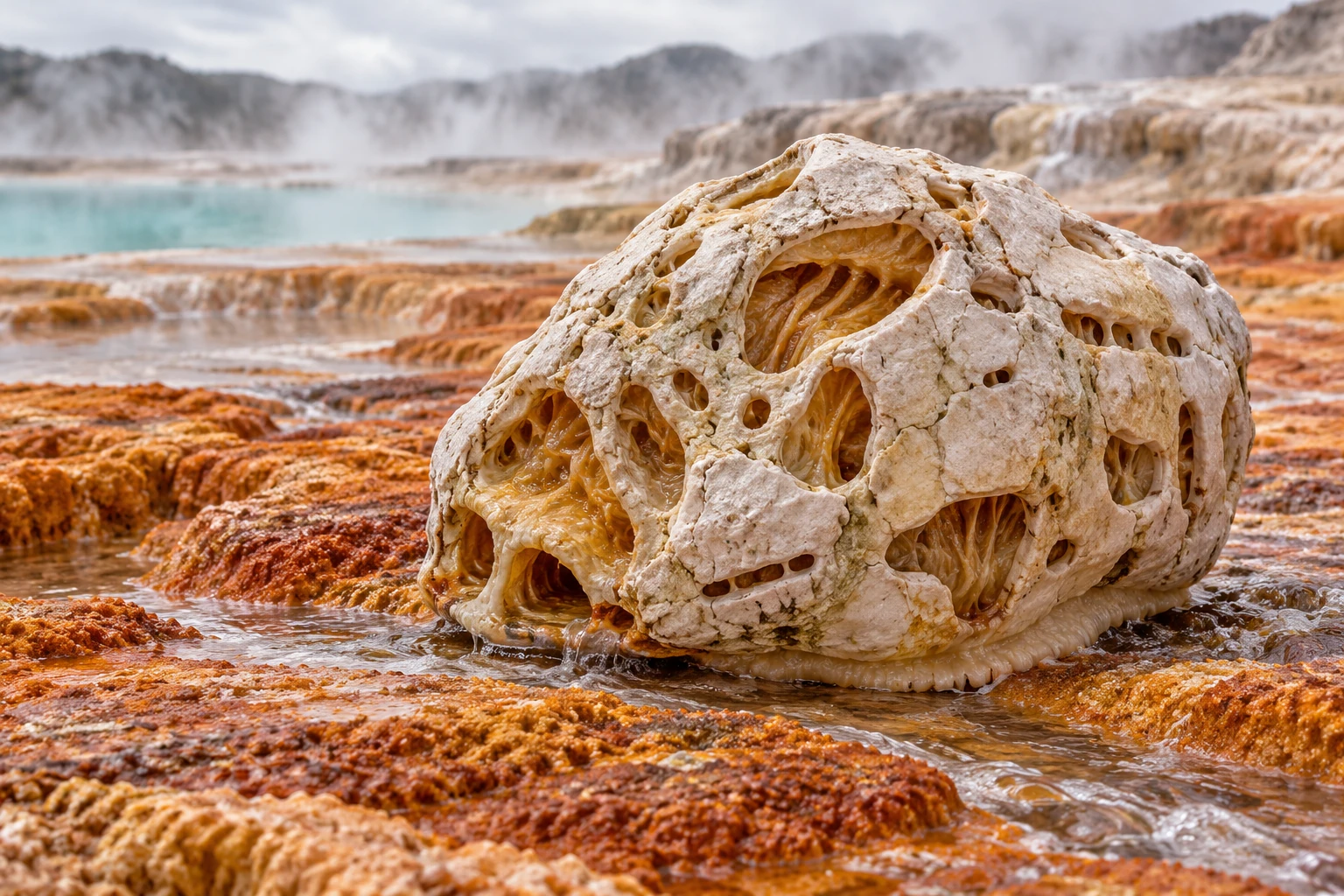
The chamberstone draws warm, organic-rich seep water through hundreds of soft chambers inside its mineral body. Contracting walls circulate food and oxygen through branching passages. Distributed pressure and temperature sensors guide each intake. A water-filled basal collar shifts the body's weight through successive inflations, moving it millimeters per minute along the terrace's changing trickles.
Frondwhisker climber#
Sketch
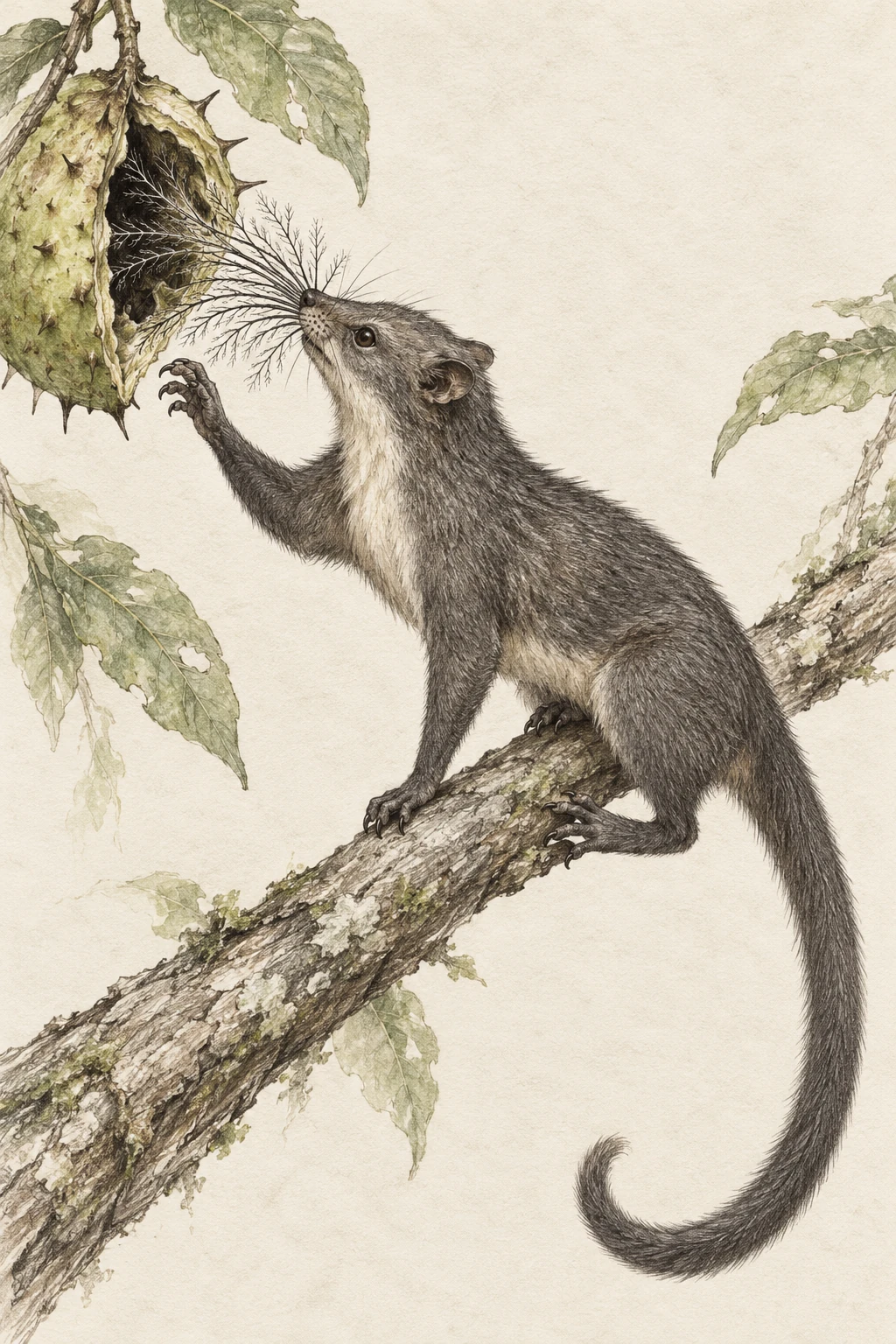
Frondwhisker climbers test fruit cavities before reaching past their thorns. Fine branches on each whisker transmit small deflections to the main shaft and its sensitive follicle, allowing the animal to map several nearby surfaces together. Curved claws secure its feet on narrow branches, and a long tail balances the body as one forepaw reaches toward food.
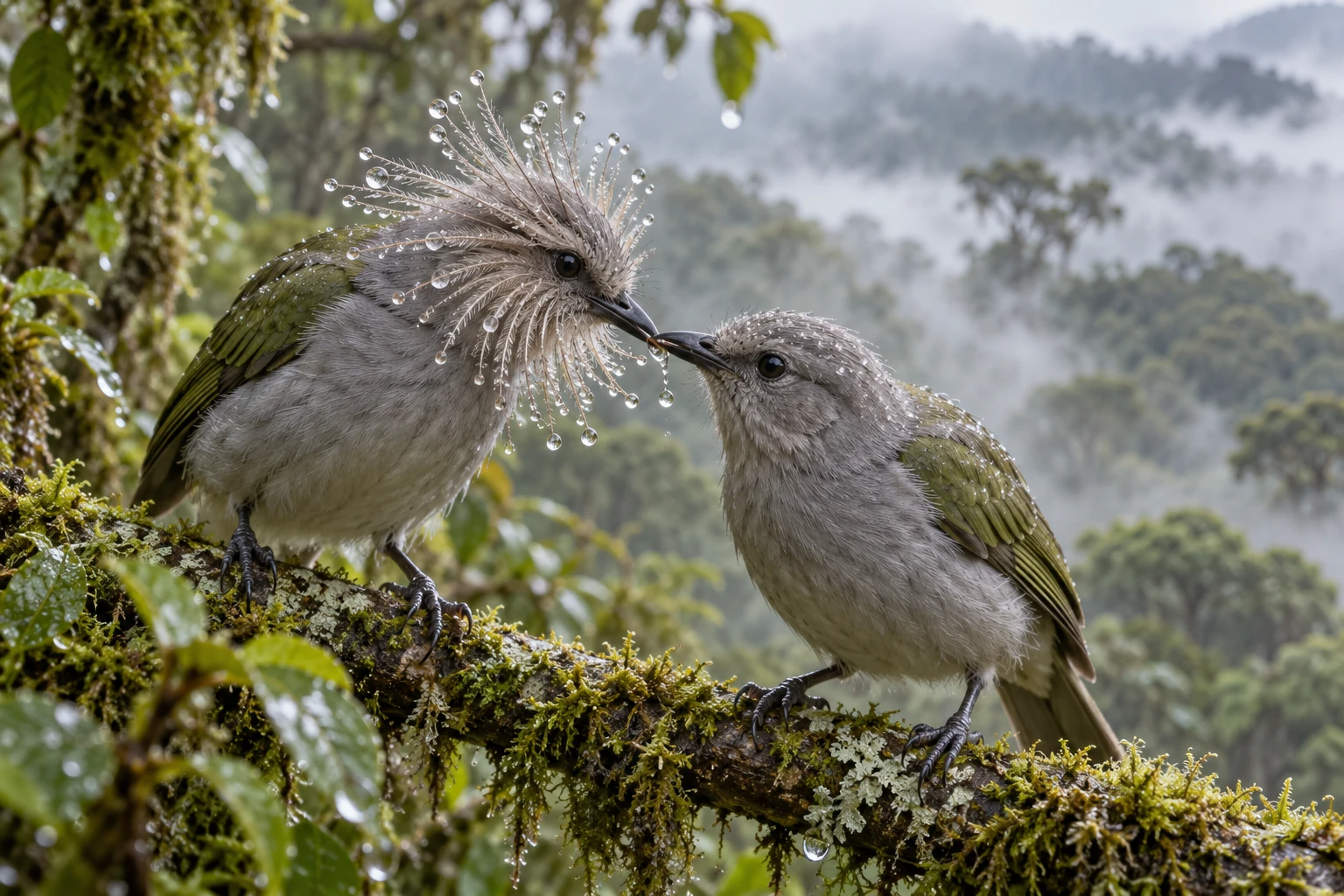
Fog-harp bird#
Illustration
The fog-harp bird intercepts cloud droplets on finely branched facial feathers. A quick shake gathers the beads toward its bill, where the bird drinks or passes them to a companion. Pairs use exposed branches as collecting stations, taking turns facing the wind while the other shelters closer to the trunk.
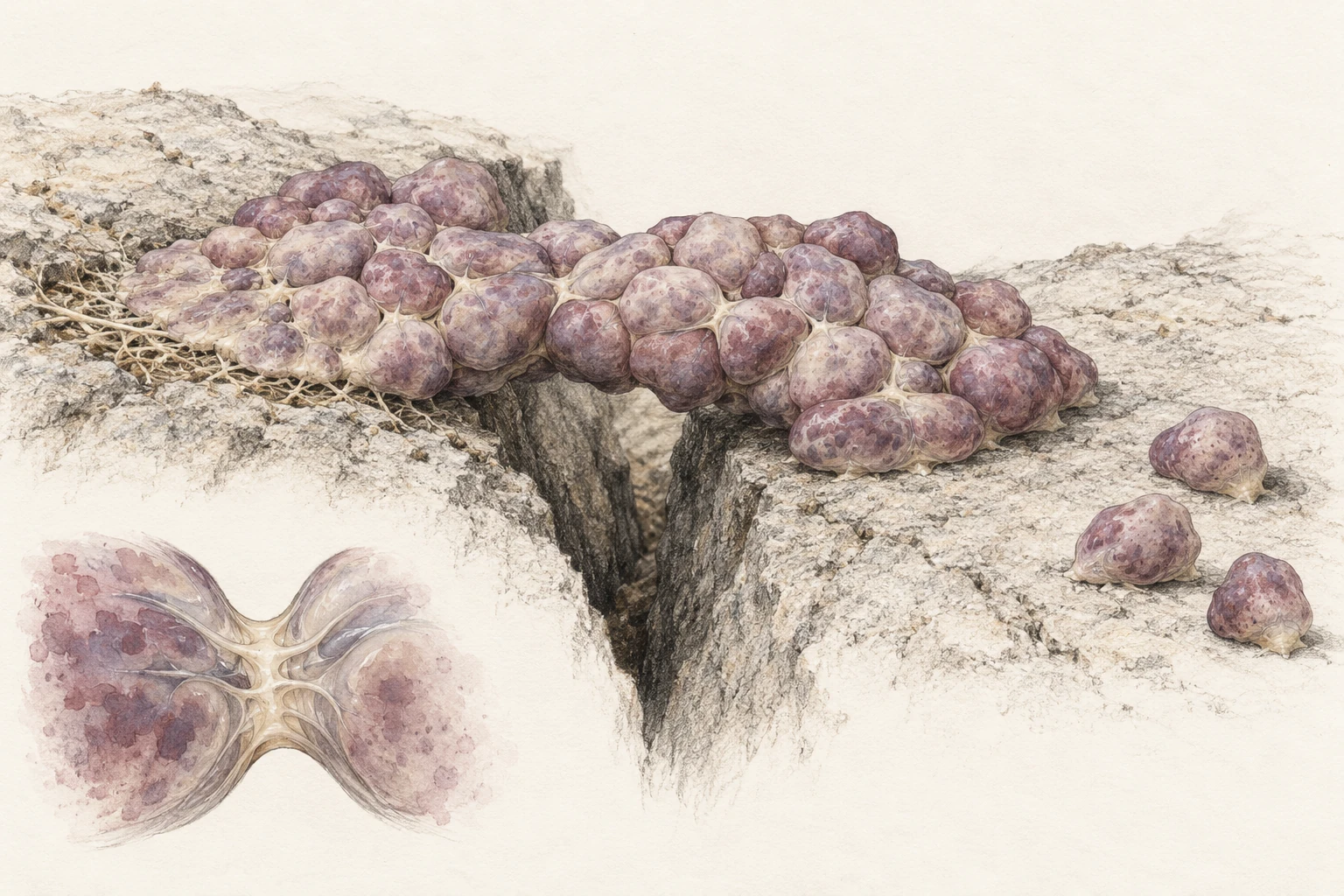
Grain choir#
Sketch
The grain choir joins soft granules through temporary vascular seals. Each granule digests food at contact patches and exchanges gases across its skin; connected granules share nutrients and chemical signals. Controlled adhesion and local contractions reshape the collective body. A thick bridge carries it over a narrow crack while three provisioned granules explore nearby fungal growth before reconnecting.
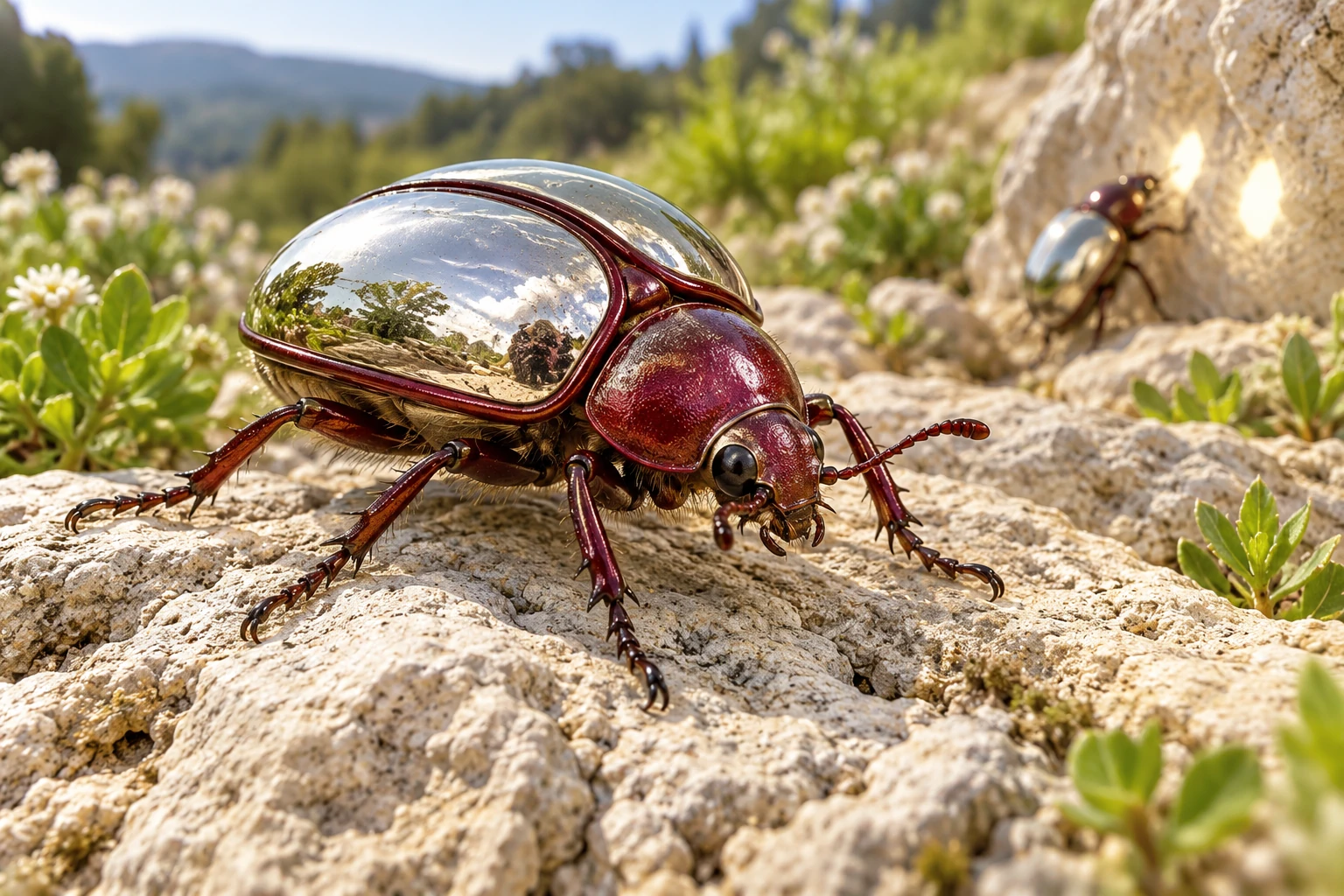
Mirror-bloom beetle#
Illustration
Mirror-bloom beetles coordinate communal displays by tilting reflective wing covers toward pale stone. Their curved cuticle spreads sunlight into moving patches that companions follow with polarization-sensitive eyes. Adults feed on soft fruit and flower tissues between displays. Small muscles adjust each cover independently, while the enclosed abdomen and folded flight wings remain sheltered beneath the reflective surfaces.
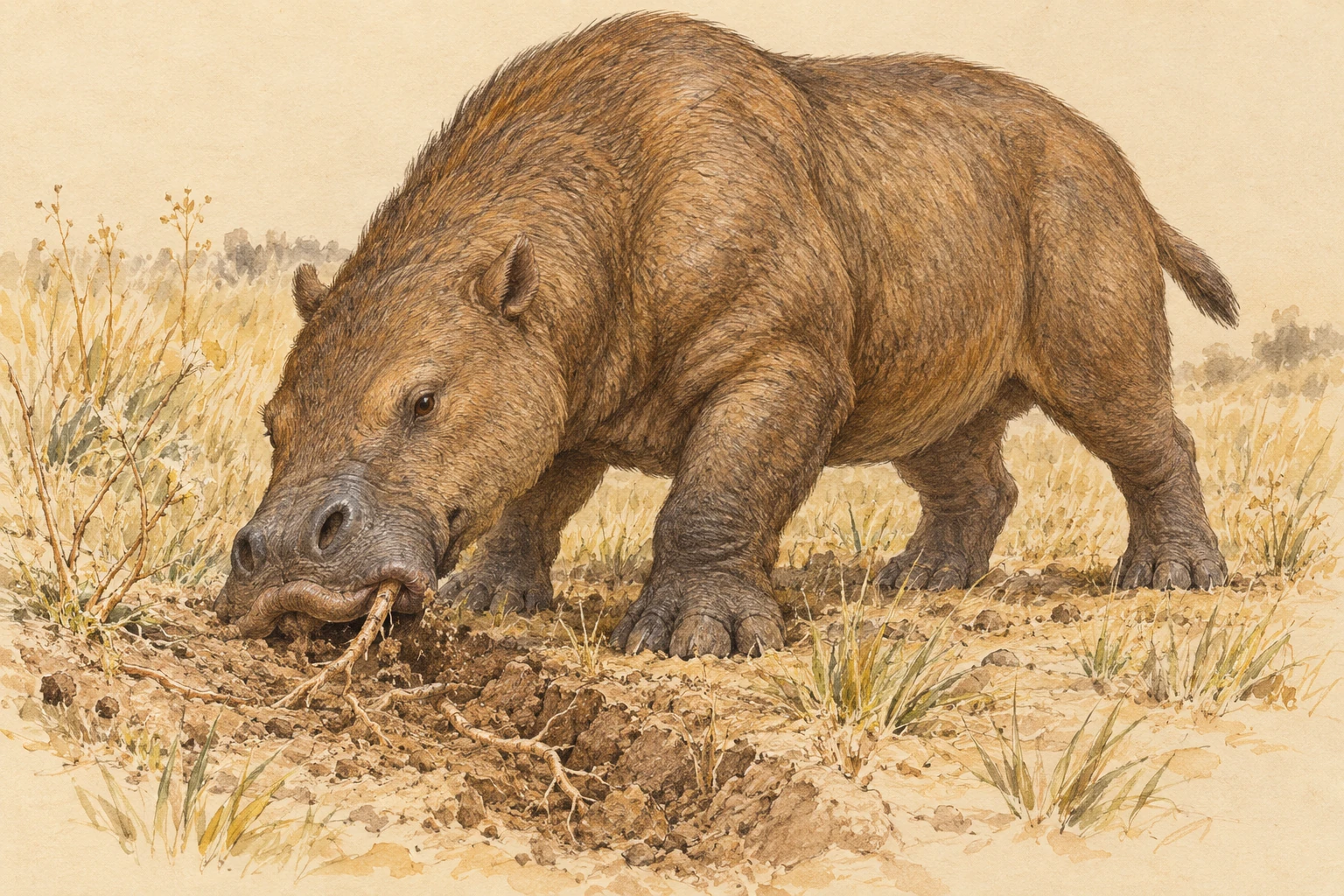
Ploughmuzzle grazer#
Sketch
Ploughmuzzle grazers part loose meadow soil with a broad cartilage muzzle supported by strong neck and shoulder muscles. Short gripping lips select exposed roots while the nostrils remain above the disturbed earth. The animal advances slowly on four broad feet, reopening favored shallow furrows as new growth develops through the season.
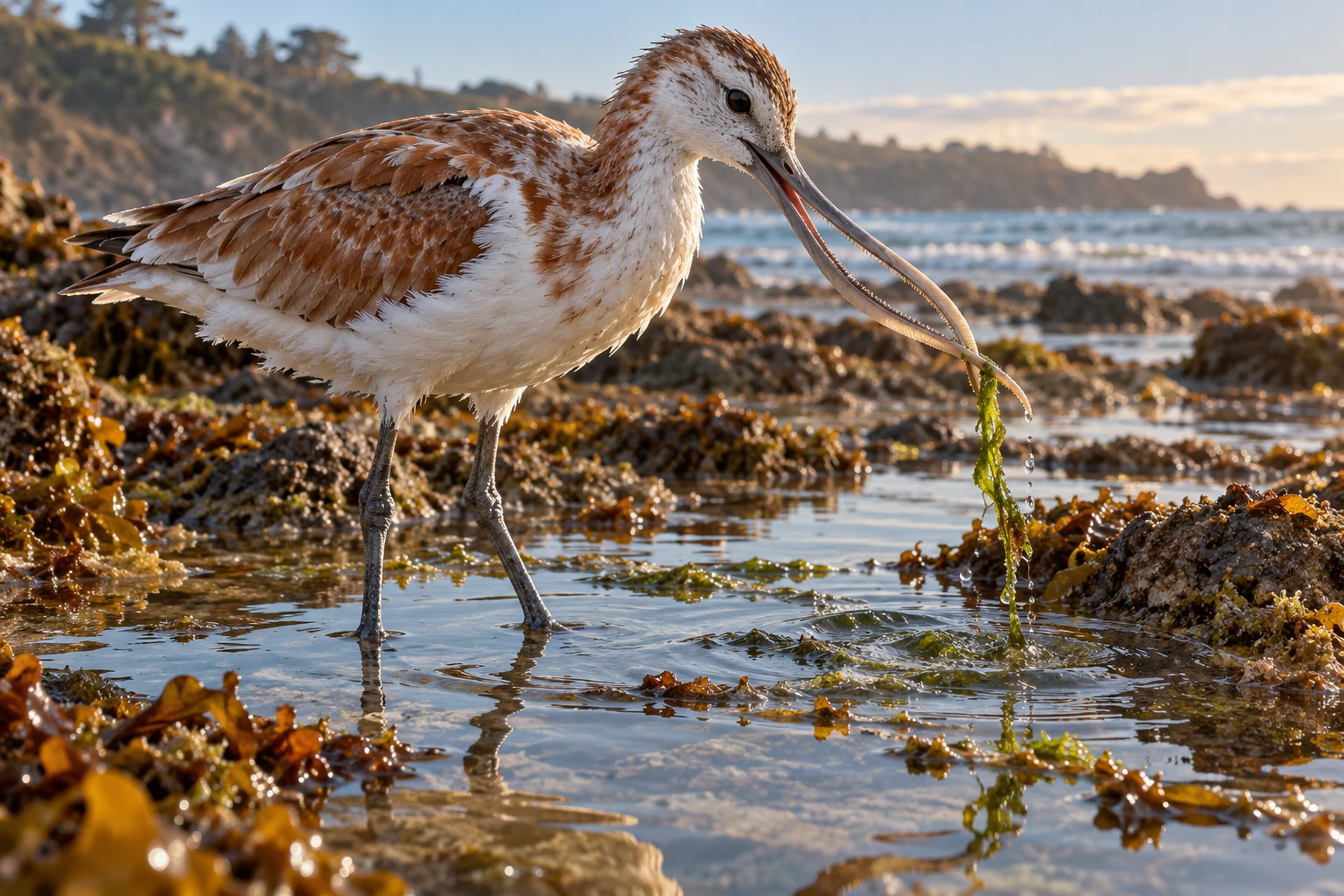
Spiralbill wader#
Illustration
The spiralbill wader draws tangled algae through the open rake formed by its two bill halves. Fine keratin edges separate edible strands, which its tongue gathers toward the mouth. It turns its head while lifting each strand, shaking free sand and small shell fragments before taking another mouthful from the pool.
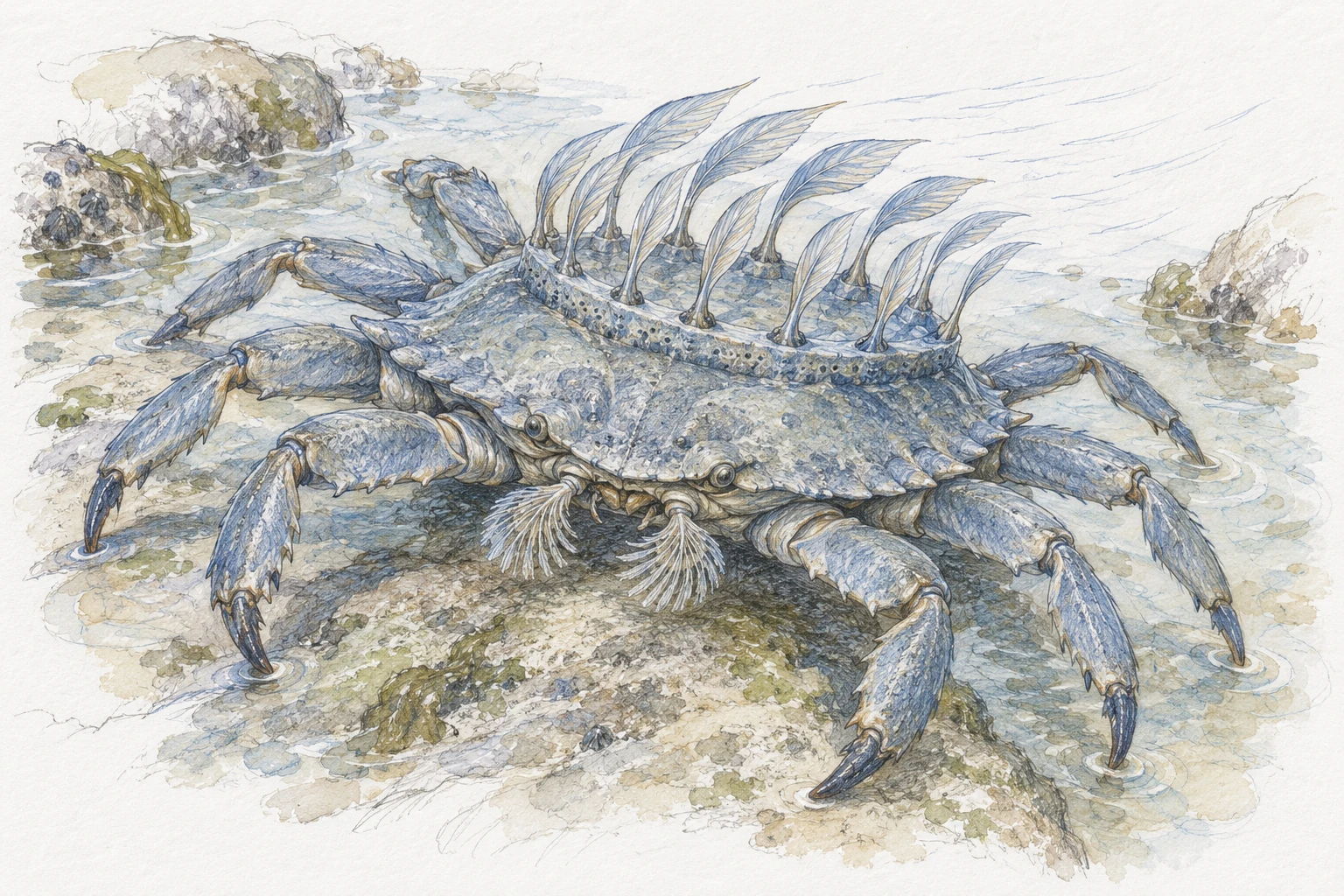
Compass crab#
Sketch
Compass crabs turn until their dorsal vanes register a favorable current. Flexible roots measure the strain on each vane, allowing the animal to compare flow across its shell. Feathered mouth appendages then sweep food particles from the passing water. The broad walking stance supports slow pivots across uneven stone as changing tides shift the best feeding direction.
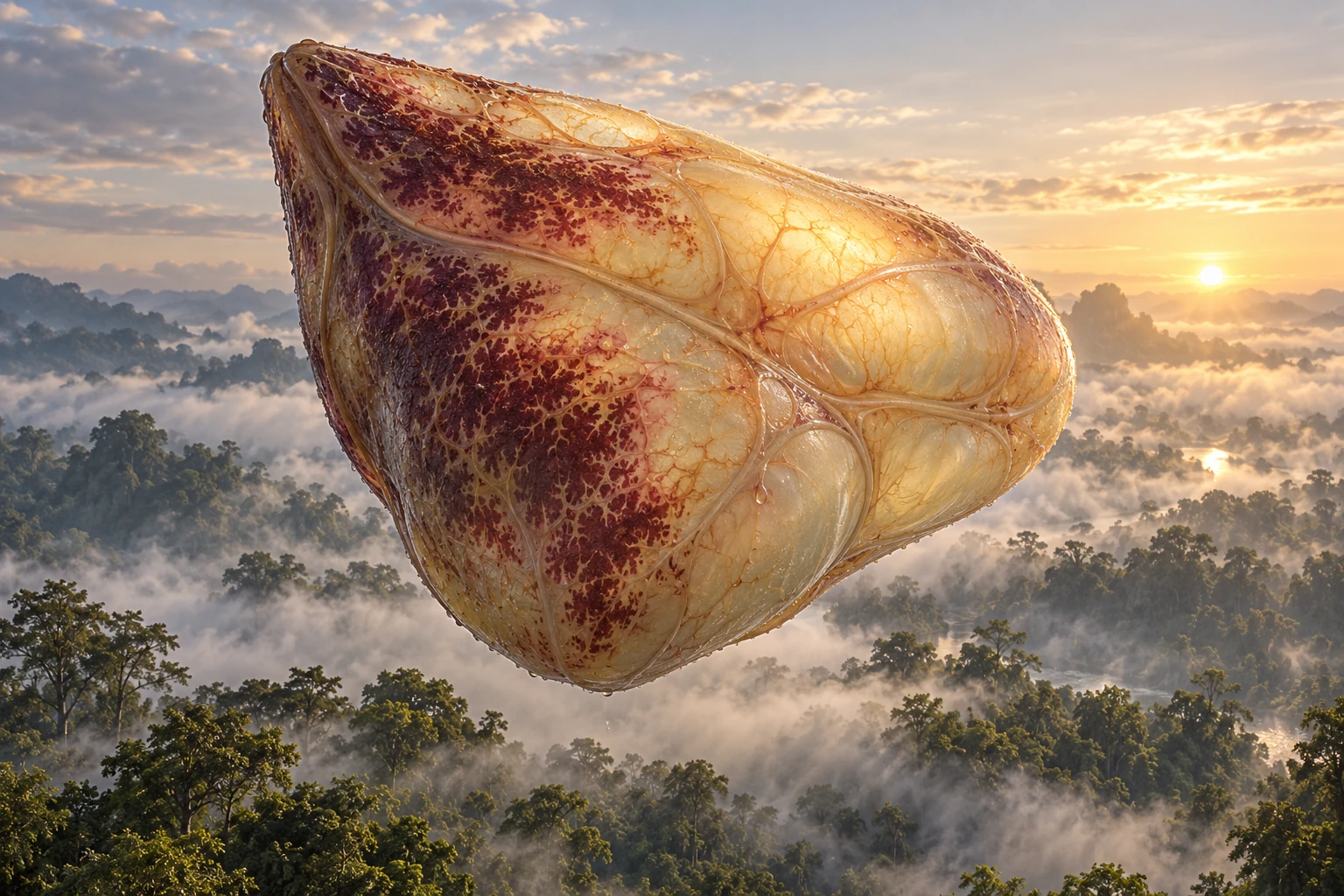
Dawn float#
Illustration
The dawn float hangs in dense air on thin-walled hydrogen chambers. Dark skin patches harvest sunlight, while surface pores collect dew and airborne organic particles. Fluid channels feed tissues around the gas cells. Light and pressure sensors coordinate changes in inflation, shifting buoyancy and drag to enter favorable currents. Solar-powered water splitting replaces hydrogen lost through the skin.
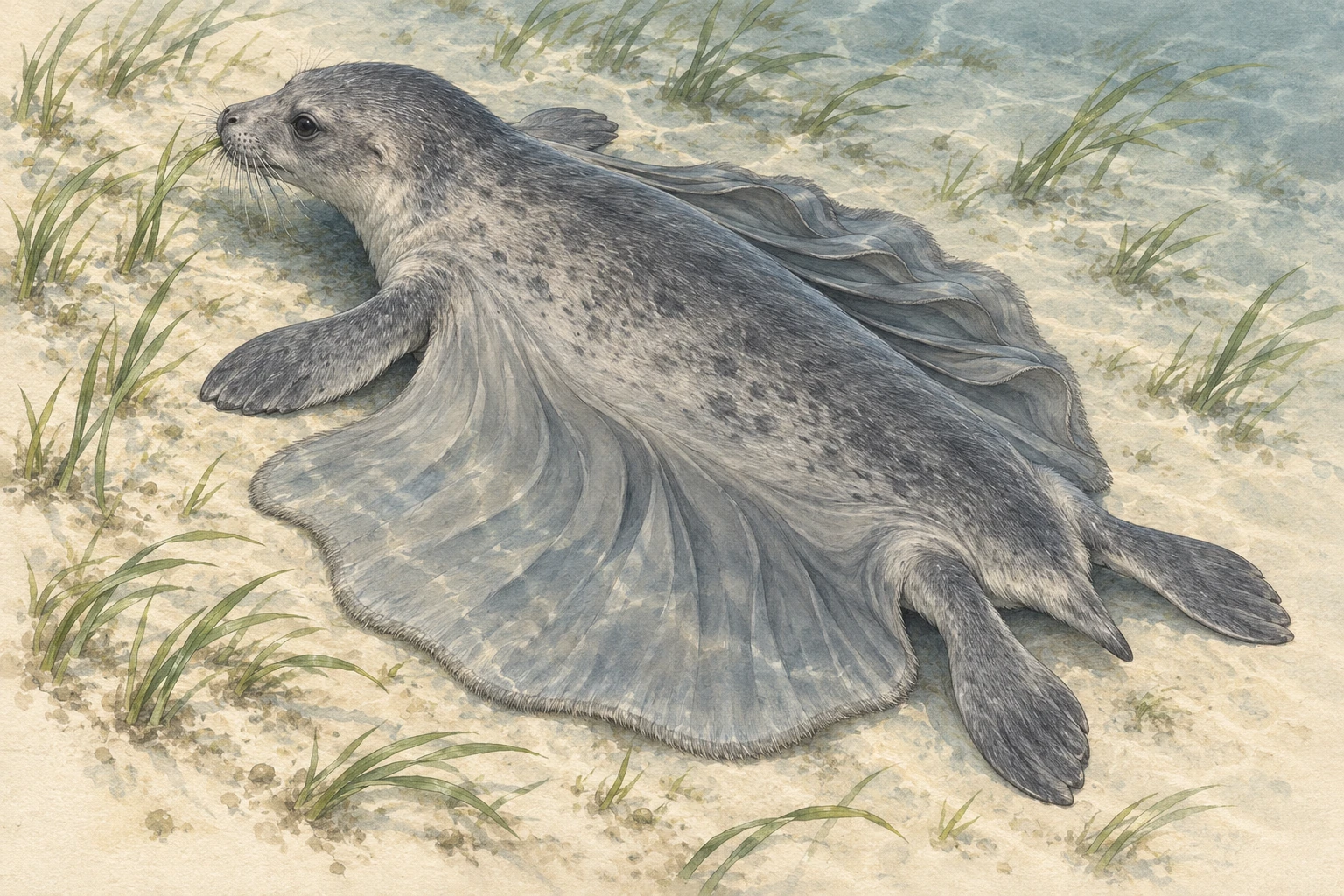
Tide-blanket#
Sketch
Tide-blankets graze shallow seagrass banks with their muscular flank membranes spread against the bottom. The broad living surfaces damp small rolls as current passes over the body. Four independent flippers handle swimming and turning. Before leaving a feeding patch, the animal gathers the membranes into close folds and rises to breathe through its paired nostrils.
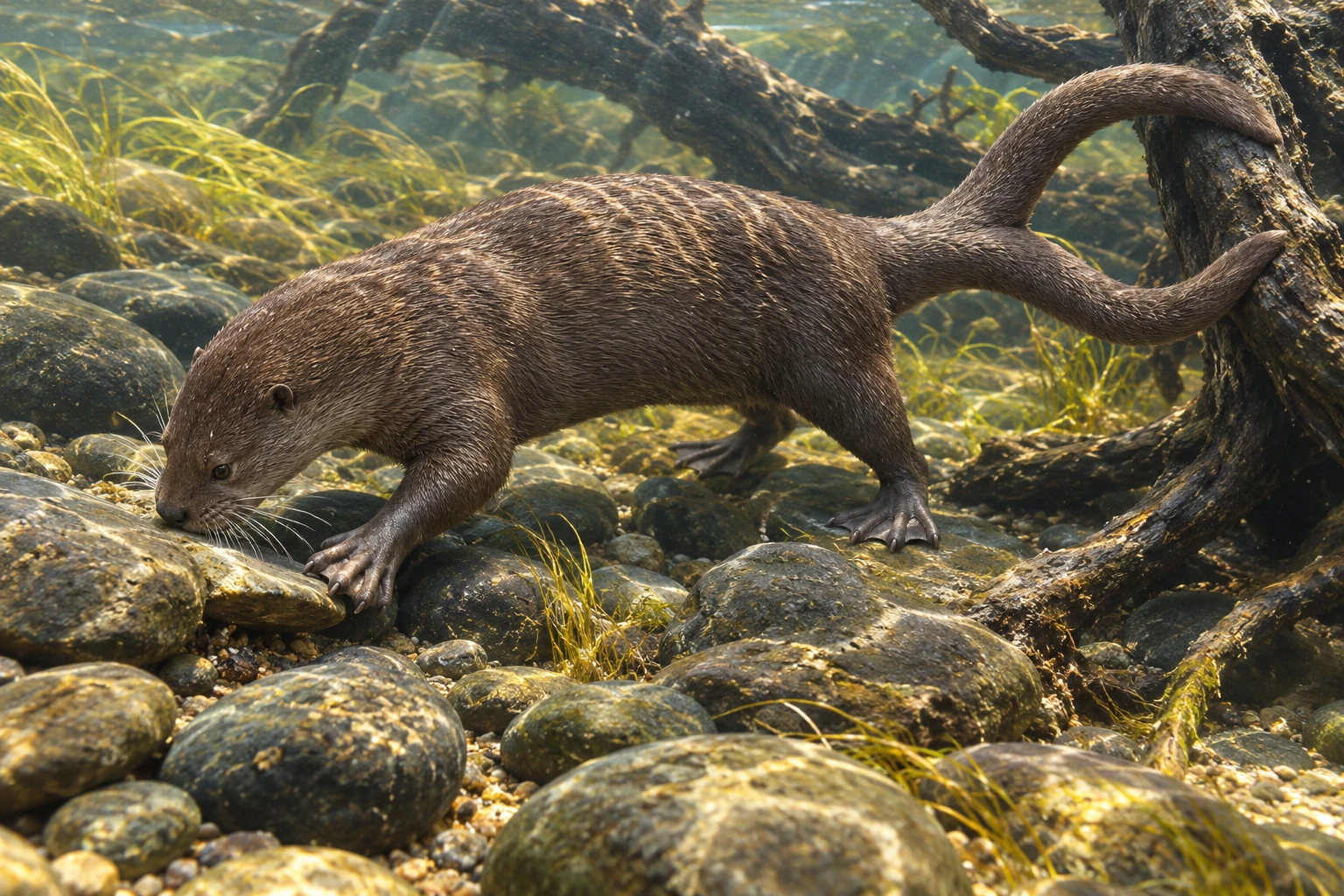
Bifid-tail diver#
Illustration
Bifid-tail divers brace themselves against submerged roots while inspecting food beneath stones. A single muscular tail base divides into two flexible steering branches, each capable of pressing against a separate contact. Webbed feet propel the animal between feeding patches. Sensitive forefeet and whiskers locate small prey in the spaces opened along a stone's edge.
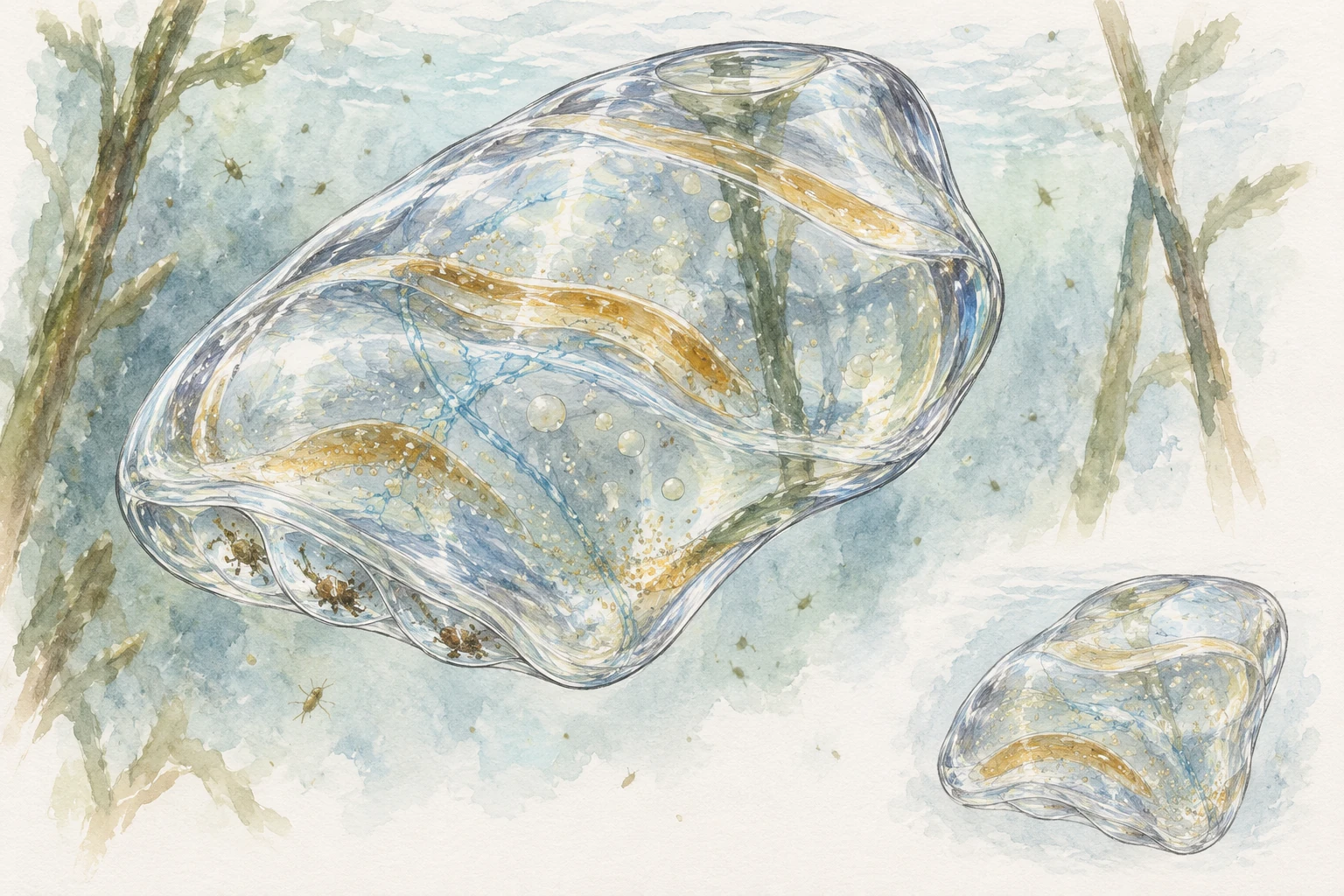
Caustic drifter#
Sketch
The caustic drifter forms images with the curved skin of its entire body. Receptor bands at different depths compare these shifting projections. Temporary surface pockets close around plankton and pass food into circulating digestive vesicles. Dissolved gases cross the broad outer skin. By altering stored lipids and internal salt balance, it adjusts buoyancy and moves between food-rich layers with the current.
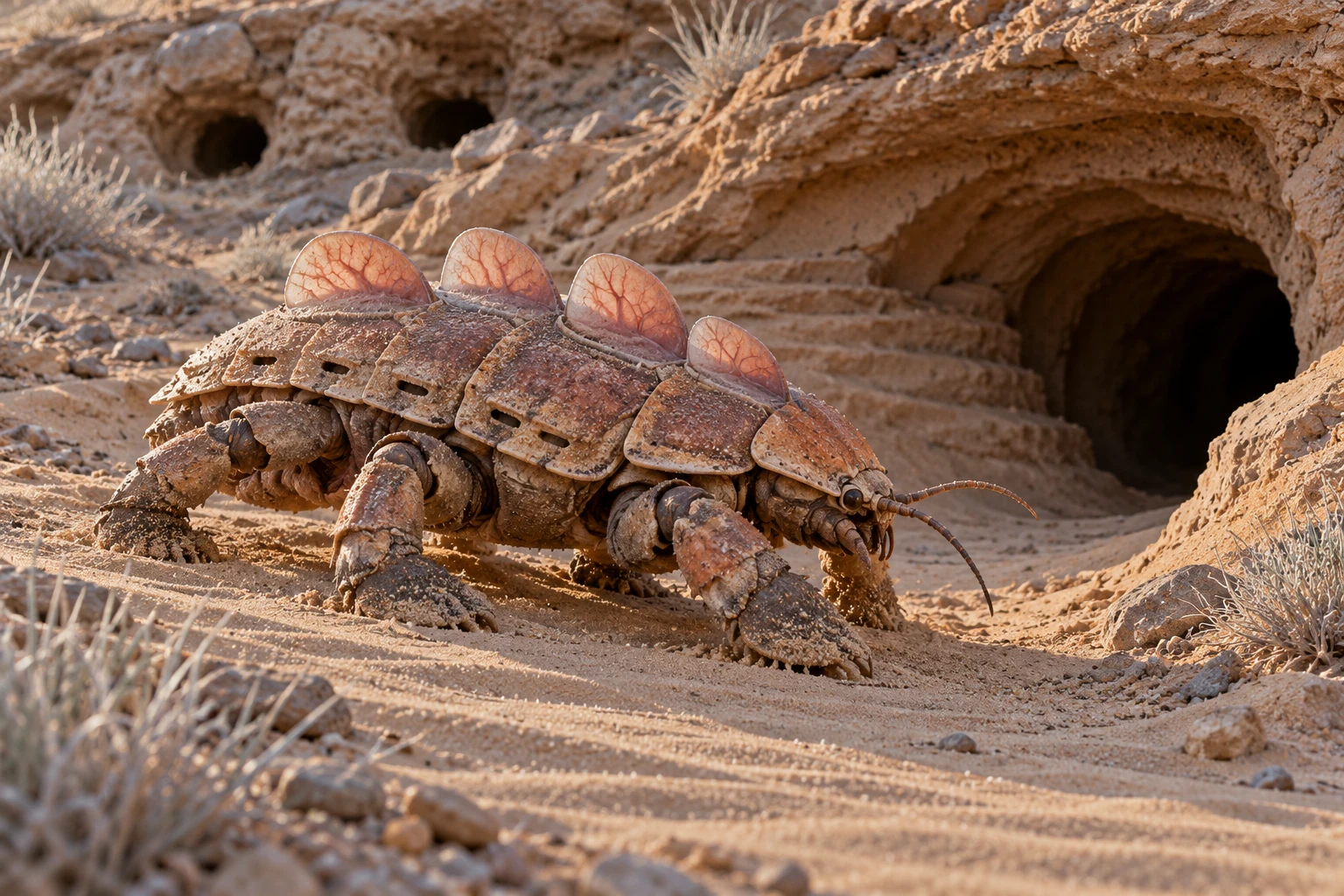
Dune-hearth crawler#
Illustration
The dune-hearth crawler warms its vascular dorsal panels at the burrow entrance each morning. Circulating fluid carries this heat into deeper resting chambers, where the animal settles against cooler nestmates. Overlapping armor sheds loose sand, broad front feet maintain the entrance, and active flank ventilation supplies oxygen while the body works beneath its heavy protective plates.
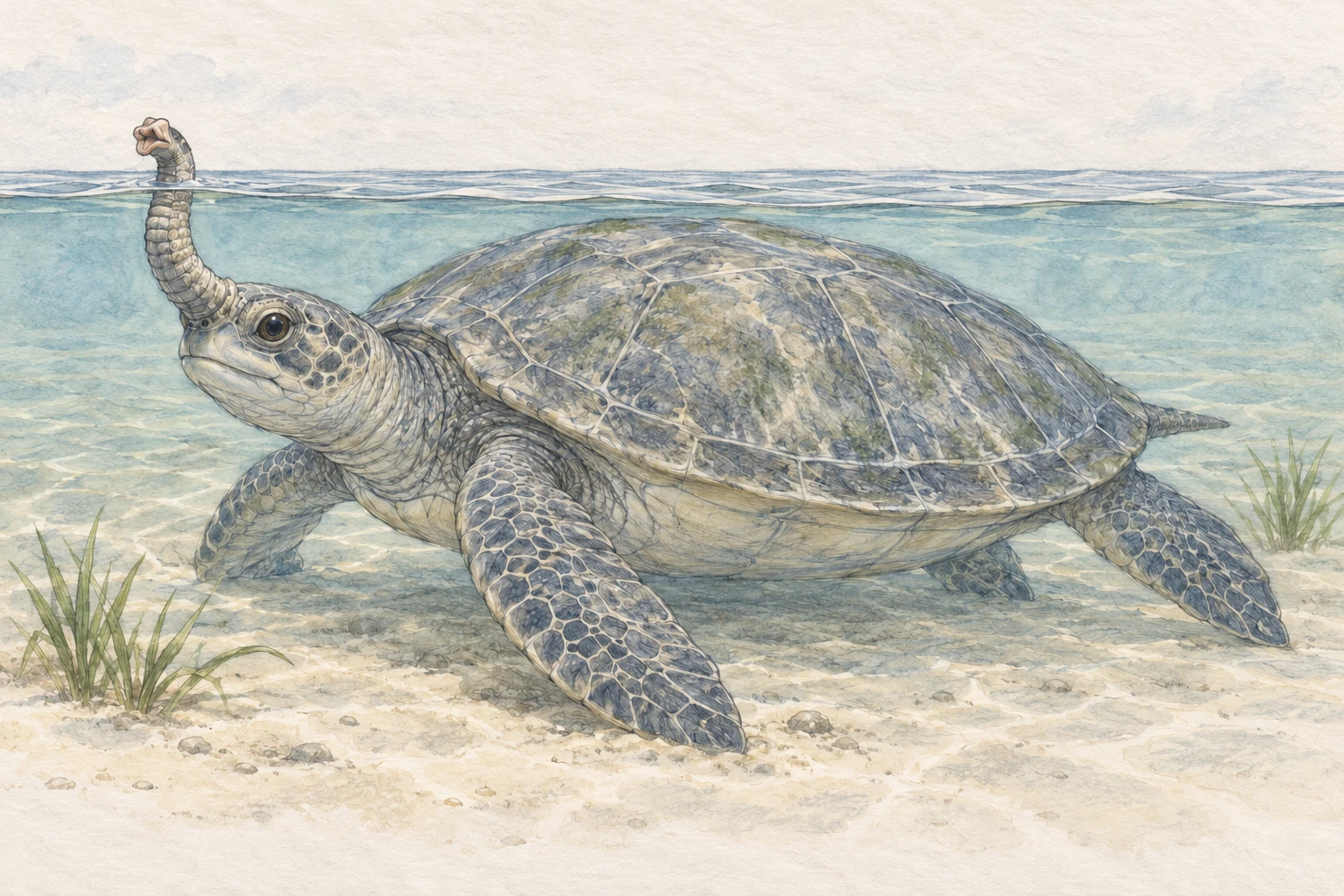
Sea-lung turtle#
Sketch
The sea-lung turtle rests in the lagoon shallows while its supported nasal extension reaches the air. Pleated skin at the root allows the short airway to withdraw beside the face. The tip closes before submergence, keeping water out as the turtle leaves its resting place and swims through the seagrass.
Reed-sluice skink#
Illustration
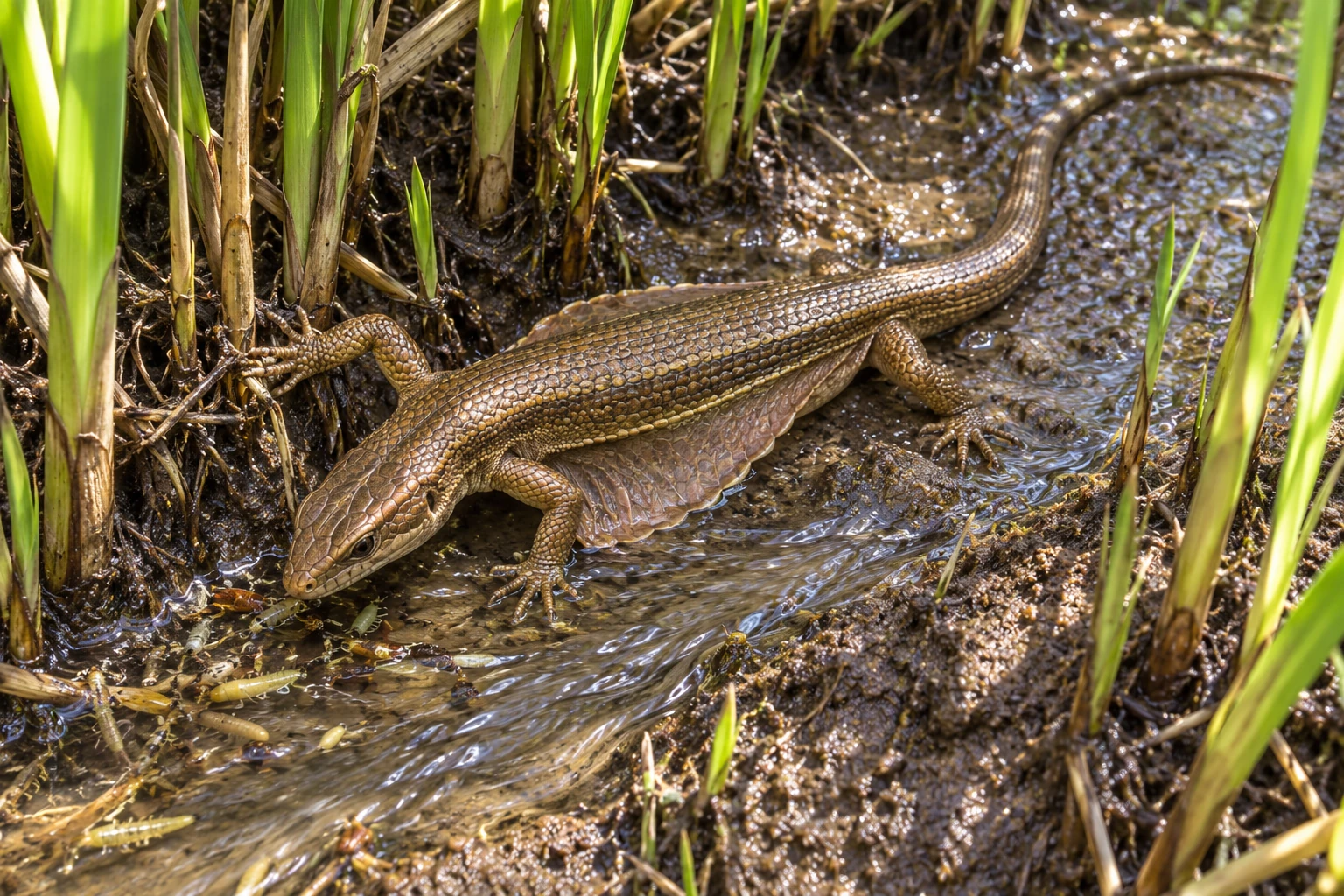
The reed-sluice skink braces beside shallow reed-bed trickles and spreads a flank gutter against the bank. The living fold guides a thin downhill flow toward a feeding patch, bringing larvae within reach of its mouth. Small changes in posture shift the channel edge as drifting food collects between the roots.
Seed-vault digger#
Sketch
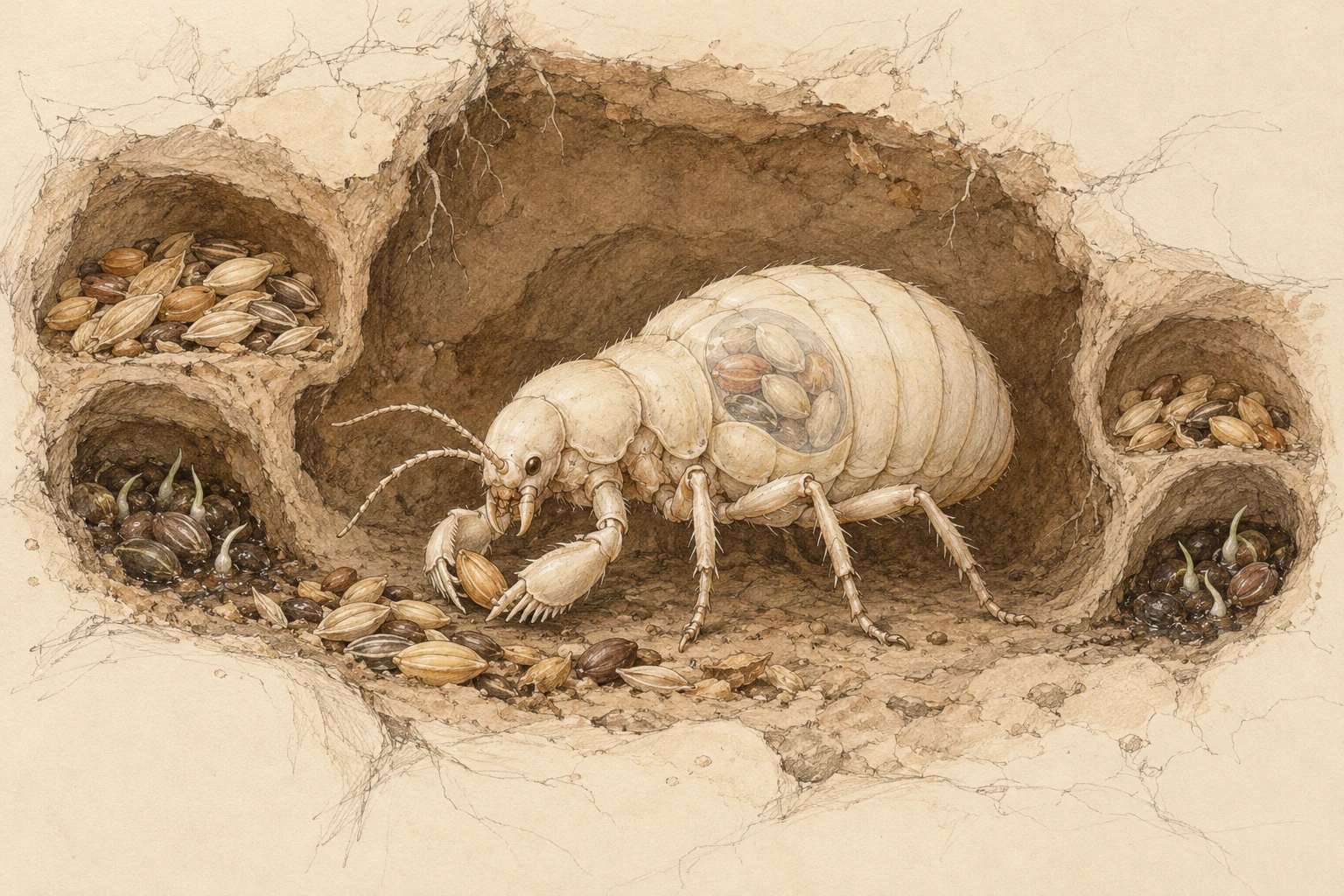
Seed-vault diggers sort their harvest between dry storage alcoves and damp chambers where seeds soften or germinate. Comb-shaped forelimbs clear debris while paired jaws test each seed before storage. A bounded translucent crop carries food between chambers. Antennae detect moisture gradients, guiding the animal as it moves supplies through the burrow's different humidity zones.
Eclipse hopper#
Illustration
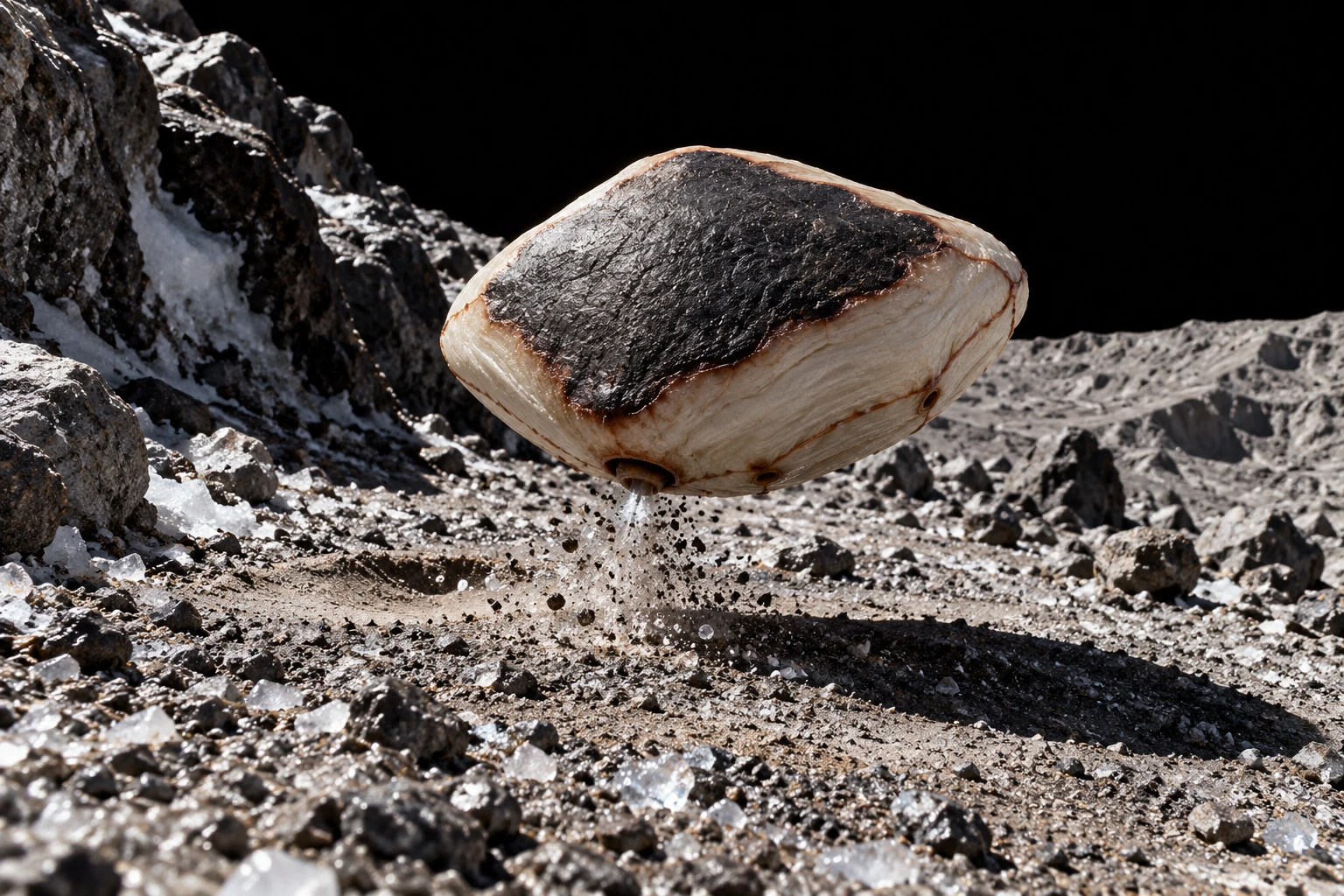
The eclipse hopper lives on sunlit, ice-bearing ledges of small airless bodies. An insulated pressure skin encloses warm circulating fluid. Solar tissues power metabolism and heat stored water; occasional tiny water impulses move it between feeding patches in weak gravity. Basal seals collect ice and organic-rich dust. Distributed light and temperature sensors time the hops, and the body enters cold dormancy when sunlight fails.
Cistern salamander#
Sketch
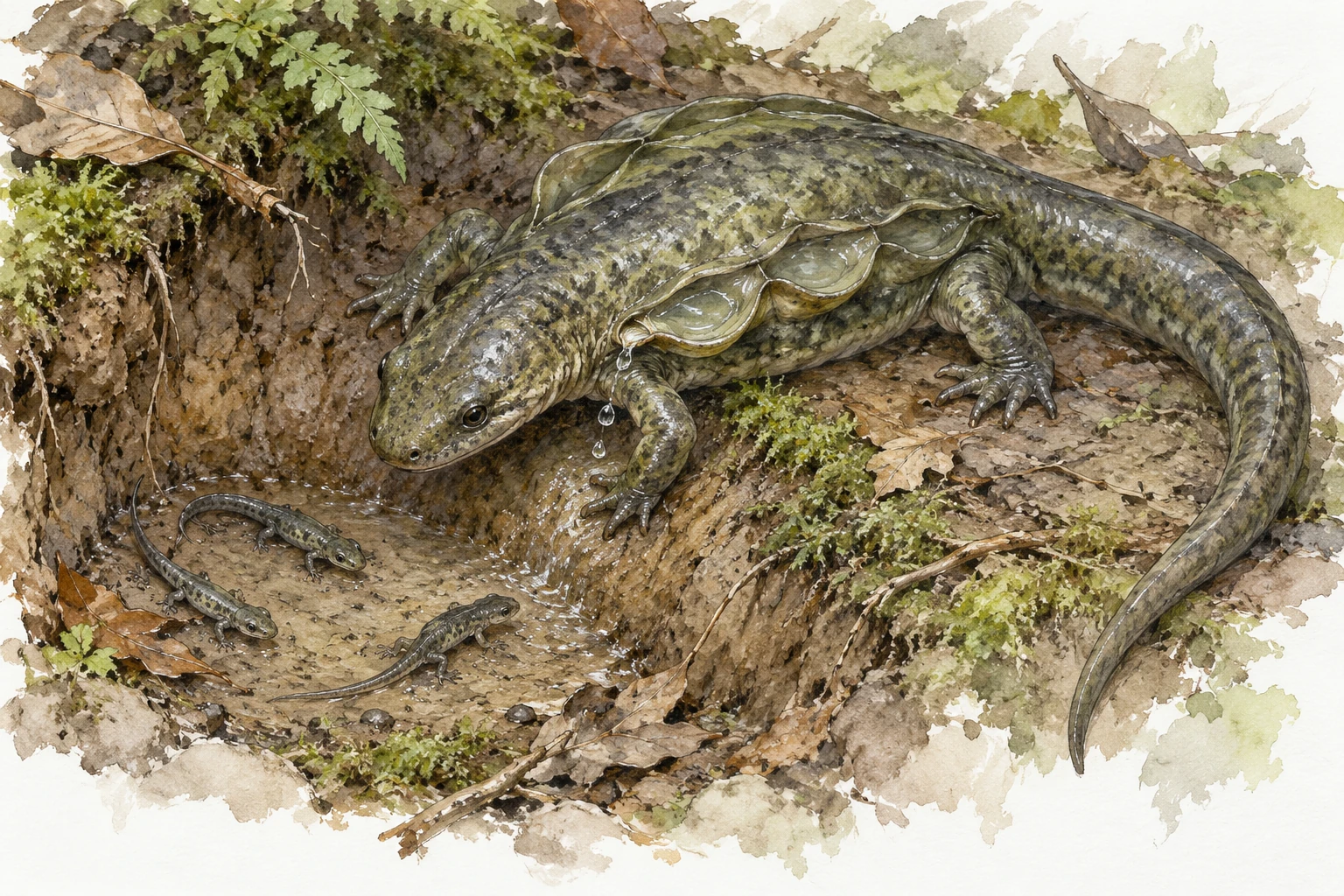
The cistern salamander carries a modest water reserve in protected folds above its flanks. At the nursery rim it opens a small channel and lets droplets run down the clay. The resulting film keeps the young moist while they browse, and the adult returns to nearby seepages to refill its folds.
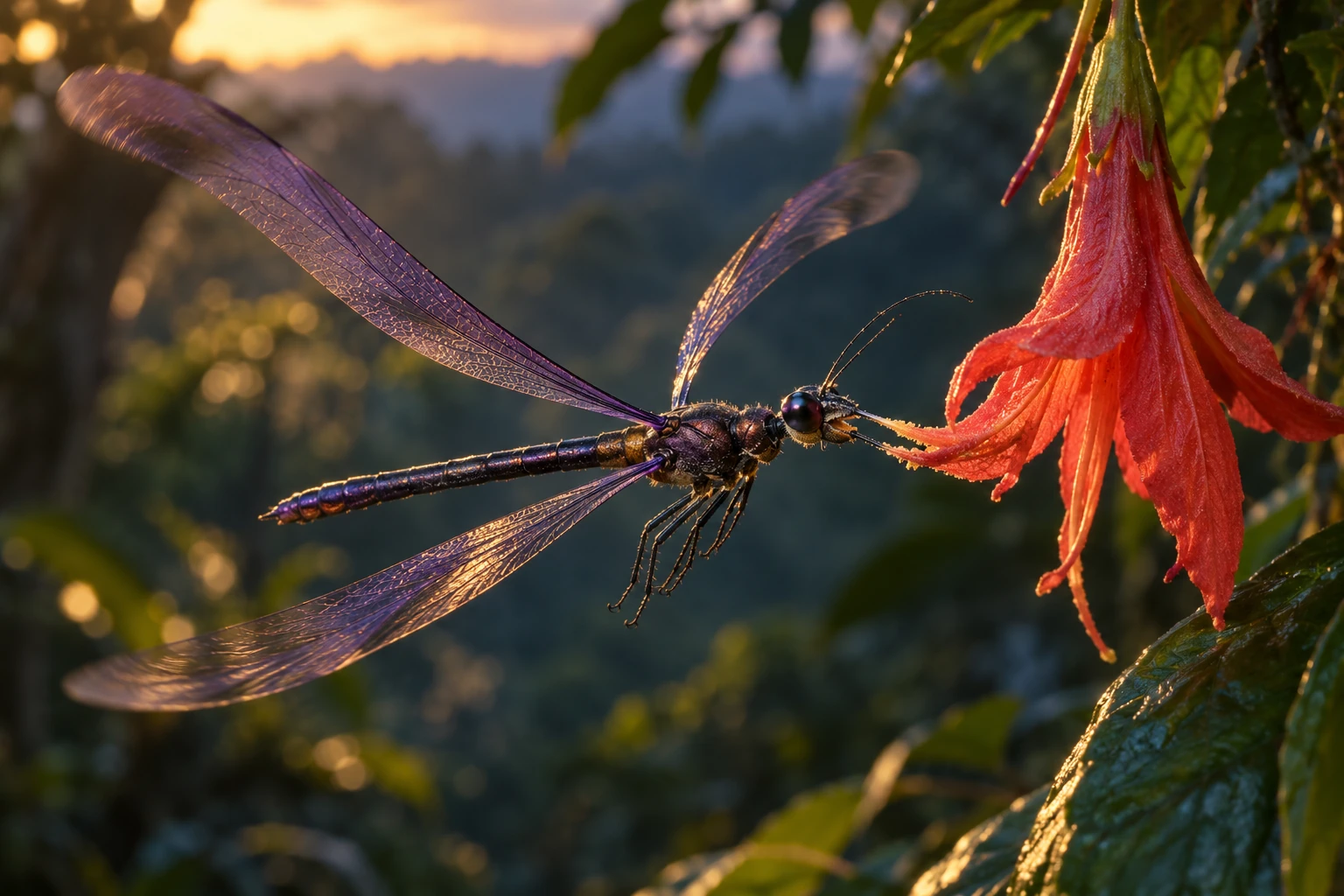
Ribbonwing pollinator#
Illustration
Ribbonwing pollinators hover beside hanging flowers and assemble short mouthparts into a temporary drinking tube. Their narrow wings carry repeated supporting veins that resist twisting during slow flight. Antennae guide the final approach through scent and touch. Pollen clings to the thoracic hairs and passes between flowers as the animal changes its feeding position through the canopy.
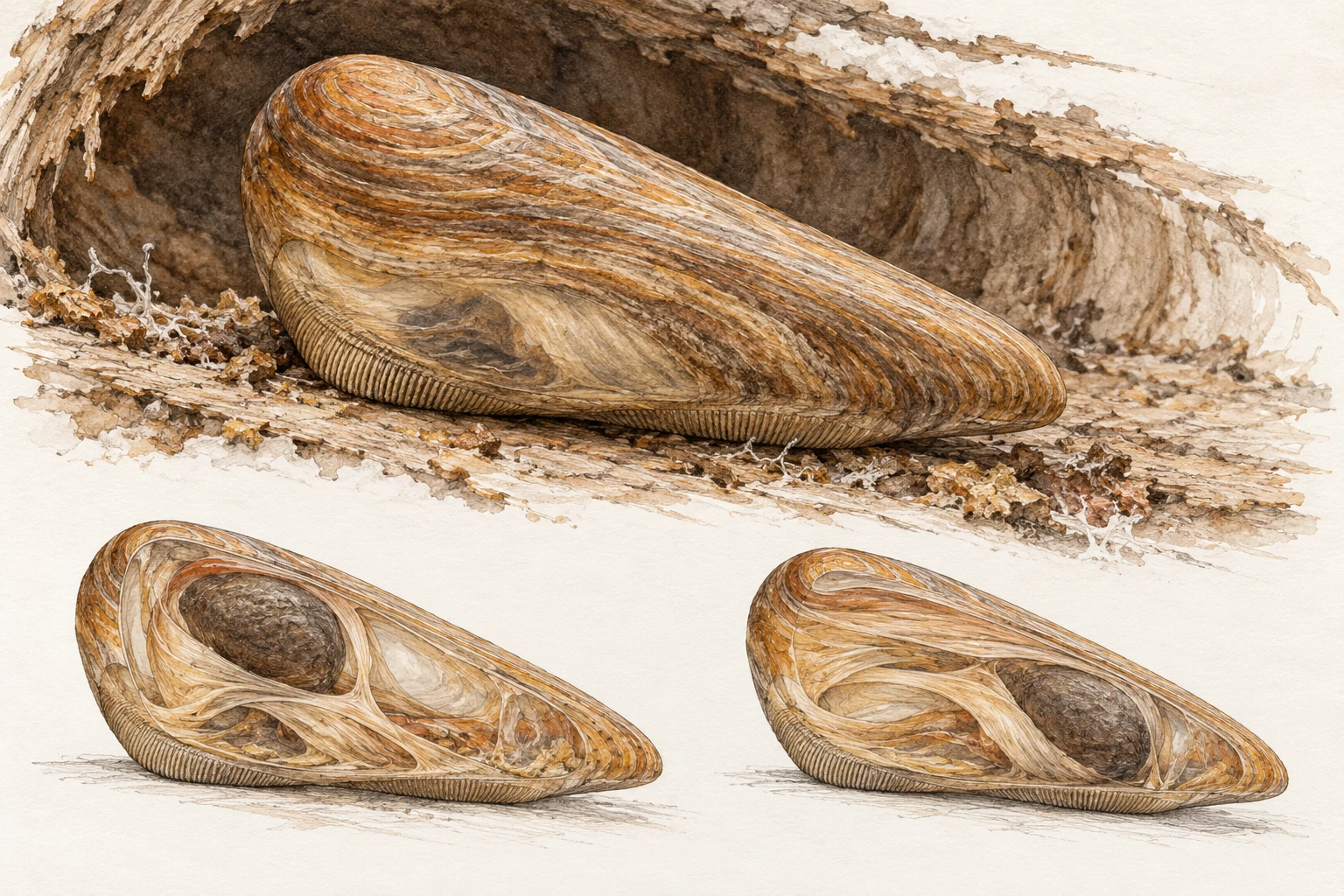
Echo ballast#
Sketch
The echo ballast maps dark wood passages by timing clicks reflected back to sensors throughout its stiff body. An internal weight shifts between elastic tissue slings, alternately loading and releasing friction bands underneath to produce slow crawling. A basal intake gathers fungal material and wood crumbs. Fluid channels carry digested nutrients, while folded breathing passages recover moisture before releasing air.
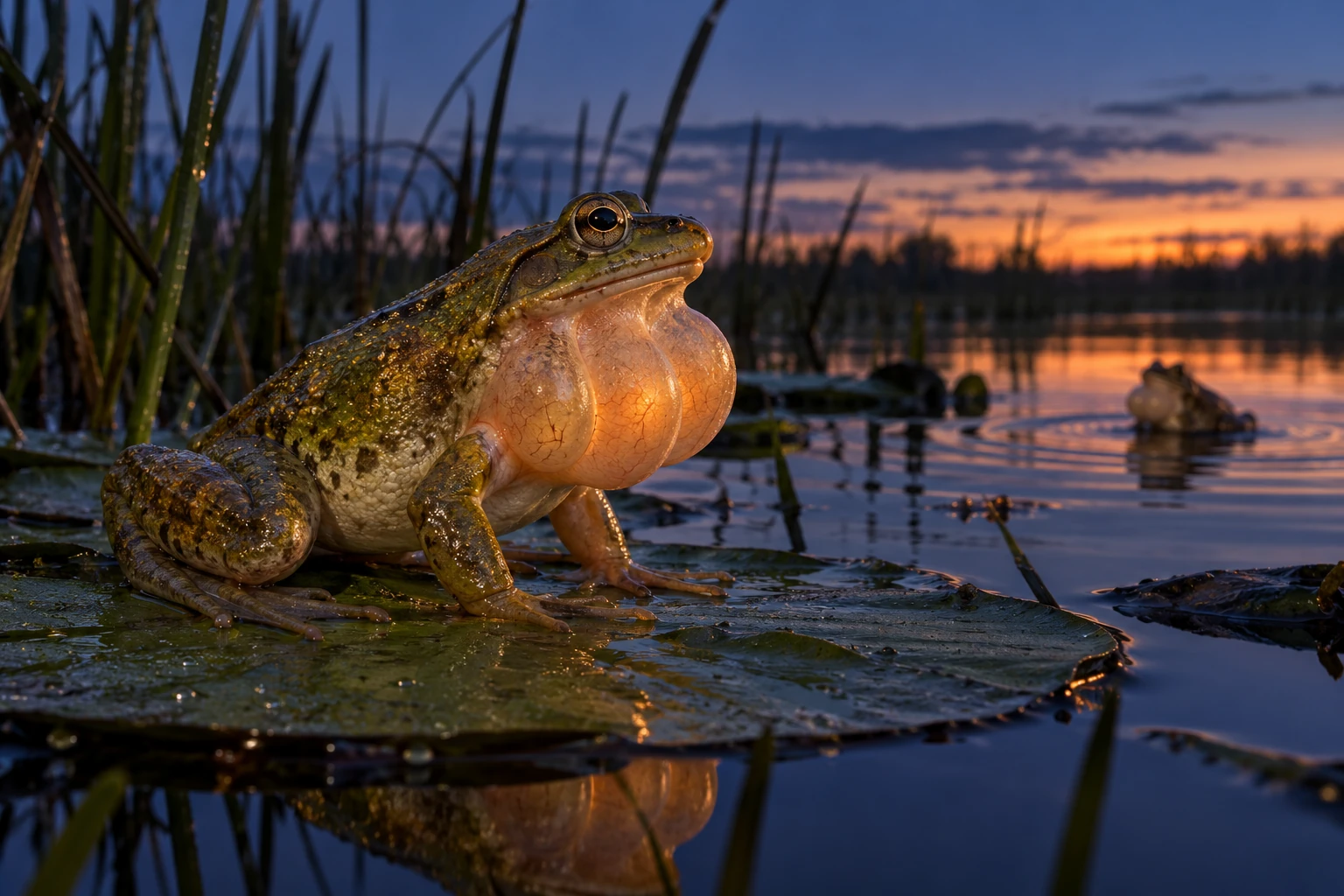
Marsh-bell frog#
Illustration
The marsh-bell frog shapes its calls with three connected throat resonators. Small muscles alter the chambers' tension and relative inflation, changing the timbre as air passes through the shared throat. Adults answer familiar neighbors with overlapping phrases, pausing to feel the water vibrations arriving through the leaves beneath their feet.
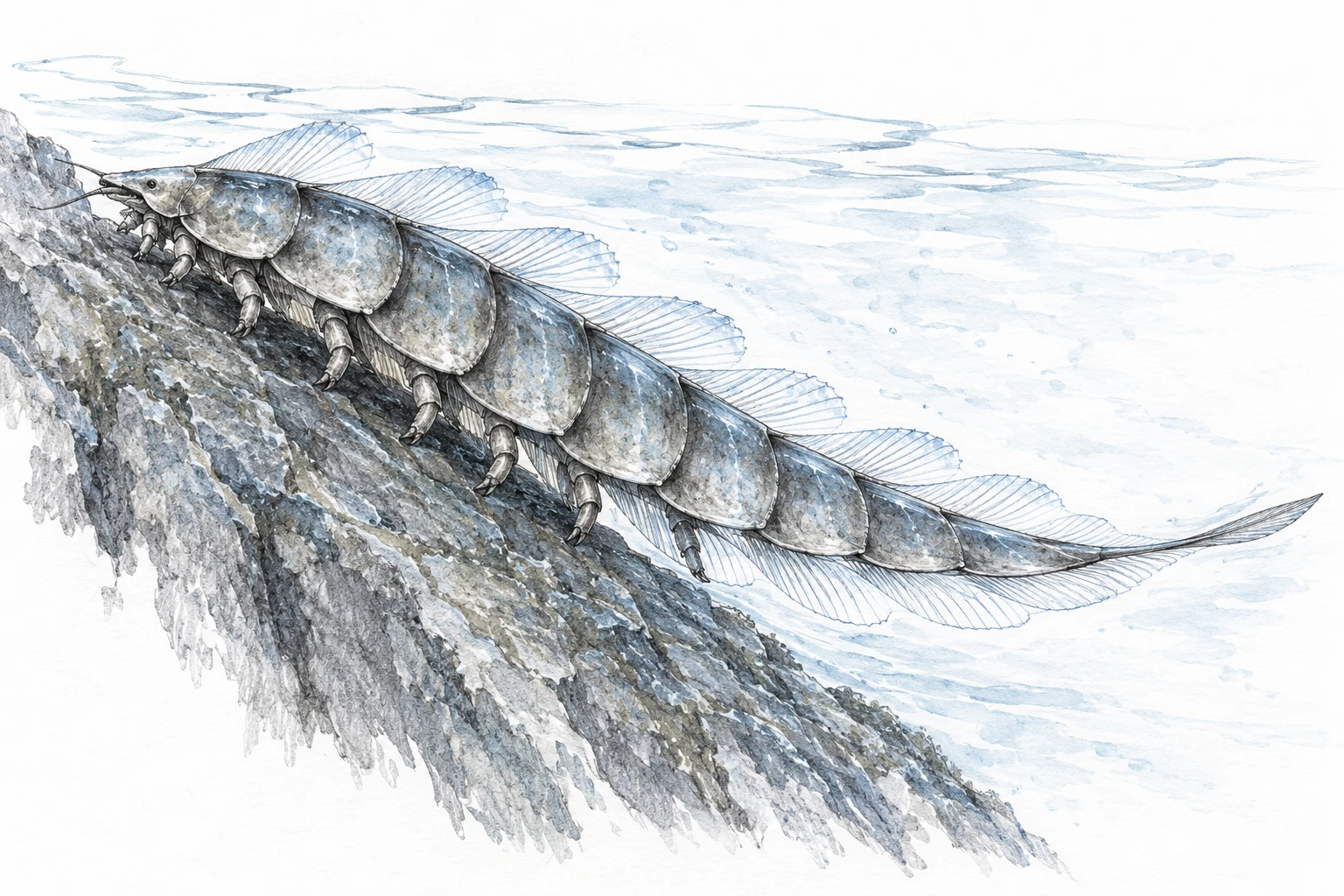
Tidal razor#
Sketch
Tidal razors graze microbial films along submerged rock edges. Short underside legs anchor the body while mouth brushes work across the surface. Paired fin fringes take over when the animal releases its grip, moving water along the articulated flanks. Flexible joints let the flattened body follow narrow contours and turn toward richer feeding patches in the tidal current.
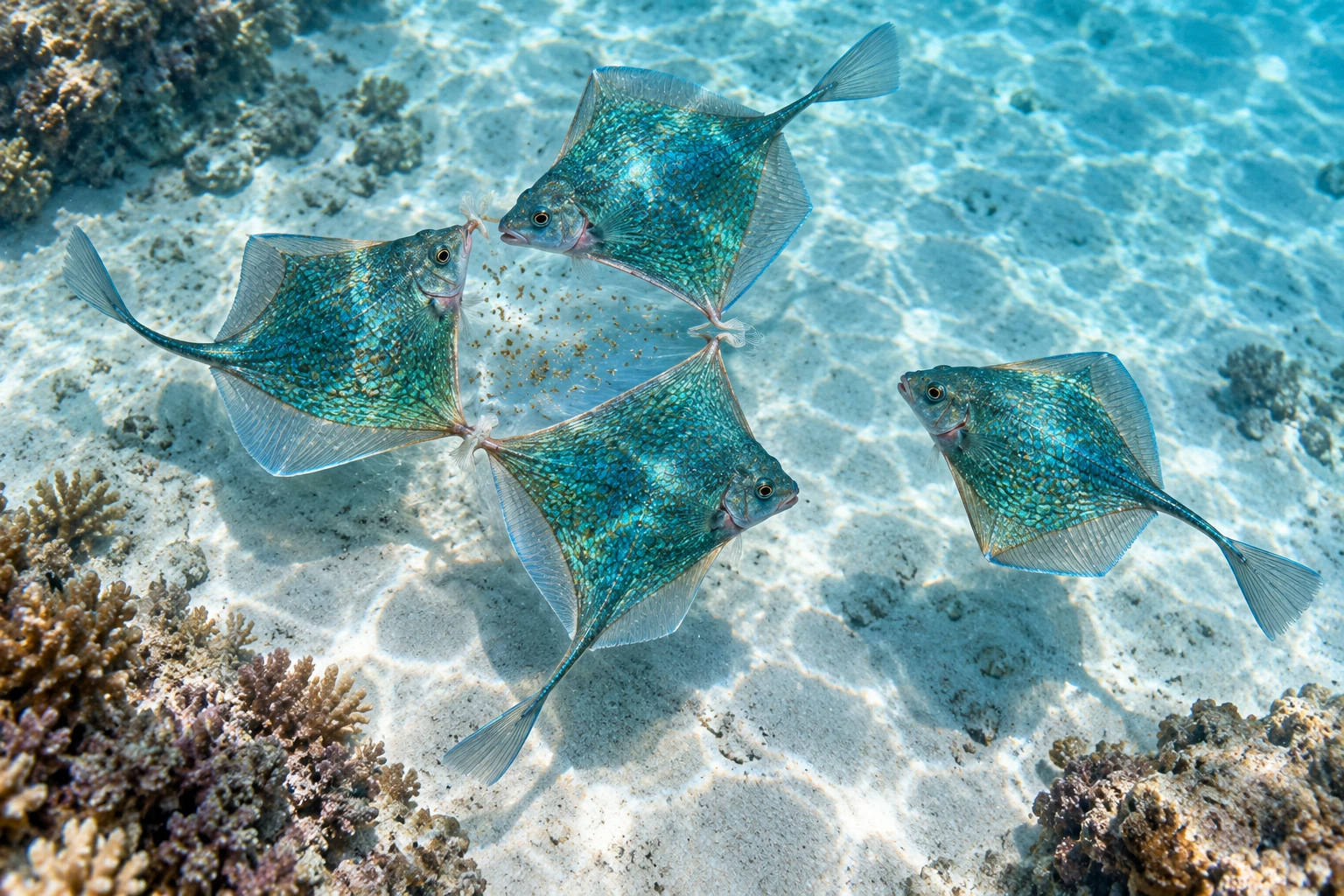
Tessellated shoalfin#
Illustration
Tessellated shoalfins briefly join soft hooks along their fin margins to hold a food-rich surface layer in a permeable feeding enclosure. Three adults form an open mosaic while a fourth approaches freely. Each fish keeps its own swimming axis and free tail; changing fin tension lets an individual release the group and choose another feeding position.
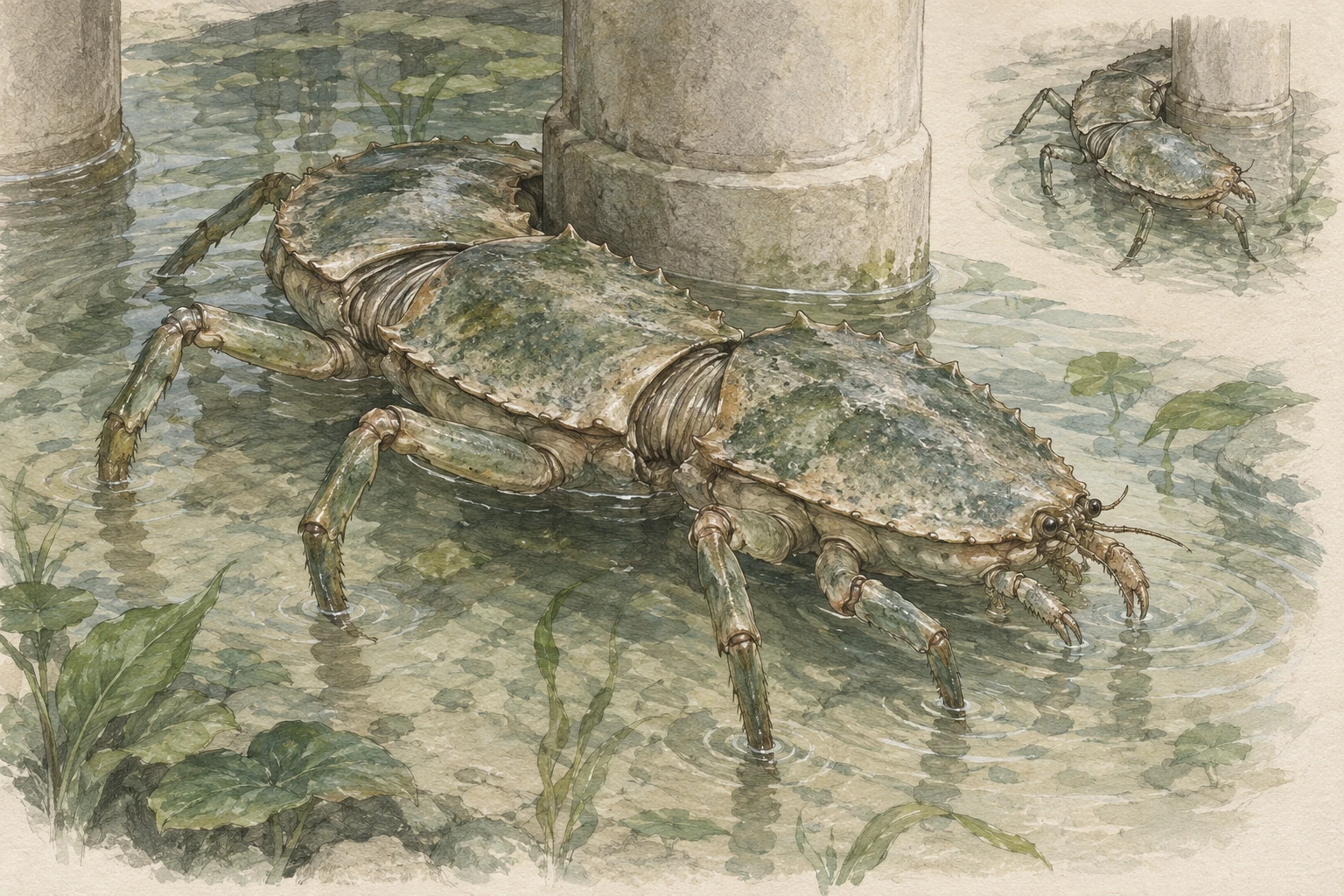
Courtyard hinge-crab#
Sketch
A courtyard hinge-crab bends its three overlapping shell sections around a pool support while choosing a resting bay. Four walking-leg pairs spread its weight across the submerged floor, and smaller front claws handle food. Flexible hinge tissue joins the armored sections above a continuous abdomen. Pumped gills remain wetted as the seventy-centimeter adult settles among the plants.
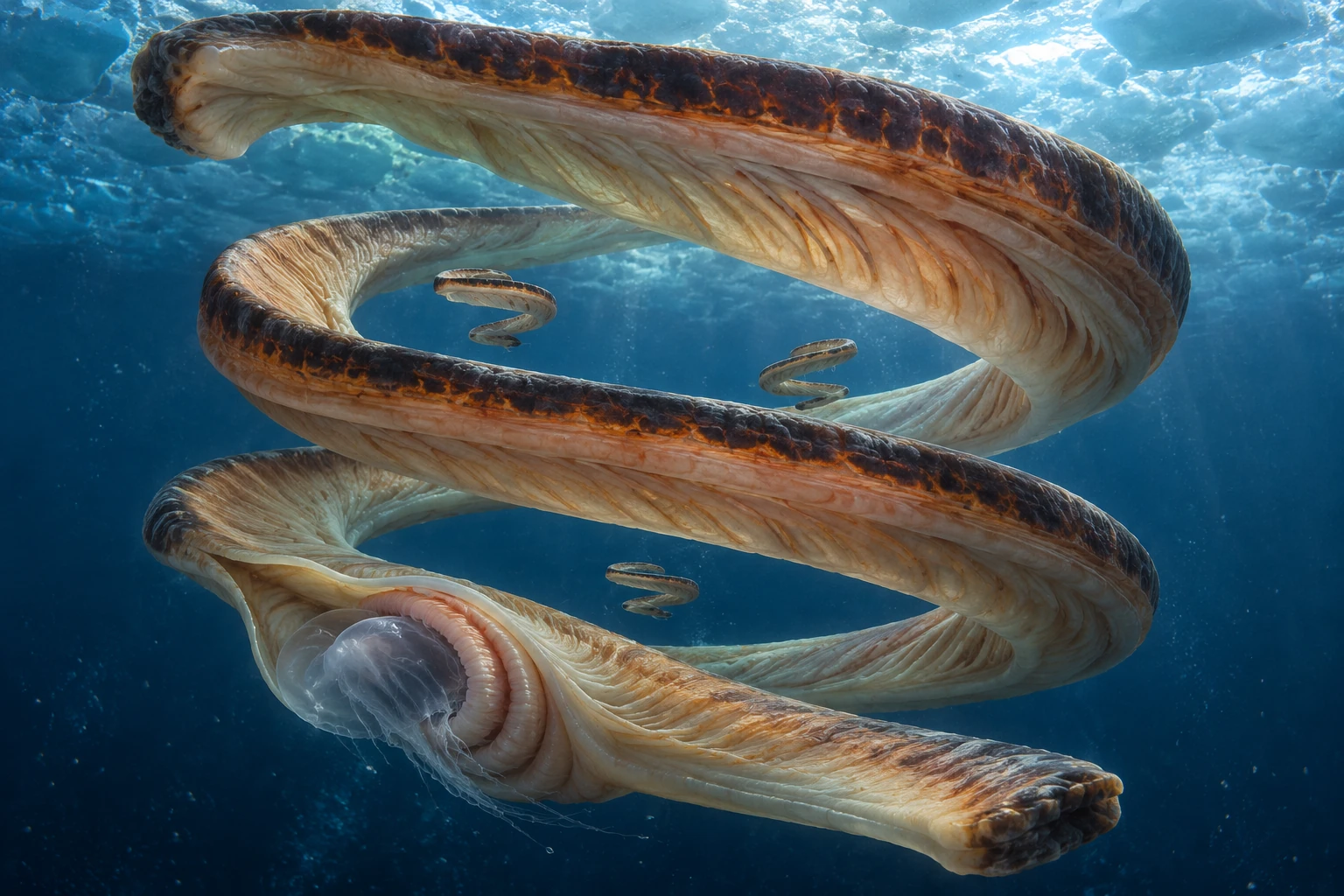
Winter helix#
Illustration
A winter helix swims by twisting successive turns of its muscular ribbon. Protected respiratory grooves supply oxygen to circulating fluid, while a thick outer edge conserves heat beneath the sea ice. The lower inner fold closes around gelatinous prey and holds it during digestion. Young helices shelter inside the adult's open turns, leaving briefly to intercept scraps before returning to cover.
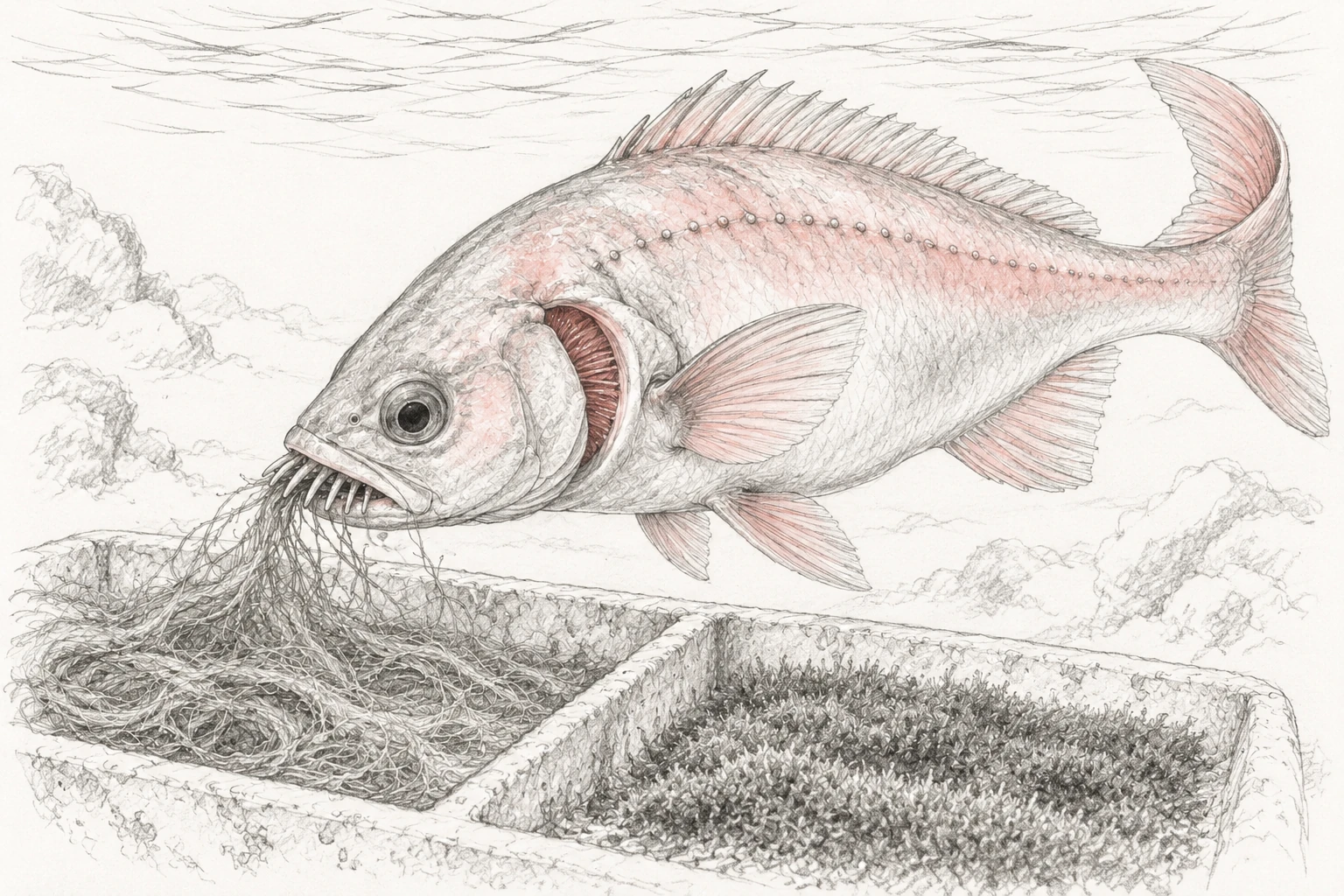
Brine combfish#
Sketch
A brine combfish draws filamentous algae through a rooted jaw comb while strong gill pumps keep water moving across its respiratory surfaces. Small flank pores expel excess salt, and a protective mucus layer buffers the skin. The submerged nursery tray offers contrasting algae textures, allowing the fish to choose its preferred patch and feeding pace.
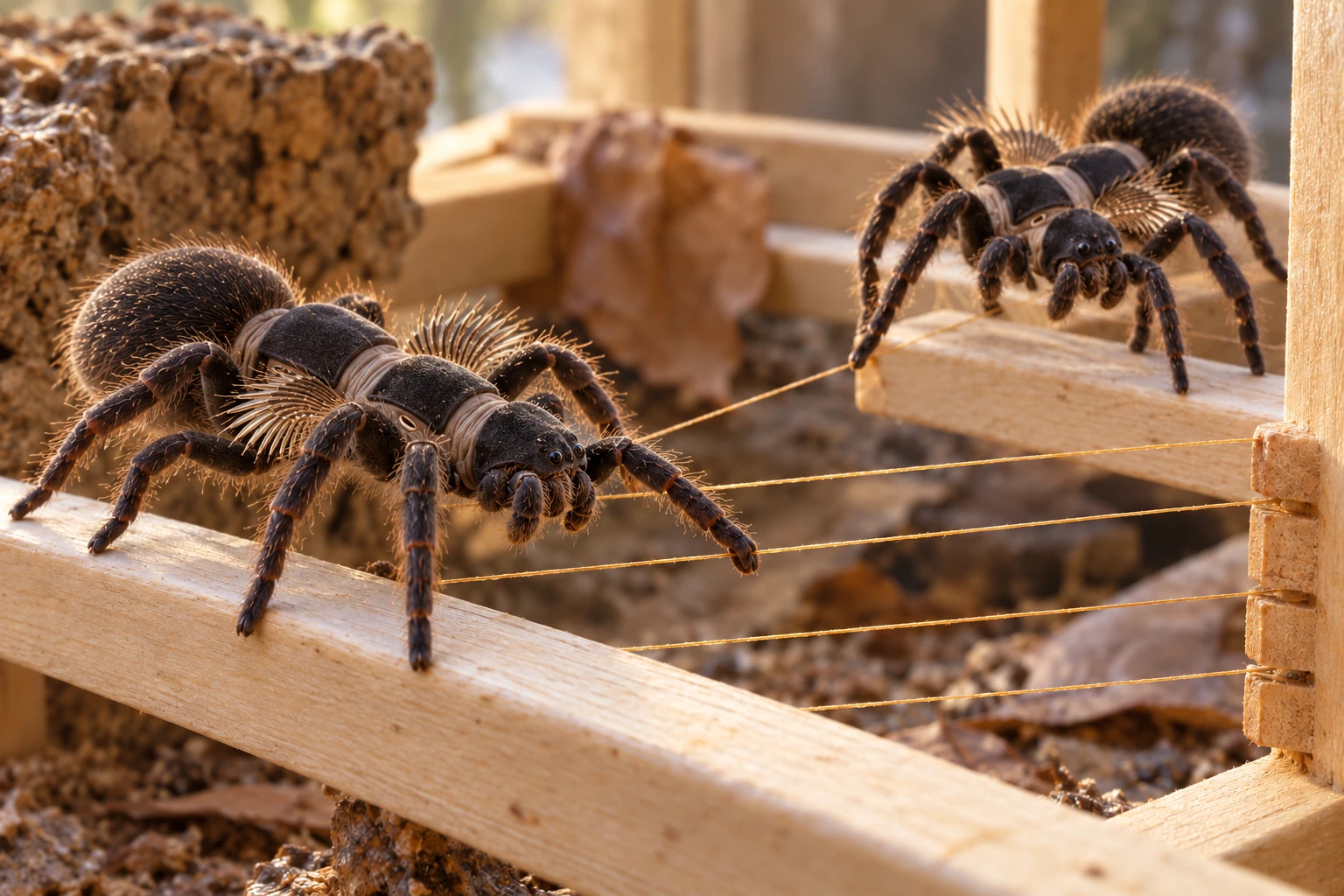
Velvet hinge-spider#
Illustration
Velvet hinge-spiders exchange learned vibration patterns through a fiber lattice. Three velvet-covered prosomal plates flex at pale skin hinges, distributing eight walking legs along the low body. Paired sensory combs read local movement while the feet distinguish a partner’s timing. The abdominal silk reservoirs let each animal retension strands between turns, keeping several feet braced on the wooden frame.
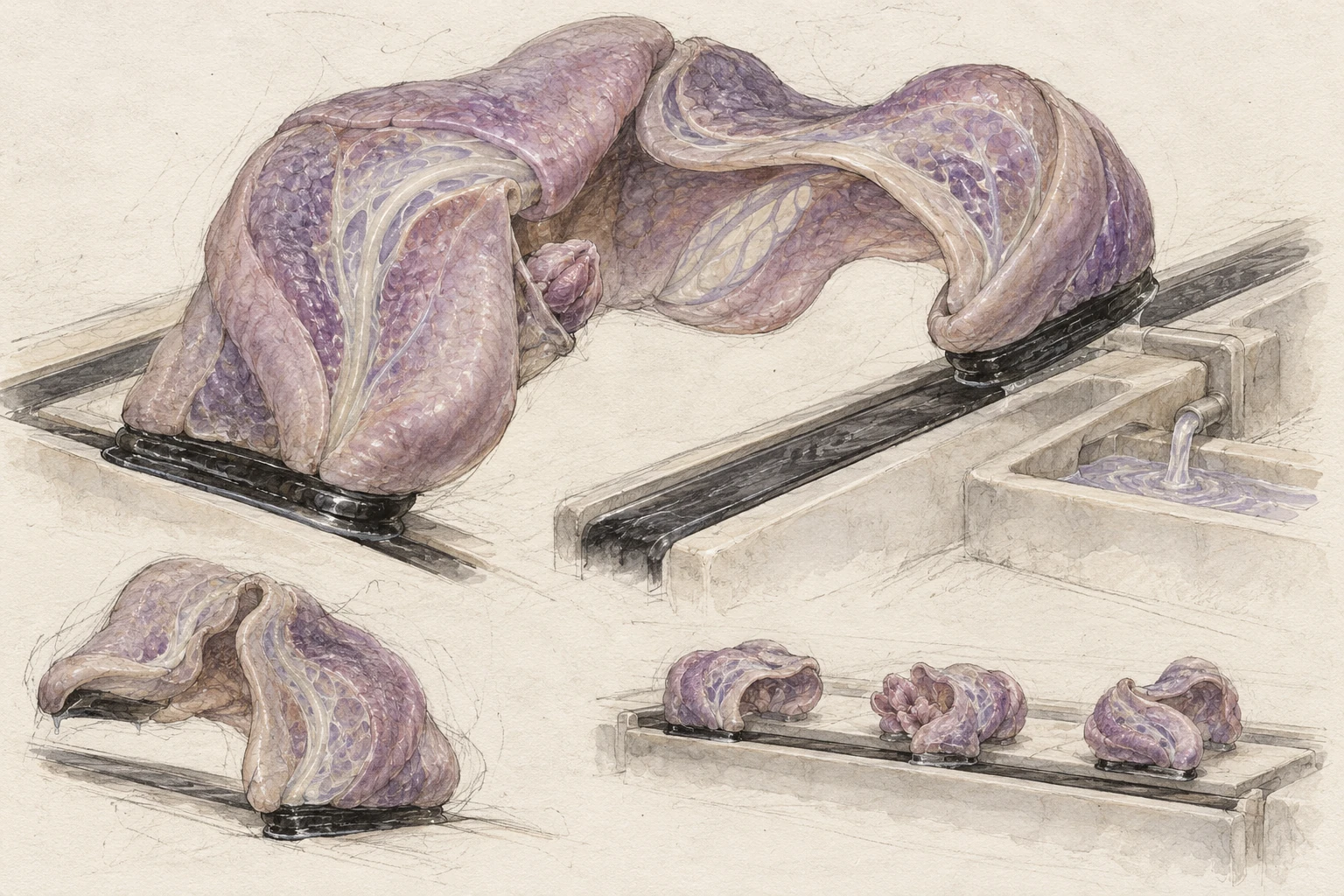
Rail grafter#
Sketch
The rail grafter draws power through two separated contact bands on its habitat rails. Its folded living panels turn that electricity into chemical stores, using supplied carbon dioxide, water and minerals to build tissue. Broad adhesive edges move it between feeding and nursery positions. Stored fuel pays for each brief loss of contact; young cuffs begin life on their own powered nursery tracks.
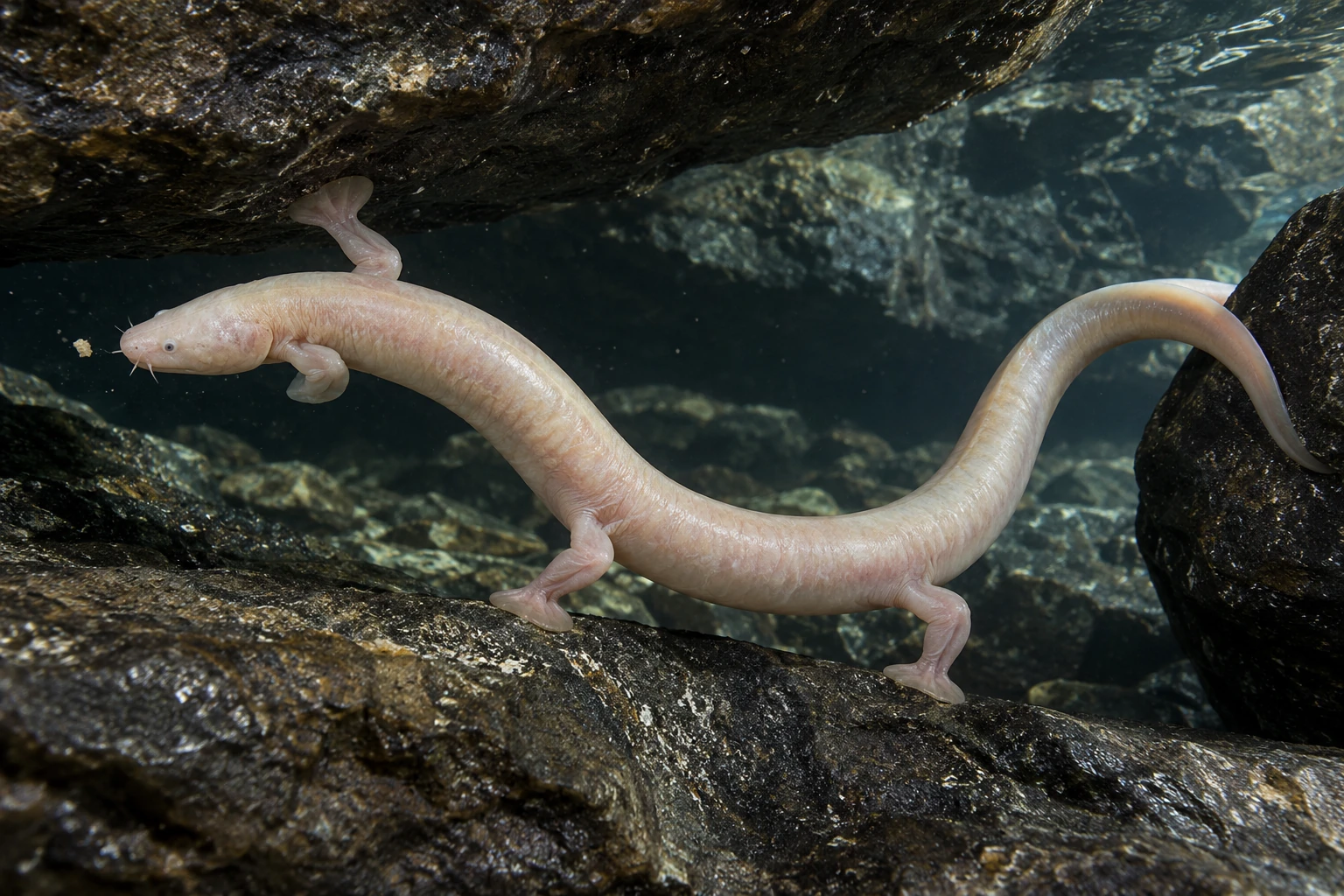
Tunnelcoil fish#
Illustration
A tunnelcoil fish holds station in flowing cave water by bracing fleshy fins against opposite rock surfaces and curving its tail around a support. Distributed electroreception helps it judge nearby walls before shifting a contact. This adult turns toward a drifting morsel, keeping its long trunk supported while it investigates the current.
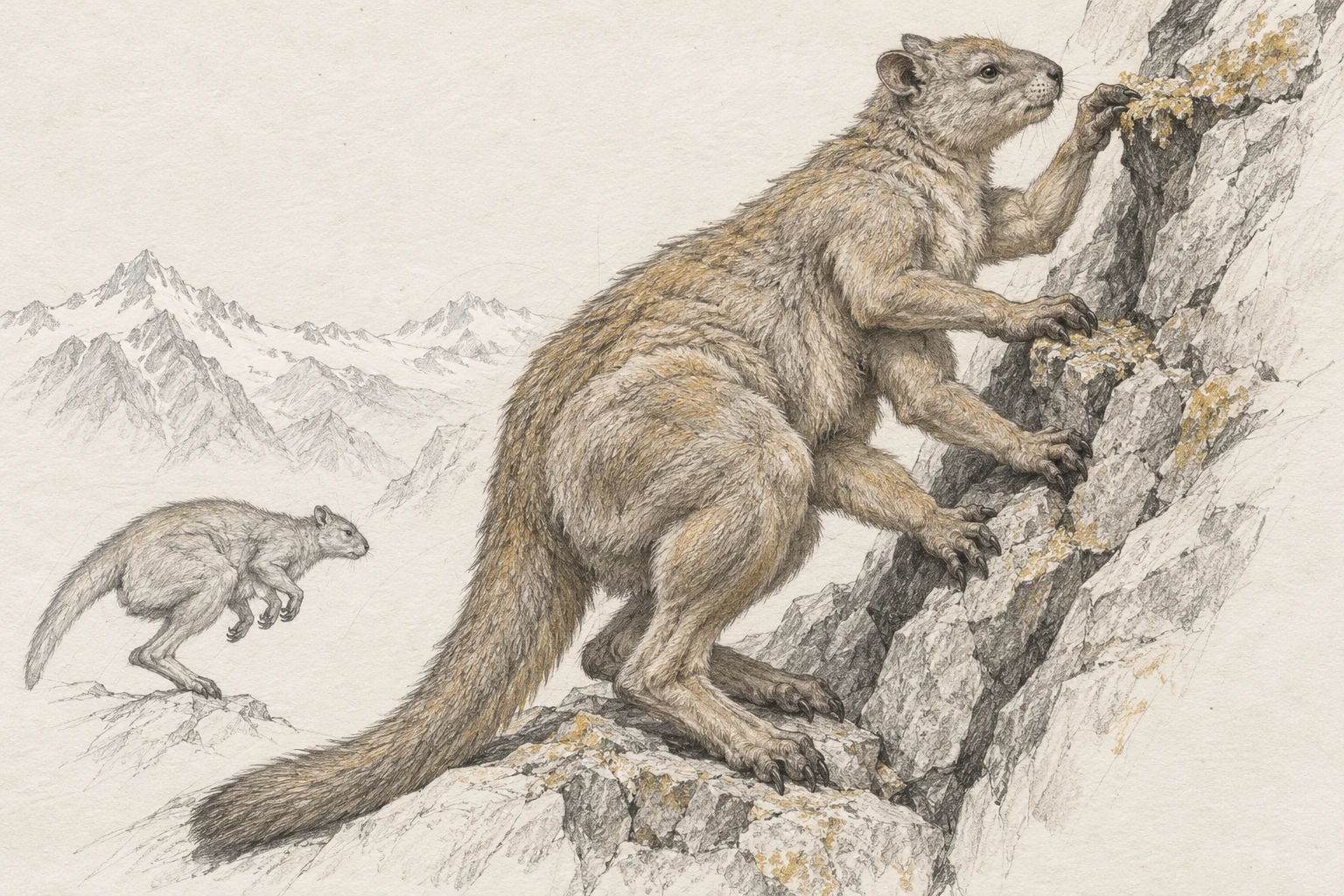
Switchback hopper#
Sketch
Switchback hoppers cross alpine faces in short controlled leaps. Two powerful hind legs and a deep pelvis supply the push, while a broad tail steadies landing. Four shorter forearms anchor the extended chest between jumps. An adult keeps three hands on secure rock contacts while the fourth tests a lichen patch, practicing a favored route through the cliff.
Ice-window shrimp#
Illustration
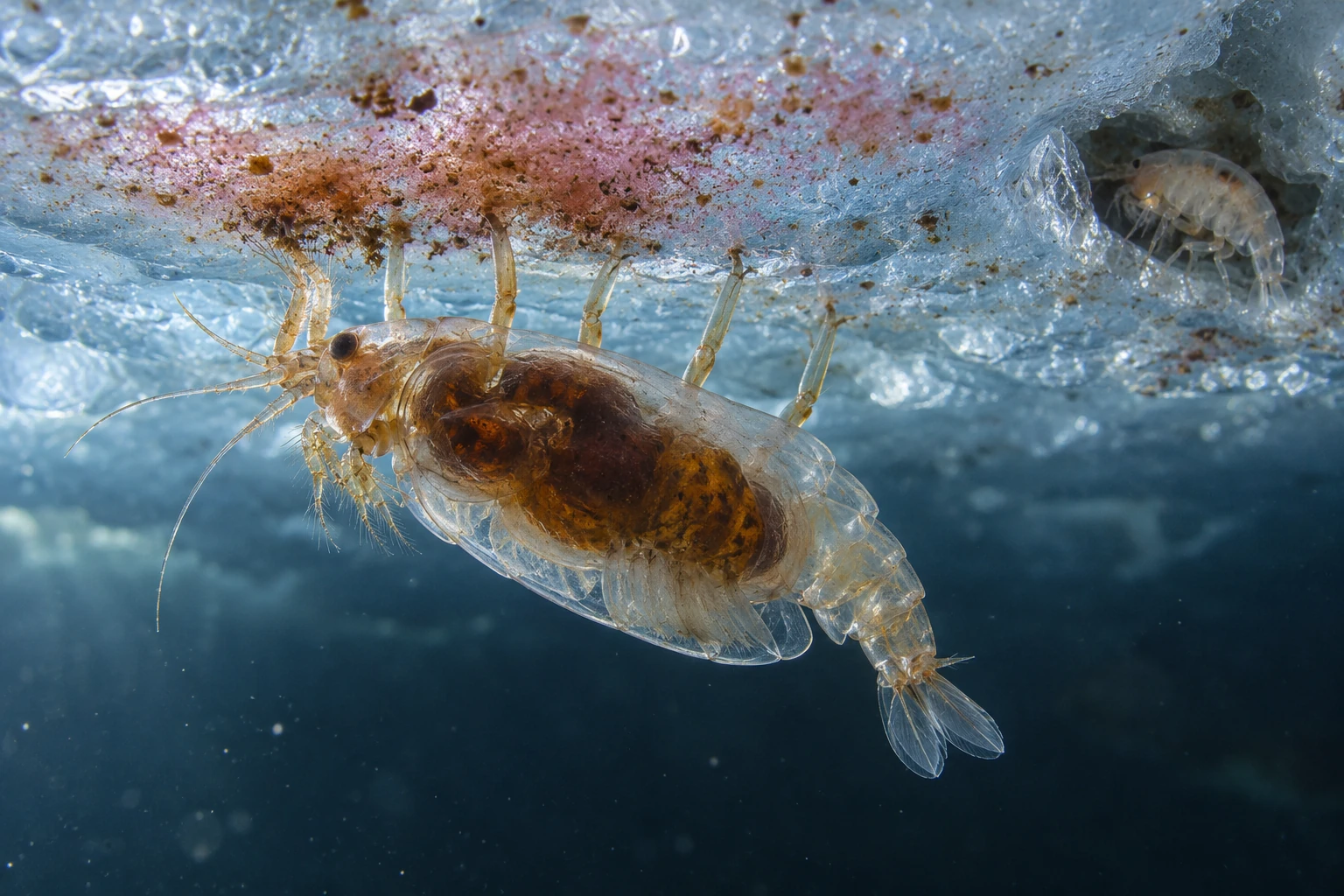
An ice-window shrimp grazes algae beneath sea ice while a pale, recently molted companion shelters in a nearby crease. Its clear peripheral shield surrounds a compact opaque organ core, leaving space for water to pass over protected gills. Gripping legs hold the ice as fine feeding brushes gather food. Lipid reserves and antifreeze proteins support the two-centimeter animal through winter.
Joinery bowerbird#
Sketch
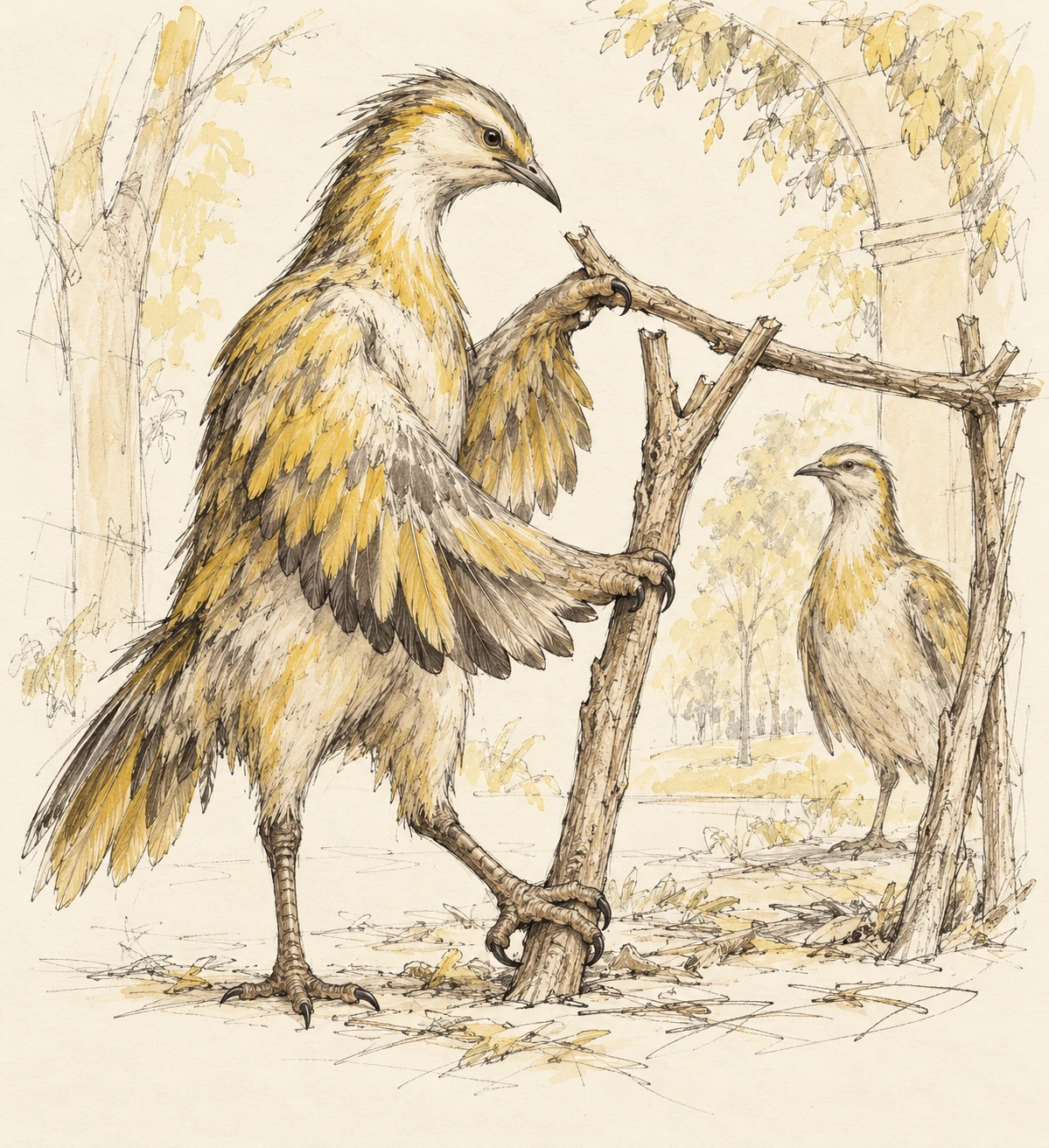
Joinery bowerbirds use clawed wing wrists to hold forked branches while their feet brace the growing nest frame. The flightless chest supports prolonged manipulation, and the remaining feather fans carry close social signals. Here a builder fits a simple supported joint while its partner waits by the opening, ready to test the passage.
Grove vault#
Illustration
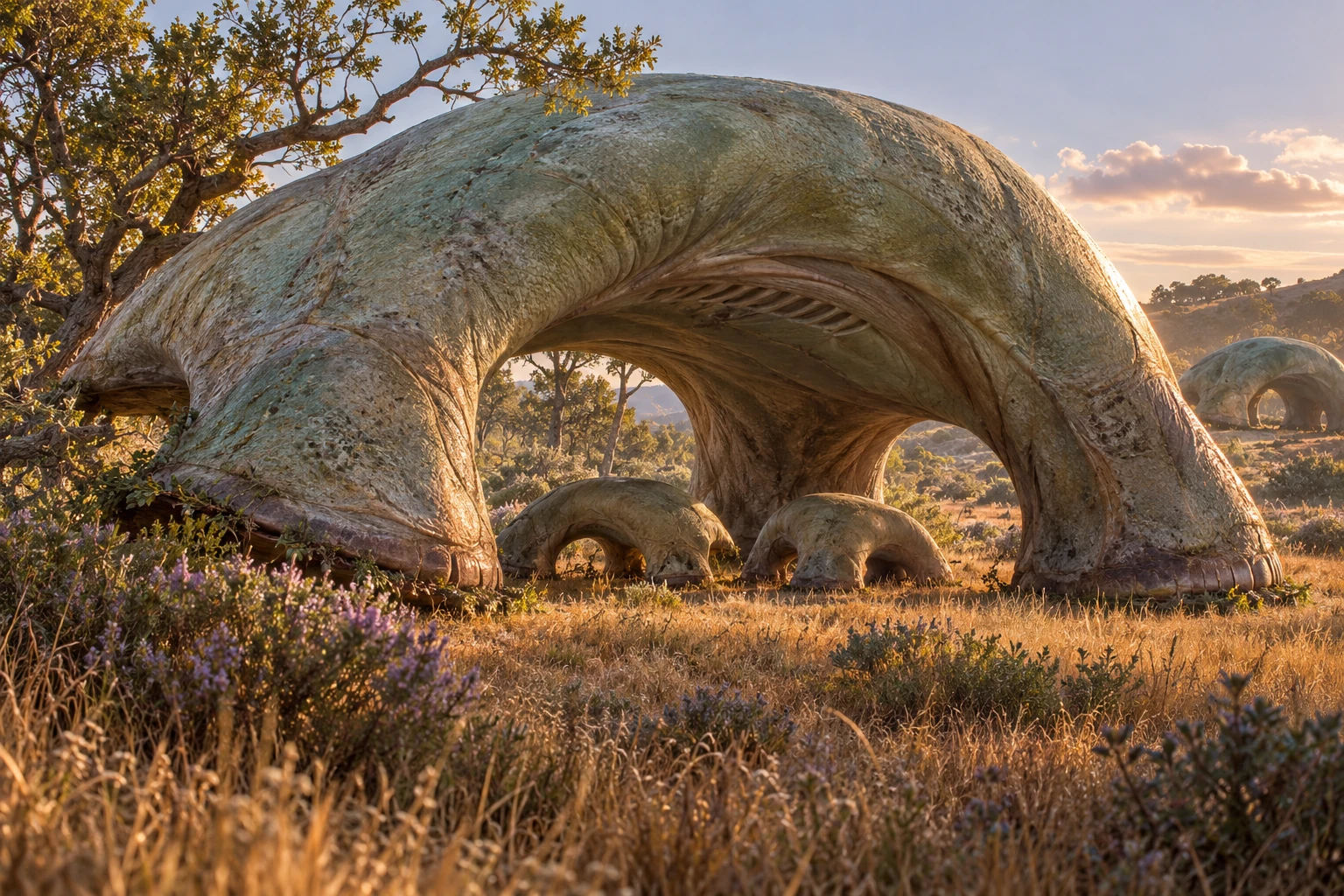
A grove vault clips grass and low branches along the rims of its arches. Food enters an enclosed fermentation channel within the thick roof, while circulation carries nutrients through its broad supporting walls. The whole body advances as one wall shortens and another extends its ground contact. Small vaults browse in the open shade below, and adults adjust their stance to keep that shelter over them.
Cabletail scorpion#
Sketch
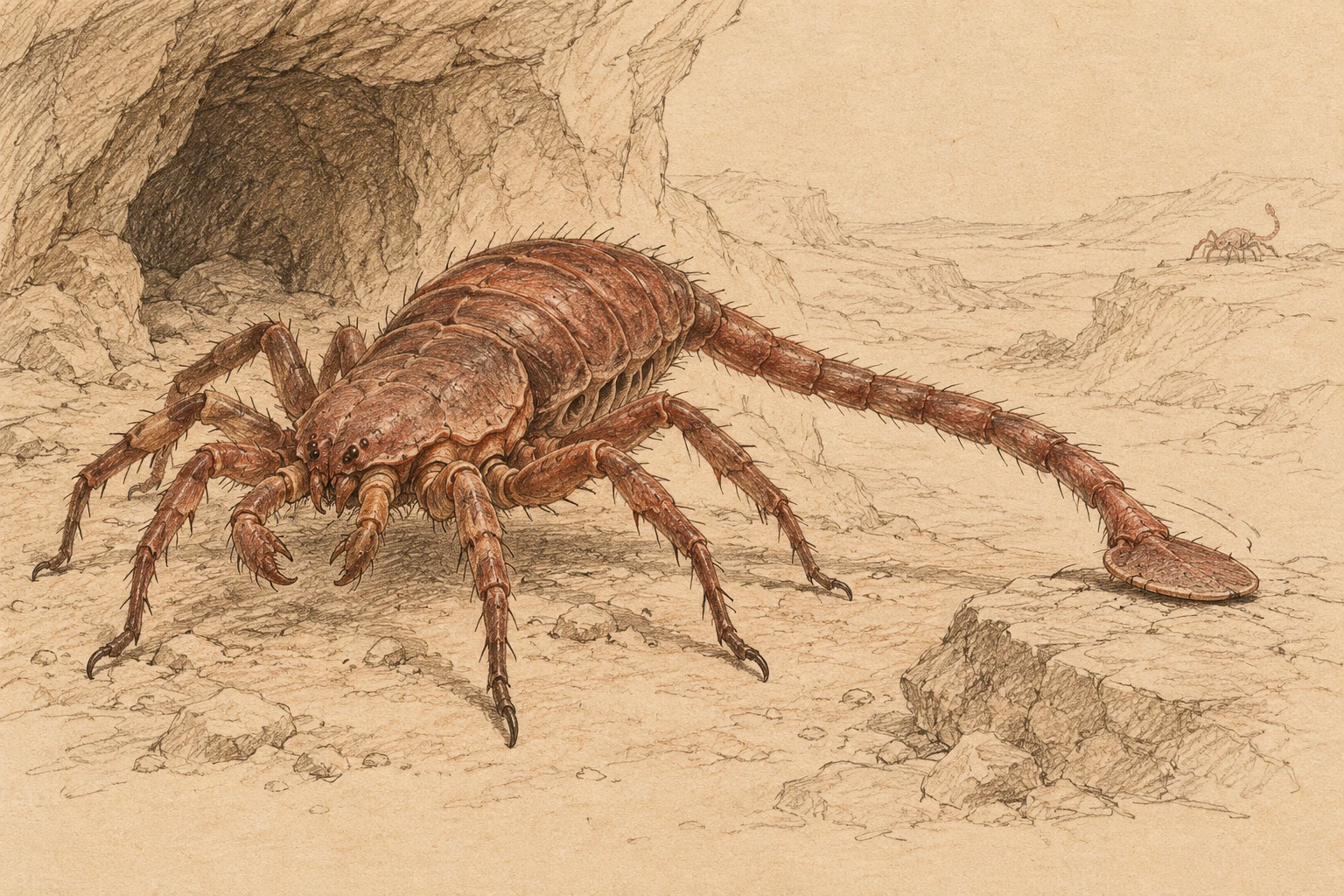
A cabletail scorpion presses its broad terminal pad against a stone after tapping a short sequence. Receptors in its tail and feet compare the arrival times of returning substrate vibrations, helping it locate a partner beyond the cave mouth. Its jointed tail carries the signal into the rock, while protected book-lung chambers conserve water during the long waits between exchanges.
Vaultback host#
Illustration
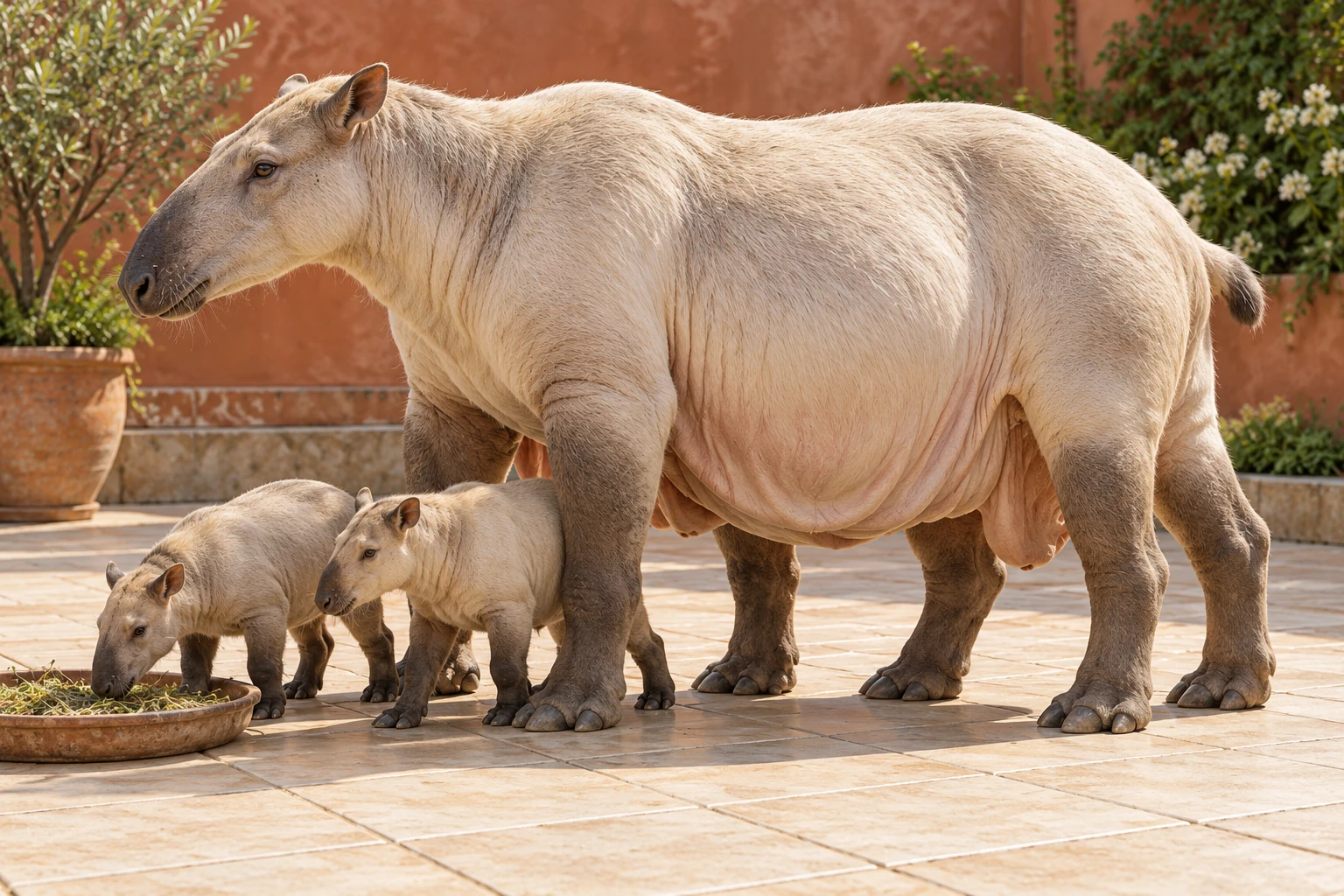
Vaultback hosts stand over their young while the juveniles choose when to leave the shelter. Three pairs of legs support a raised trunk whose insulated flank folds gather close during walking. Blood flow through the folds warms the protected space beneath the abdomen. A large fermenting gut supplies heat as the family feeds on fibrous courtyard forage.
Tandemwing threader#
Sketch
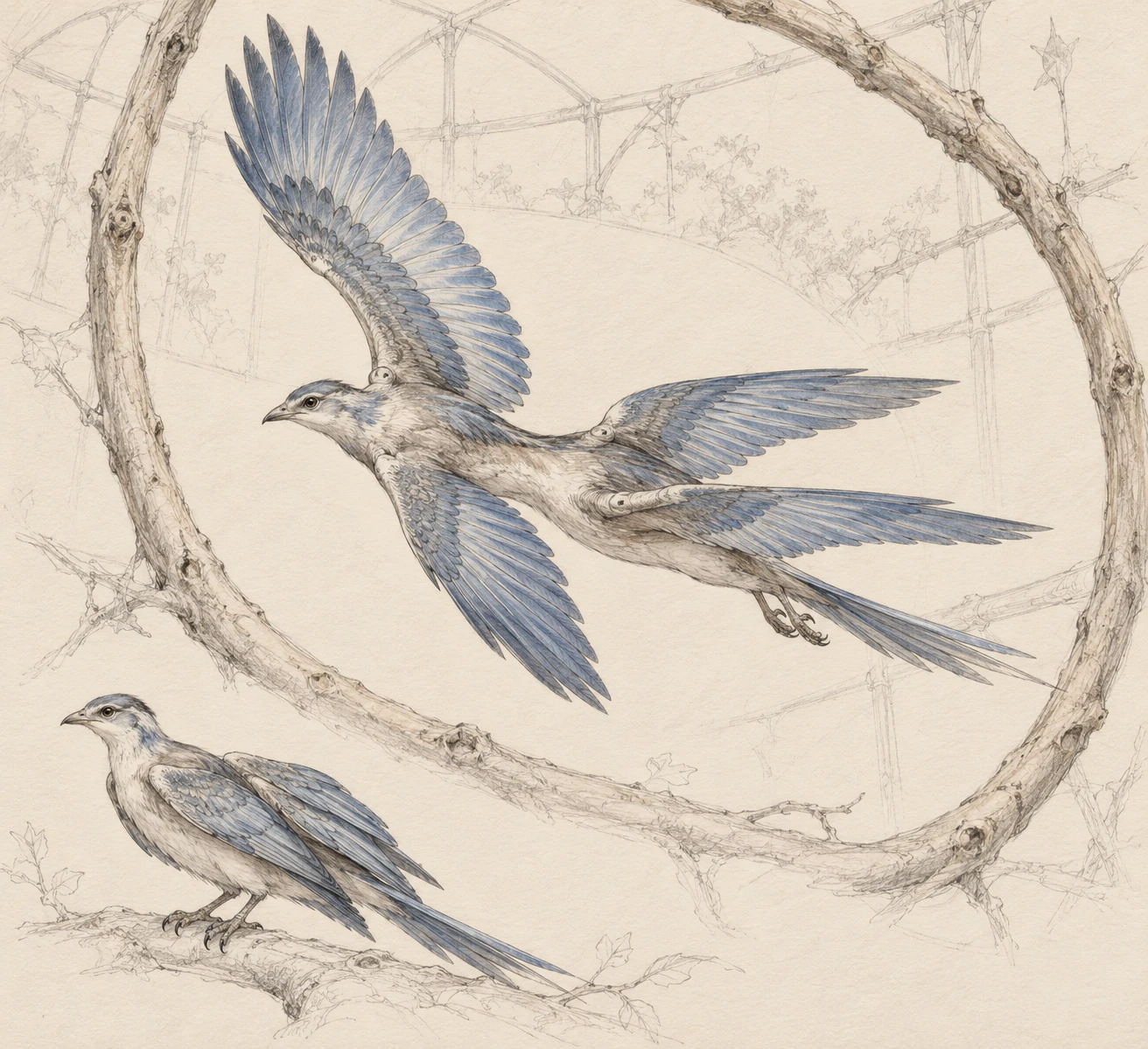
A tandemwing threader practices a curved passage through a broad branch hoop in its flight habitat. Separate chest girdles carry the forward and rear wing pairs, allowing their strokes to be timed independently. The narrow tail counters turning torque while the bird learns a comfortable line; a perched study shows how the wings fold between flights.
Turncase#
Illustration
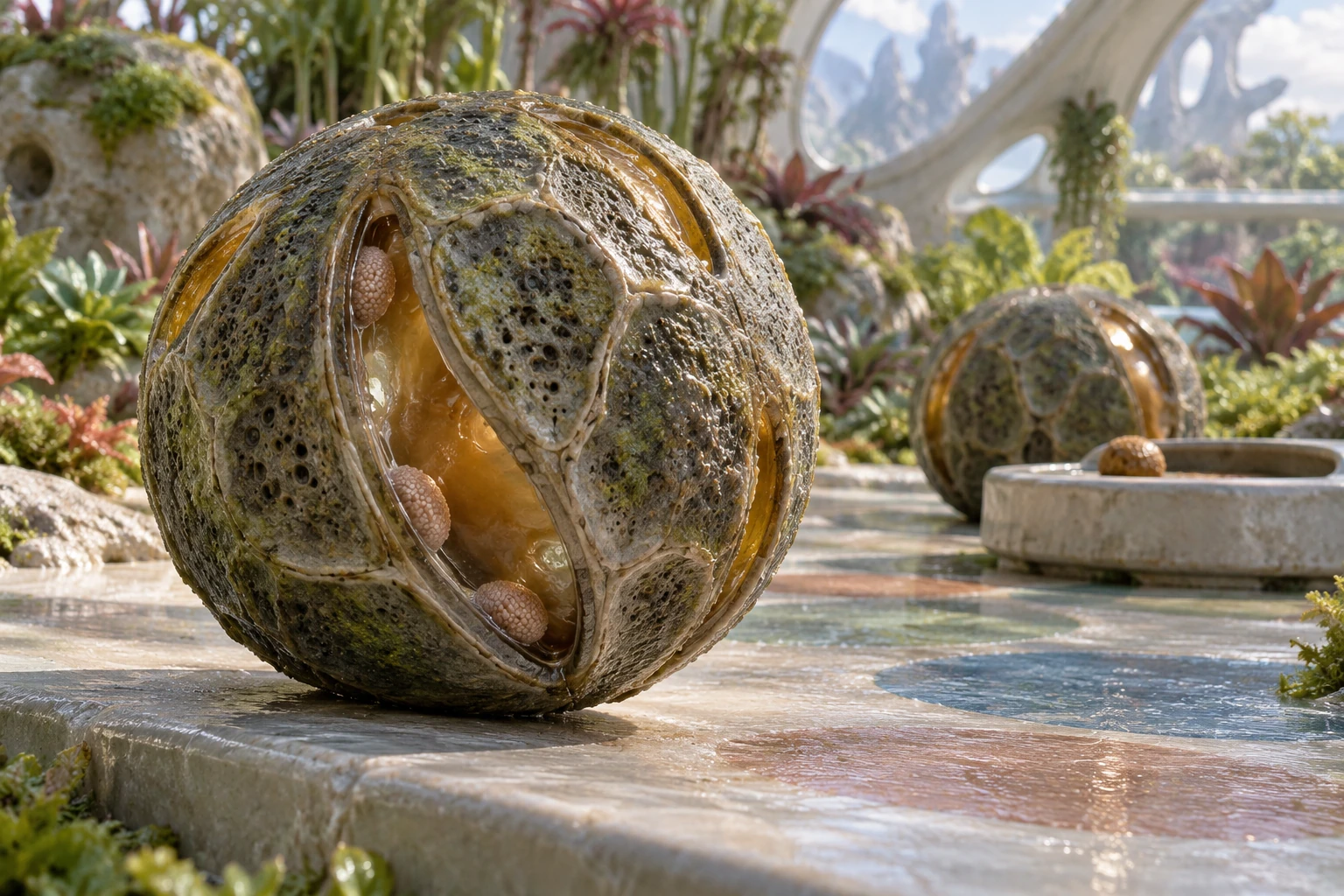
A turncase rolls its living outer case around a softer inner body. Small gripping pads supply the turning force, and a sealed nutrient bath feeds the rotating case across its lubricated bearing. Chemical and tactile signals pass between the layers. In this low-gravity nursery, trained adults follow colored floor patches toward pellet trays, waiting at a familiar signal before taking their turn.
Doorway cirriped#
Sketch
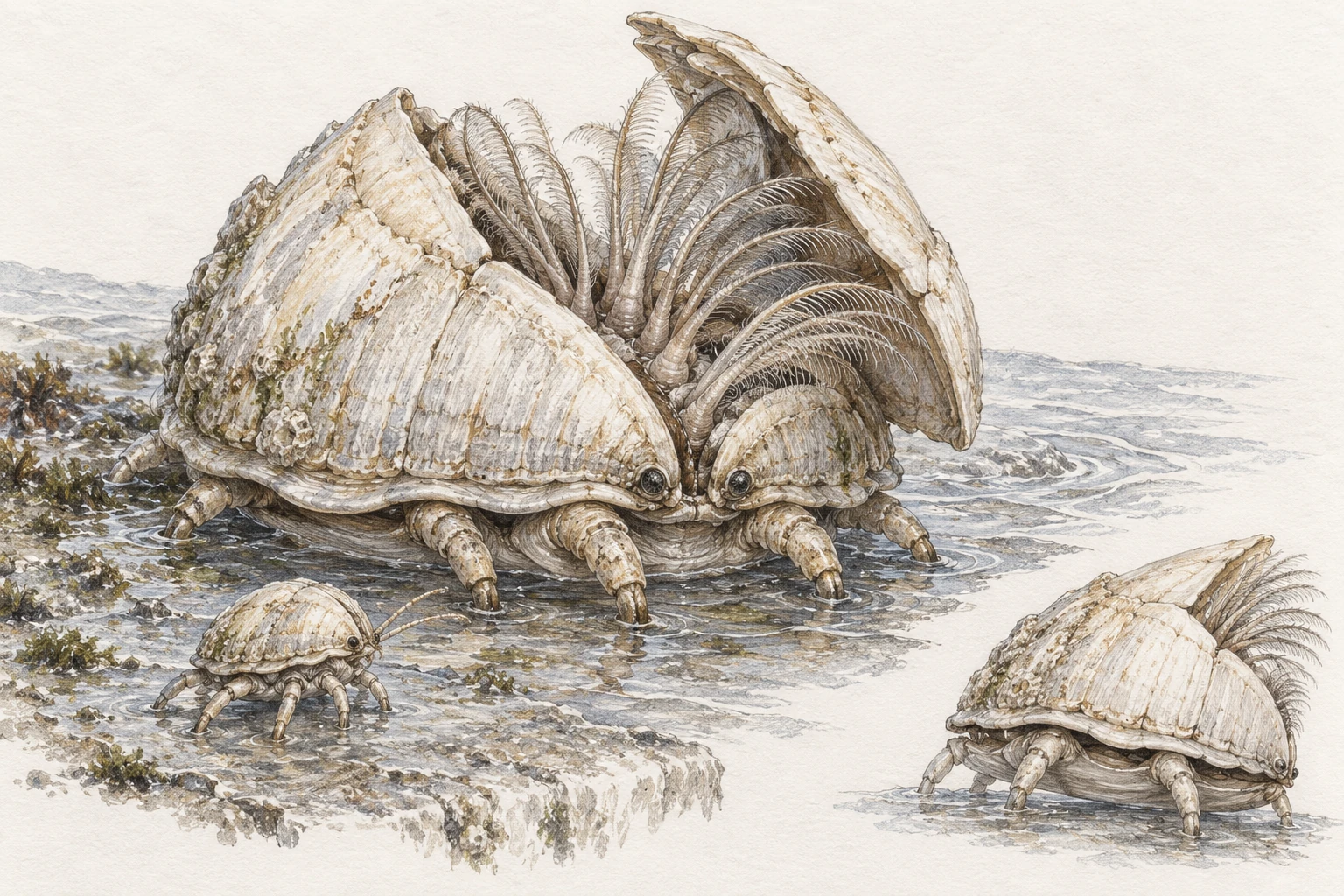
A doorway cirriped opens its paired shell doors to extend muscular filtering cirri into the tide. Six short basal legs let the adult release its attachment and move a little along the ledge before settling again. The approaching juvenile uses the same jointed limb plan beneath a small shield. Growth enlarges the protective doors while preserving this ability to reposition.
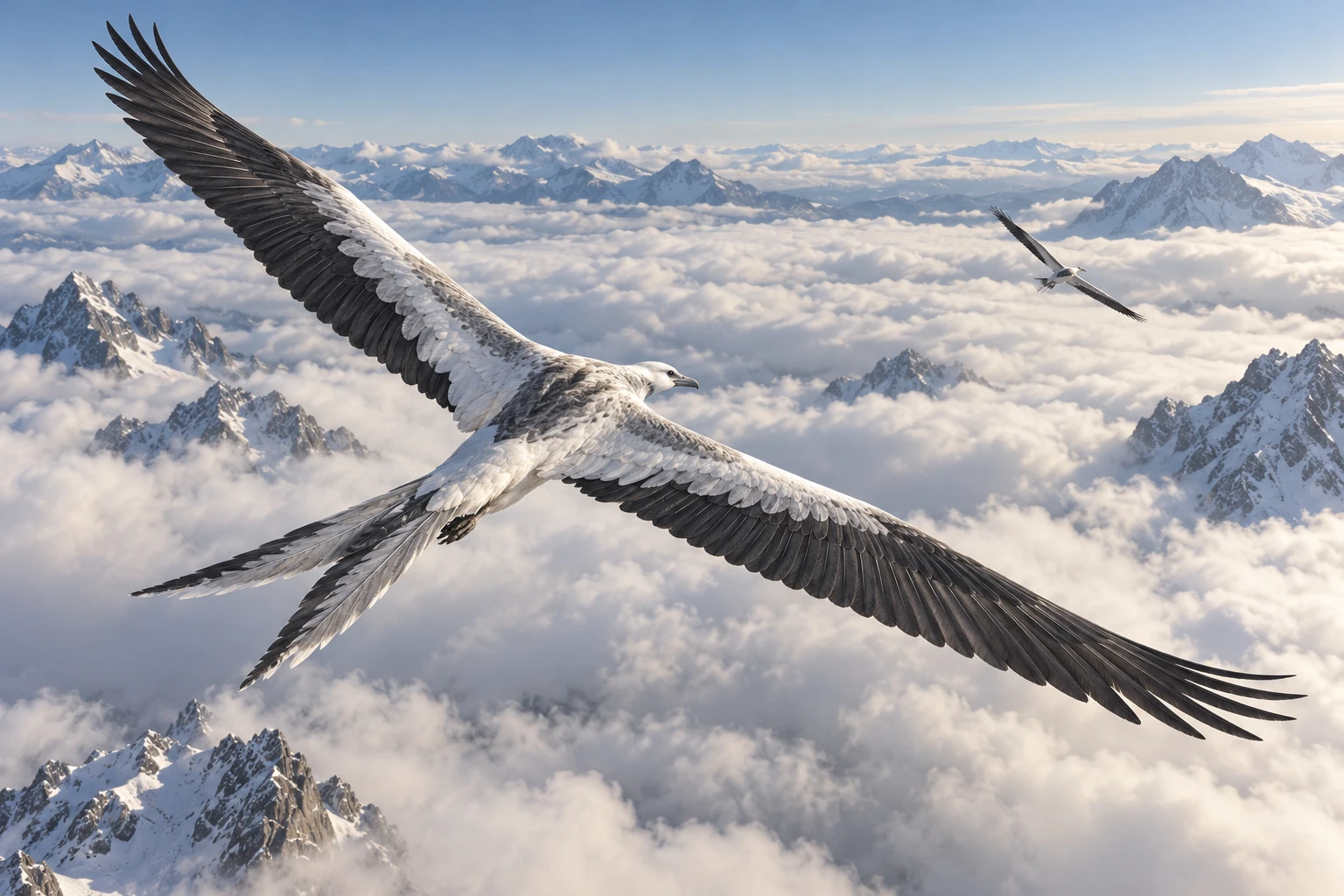
Skyweft skimmer#
Illustration
Skyweft skimmers circle alpine thermals on long feathered wings, adjusting small regions of camber as rising air shifts. Their light chest encloses large air sacs and efficient lungs that sustain high-altitude flight. The nearer bird matches a partner's bank above the cloud sea before they separate into neighboring air lanes, maintaining contact across a broad foraging range.
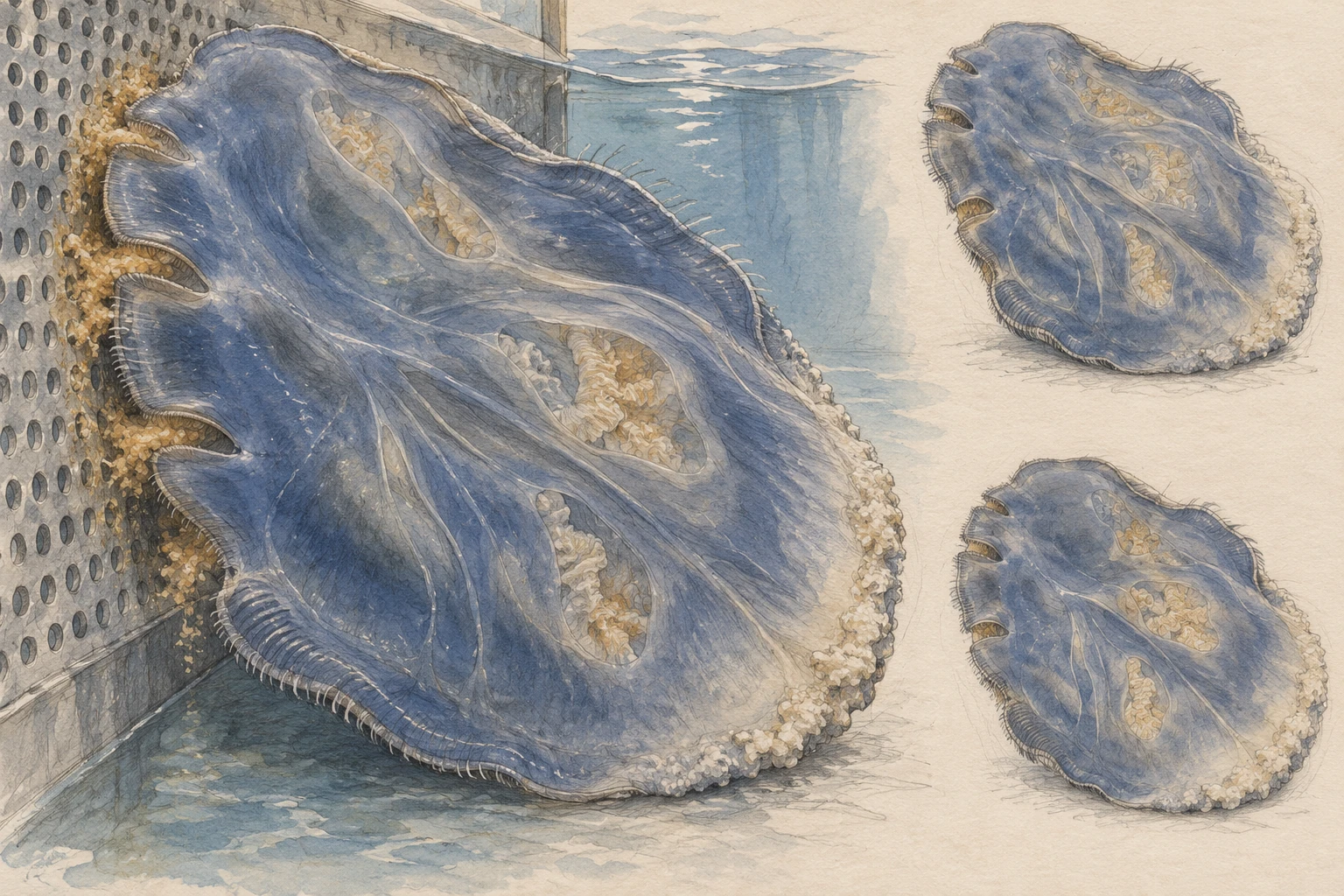
Organ drift#
Sketch
The organ drift redistributes its working tissues as feeding and repair demands change. Small folded packets travel through circulating gel along contractile tracks, gathering beside food slits or a scuffed margin. Respiratory folds in its broad thin wall keep transport distances short. These successive studies show the same animal rearranging its internal packets before moving toward a blue-lit resting station.
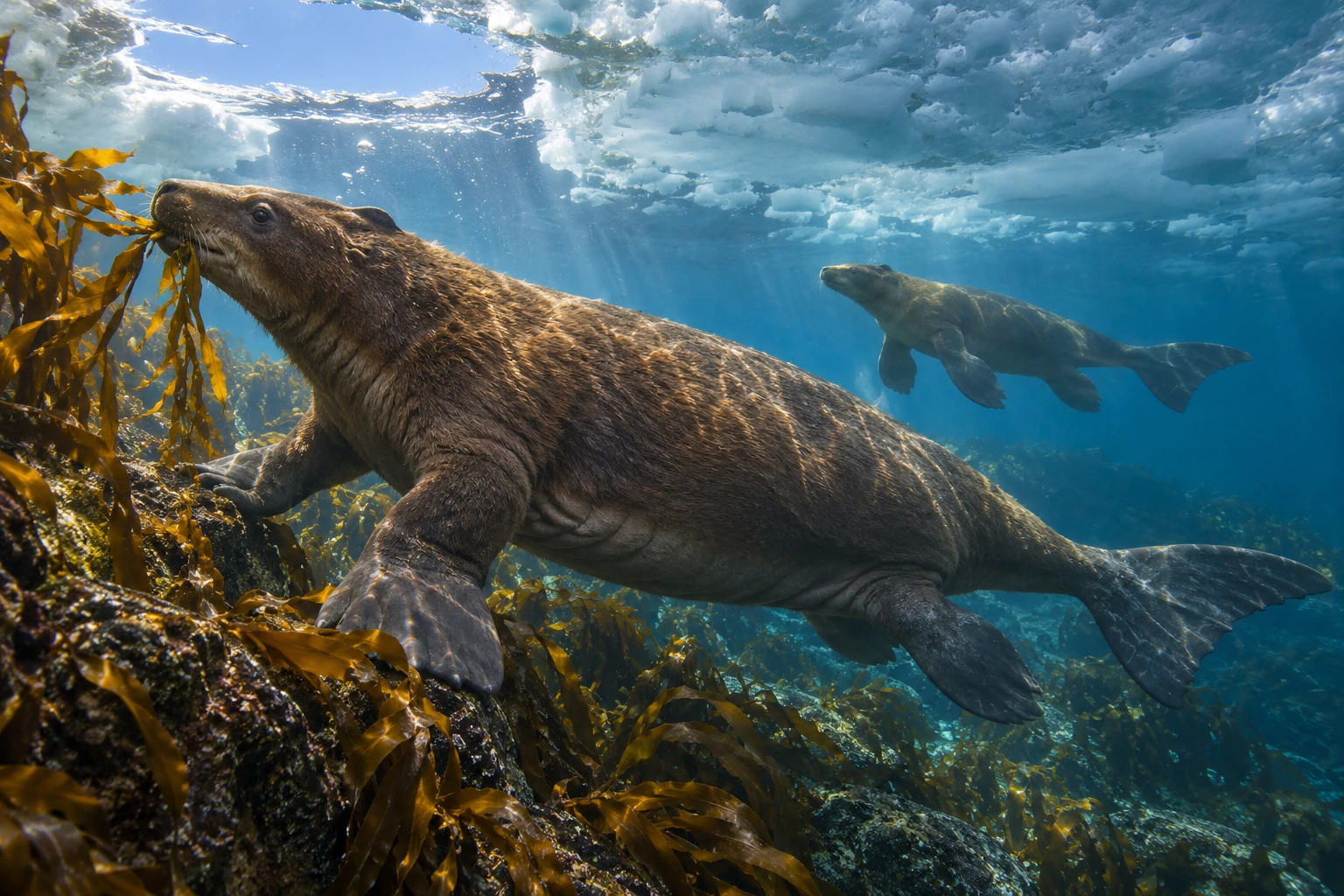
Icekeel browser#
Illustration
Icekeel browsers brace with their foreflippers while gripping kelp stems in flexible lips. A smooth skull keel protects the head during short journeys beneath broken ice. Four flippers control position around rocks, and one broad horizontal tail drives swimming. Warm nasal passages reclaim heat between breaths at open leads. Juveniles follow adults between feeding patches and sheltered nursing stops.
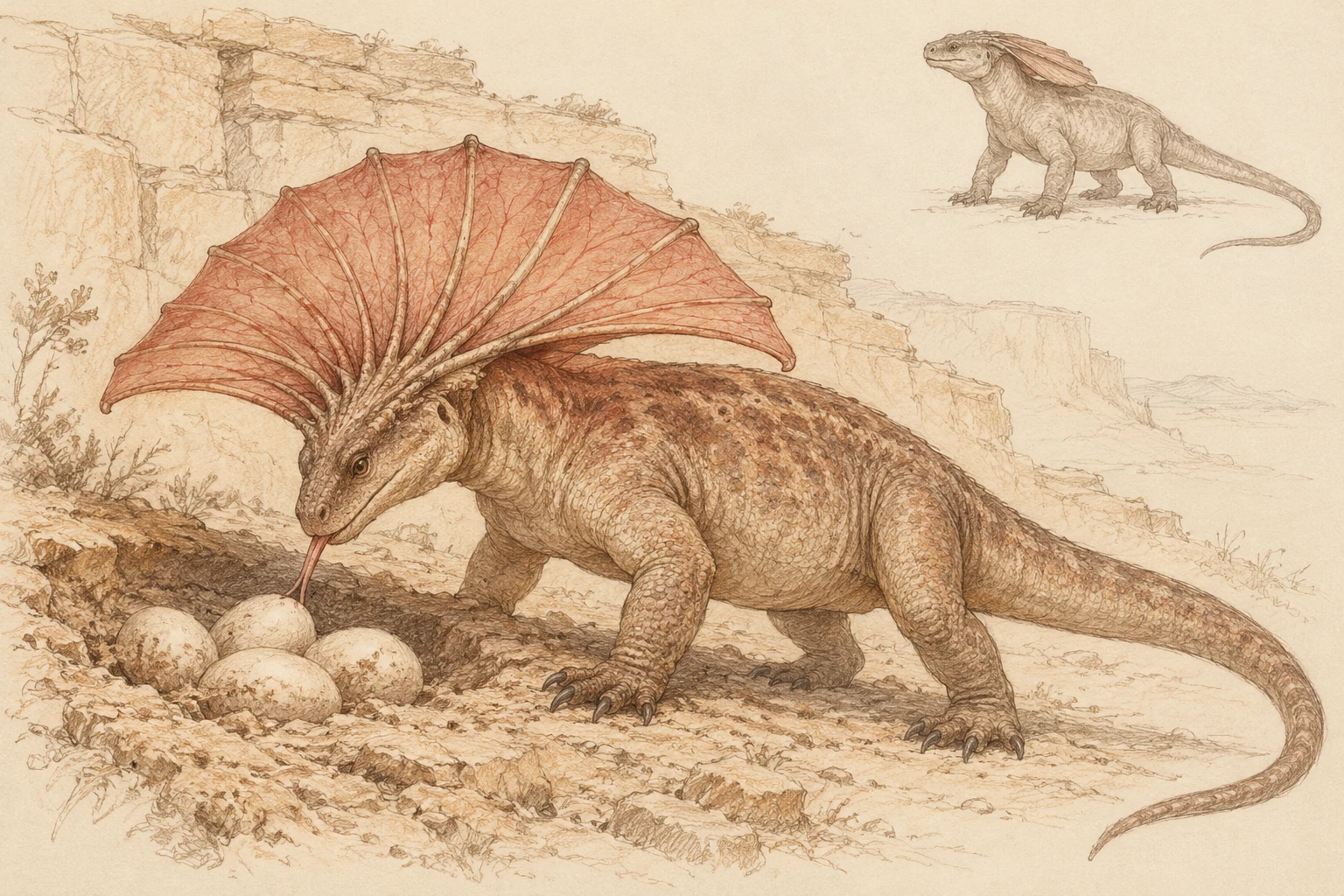
Kilncrest brooder#
Sketch
A kilncrest brooder changes the angle of its vascular head crest as sunlight moves across the nesting hollow. Light keratin ribs hold the living membrane above the clutch, adjusting shade and releasing modest warmth stored during basking. The adult checks an egg with its tongue; the smaller posture shows the crest folded close for travel.
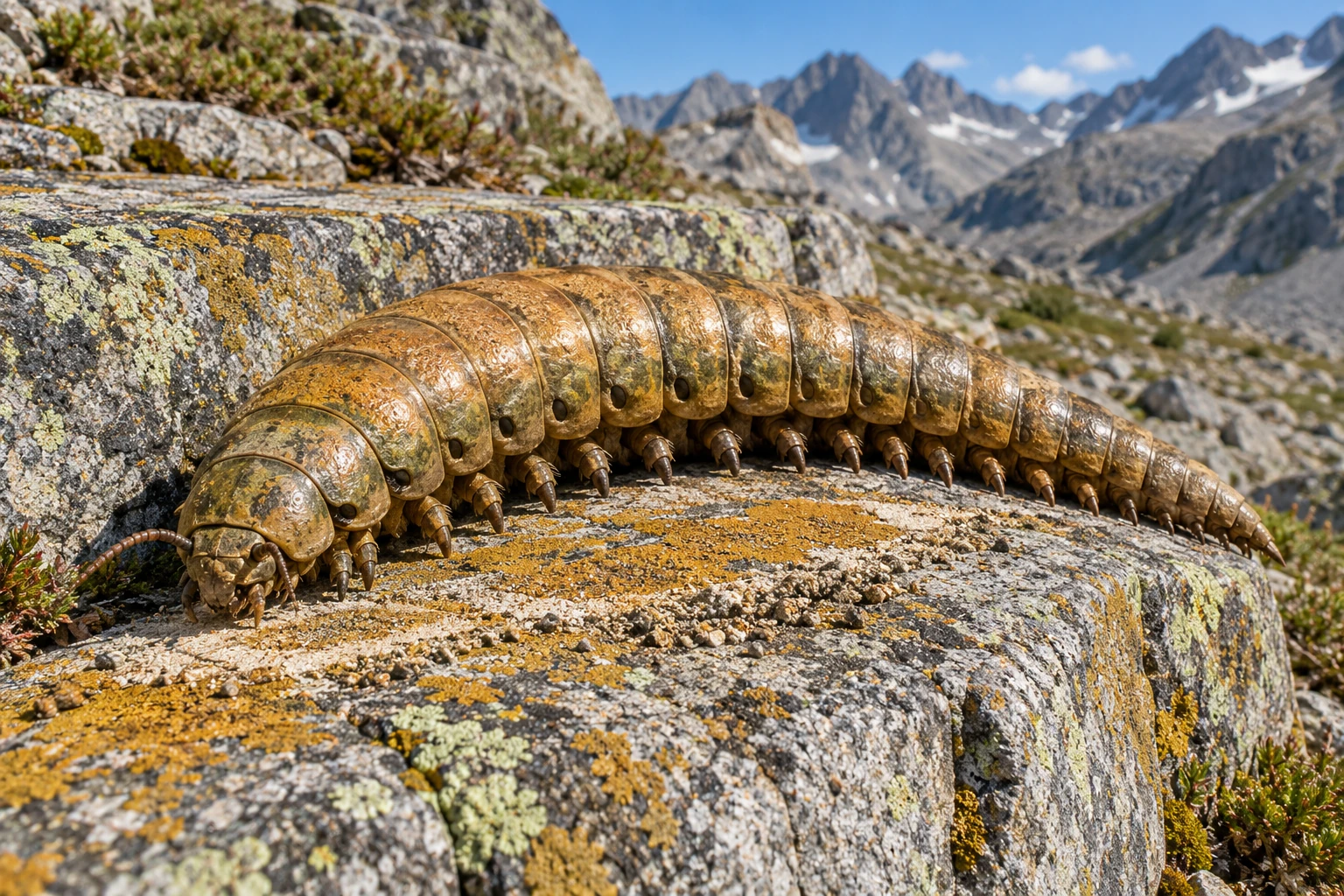
Terrace millipede#
Illustration
A terrace millipede follows the contour of an alpine rock shelf, scraping a narrow strip through lichen crust. Its repeated legs shift loose grit toward the outer edge, gradually forming small ridges around a favored feeding terrace. Broad plates spread absorbed heat along the eighty-centimeter trunk. Ventilated flank chambers and circulating oxygen carriers support its heavy, many-legged body.
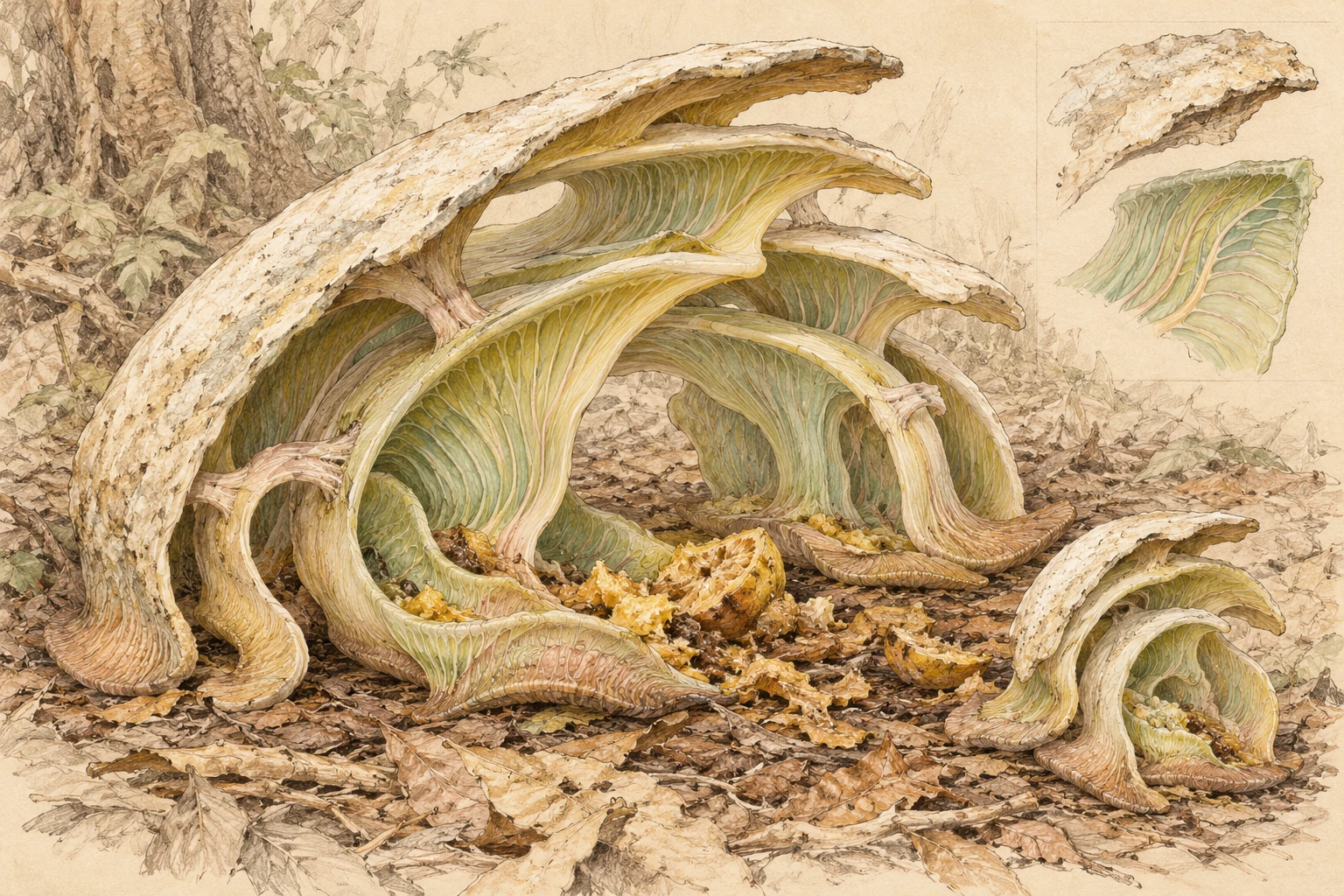
Inheritance lantern#
Sketch
Each generation of an inheritance lantern grows a living wall inside the shelter of older generations. Temporary vascular bridges share nutrients while the young develop independent circulation. The oldest outer layers become protective mineral roofs, carried onward by younger tissue. Here a small individual departs with an inherited roof fragment as the remaining family gathers fallen fruit through low feeding rims.
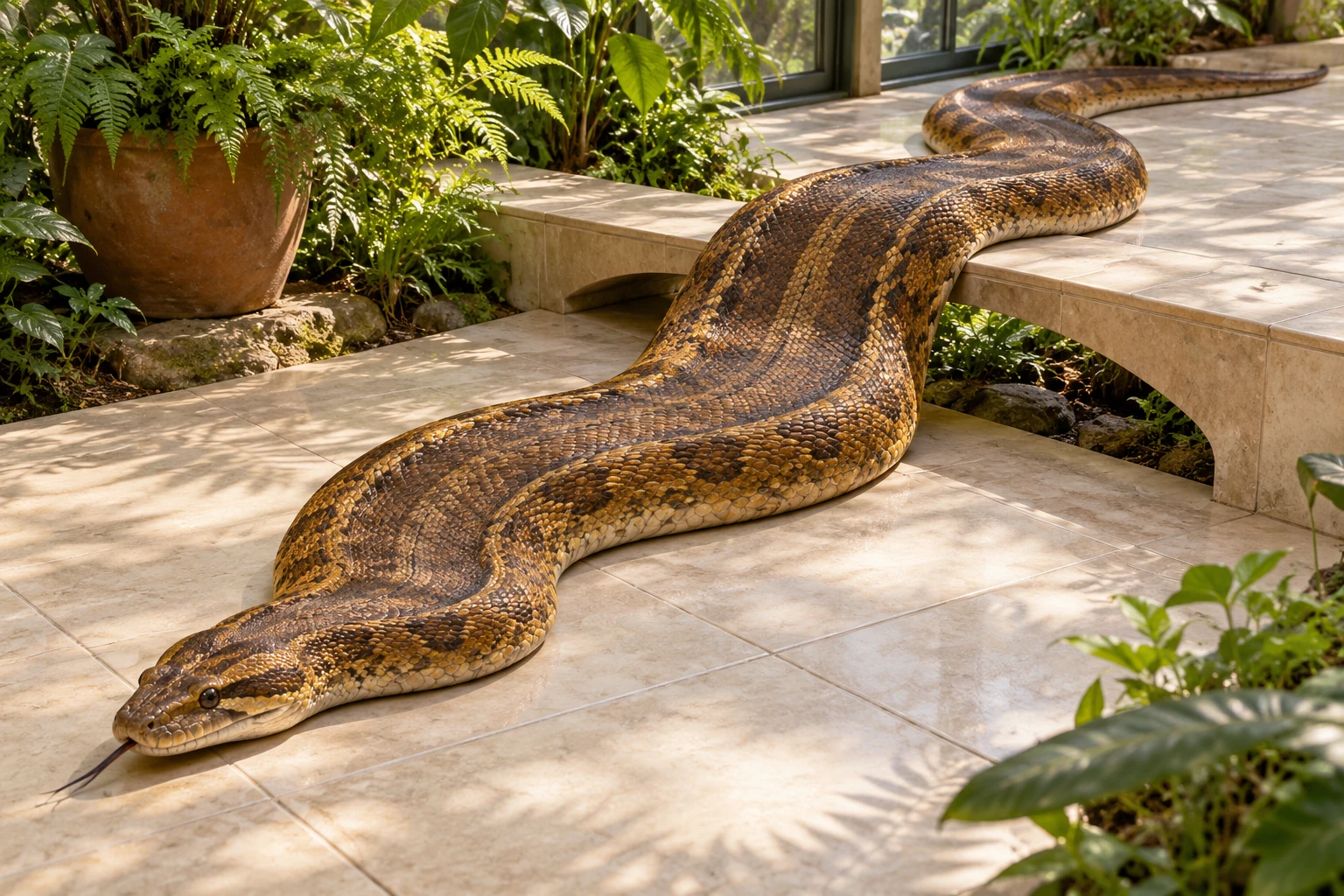
Ladderback serpent#
Illustration
The ladderback serpent distributes bending loads through parallel axial columns joined by flexible rib bridges. Its broad muscular trunk leaves a central corridor for the gut and makes shallow supported arches across habitat openings. This adult follows a scent route over warm ceramic, testing contact pressure along its underside before advancing the next section of its body.
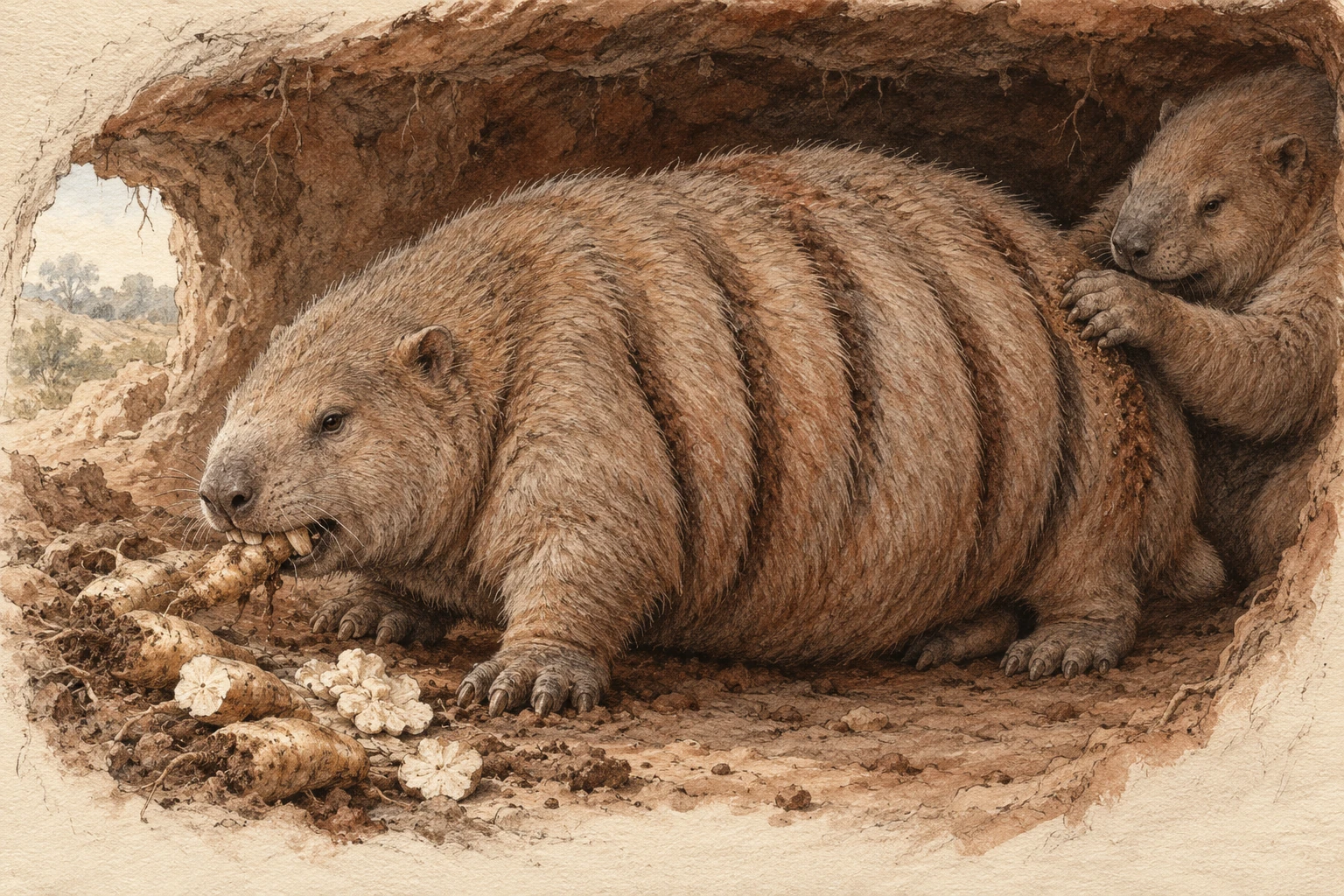
Hearthgourd#
Sketch
Hearthgourds feed on roots and cultured fungi before settling into communal alcoves. Their deep gut ferments fibrous food, and oxidation supplies the heat that passes through the dense fleece. Muscular flank folds widen selected air channels after a meal. A companion picks soil from a rear pleat while the feeding animal chooses how much warmth to release into the chamber.
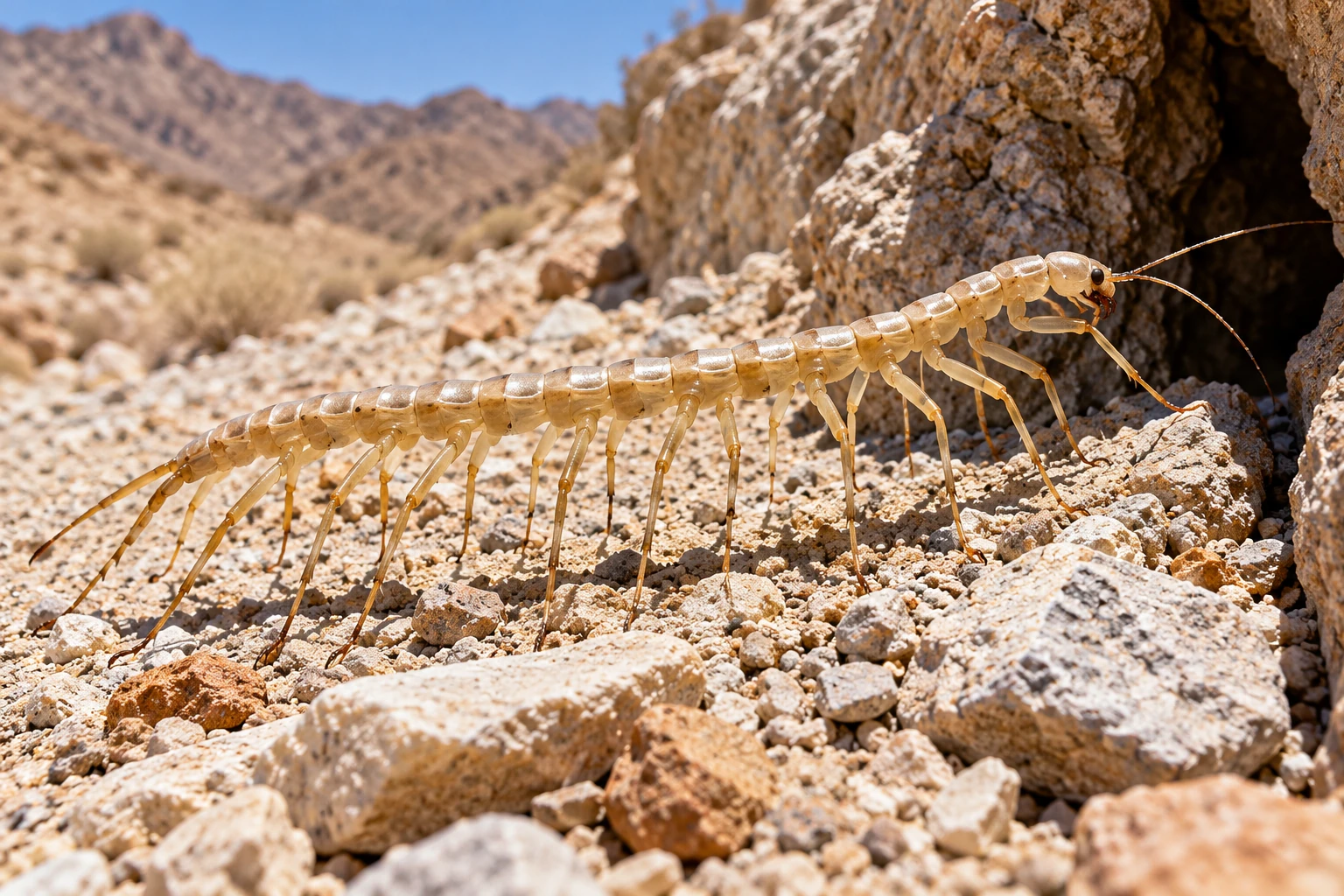
Suspension centipede#
Illustration
A suspension centipede holds its light trunk above hot gravel while its front leg groups test cooler contacts near a shaded slot. Alternating support groups keep the body stable as individual feet lift and probe. Thin dorsal plates and internal struts limit the mass carried by its long legs. Small ventilated chambers supply oxygen along the half-meter trunk.
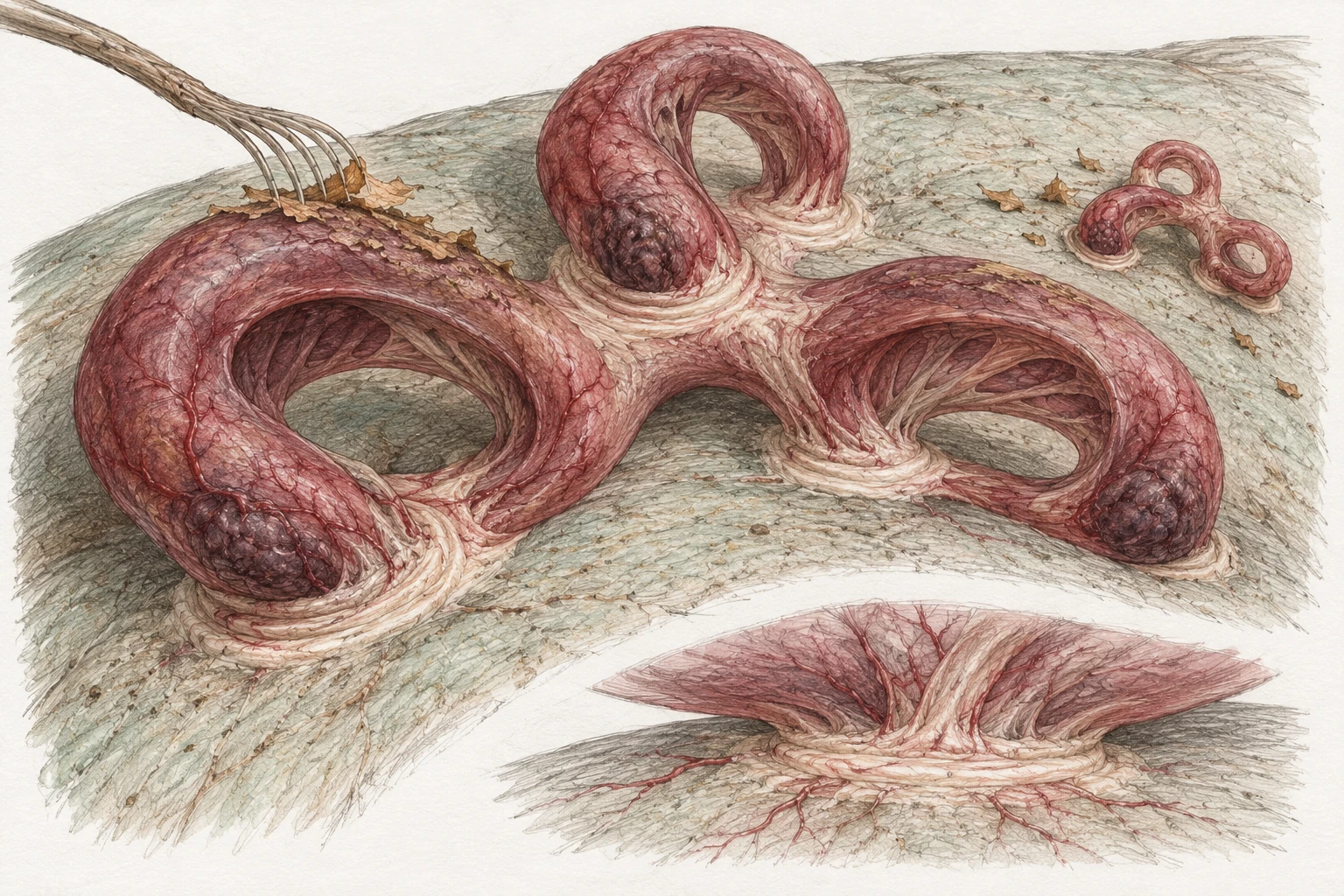
Vein guest#
Sketch
A vein guest joins its circulation to a grove vault through shallow sealed grafts. The host supplies carbon compounds and oxygenated fluid; protected nodules house microbes that spend some of that carbon fixing nitrogen for both partners. The triple-loop body adjusts its strain as the host moves. A provisioned youngster explores nearby while a soft comb clears loose leaf debris from the adult.
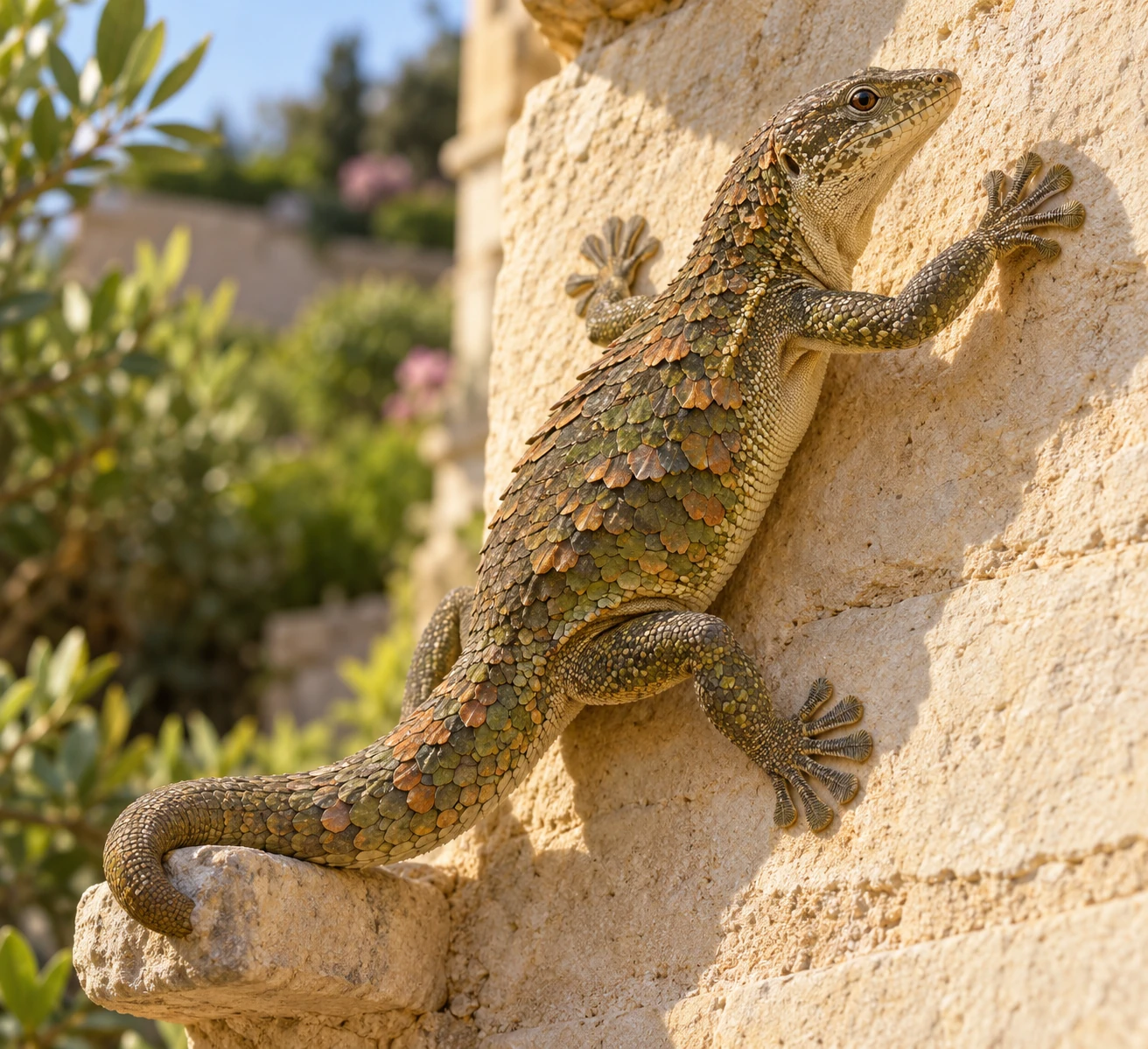
Mosaic wall monitor#
Illustration
A mosaic wall monitor spreads its adhesive toe surfaces across a warm garden wall and anchors its tail around a stone projection. The flattened trunk distributes climbing loads, while protected flank folds retain water. Small connected back scales shift as the animal grows and basks. Choosing a resting patch combines thermal sensing with careful testing of surface contact.
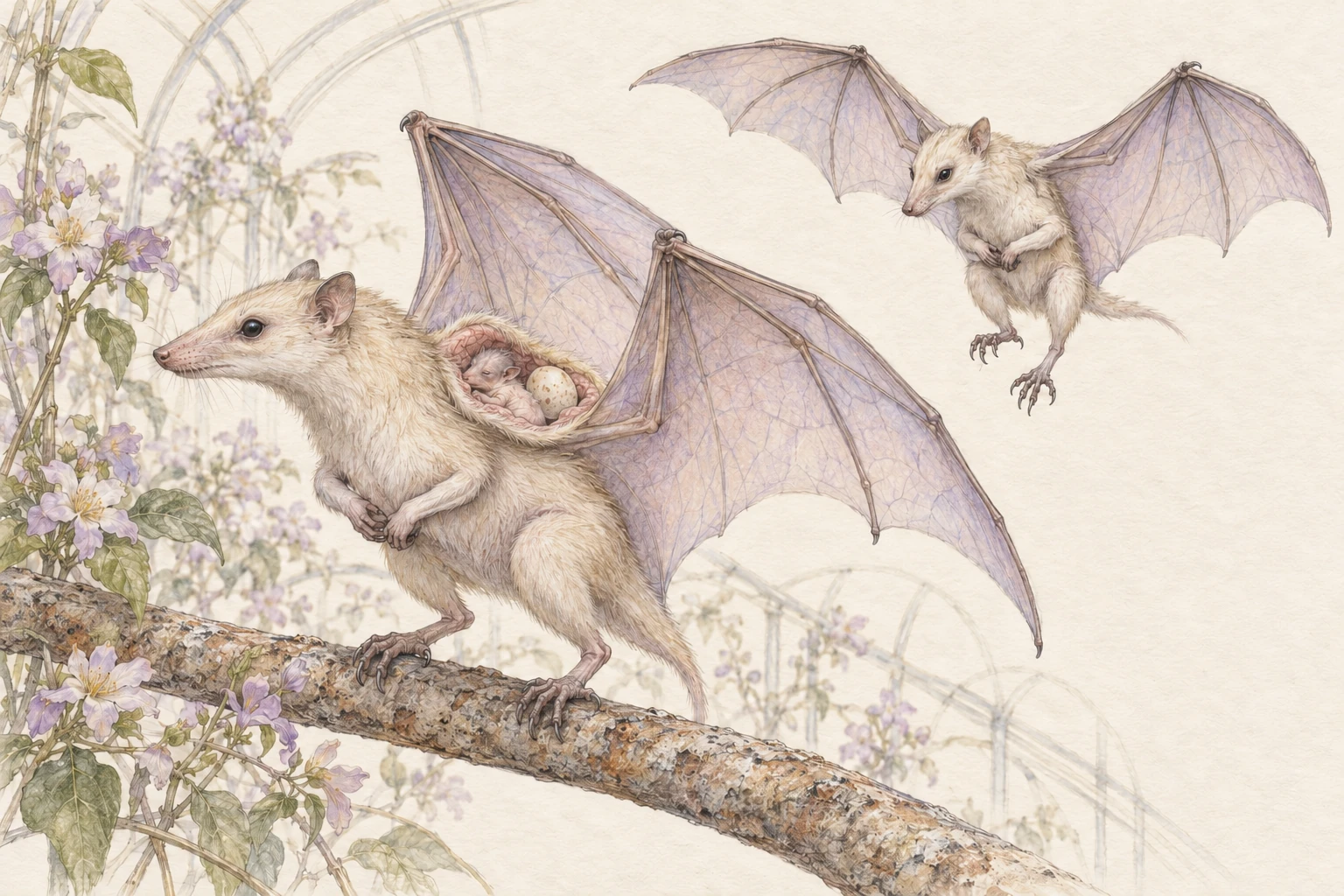
Milkwing#
Sketch
Milkwings divide their six limbs between flight, carrying and perching. A fur-edged dorsal fold keeps a small egg and newly hatched young against warm skin, where milk-secreting pads supply the first meals. Adults alternate feeding trips and roost duty. Here one partner approaches while the other rests with its nursery fold open and its small carrying arms gathered against the chest.
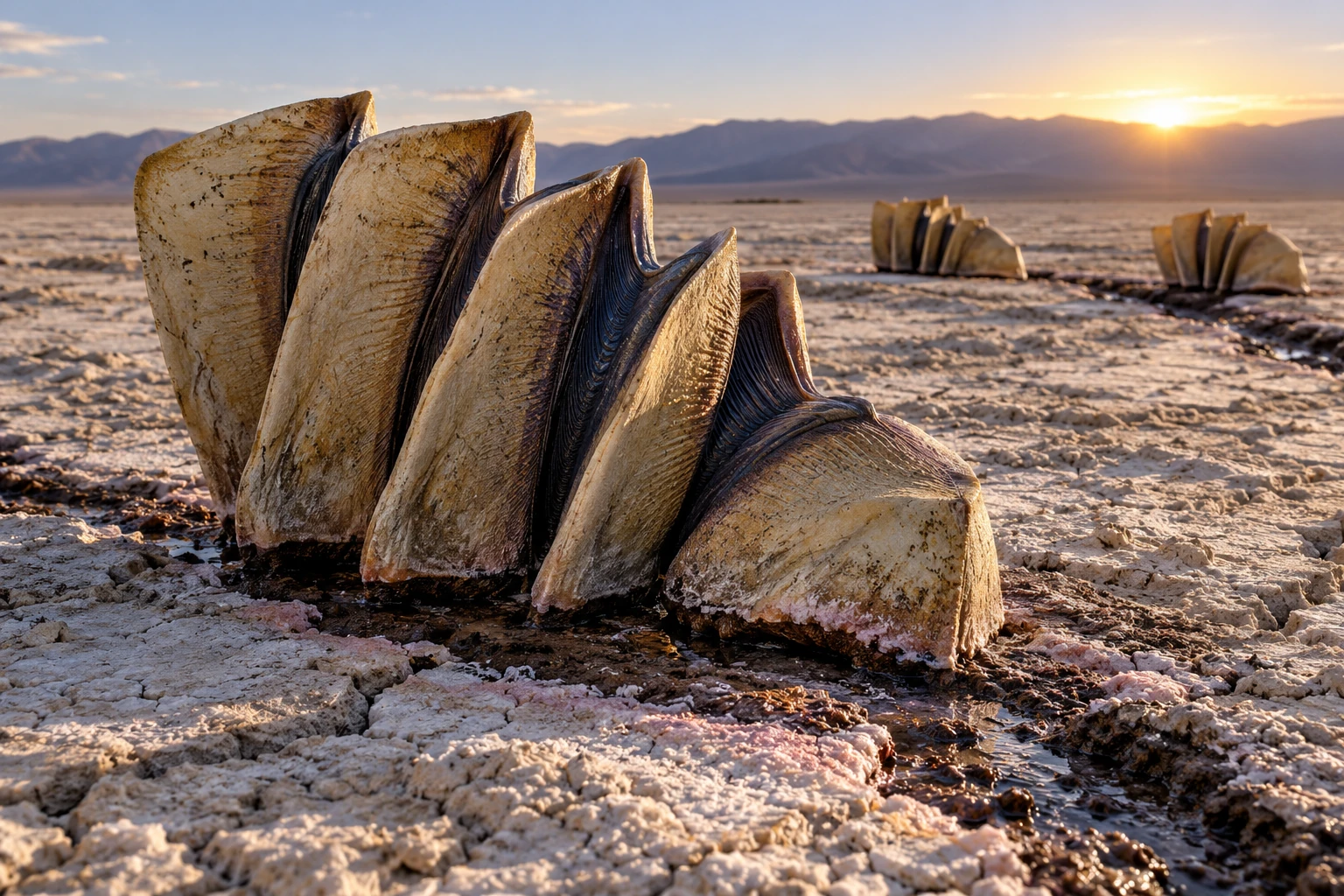
Seep folio#
Illustration
Seep folios gather where methane rises through shallow soil cracks. Inside their stiff folded panels, moist reactor tissues combine methane with oxygen under controlled conditions, providing organic carbon and chemical energy. Tough outer surfaces conserve water. Broad basal edges grip the ground as muscular hinges move the body toward fresh seepage; nearby individuals spread their panels over other parts of the crack.
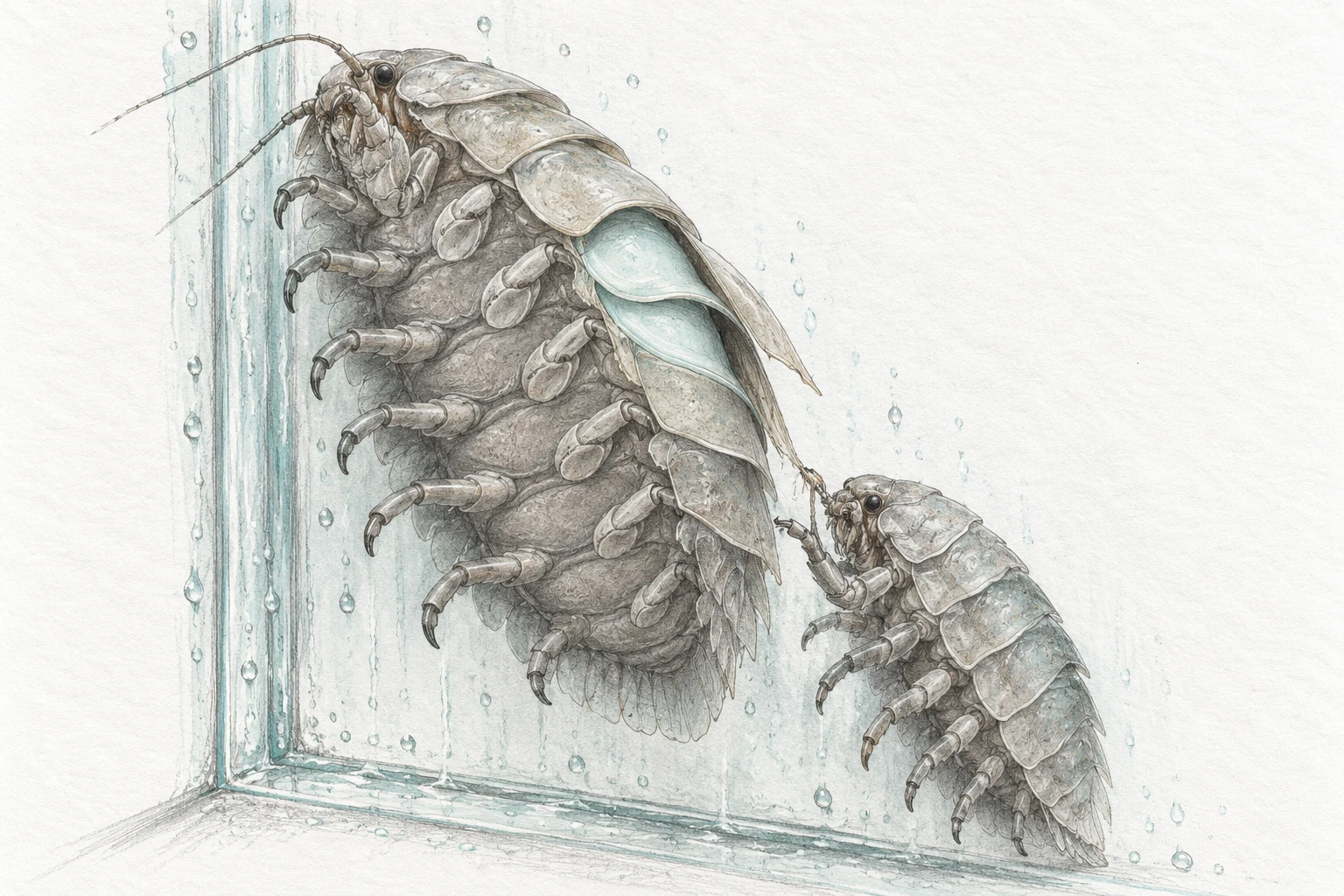
Glassgrip isopod#
Sketch
A glassgrip isopod rests on a humid pane while two old plates lift above intact pale replacements. Adhesive pads on the remaining segments keep the body supported during the staged molt. Its companion grooms loose fibers from a hardened rear plate. The thin respiratory skirt stands slightly clear of the glass, maintaining a moist passage for gas exchange.
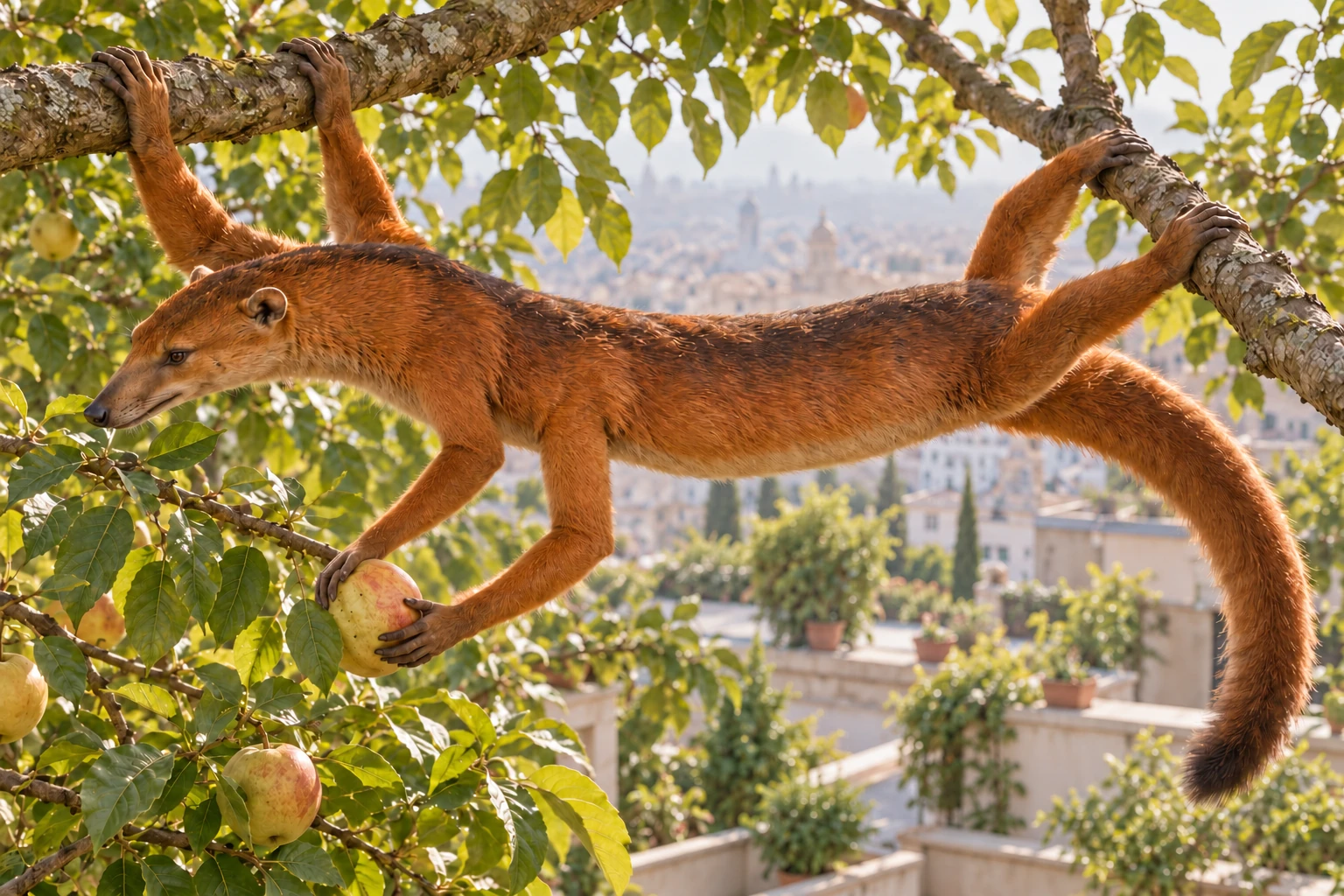
Spindle orchardist#
Illustration
Spindle orchardists distribute their weight among four branch grips while two free arms turn and smell fruit. Each limb pair has its own muscular girdle within the extended trunk. A broad tail corrects slow rolls as the hands change position. Adults revisit chosen trees, testing ripeness and clearing damaged fruit from the aerial orchard.
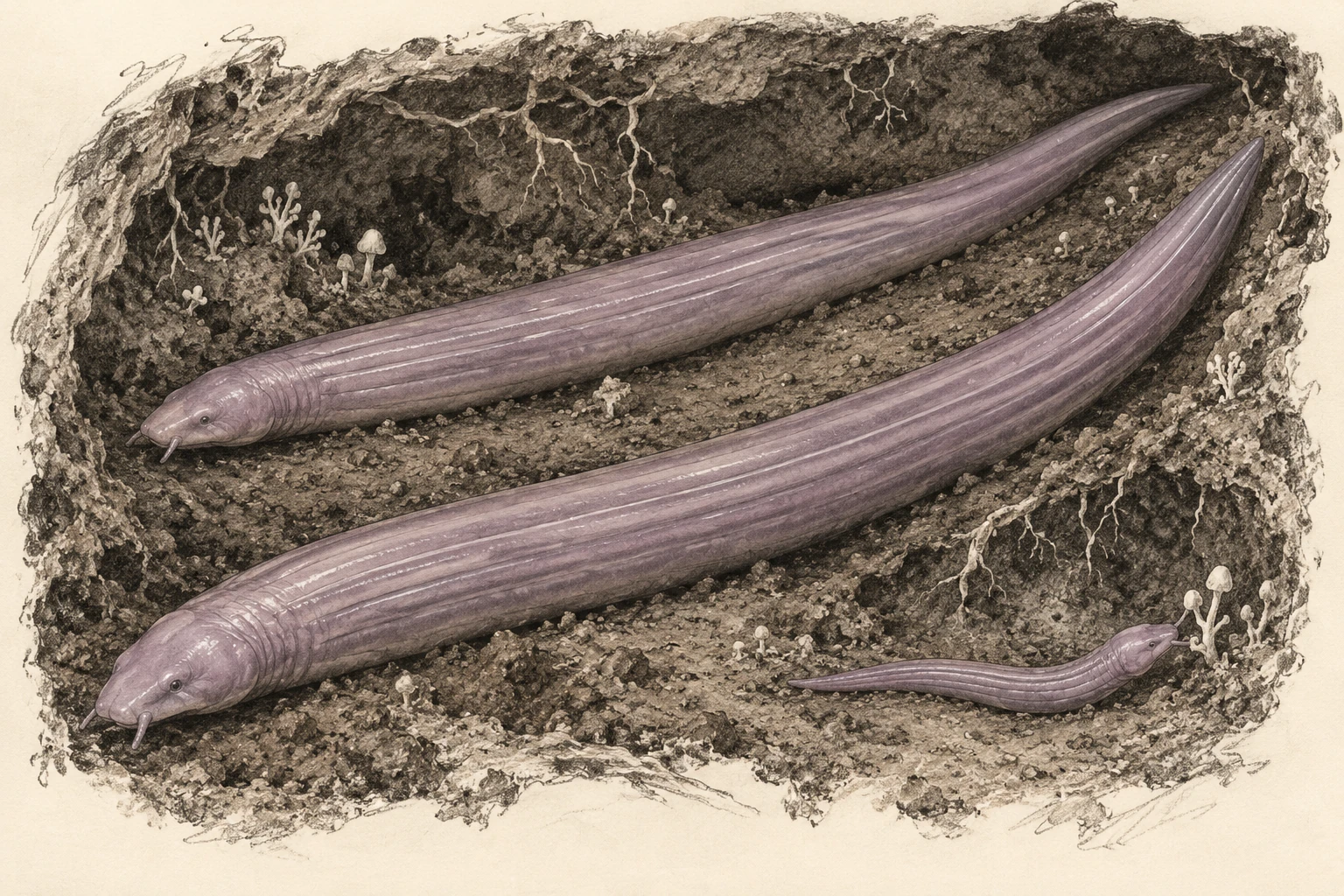
Pleatbed caecilian#
Sketch
Pleatbed caecilians rest together in damp, aerated tunnels whose fungal walls provide soft food. Longitudinal skin pleats enlarge their gas-exchange surface, while reinforced wedge-shaped skulls open passages through loose soil. Two adults lie along a shared resting bed as a juvenile samples a fungal patch, keeping its smaller body within the humid chamber.
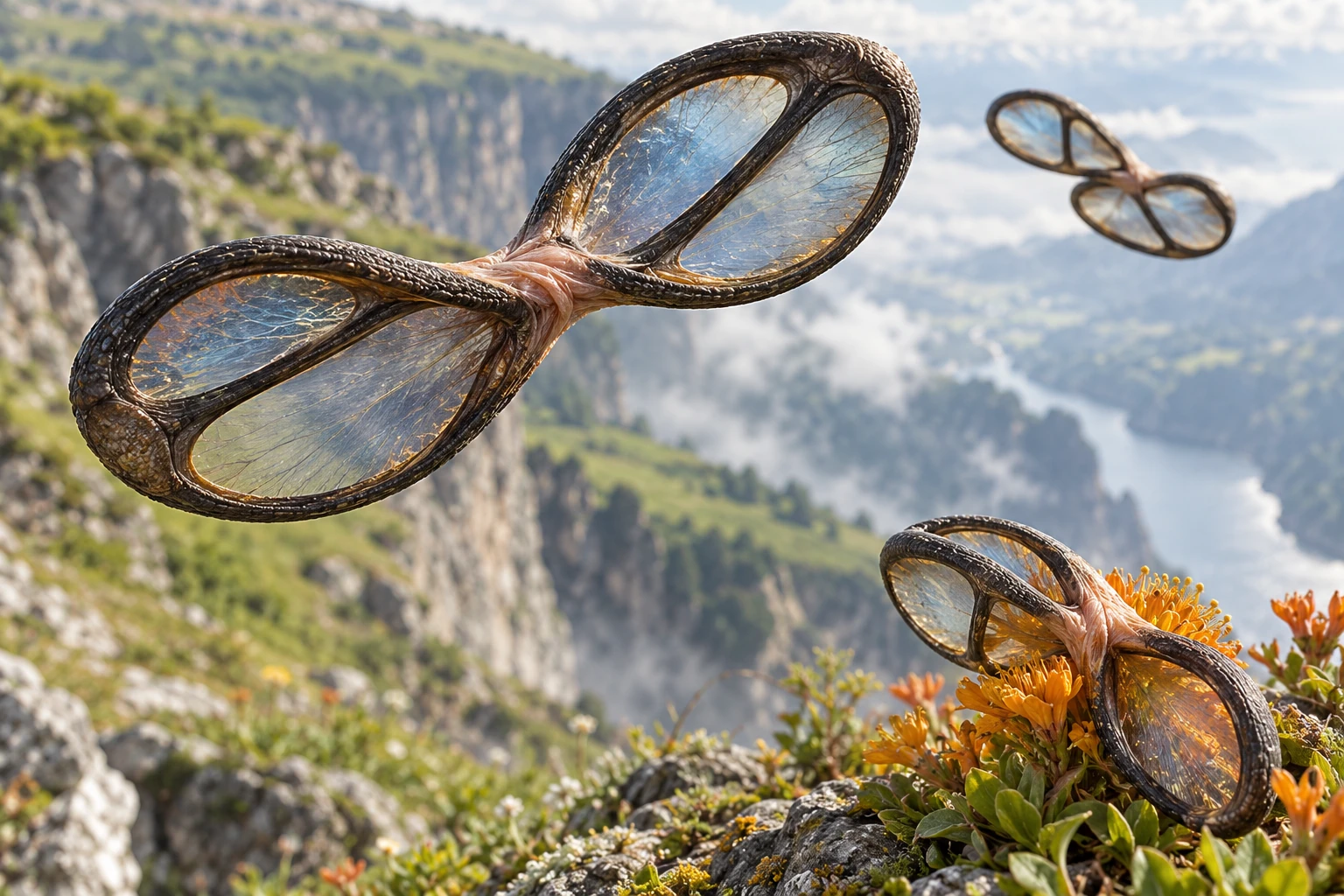
Shutterwing#
Illustration
The shutterwing's two living loops form its entire flying body. Thick edges contain muscles, circulation and respiratory channels; elastic ribs divide the loops into four membrane fields and recover energy between strokes. Nectar and pollen fuel rapid flapping. Above cliff meadows, adults briefly match their wingbeat timing during courtship, then close their loop bodies around flower clusters to feed.
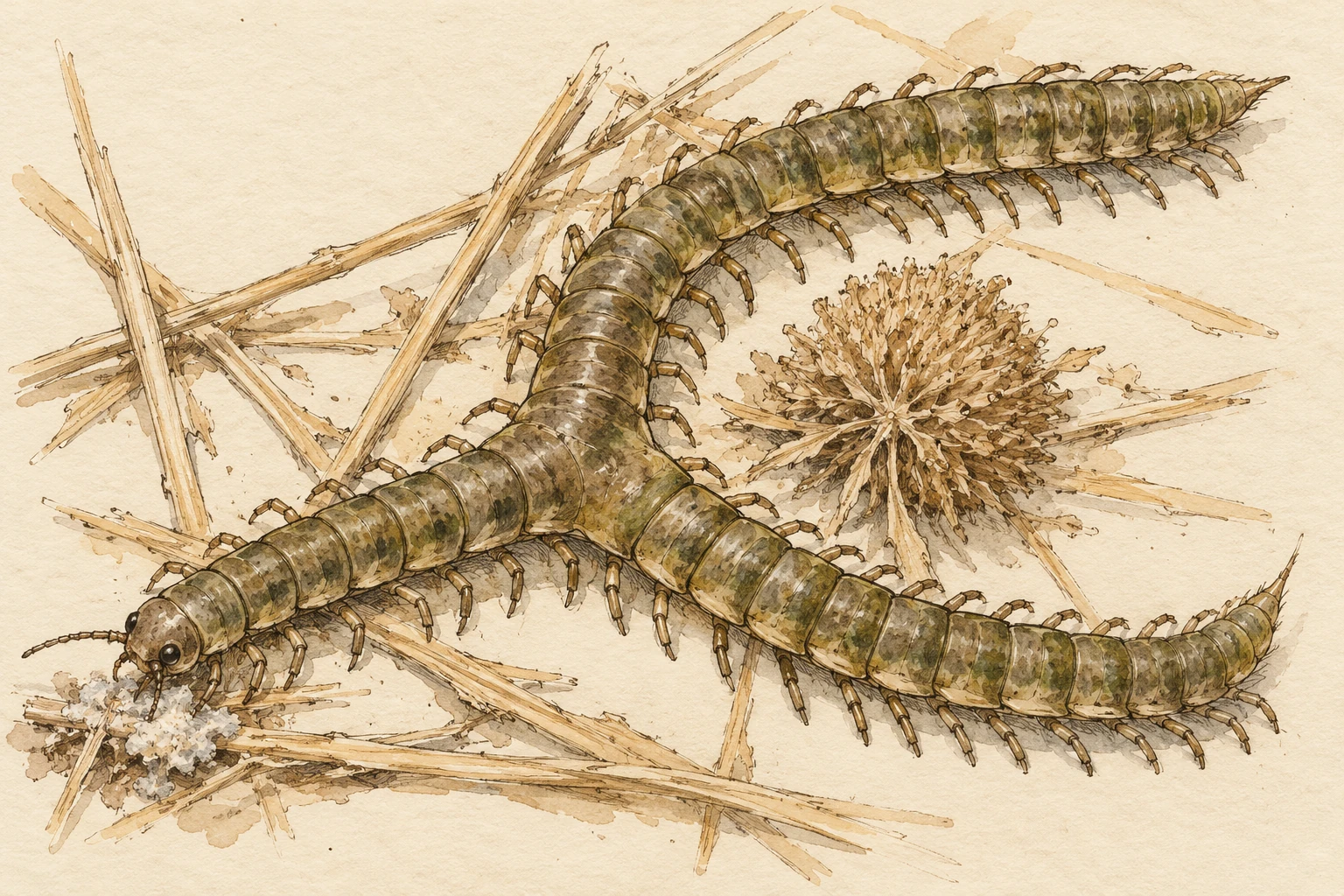
Forkline millipede#
Sketch
A forkline millipede feeds at one fungal patch while its two posterior trunks pass around opposite sides of a seed head. Each branch contains a gut extension and nerve chain, coordinated through the shared front trunk. Repeated paired legs support both routes and the broad junction between them. Chemical sampling at the jaws guides the whole animal toward the next patch.
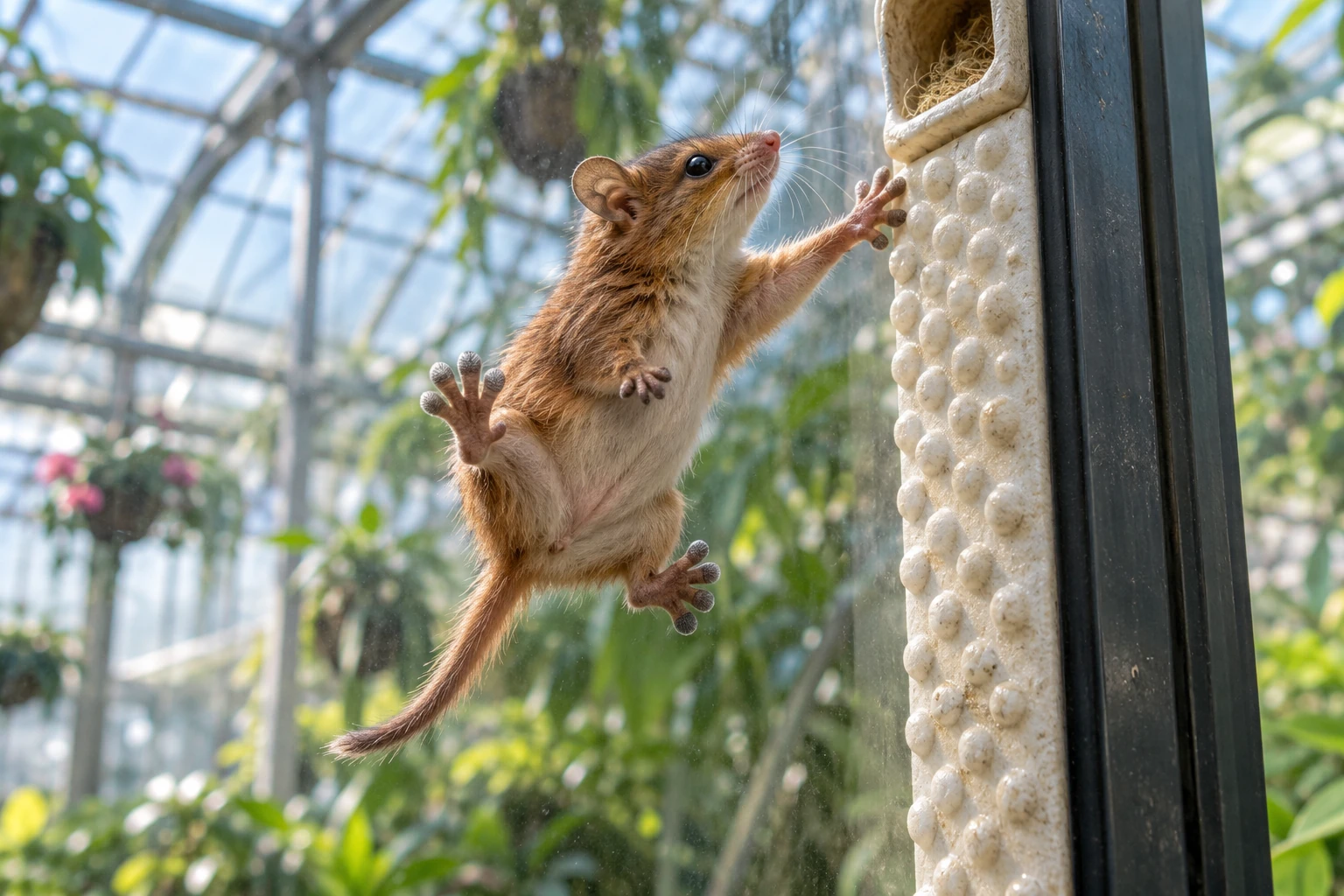
Panewalker#
Illustration
Panewalkers explore glasshouse panes with fan-spread padded toes. Fine adhesive hairs hold each contact while closable moisture channels regulate the pad surface. The flattened trunk stays slightly clear of the glass so the ribs can move. Whiskers test the next foothold. Here an adult reaches onto a textured puzzle strip beside its preferred sleeping recess.
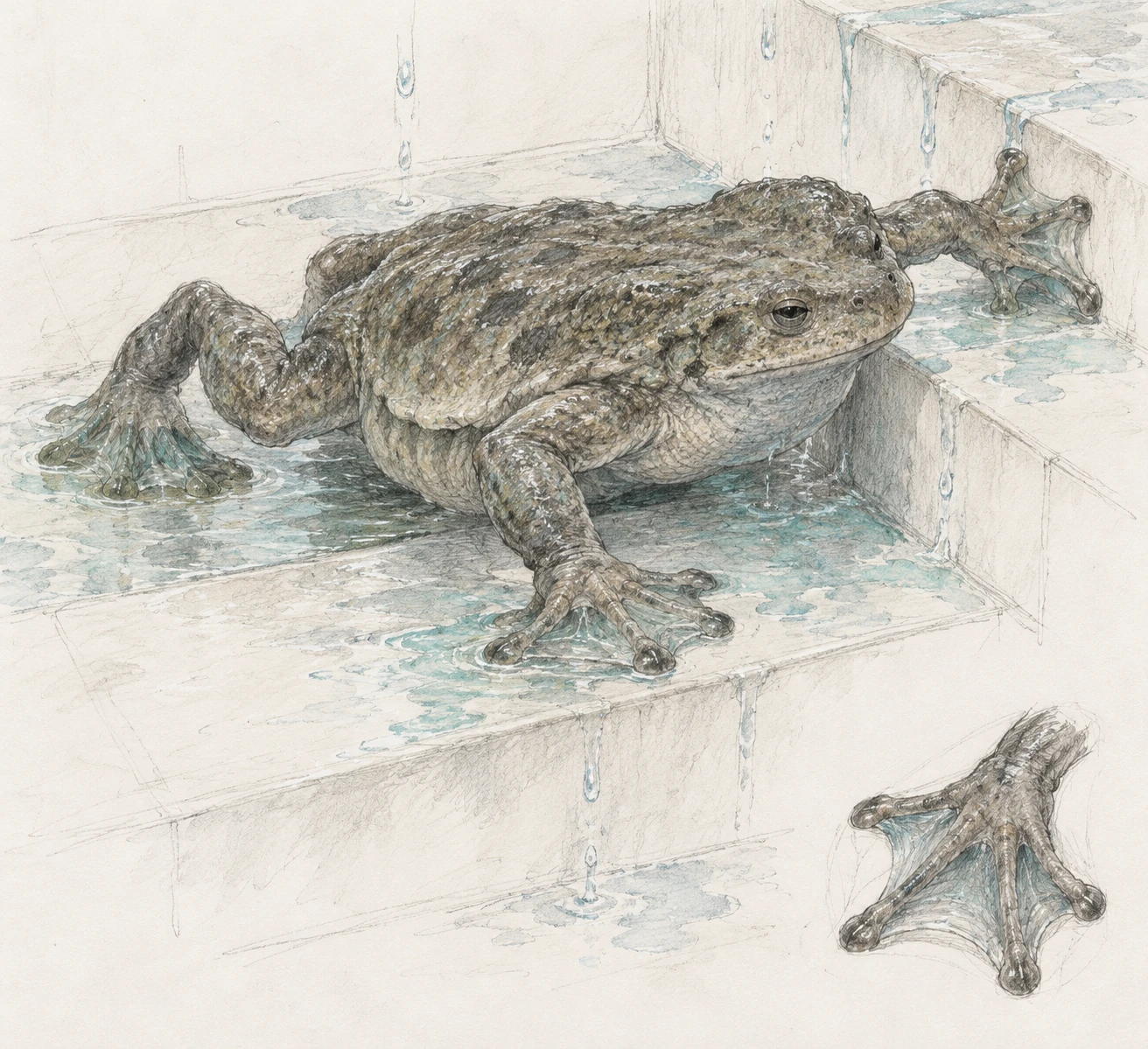
Archfoot toad#
Sketch
An archfoot toad explores wet ceramic steps by spreading and gathering the webs between its adhesive toes. Broad contact patches support the low body while pressure-sensitive skin helps it select the next foothold. Moist flank folds and a pumping throat sustain gas exchange between short climbs. The foot study shows the continuous webbing that changes shape during contact.
Spore-scarf moth#
Illustration
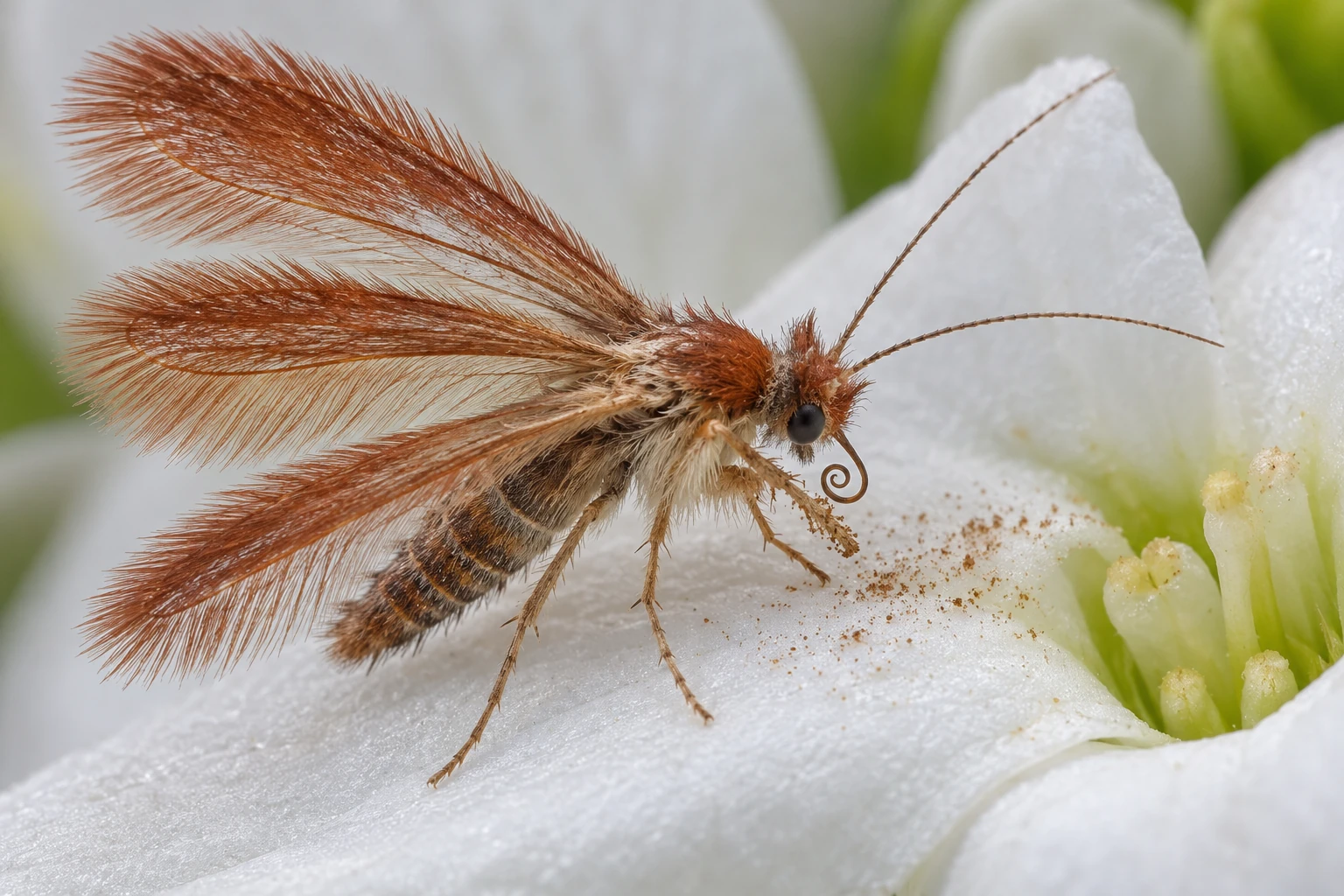
A spore-scarf moth combs a small load of fungal spores from its collar hairs onto a nursery flower. Its deeply fringed wings provide flight surfaces suited to a four-millimeter body, while slender legs brace against the petal. The moth feeds at a neighboring opening after transferring the dust. Nectar and soft nutrient-rich tissues supply the energy for flight and spore carriage.
Latchfold#
Sketch
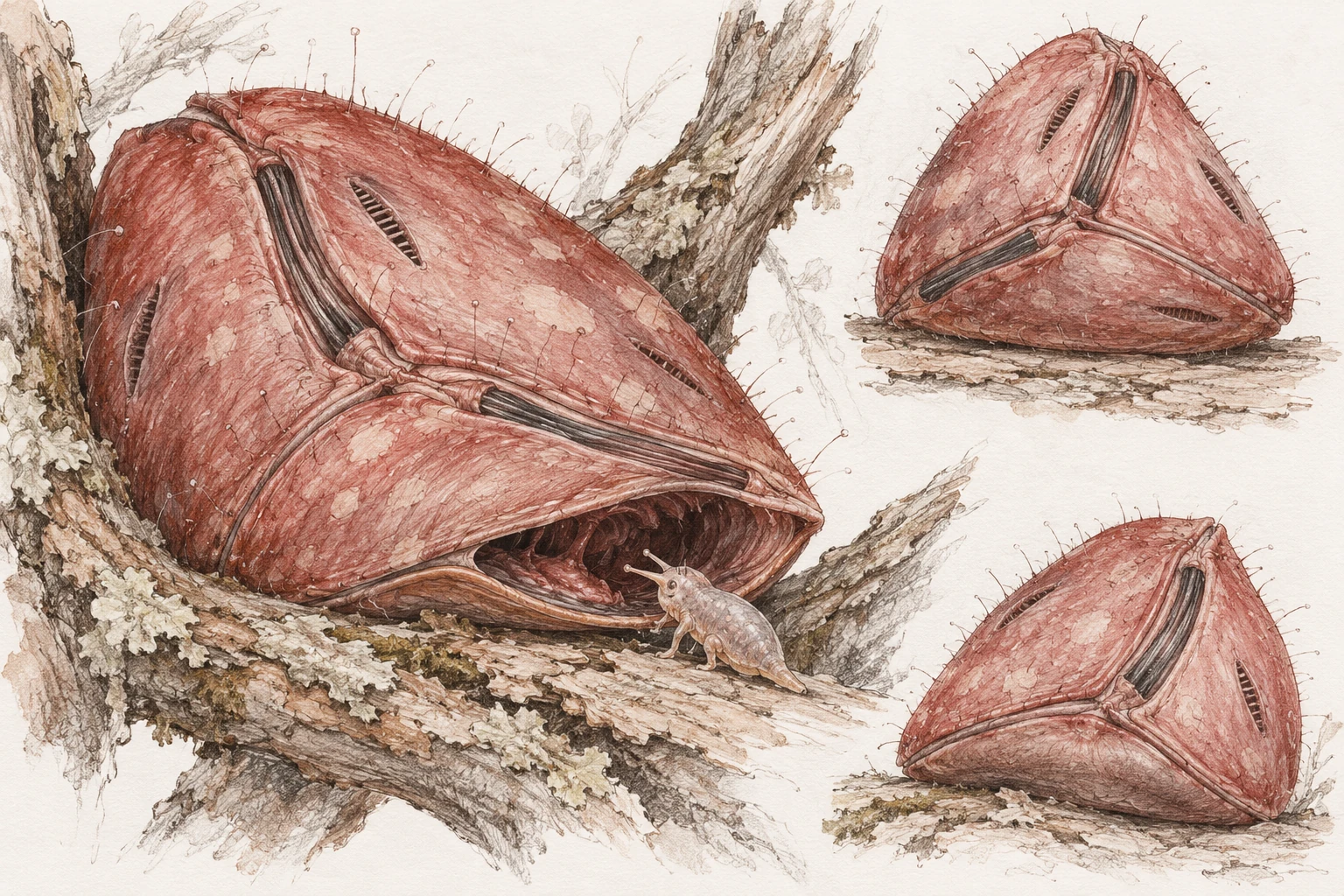
A latchfold waits with one of its three capture seams slightly open. Muscles slowly load curved elastic bands within the body wall; pressure hairs trigger a rapid closure when small prey enters. Separate chambers digest meals while protected respiratory folds keep working. Broad adhesive surfaces let the animal change its supporting face, so any seam can become the next feeding edge.
Thawcoil newt#
Illustration
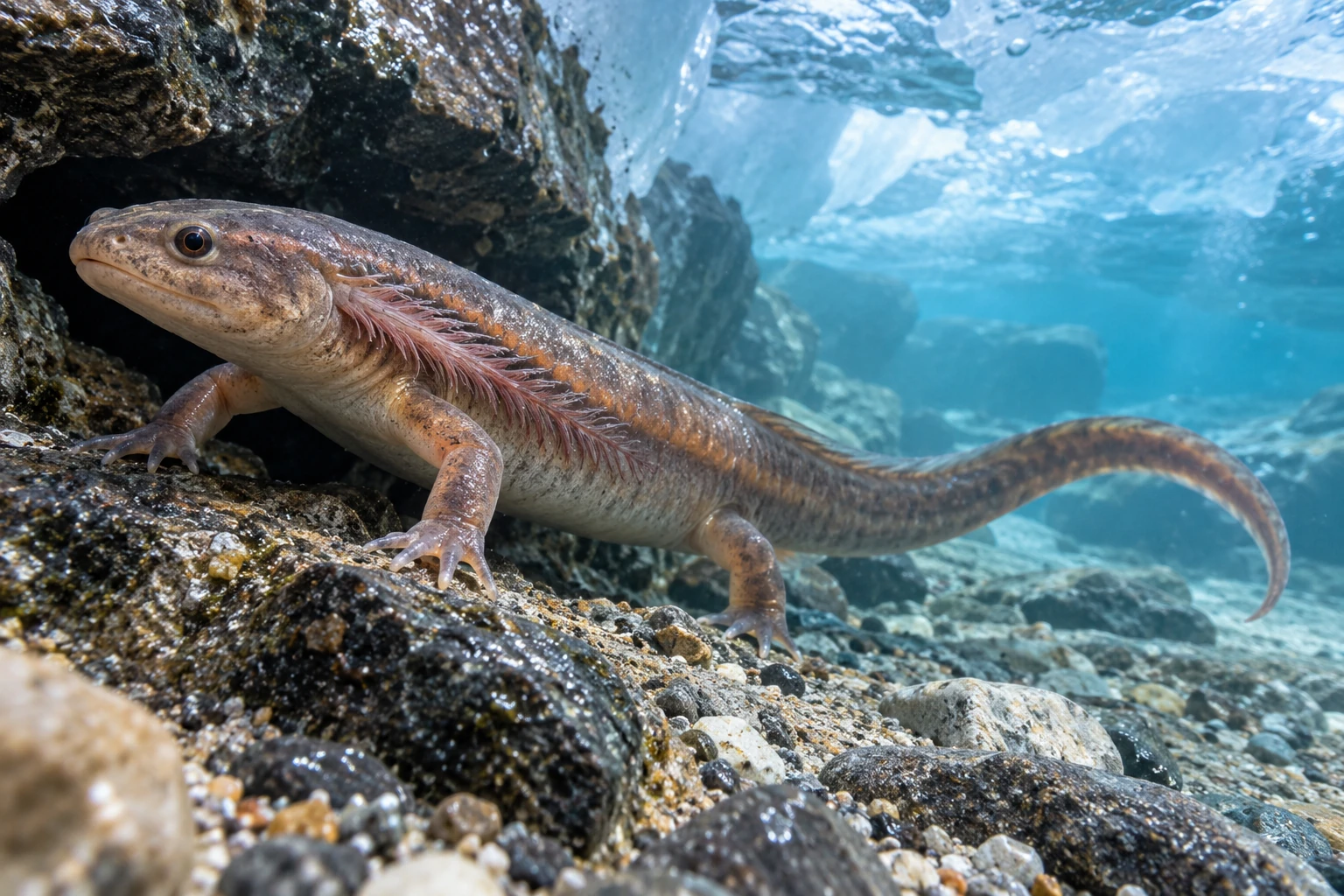
A thawcoil newt leaves its overwintering recess as fresh meltwater enters the channel. Protected lateral gill folds sustain underwater respiration, while antifreeze proteins and a slow winter metabolism help it endure cold liquid water. The adult braces on the rock lip and opens its long tail into the current before beginning its seasonal journey.
Twin-crown browser#
Sketch
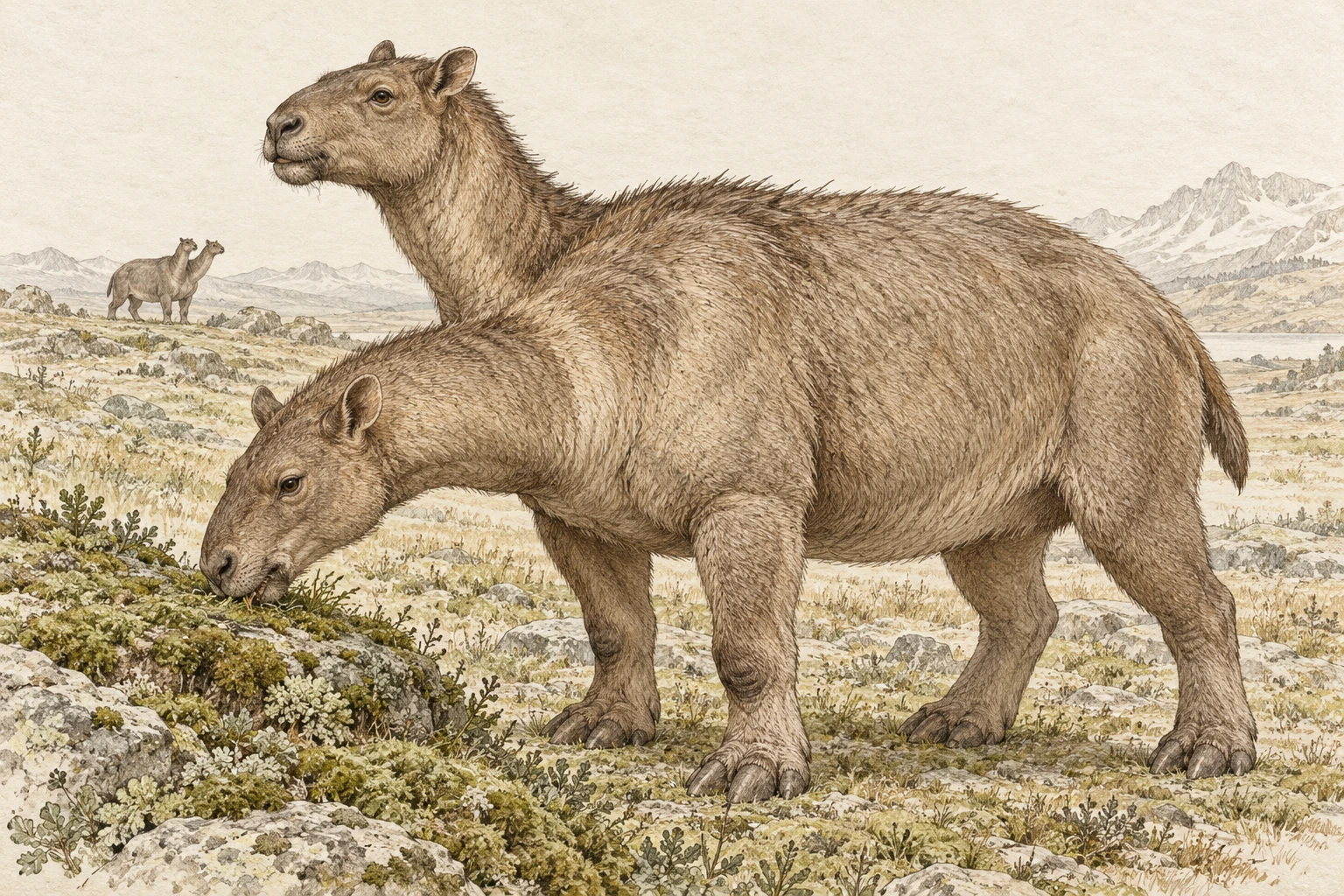
Twin-crown browsers coordinate two sensory brains through a thick shared nerve tract and common spinal circuits. Each short neck carries its own airway and food passage into the broad chest, while both mouths supply one fermenting gut. One crown browses a moss shelf as the other watches a companion. Four broad feet maintain the settled stance while the crowns exchange attention.
Fourfold listener#
Illustration
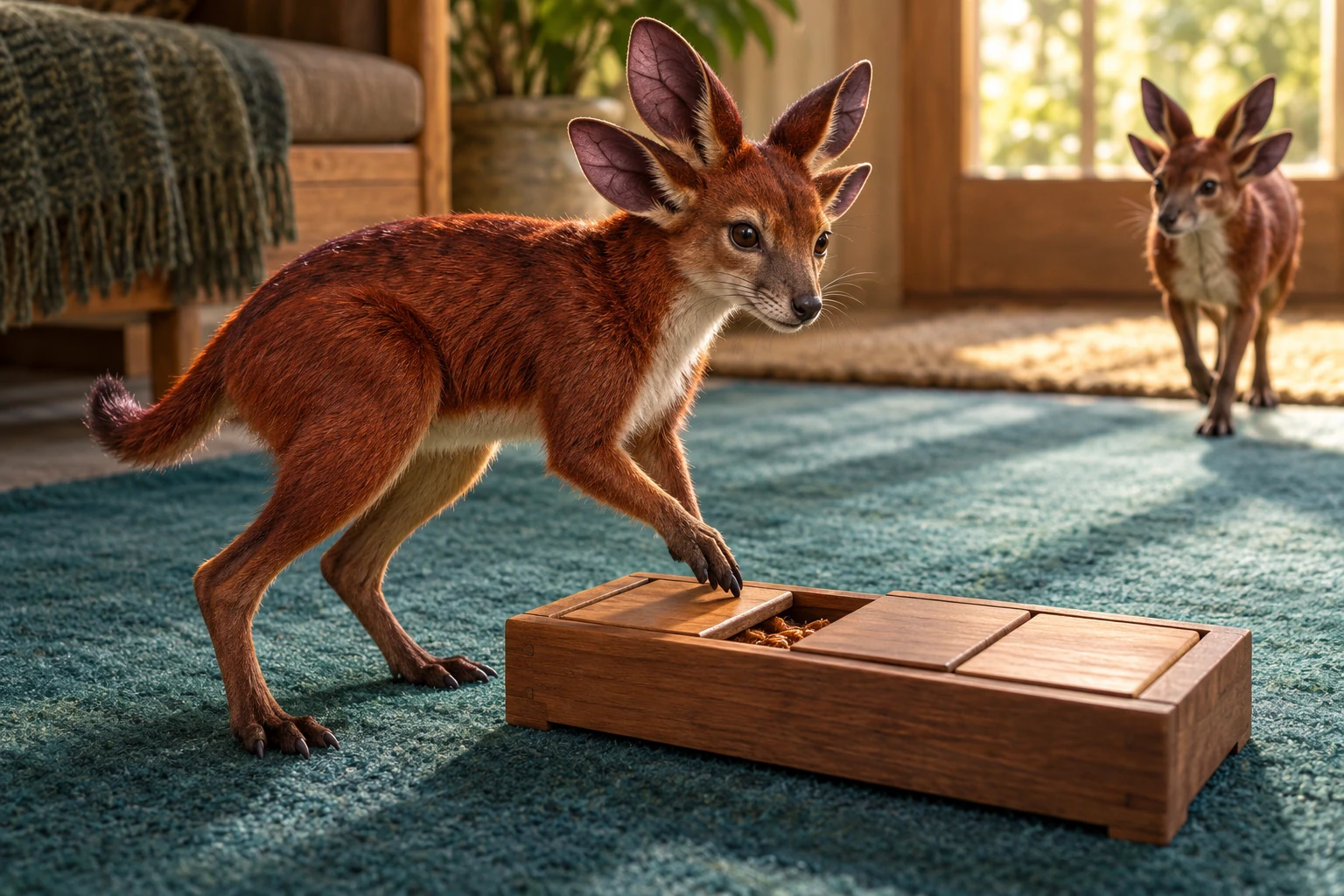
A fourfold listener slides open a compartment in its household sound puzzle while a companion approaches across the rug. Two staggered pairs of ears sample the room independently. Their canals lead to separate middle-ear assemblies, and the animal compares timing and frequency patterns before choosing a cover. Long hind legs carry its weight while the short forehands investigate the insect rattle.
Runnel slush#
Sketch
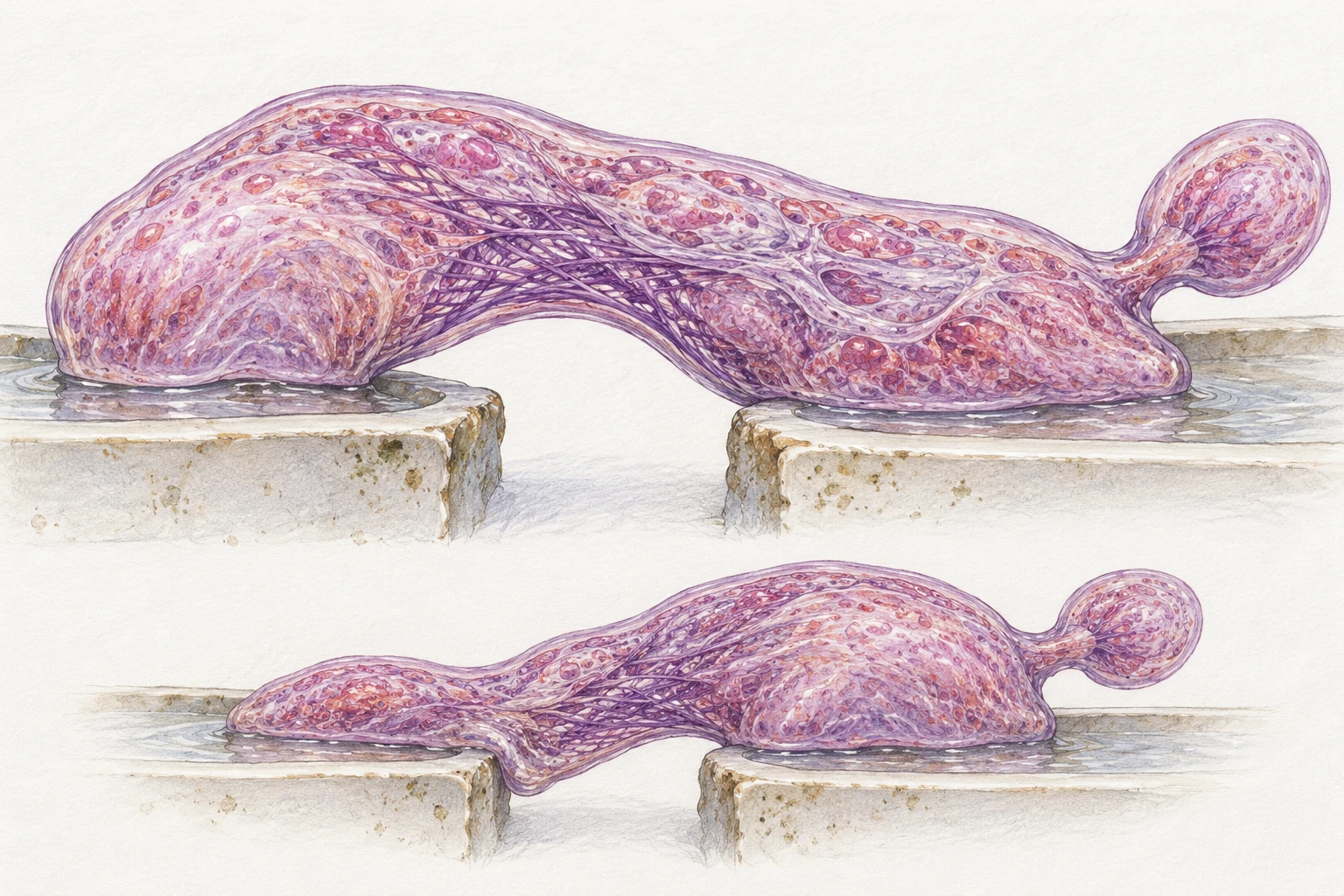
A runnel slush bridges a small break in its feeding gutter while temporary woven crosslinks stiffen the tissue carrying its weight. Softer cellular gel redistributes around this support, and connected channels carry nutrients through the changing body. The two sectional studies show different load paths within the same sealed volume. A rounded bud remains joined by a substantial tissue neck.
Gatejaw grazer#
Illustration
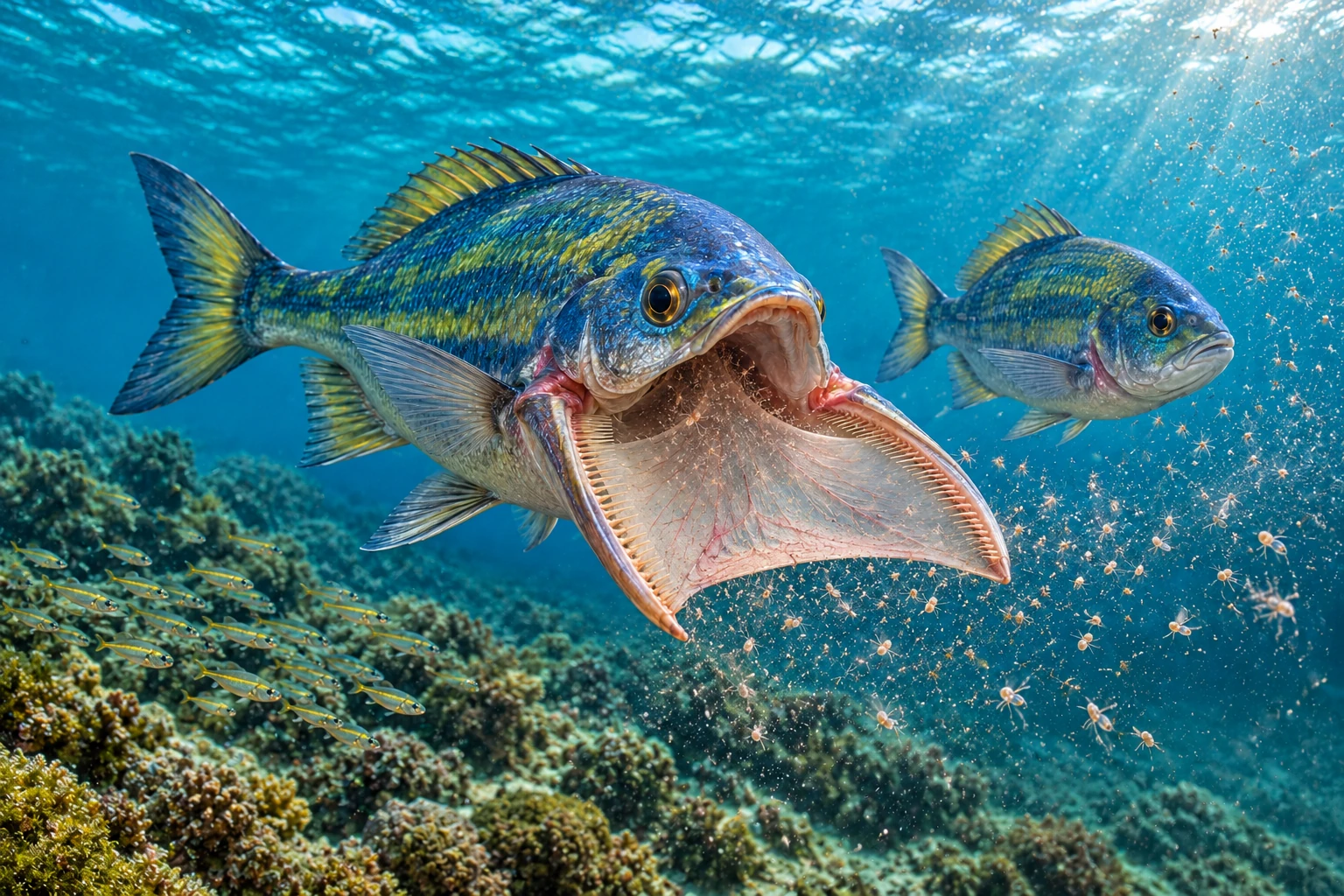
A gatejaw grazer spreads its two lower-jaw rami into the current, stretching the living mouth floor between them. Fine comb teeth retain drifting prey as the gate closes. Muscular pumping sends water past protected gills. A closed-jawed adult holds the neighboring feeding lane while small fry gather near the reef below, where larger grazers leave a shifting supply of suspended food.
Rosin-cup weevil#
Sketch
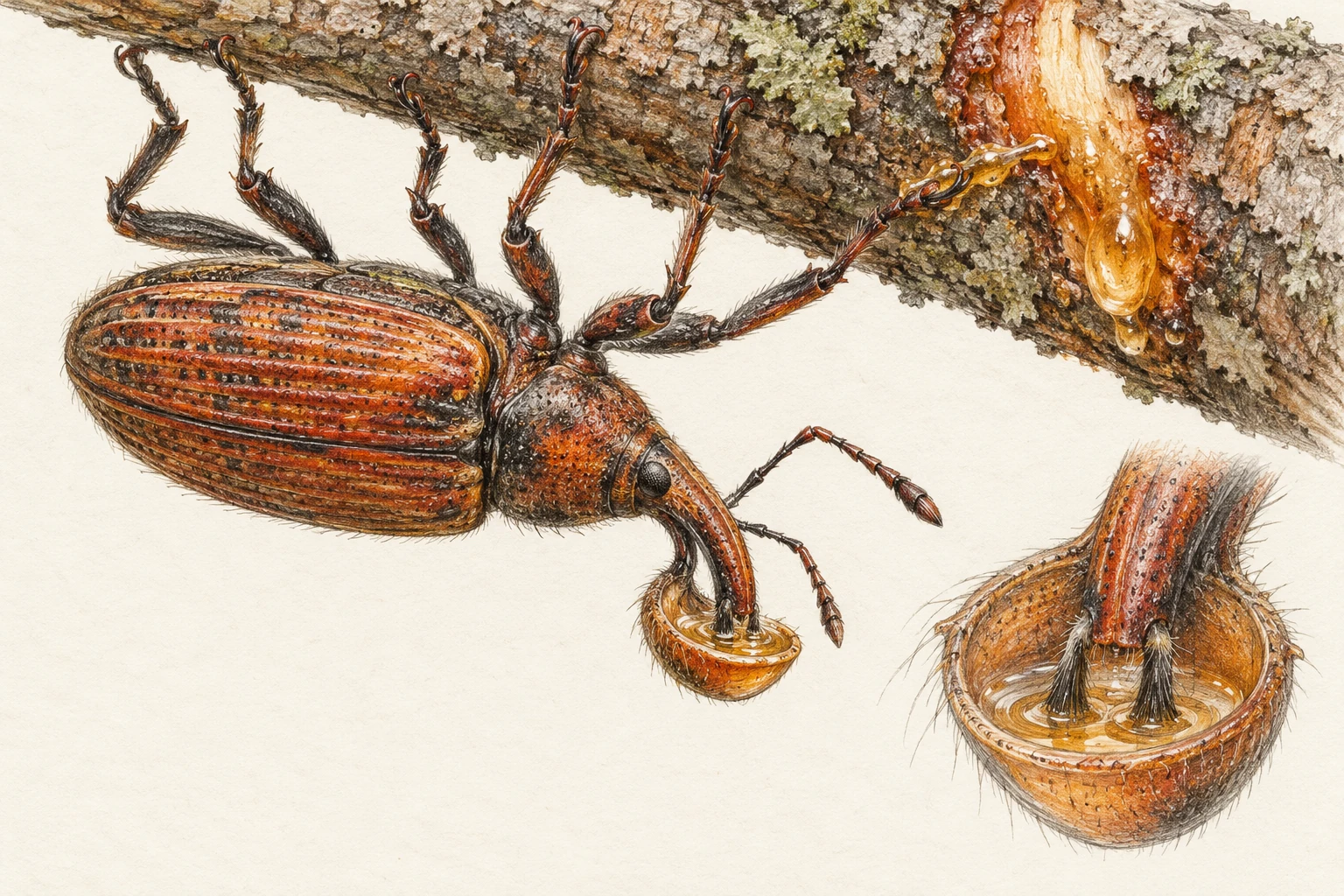
A rosin-cup weevil hangs beneath a fresh tree wound with a droplet held in the flexible cup below its snout. Mouth brushes work at the resin-water boundary while a forefoot returns a thin amber smear to the bark. Its enlarged foregut separates fungal food and dissolved sugars from the resin. Individual adults revisit favored wounds, occasionally reopening the bark as they feed.
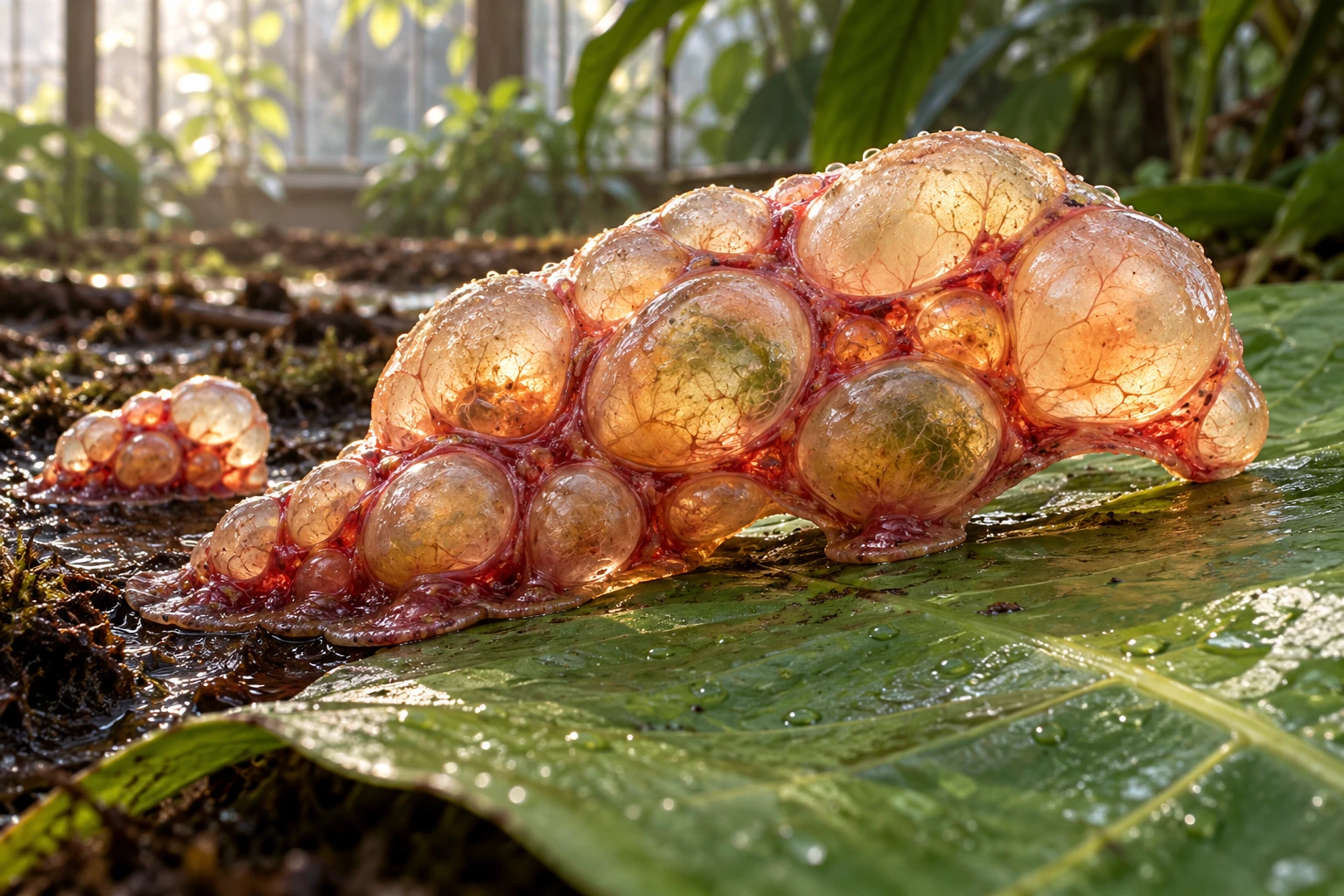
Bubbleridge#
Illustration
The bubbleridge shifts gas and liquid between compartments as it crawls from a humid feeding mat onto a leaf. Thick cranberry junctions carry circulating nutrients, while broad low patches grip the surface beneath the lighter gas-filled regions. Shared walls keep the foam coordinated as one animal. A small juvenile follows nearby, its few compartments already joined by the same living tissue.
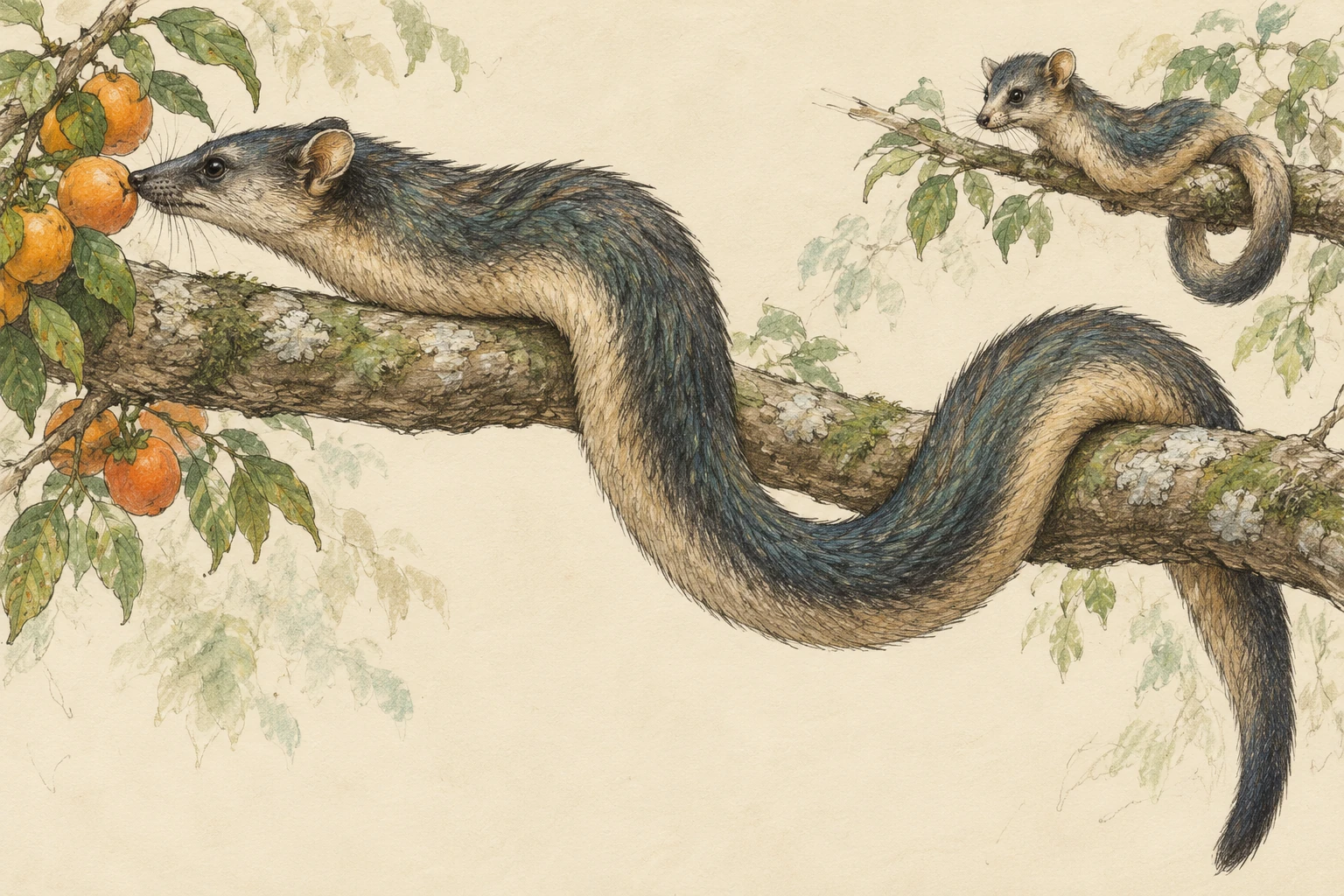
Ribbon-mink#
Sketch
A ribbon-mink drapes its muscular trunk across two broad contact regions on a fruiting branch, lowering its muzzle toward an orange fruit. Dense belly fur spreads pressure and supplies friction as the body bends between supports. The small animal above practices a tighter curve. Flexible ribs leave room for breathing during these slow transfers, and frequent fruit and protein meals support its warm body.
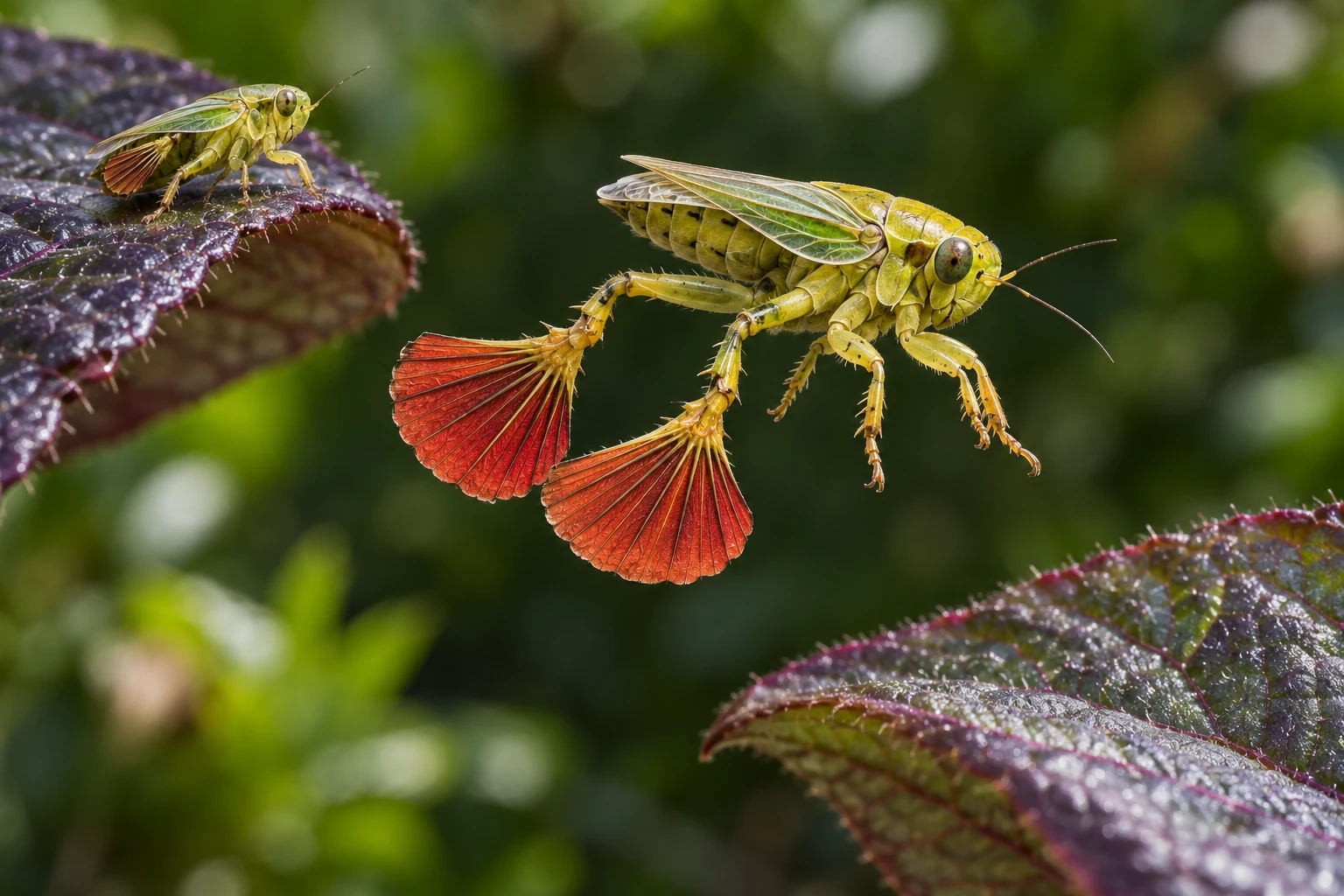
Flarefoot leafhopper#
Illustration
A flarefoot leafhopper spreads its vermilion hind-foot fans after leaving the upper leaf. Radial cuticular struts hold the thin membranes against the passing air, slowing its descent toward the lower landing. The waiting adult keeps its fans folded beside its legs. At this scale the expanded feet provide useful drag, while side eyes and antennae guide the final approach.
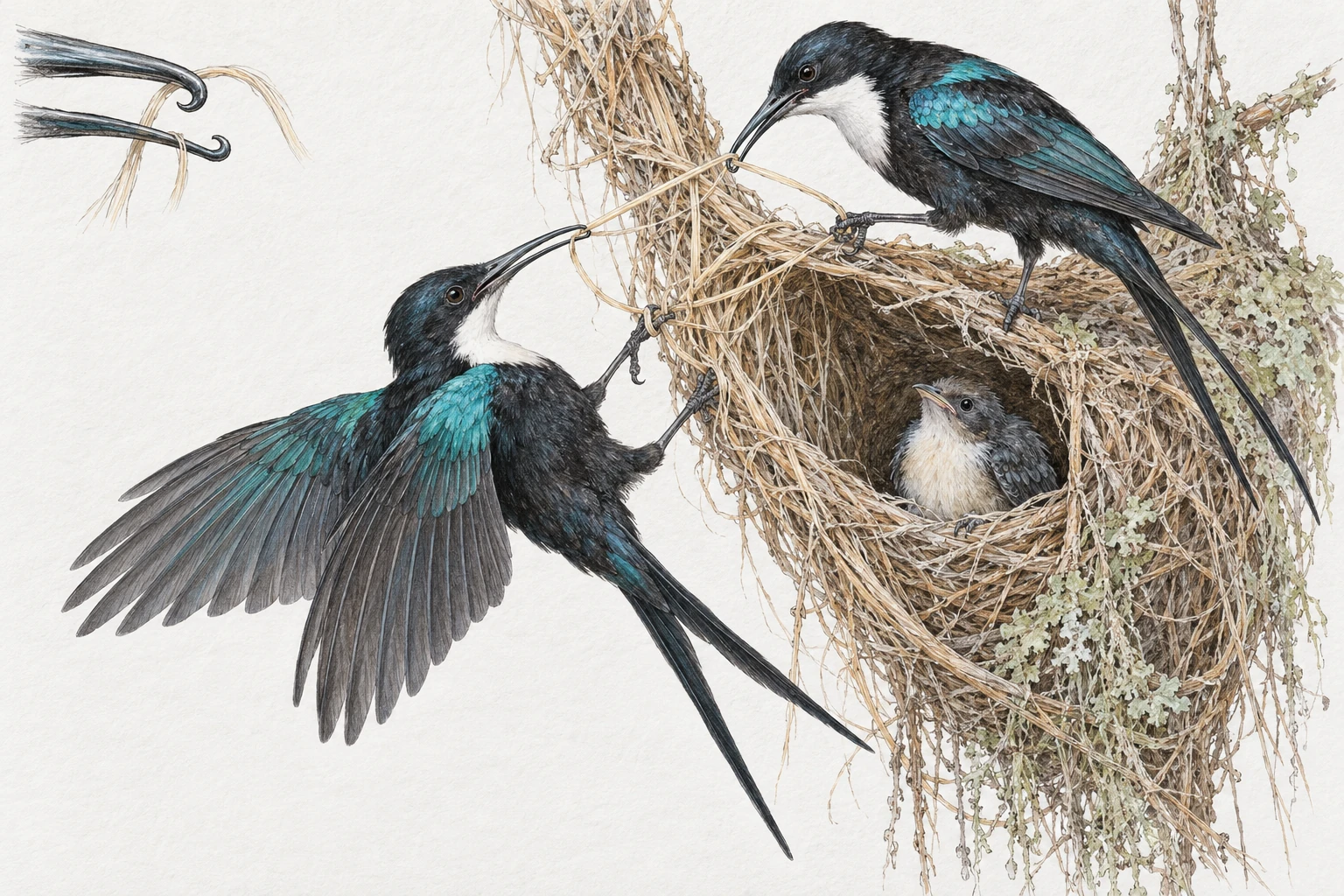
Darning swift#
Sketch
Two darning swifts tension a loose nest crossing. The hanging adult draws a fiber through a loop with its offset hooked bill tips while its partner steadies the opposite end with bill and foot. Salivary adhesive sets around the new crossing. A juvenile watches from the sheltered nest interior. The enlarged tip study shows how the beak catches a loop during repair.
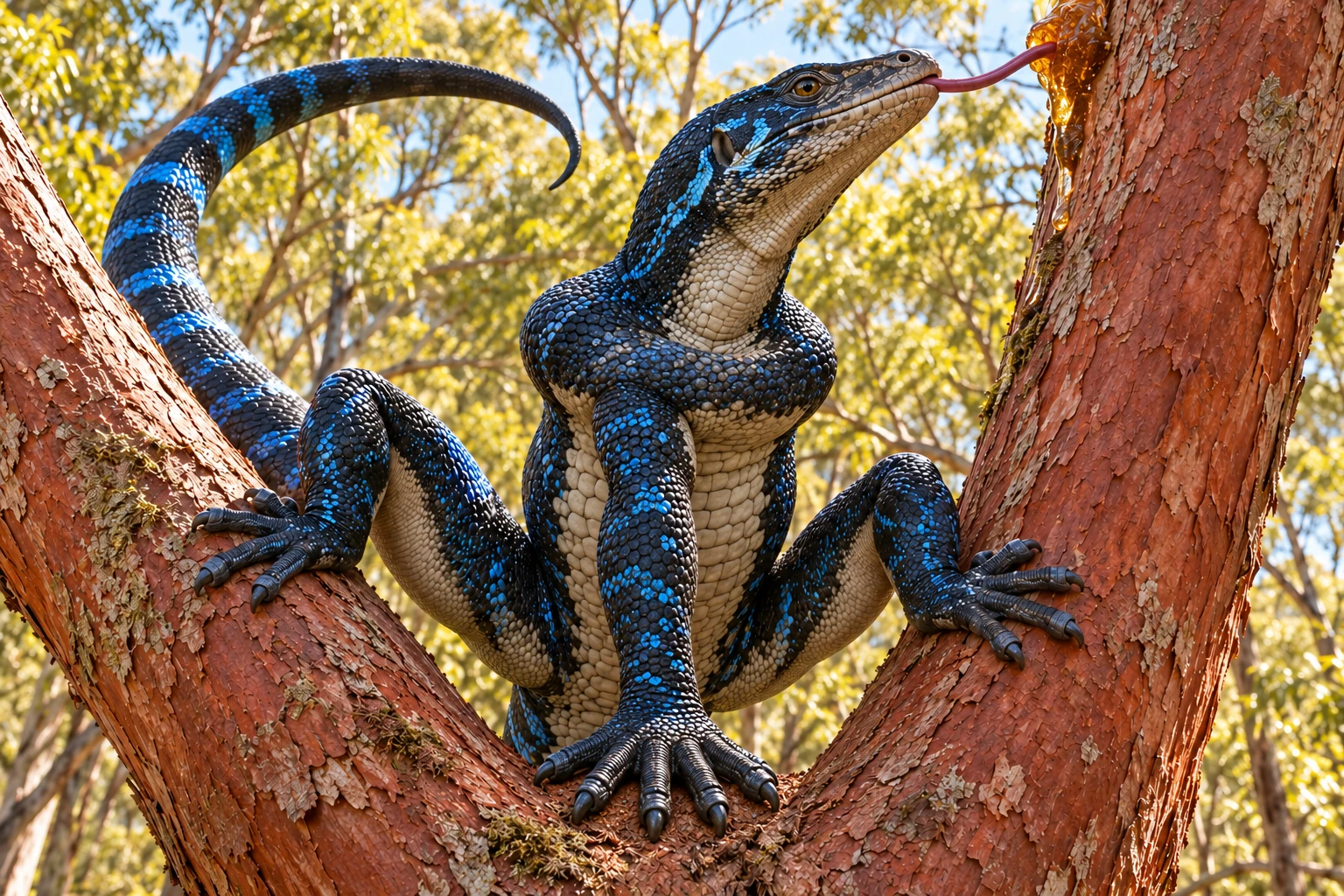
Tripod gumlicker#
Illustration
The tripod gumlicker braces one broad forepalm in the crotch of a tree while its two hindfeet grip the diverging trunks. A heavy shoulder crossbar supports the single central arm and spreads its load across the chest. The long tongue samples amber gum above the fork. Its curved tail balances the body as it shifts one contact at a time along a feeding route.
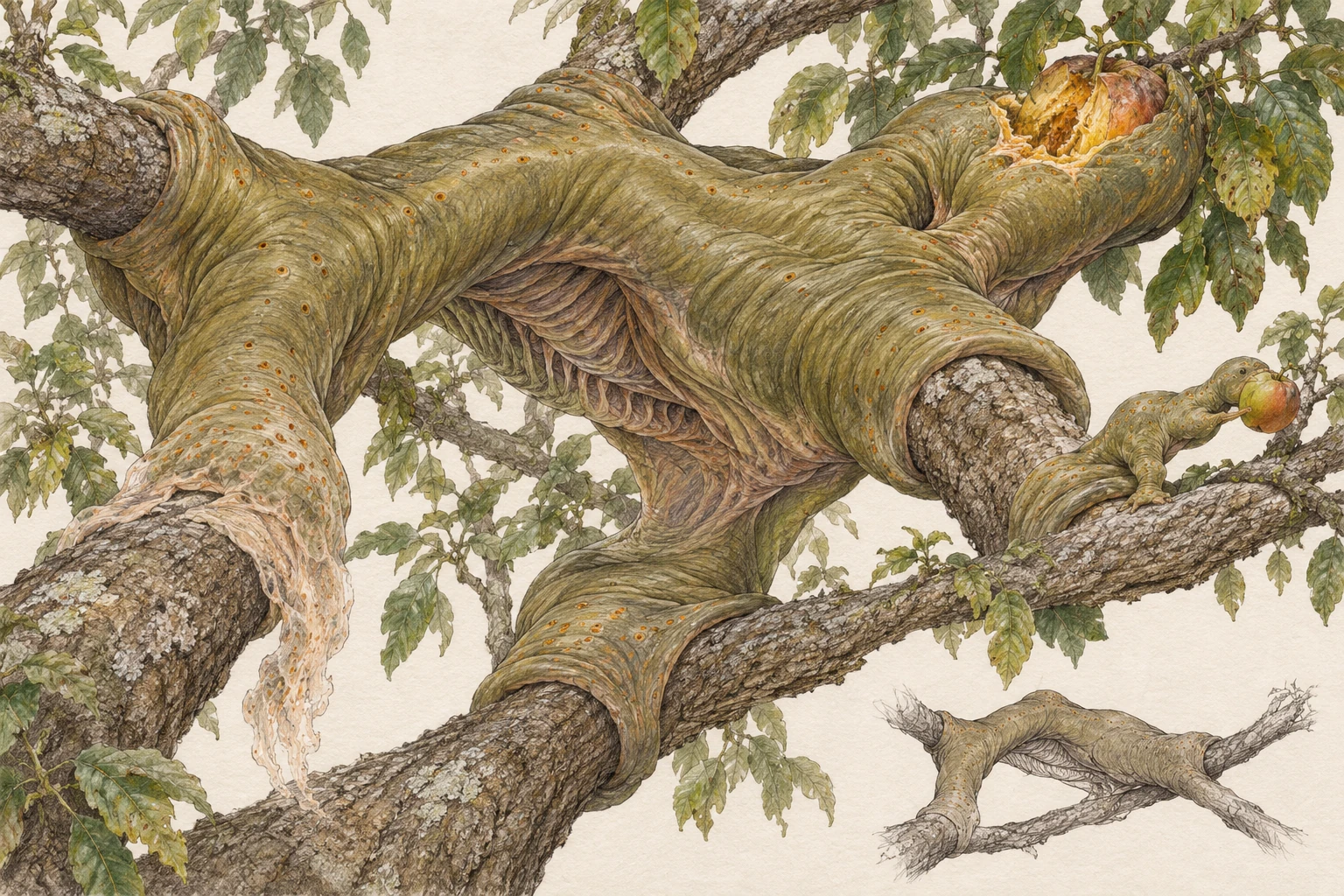
Loadweft#
Sketch
A loadweft thickens the tissue route leading to split fruit while a pale older attachment narrows on the left. Broad muscular saddles keep the branching animal connected across sturdy orchard limbs. Material travels through internal channels as unused routes slowly resorb. The protected underside carries respiratory folds, and a young animal practices a short reach from a neighboring branch.
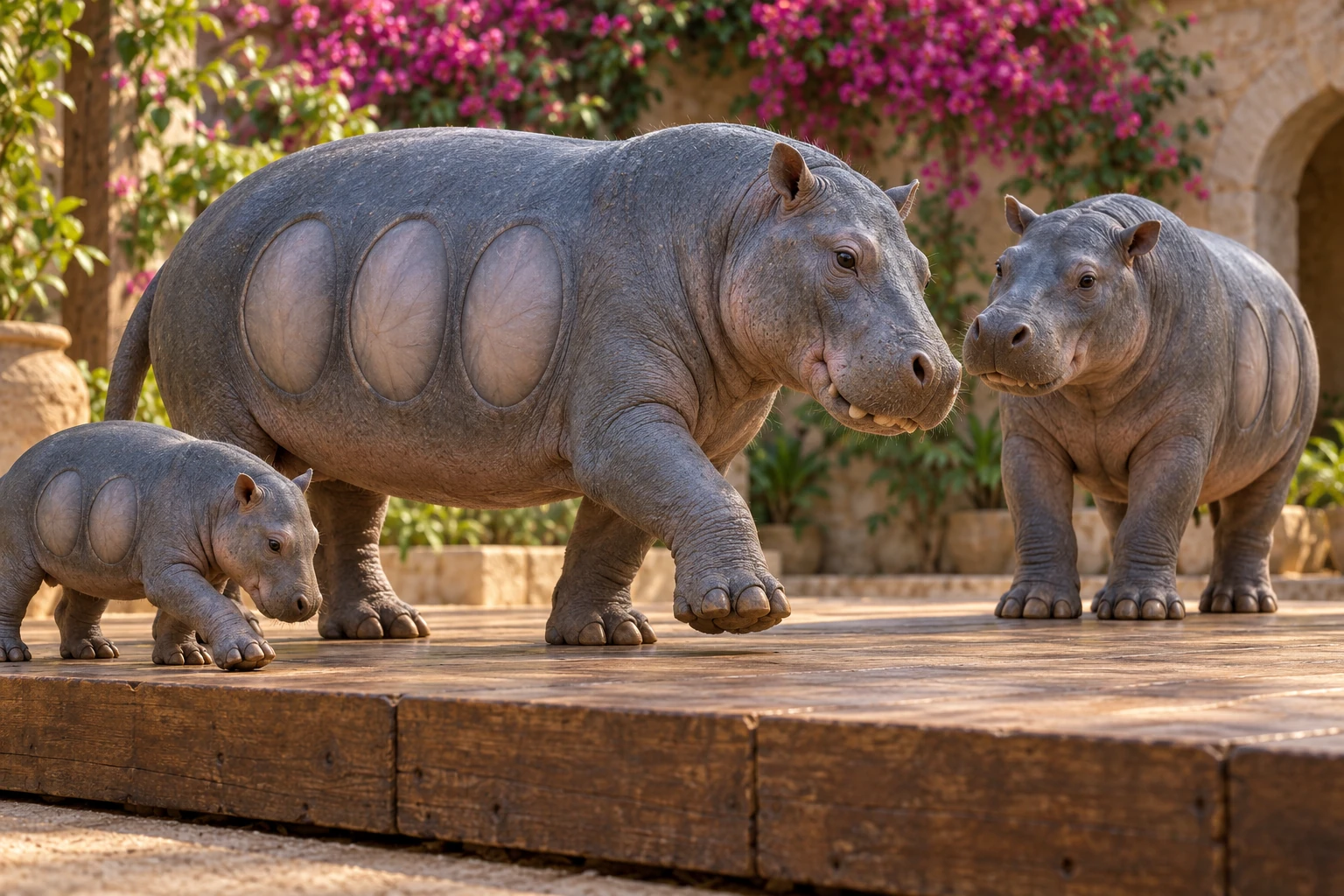
Pad-drum companion#
Illustration
The near pad-drum companion lifts a forefoot above the wooden platform while its partner waits for the next beat. Three taut skin windows cover shallow flank resonators, whose muscular walls adjust the pulses accompanying each tap. A youngster tries the same movement at the platform edge. Thick soles soften the impacts, and repeated pauses let each animal hear and feel its companion’s reply.
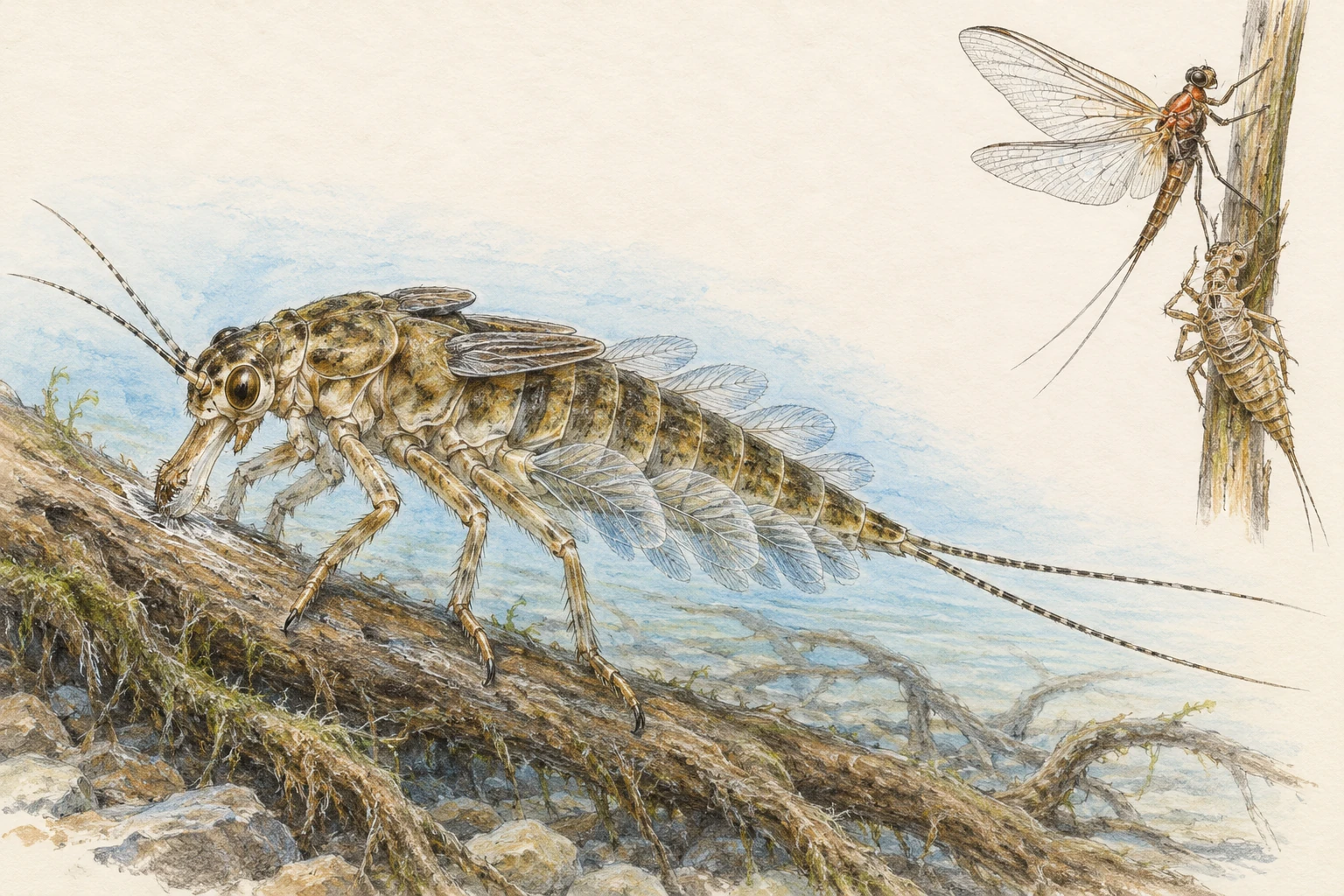
Jawharp nymph#
Sketch
The jawharp nymph braces on a submerged root and works its stiff lower-lip tongue across a transverse ridge. The scraping reaches other nymphs through the root before it chooses an emergence stem. Leaflike abdominal gills exchange gases with the surrounding water. Above, an emerged adult rests beside its split skin while the clear wings harden for life along the pond margin.
Pore pilgrim#
Illustration
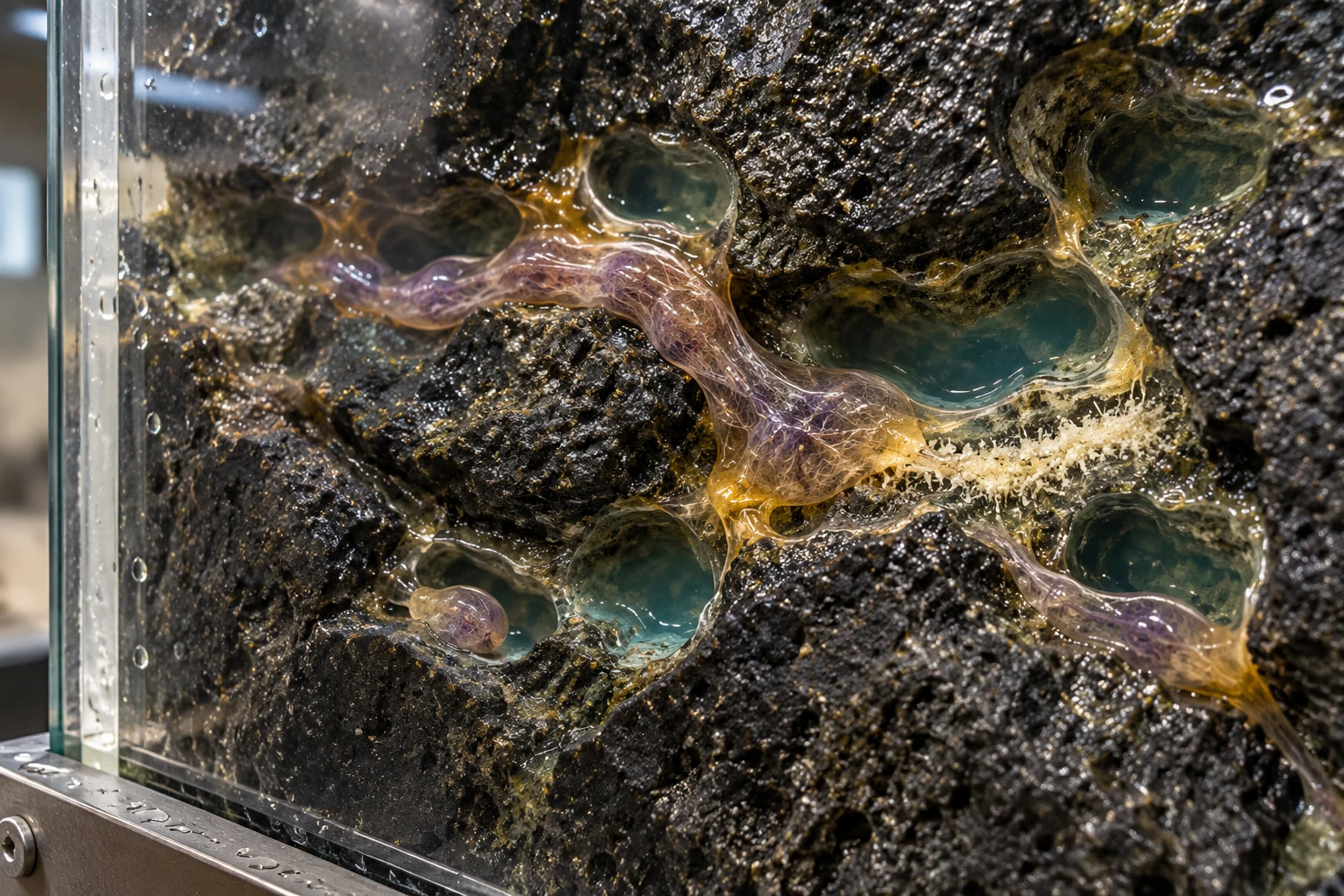
A pore pilgrim advances through water-filled basalt passages beside a nursery's quartz viewing wall. Amber menisci enter neighboring pores while older violet sheaths narrow behind them, keeping the circulating body connected through the rock. The pane reveals intact tissue beside a pale microbial seam; deeper passages continue beyond view. A separate juvenile waits in a neighboring wet pocket for a usable water connection.
Pollen-pocket frog#
Sketch
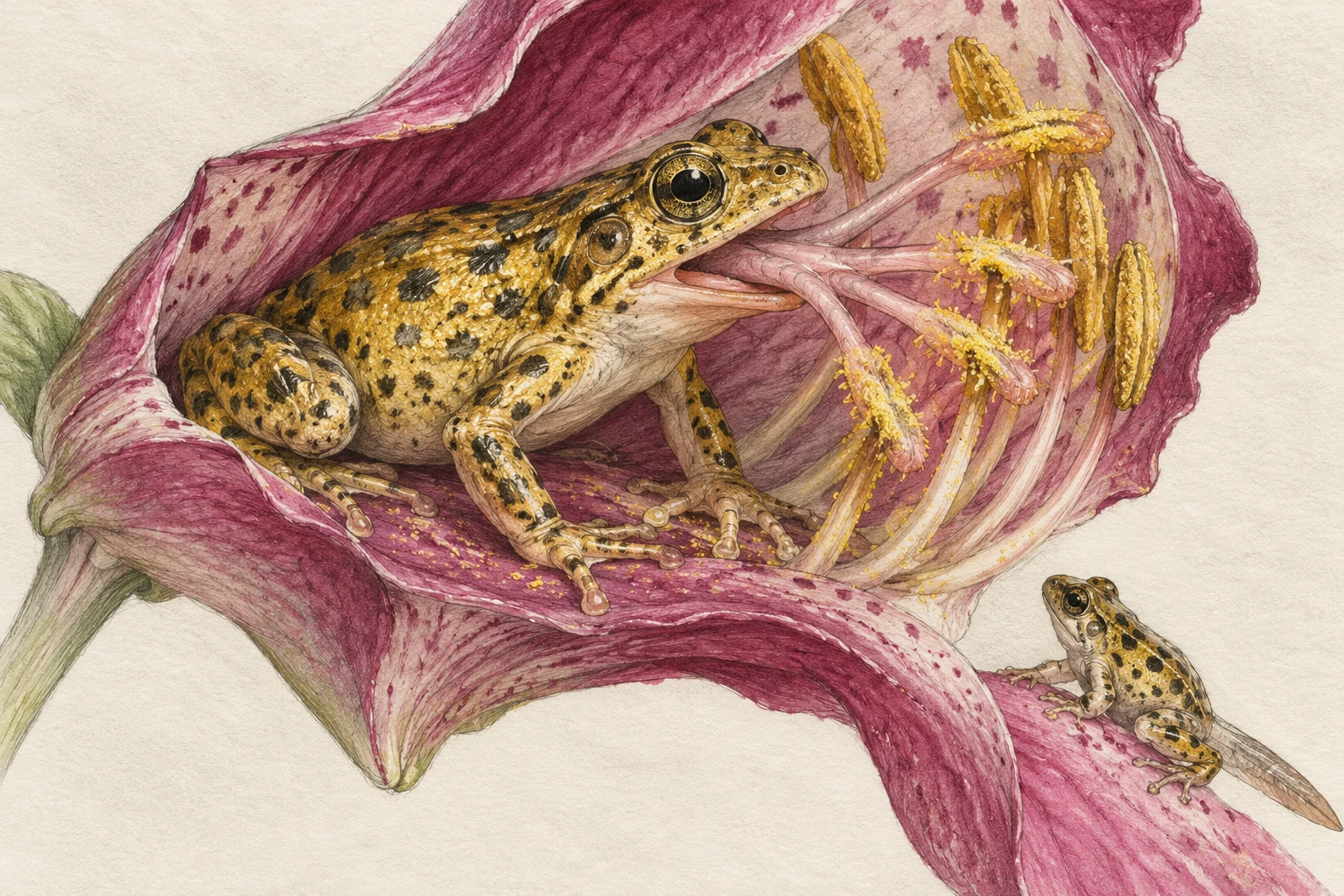
A pollen-pocket frog braces inside a humid flower and spreads four tongue branches across its anthers. Mucus papillae gather pollen, mites and soft floral tissue, then the branches fold toward their common muscular root. Moist ventral skin continues exchanging gases while dorsal secretions slow water loss. A small metamorph, still carrying its residual tail, tests the outer petal before entering the humid chamber.
Wound-stitch mantis#
Illustration
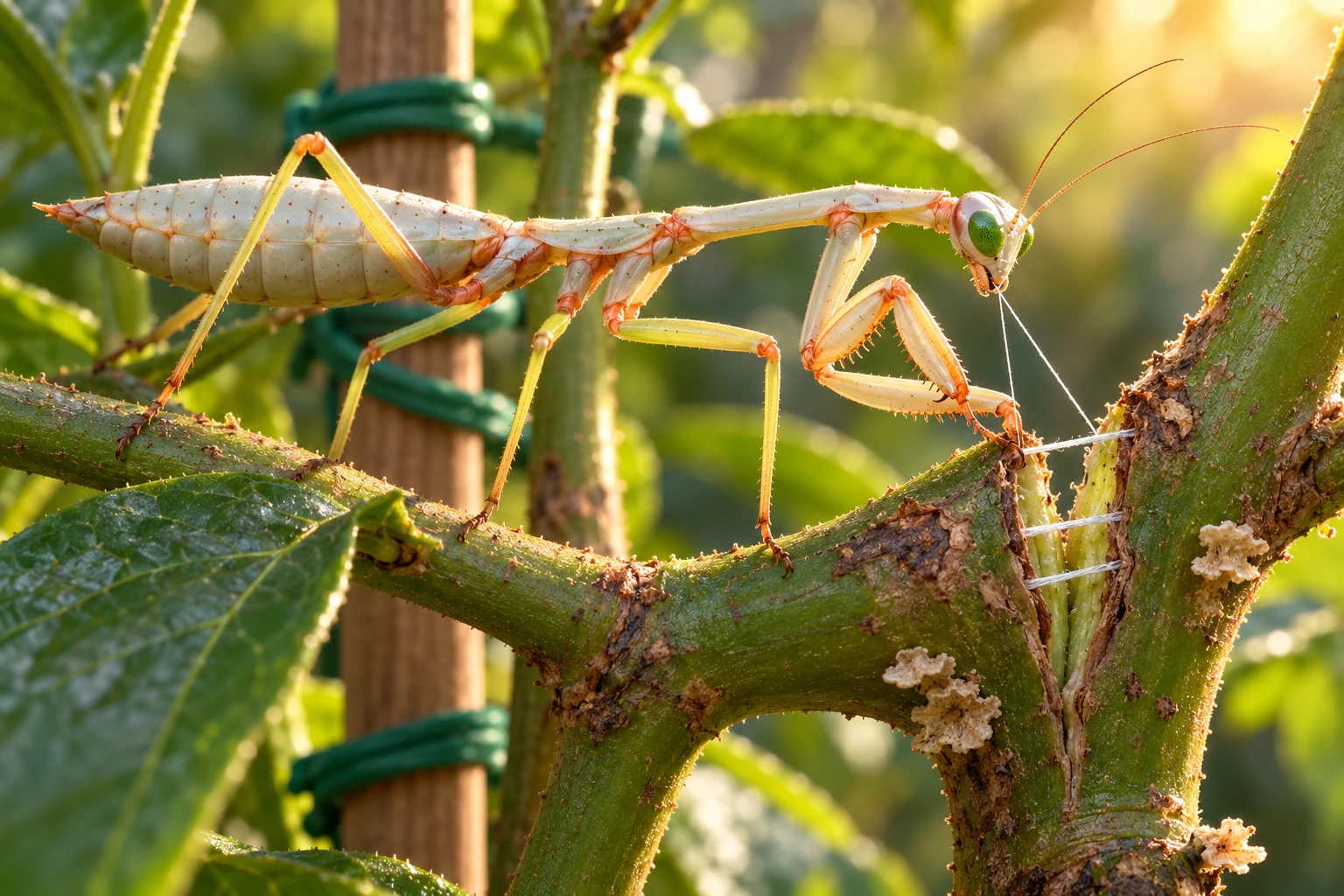
A wound-stitch mantis braces above a split young stem and presses a fresh silk strand onto its ragged edge. Paired mouth spinnerets supply the fiber while the fine forelegs place it beside earlier stitches. A garden stake carries the plant's larger loads. Between repairs the mantis grazes soft fungus at the wound, replenishing some of the protein consumed by its abdominal silk glands.
Threadtongue thimble#
Sketch
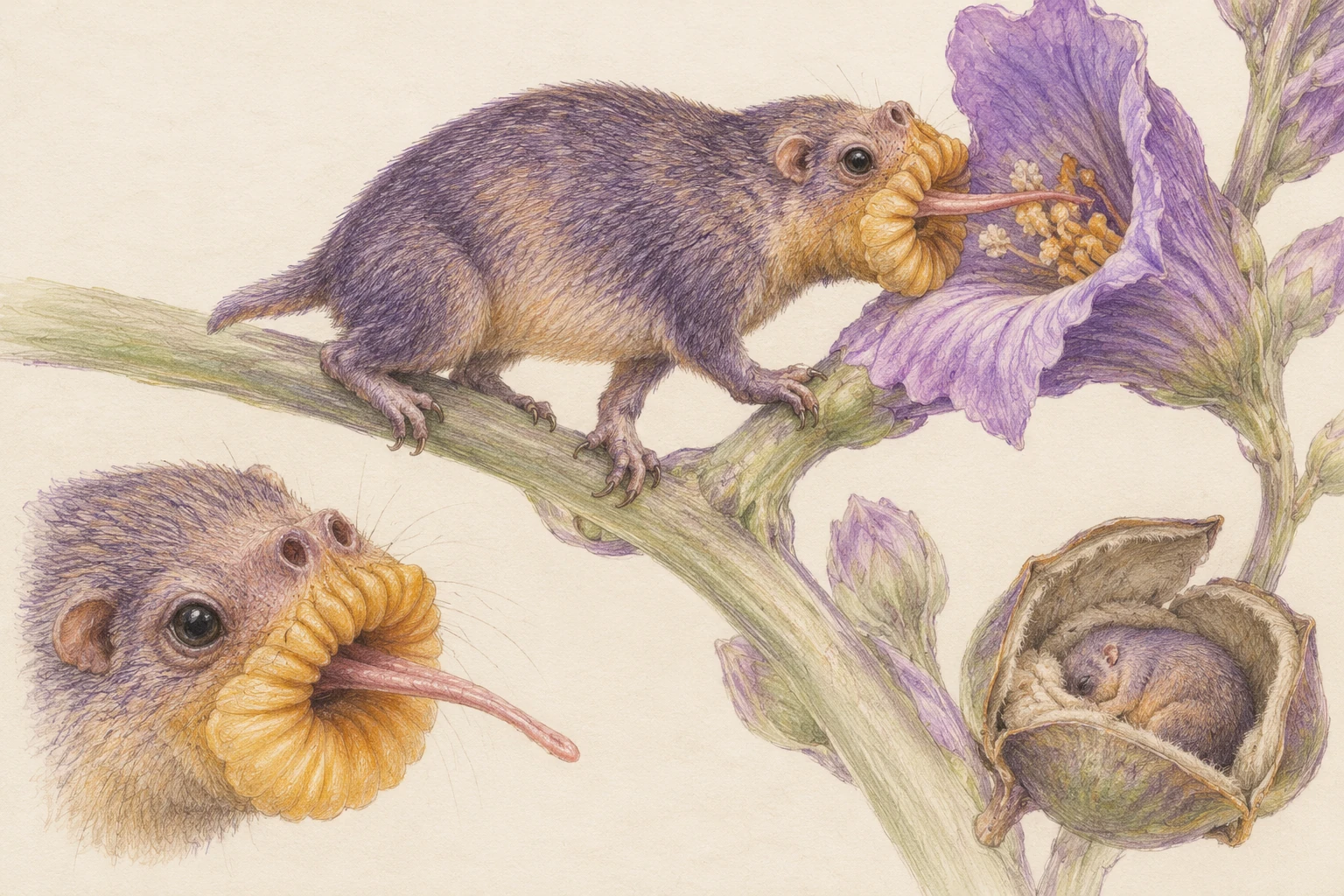
A threadtongue thimble grips a sturdy flower stalk while its fine tongue reaches between the stamens. The saffron lip collar spreads against the petals, and the nostrils remain raised above the feeding surface. An enlarged muzzle study shows the tongue’s independent route through the collar. Nectar supplies quick energy, small flower-dwelling prey supply protein, and the companion rests in an insulated capsule nearby.
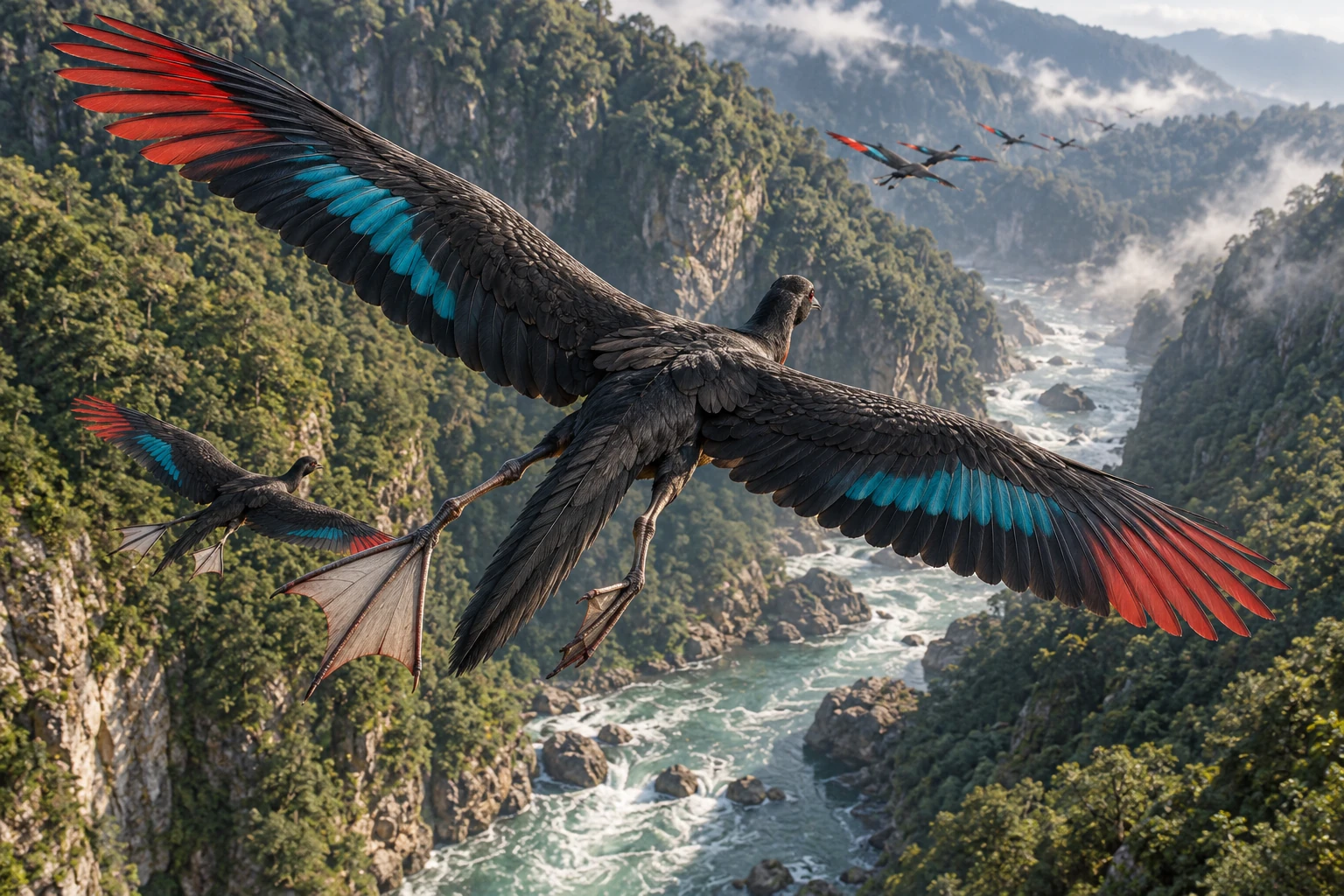
Sternsail migrant#
Illustration
A sternsail migrant banks above the gorge with one foot membrane spread and the other partly folded. Each small sail stretches between long toes at the end of a trailing leg. Tendon locks hold their angles while the feathered wings carry the bird. Differential drag trims the turn around its narrow tail. Younger birds follow experienced migrants along the rising air above the river.
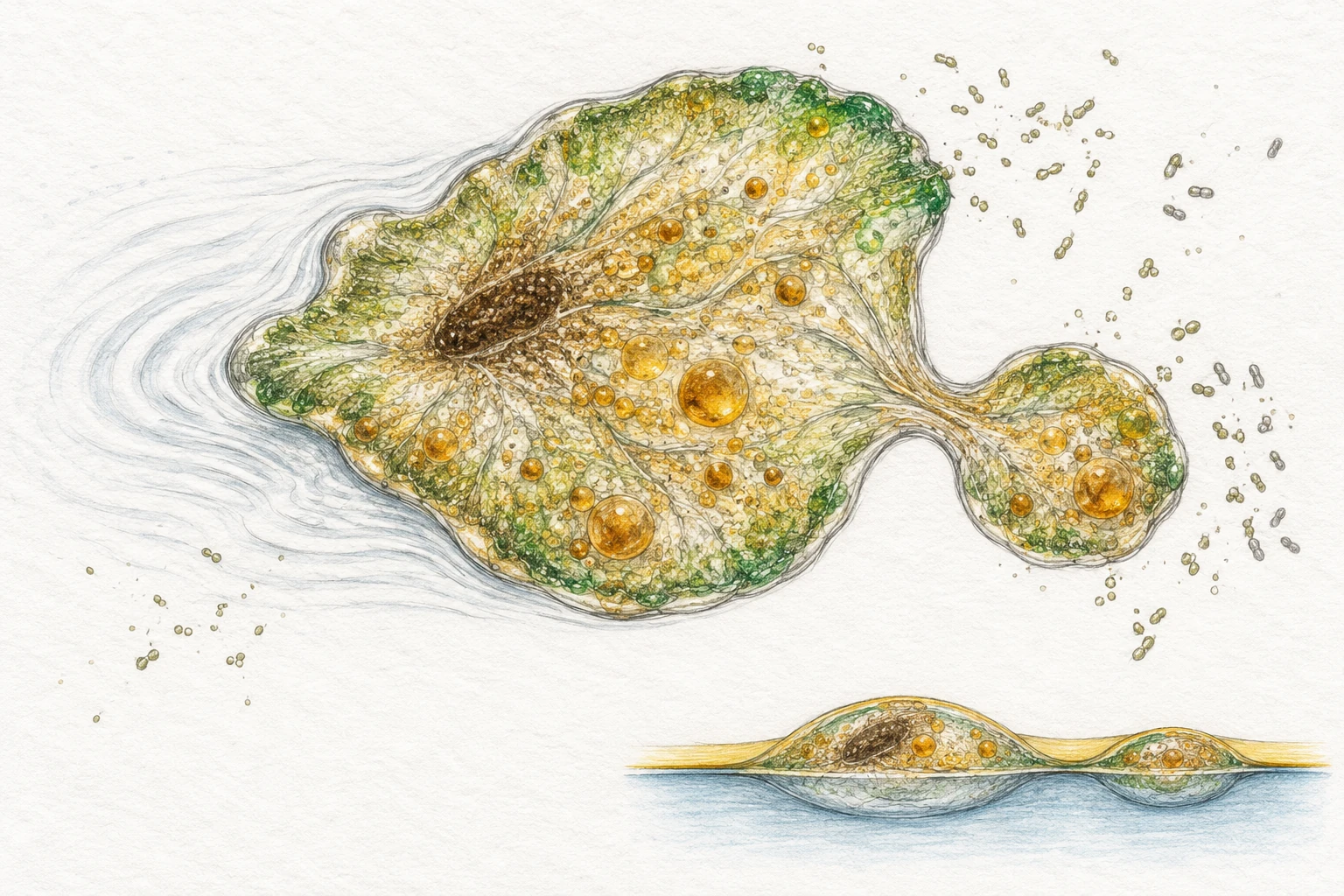
Waxwake#
Sketch
The waxwake travels along a calm oil-water boundary by spending food on local surfactant secretion. Uneven surface tension draws its cohesive living lens toward bacterial patches, leaving a smoother wake. Amber nutrient droplets move within the body around an off-center control knot. A daughter remains joined through a narrowing waist; the small side study shows both lenses seated across the liquid interface.
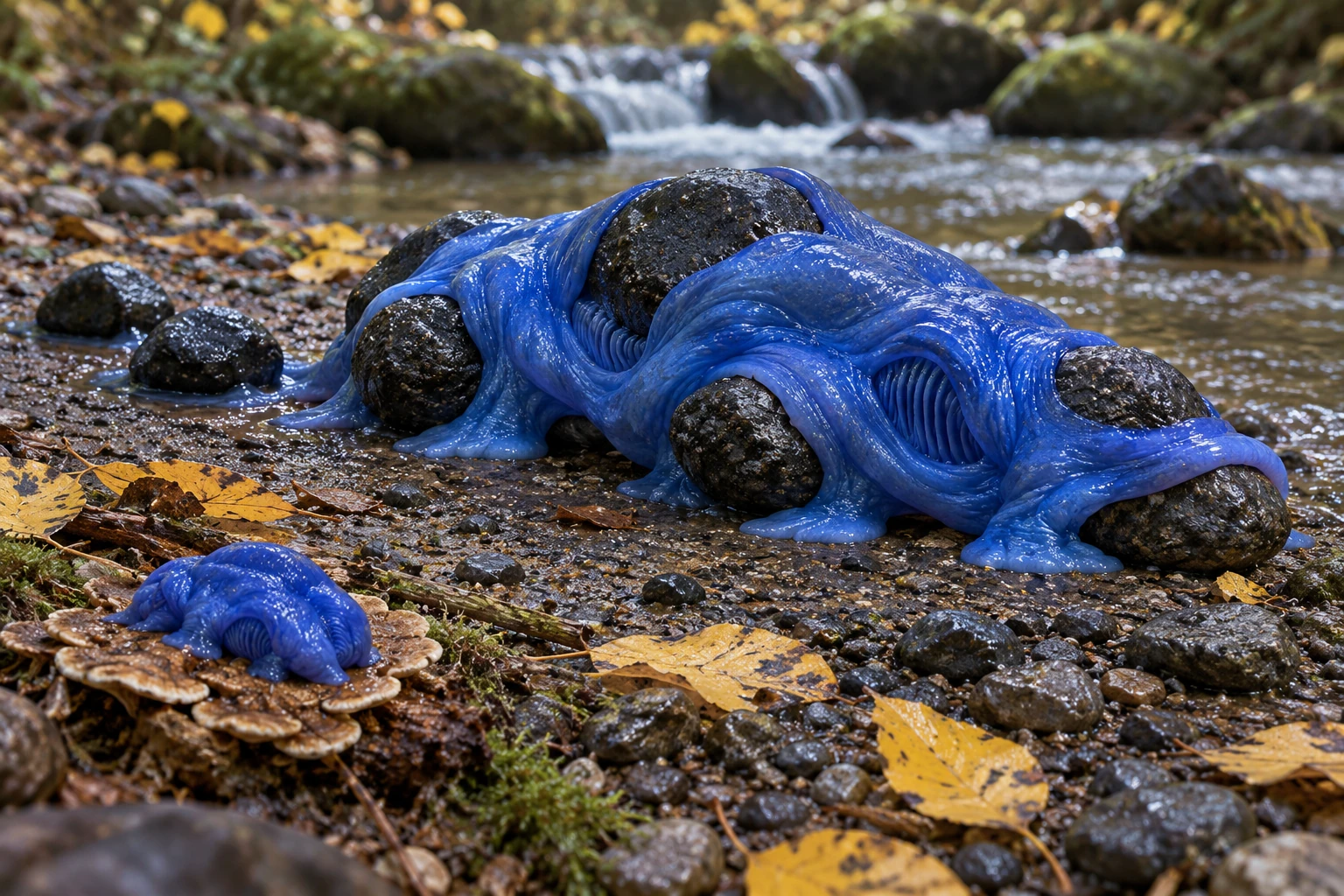
Rubble borrower#
Illustration
The rubble borrower carries replaceable stones within broad saddles of cobalt muscle. At its advancing margin, tissue envelopes a fresh pebble while older supports are released behind, leaving wet traces across the gravel. Sheltered pleats exchange respiratory gases between the load-bearing contacts. A pebble-free juvenile feeds on fungi nearby before selecting its first supports, which it will repeatedly exchange during slow travel.
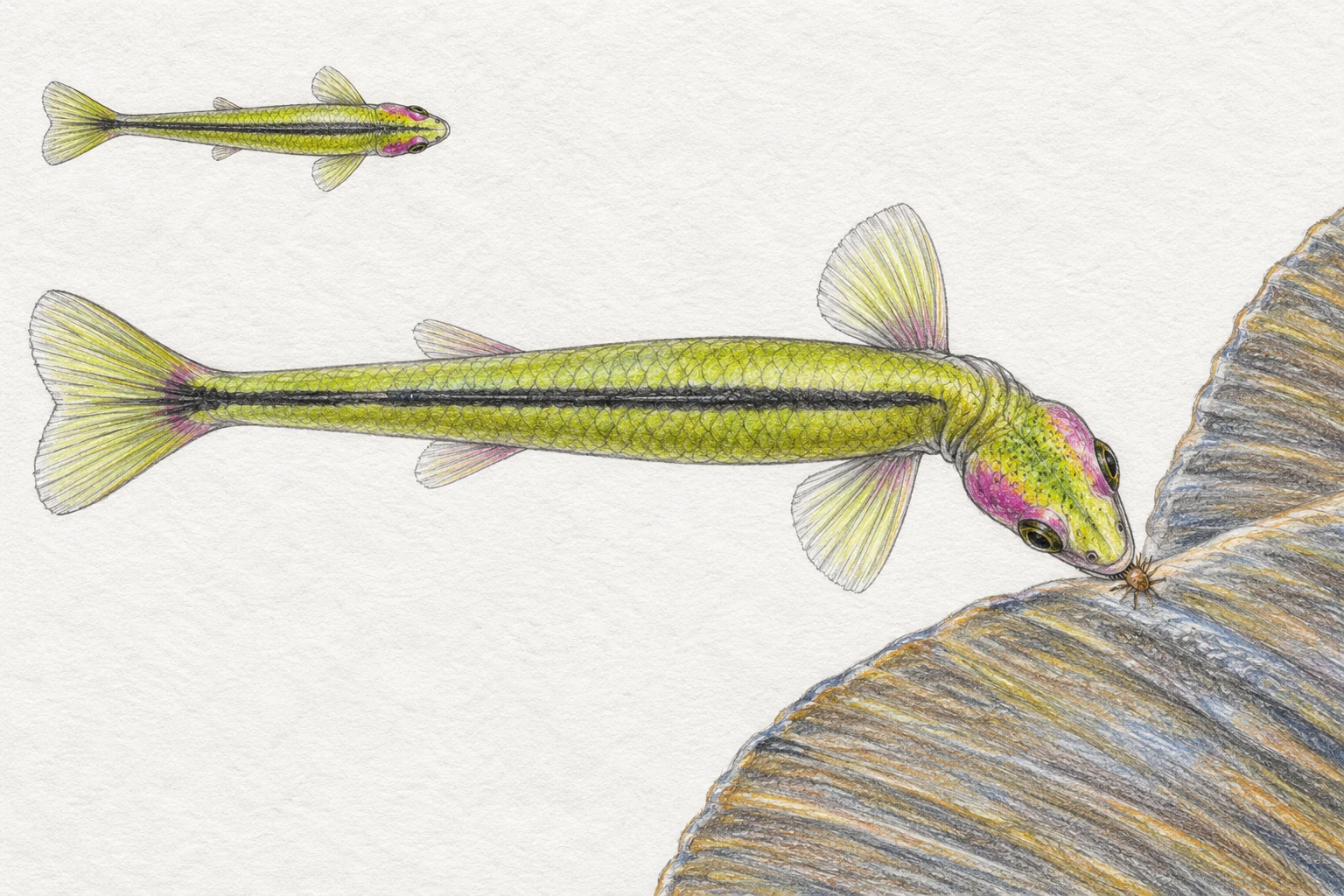
Turningjaw cleaner#
Sketch
A turningjaw cleaner holds its narrow trunk beside a client's fin and turns its head into a crease. A short flexible neck carries the bend while the paired fins steady the body. Fine brushing teeth lift parasites from the exposed fold. Slack vessels and protected nerve sheaths accommodate the turn; swallowing follows as the head returns toward the waiting cleaner's straight posture.
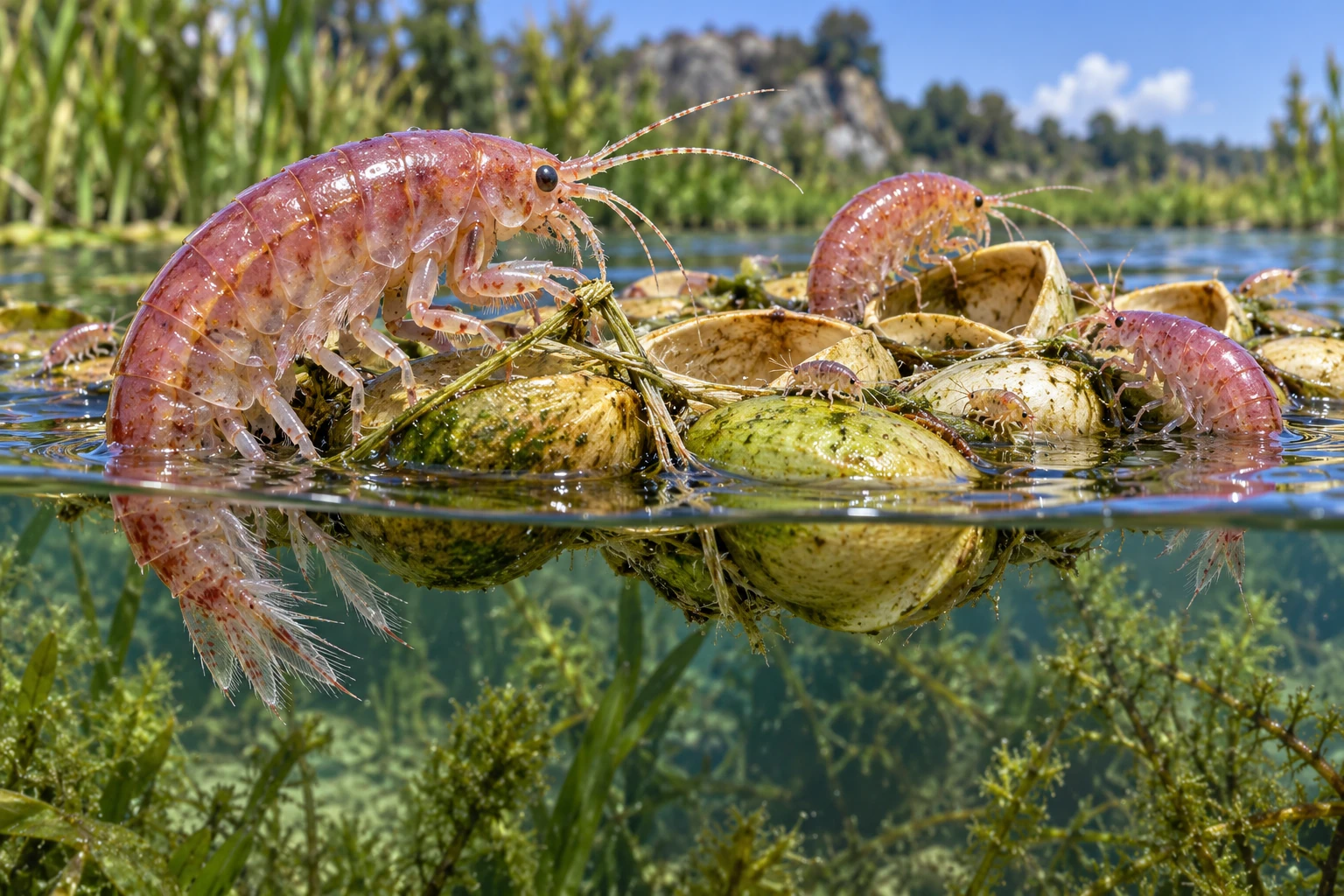
Shell-raft amphipod#
Illustration
Shell-raft amphipods bind hollow seed husks with fibers and fine silk, keeping a shared nursery at the lagoon surface. The foreground adult braces against the rim while its submerged abdominal limbs row beside the raft. Young graze microbial films on the wet husks. The trapped air carries the platform's weight, and adults regularly dip their gill-bearing undersides as they work.
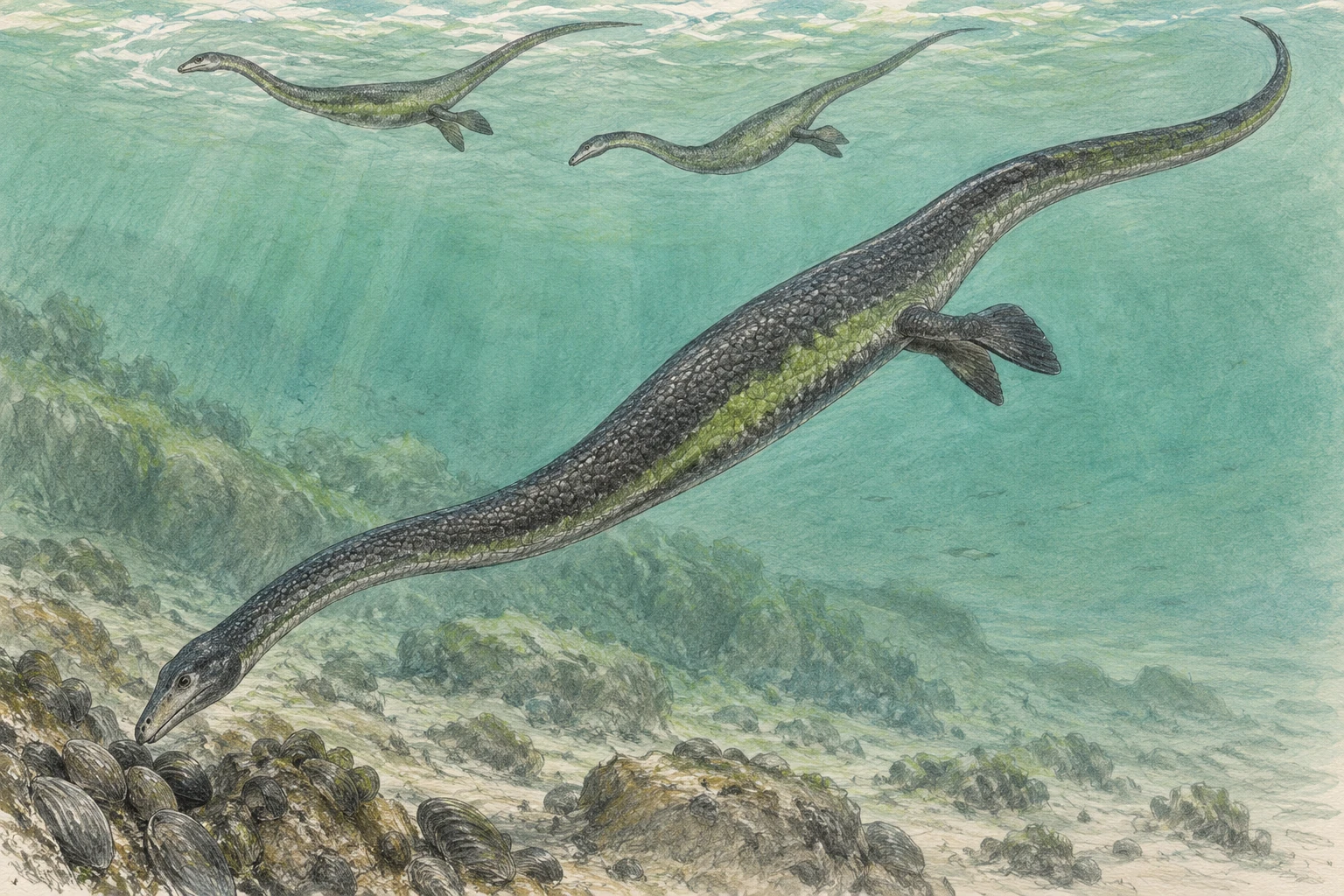
Masthead swimmer#
Sketch
A masthead swimmer descends toward a shellfish bed with its neck extended and its rear flippers spread for braking. Waves along the long trunk and tail provide thrust. Closable nostrils at the beaked snout protect the airway during the dive. Two smaller young remain near the surface, practicing the same descent over shorter intervals before returning to breathe.
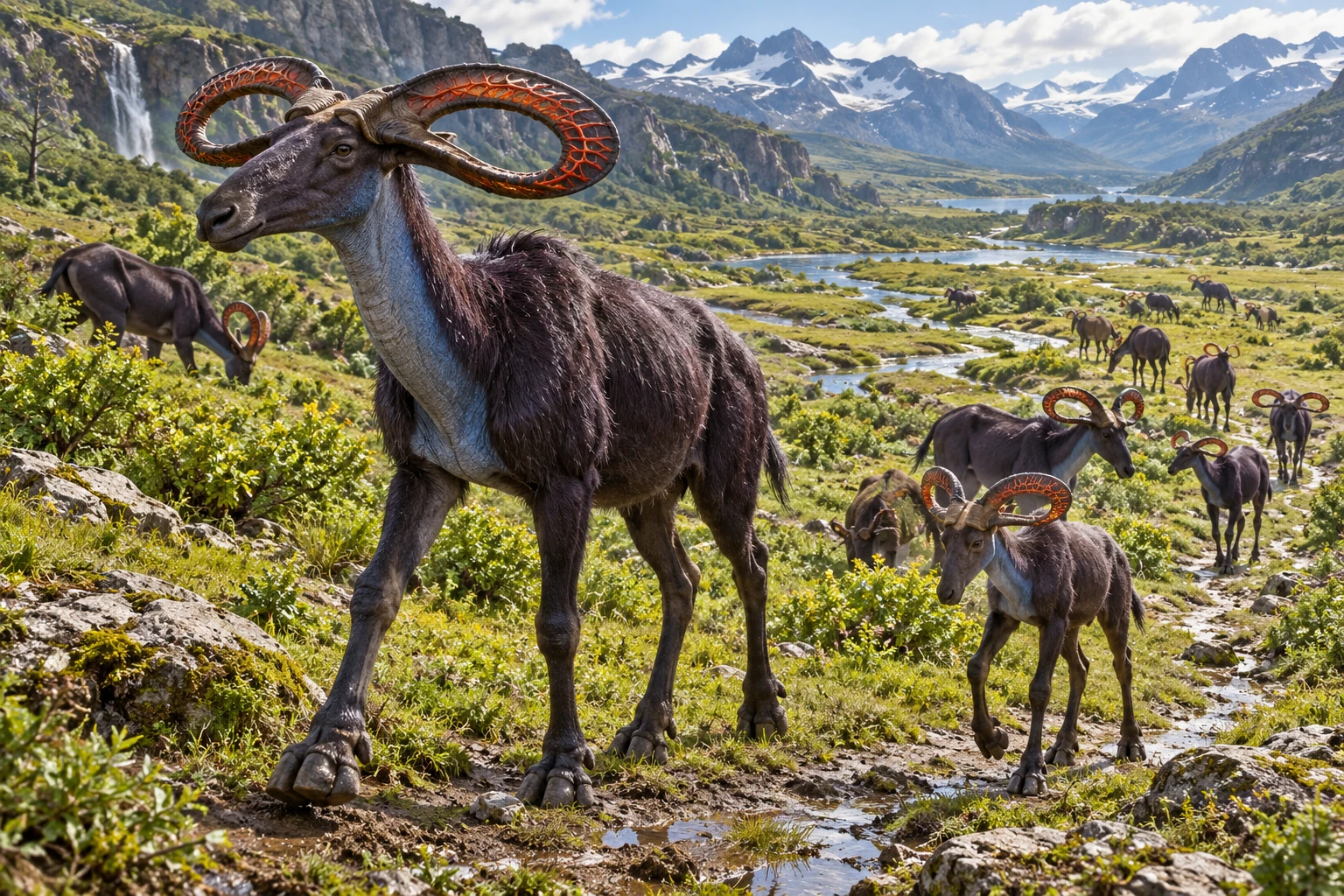
Veinhorn migrant#
Illustration
Veinhorn migrants follow a green valley route after rain. The nearest adult turns its broad horn loops across the airflow, exposing branching vessels beneath thin keratin. Blood moving through their reinforced living cores releases heat when the air is cool enough. A youngster steps around the wet hoof depressions while scattered adults browse along the corridor, widening the trail with each seasonal passage.
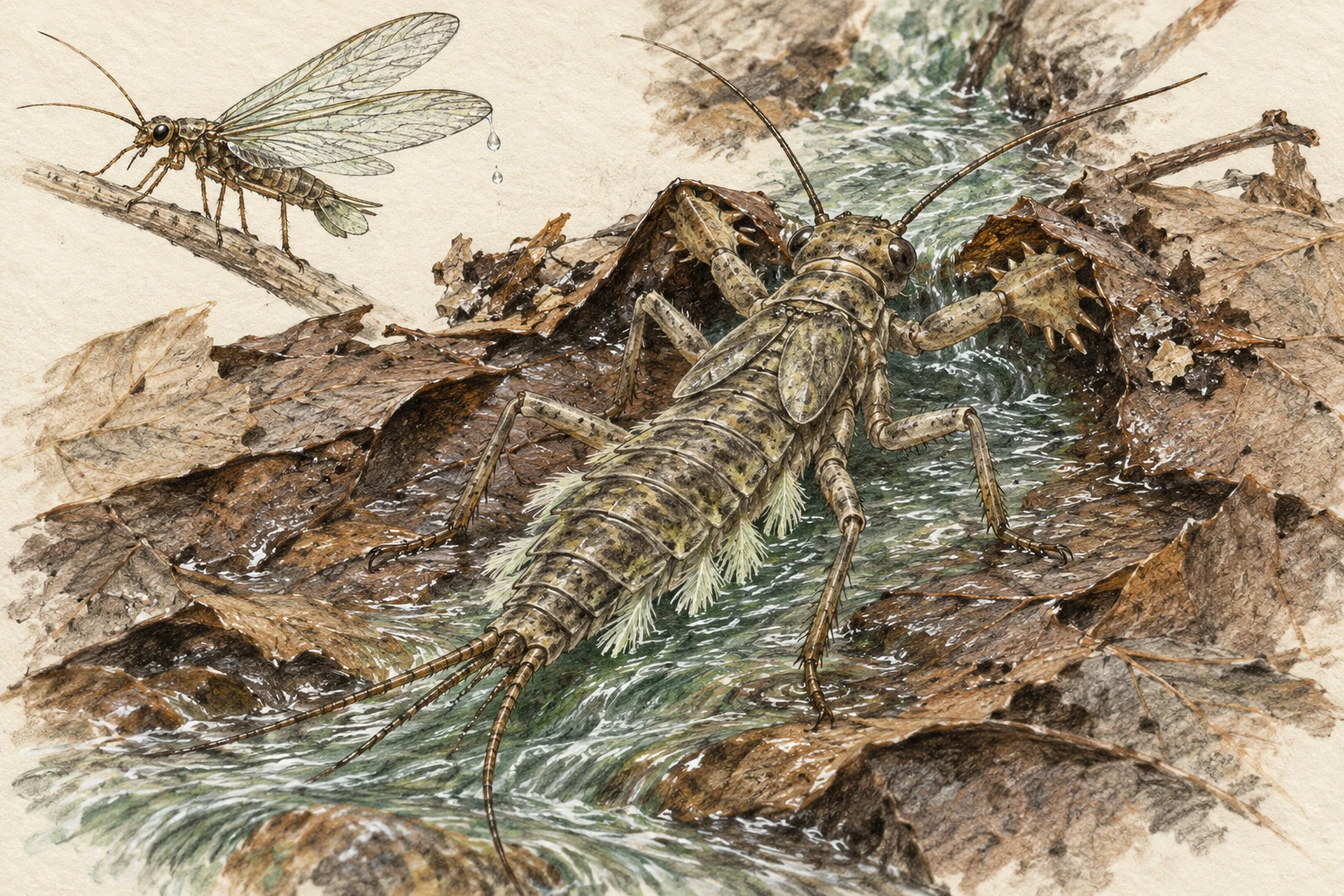
Rakewing nymph#
Sketch
A rakewing nymph pushes wet leaf edges aside with its broad toothed forefeet. The opened channel carries stream water past gill tufts beneath the abdominal covers, bringing oxygen and fresh fragments of food. Its four remaining legs brace on the litter. The adult study shows the dry stage shedding water from broad wings, with small abdominal flaps retained from the juvenile covers.
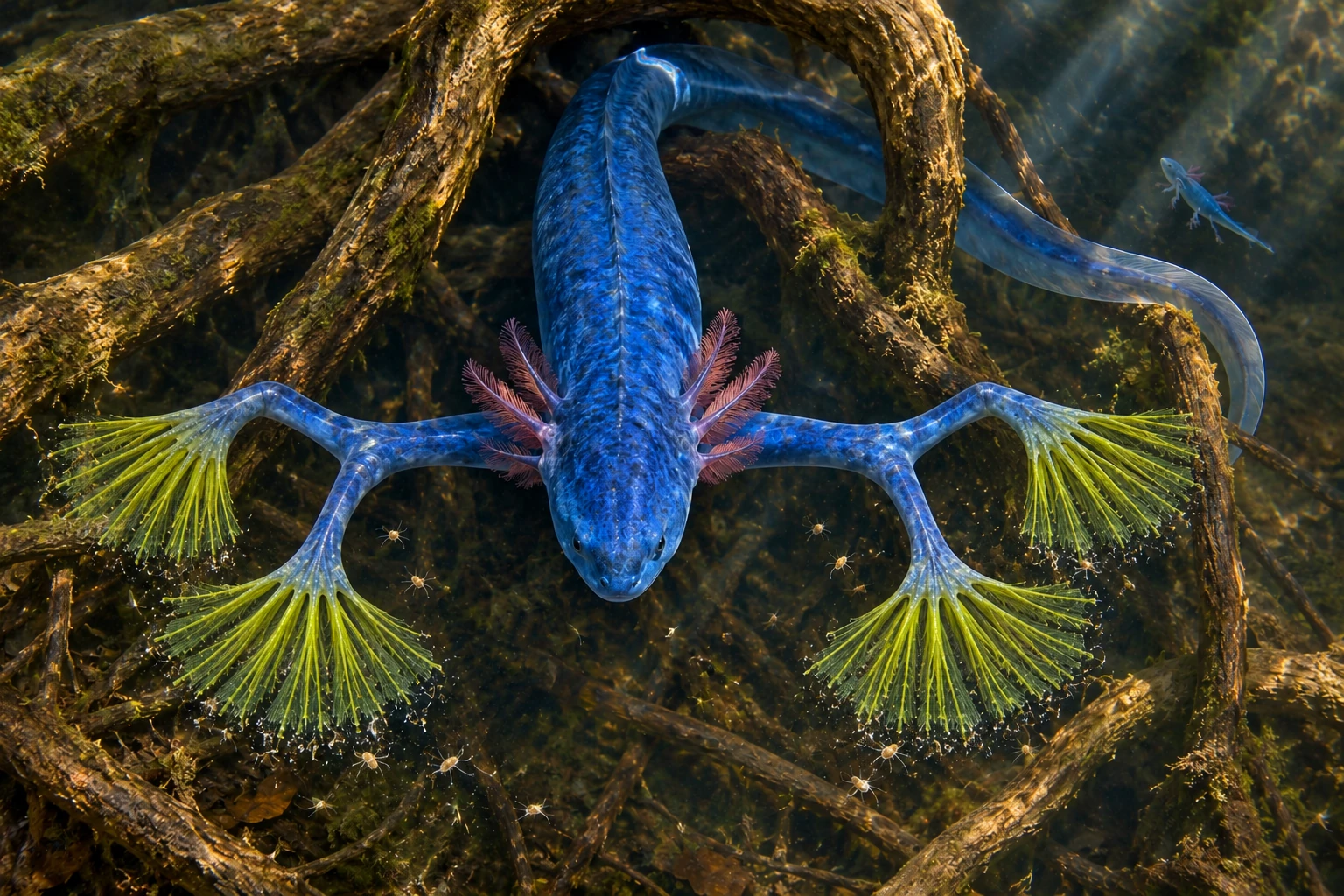
Scoophand siren#
Illustration
A scoophand siren spreads four hand fans into separate lanes beneath the roots. Each thick upper arm reaches a broad elbow and divides into two forearms, giving every fan its own wrist. The fingers collect drifting soft prey and pass it toward the mouth. External gill folds behind the head supplement skin respiration, while the long tail carries the animal between feeding stations.
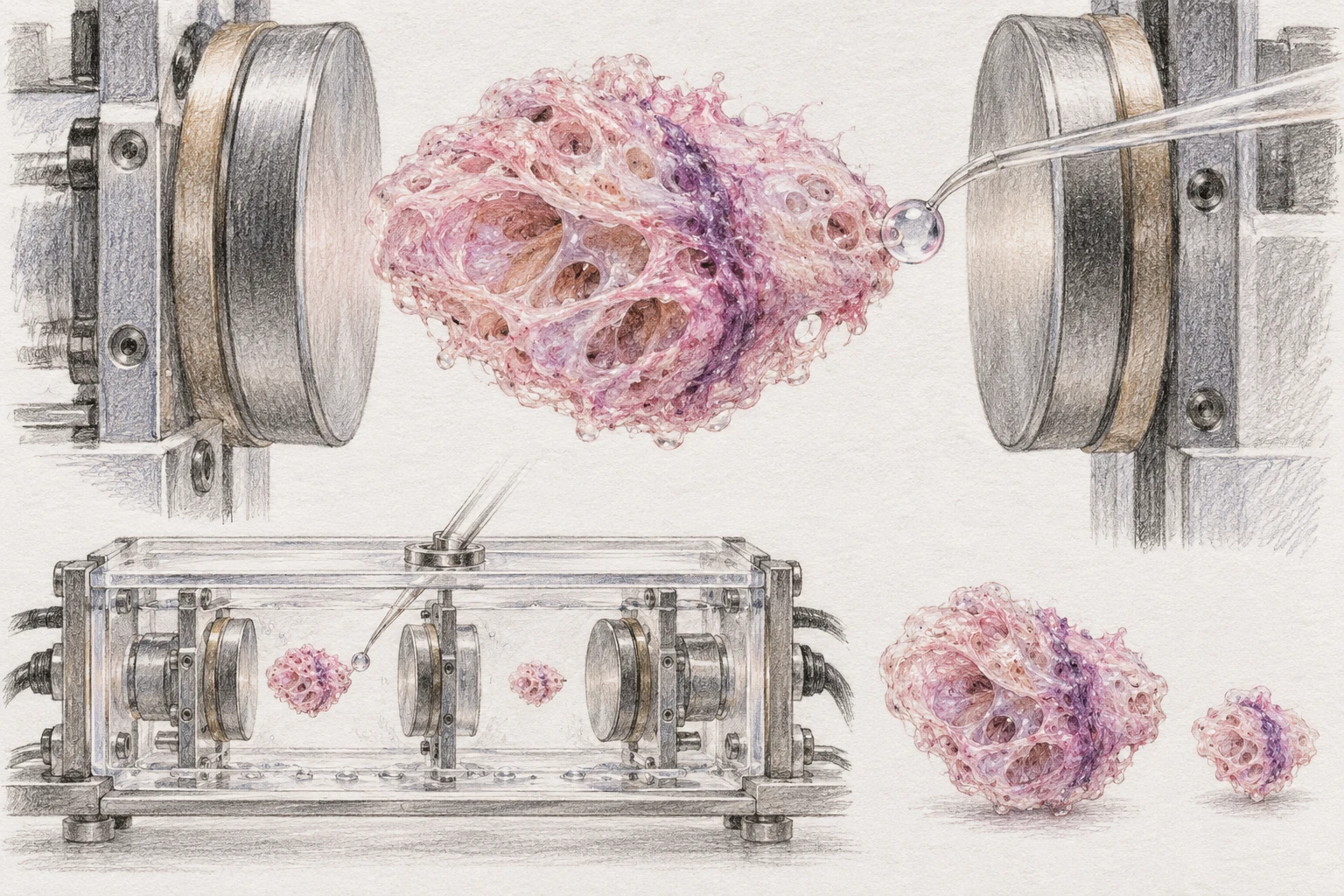
Acoustic skein#
Sketch
An acoustic skein receives a nutrient droplet between opposed ultrasonic transducers. The humid chamber supplies acoustic support, food and water, while the animal adjusts its porous tissue's stiffness to change orientation and choose among nearby stable positions. Fine connected channels distribute the meal through its fused fibers. The lower apparatus study shows an adult and smaller daughter occupying separately maintained traps.
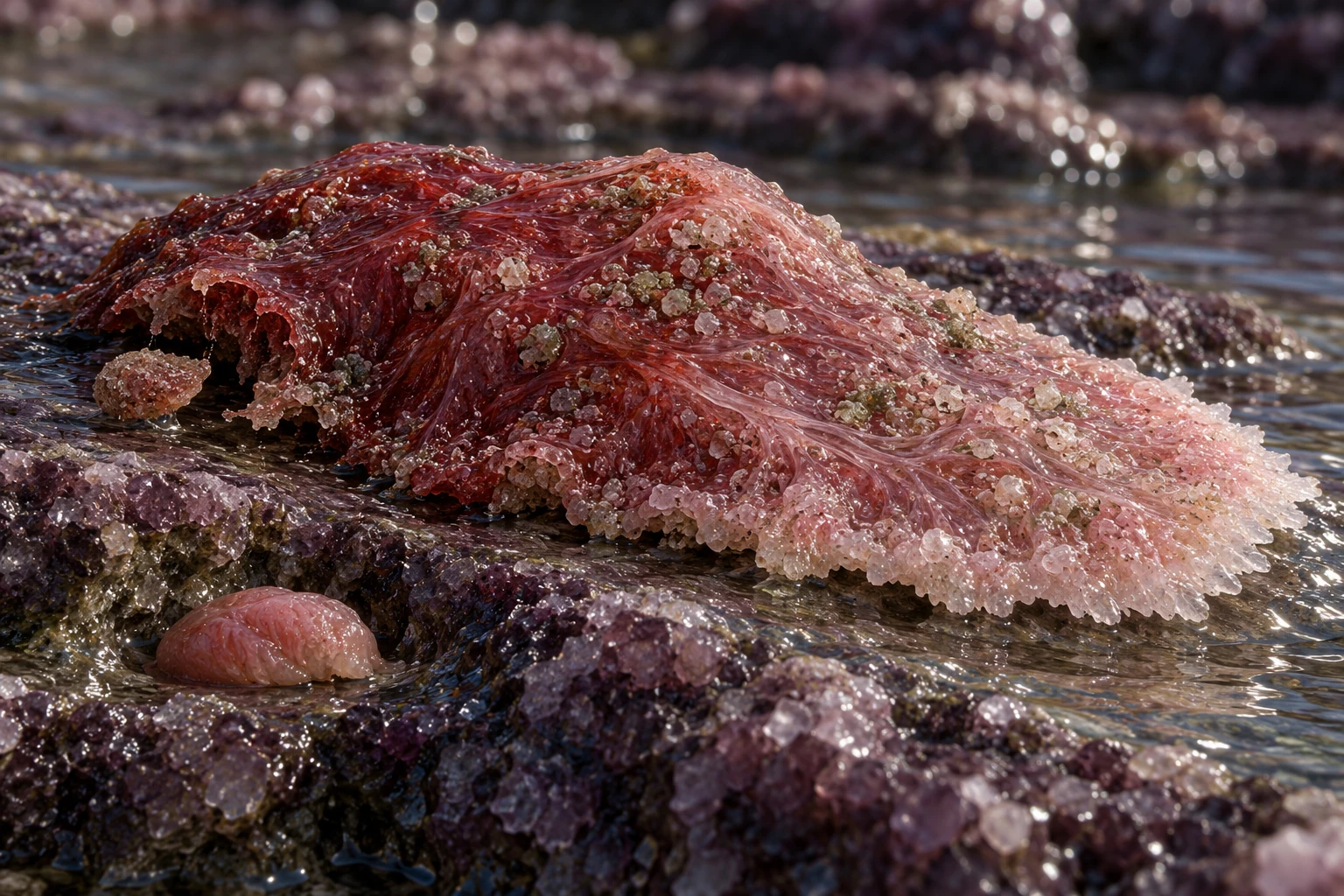
Saltcast#
Illustration
A saltcast creeps along a supplied brine ledge by rebuilding the mineral fraction of its body. Fine crystallites form inside the pale advancing tissue while darker trailing layers dissolve their supports and retract around a loosened grain. Continuous wet cell layers and fluid microchannels preserve circulation throughout this slow exchange. The sheltered juvenile remains soft while developing its first mineral inclusions.
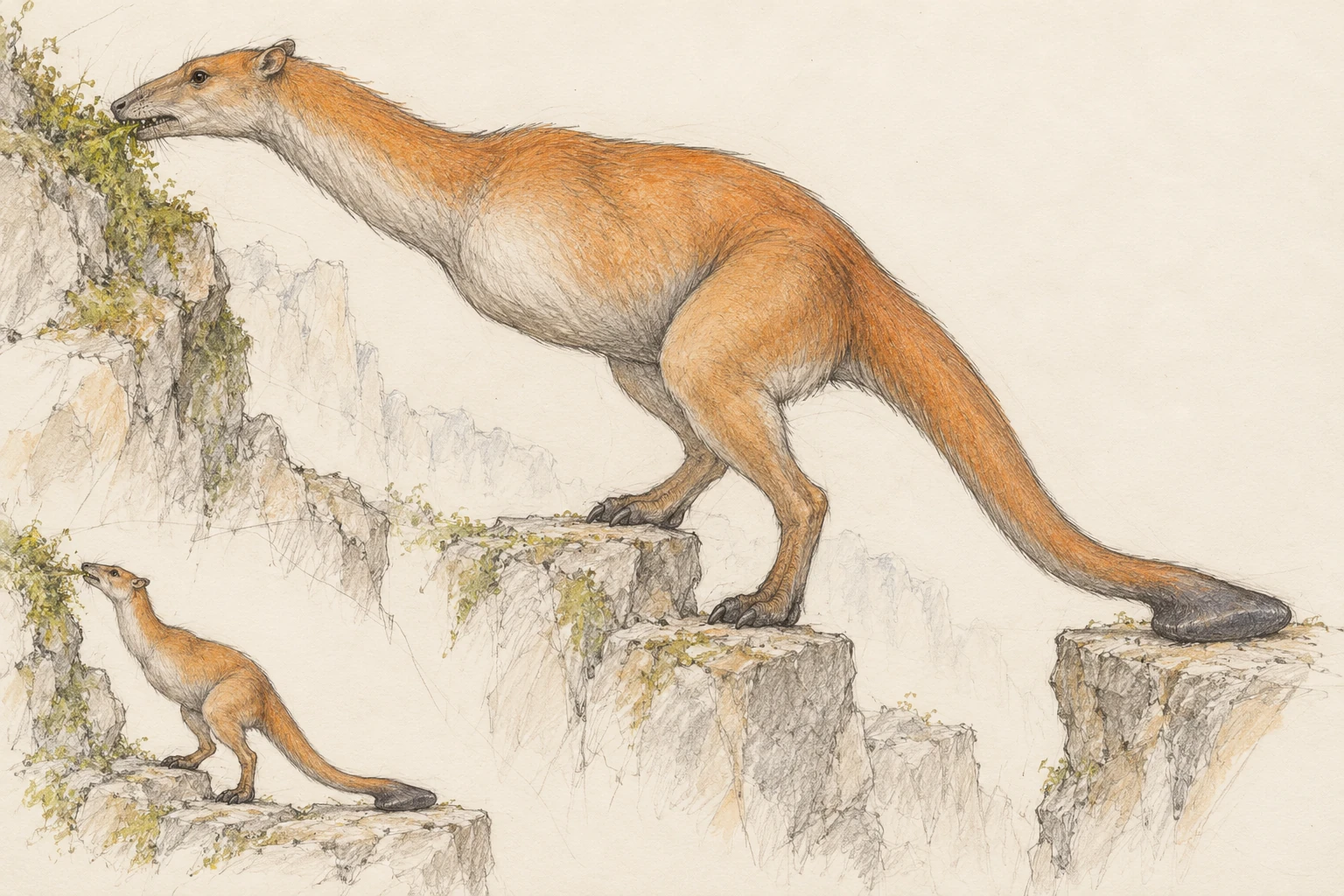
Tail-crutch grazer#
Sketch
A tail-crutch grazer crops moss while its two hindfeet stand on separate ledges and its broad tail pad presses against a rear shelf. The reinforced pelvis and lower spine distribute weight among these three contacts. Slow foot transfers keep the body over its supports as the long neck reaches ahead. Below, a juvenile practices the same stance on a low sequence of steps.
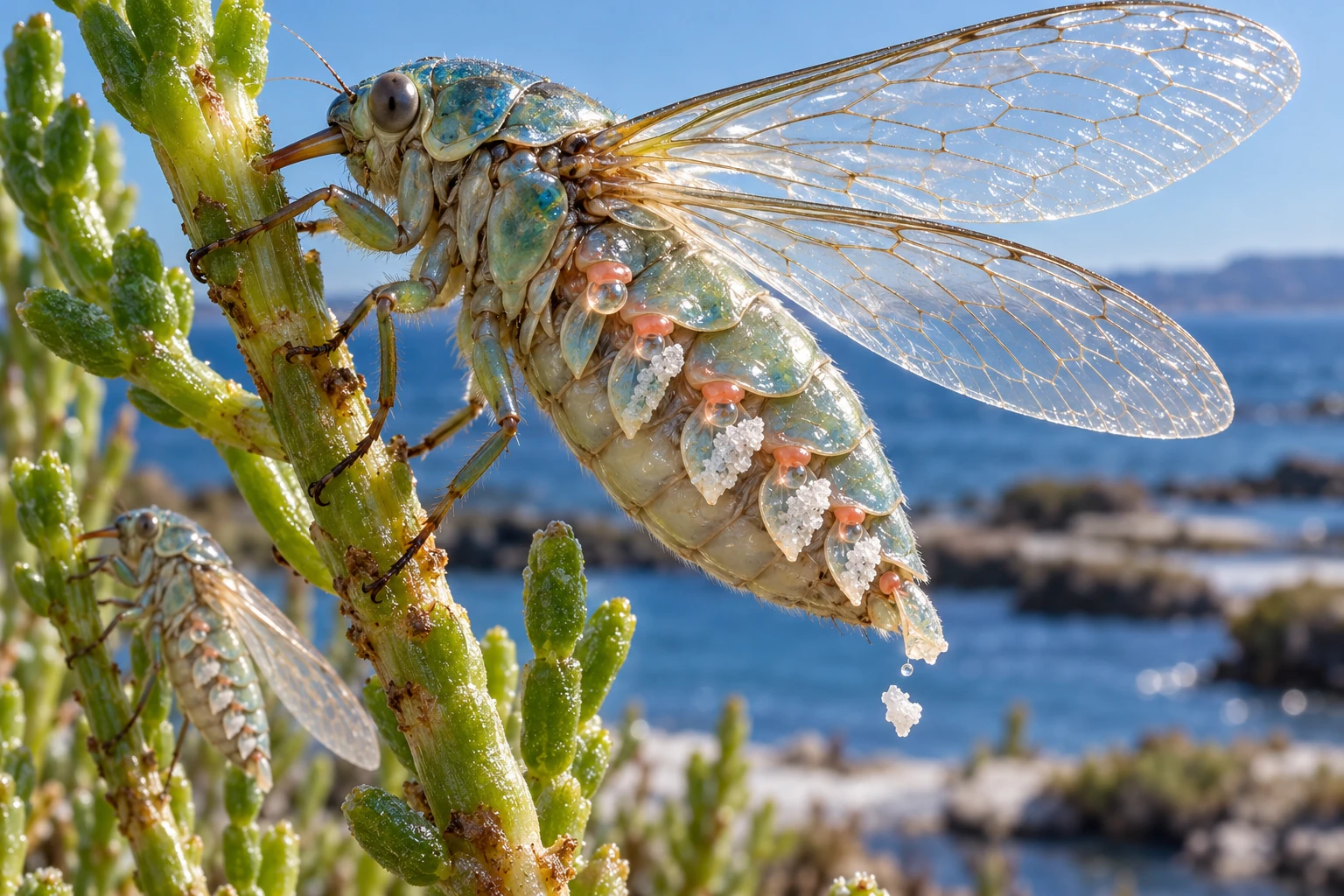
Salt-screen cicada#
Illustration
A salt-screen cicada pumps xylem sap from a coastal succulent while brine gathers on its abdominal tabs. Coral gland openings feed each small hinged surface; evaporation leaves the pale crusts below its clear wings. Flexing a terminal tab drops an old flake. The younger adult begins a thinner coating nearby, and both replenish the water lost while concentrating salts from their food.
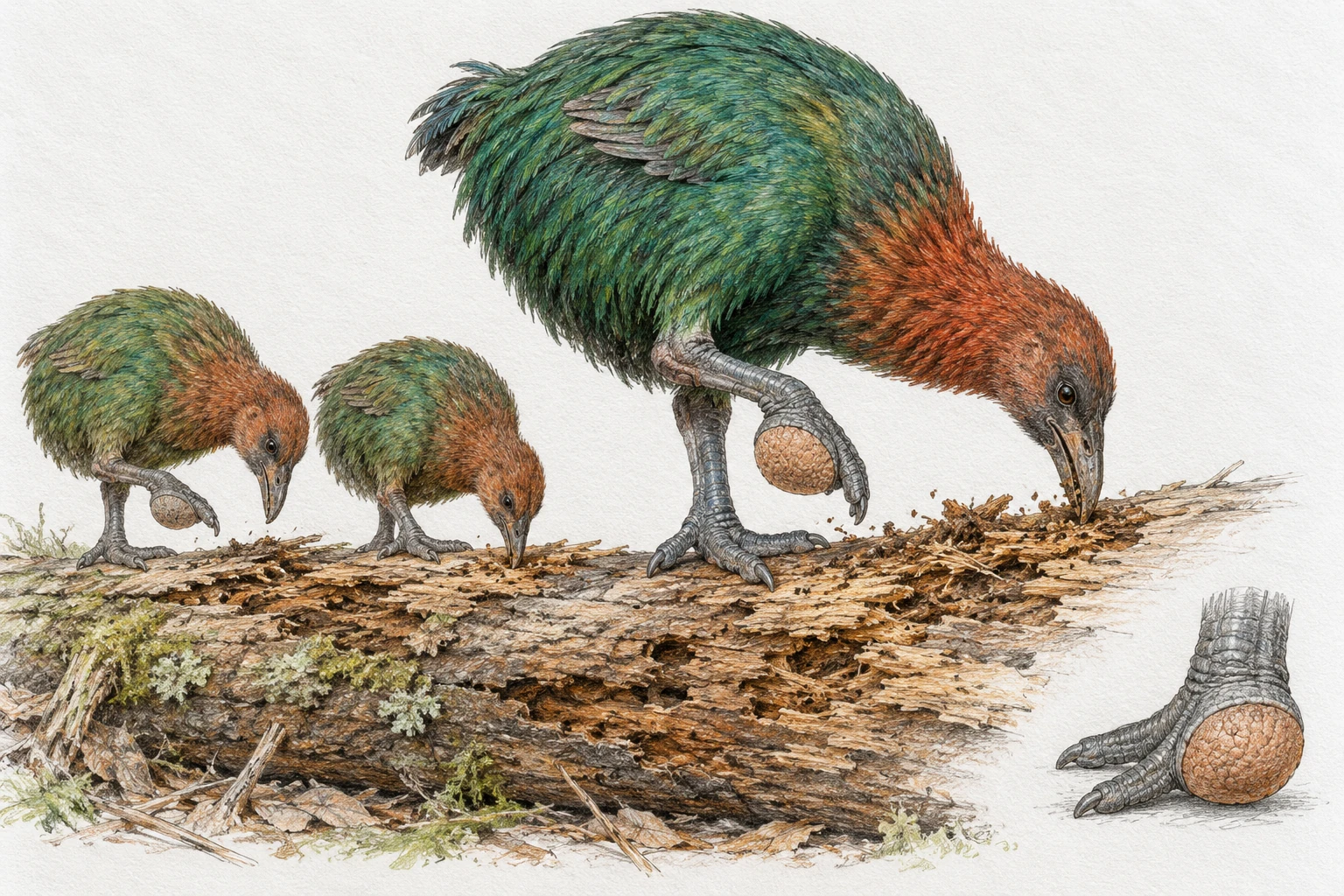
Stoneheel drummer#
Sketch
A stoneheel drummer raises its padded heel over a rotten log while its planted foot receives vibrations from the wood. Reinforced bones and elastic tendons carry the percussion load. After a tap, the bird listens and probes a loosened patch with its blunt bill. Two juveniles practice lighter movements nearby. The separate foot study shows the broad living pad behind the forward toes.
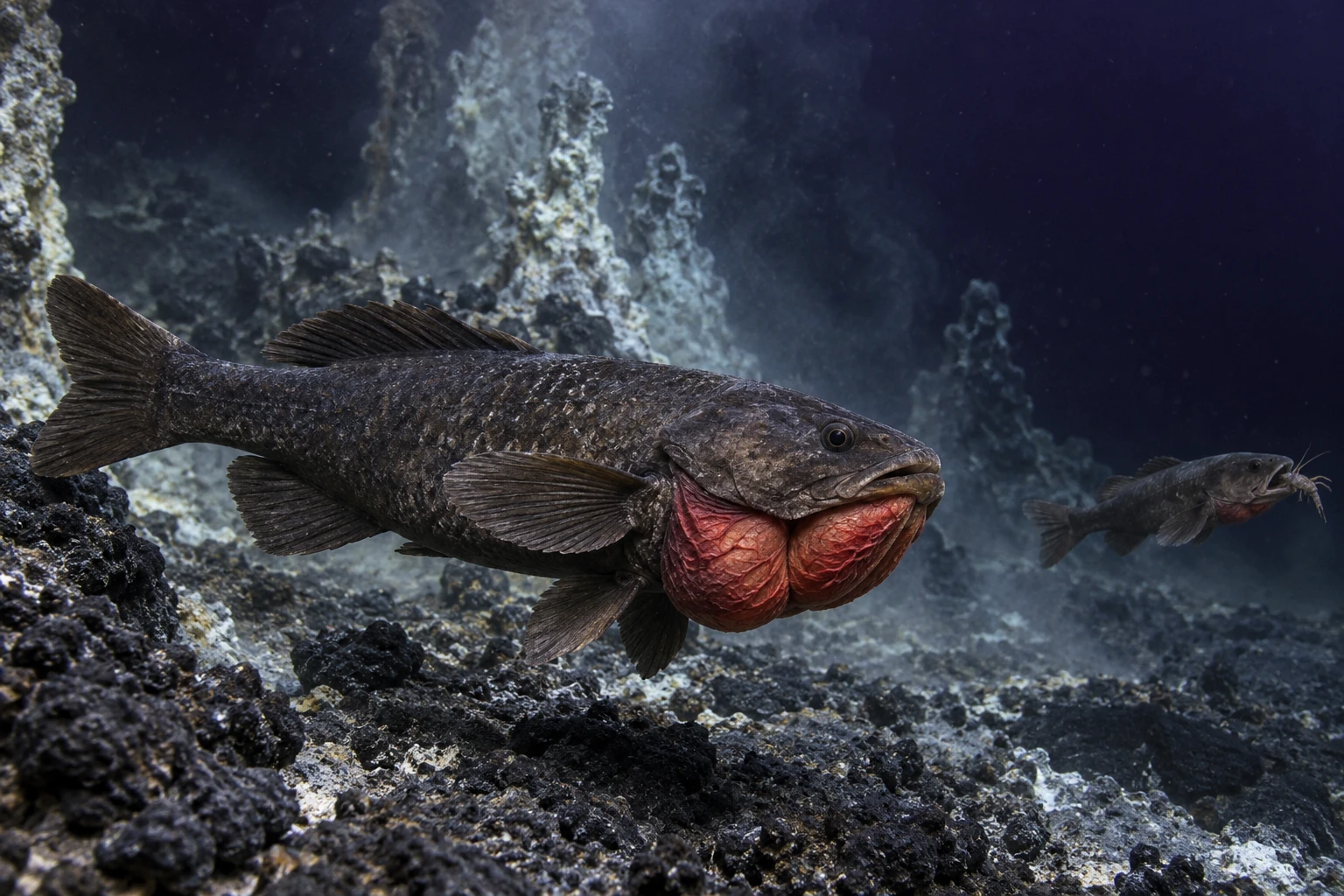
Emberjaw ventfish#
Illustration
An emberjaw ventfish holds its paired throat pouches where a dilute vent plume meets oxygenated seawater. Folded vascular membranes maintain separate fluid paths for sulfur-oxidizing symbionts and the host's circulation. Their organic products supplement captured prey. The smaller fish beyond the interface takes a crustacean while its pouches develop. Gentle fin movements keep the adult at the cool edge of the chemical gradient.
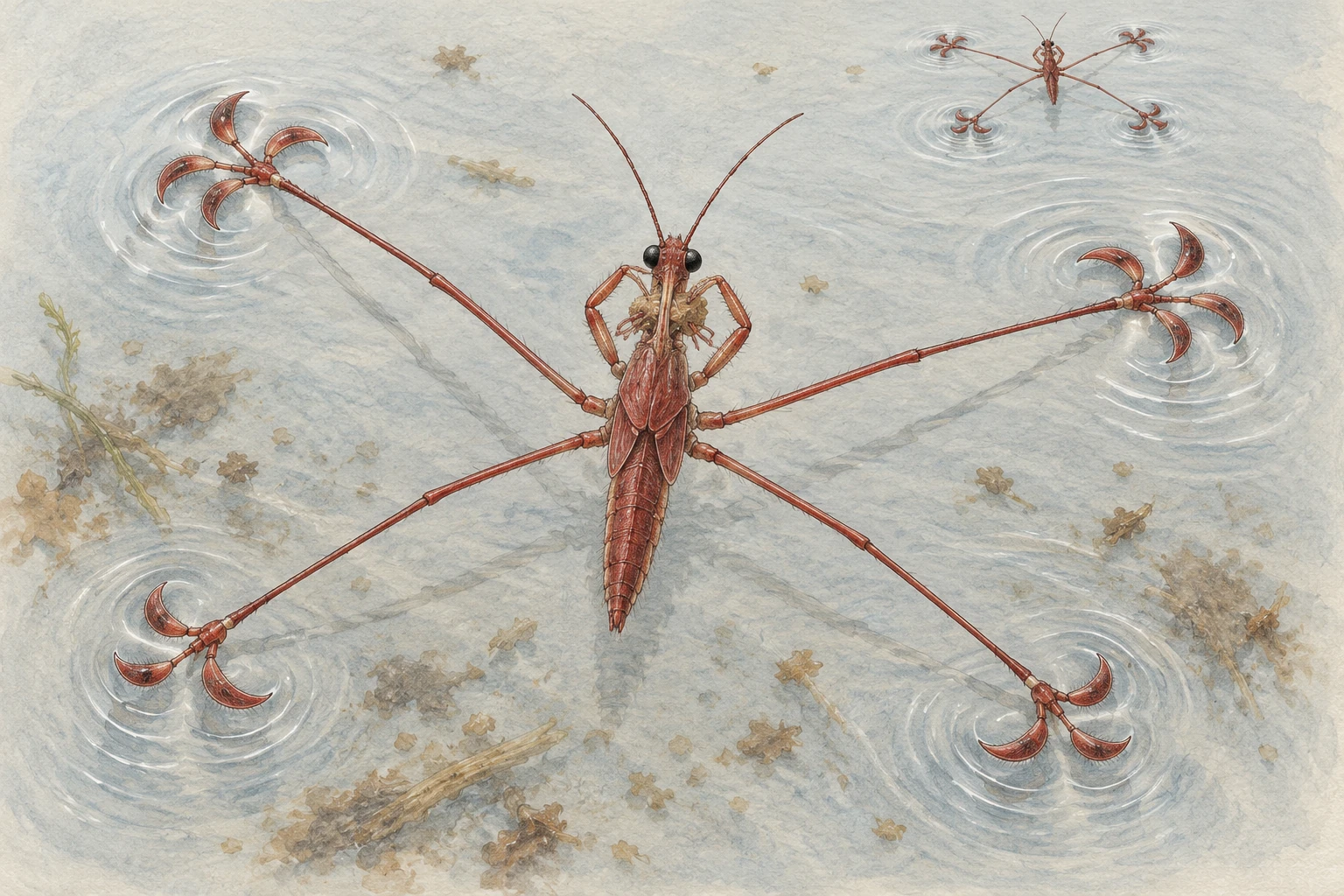
Meniscus strider#
Sketch
A meniscus strider holds a detrital crumb between its short forelegs while rasping palps gather the soft material. The long legs spread crescent pads across the surface film. Each pad folds at its own small hinge, selecting contact length as the animal rows and anchors. Strain receptors compare arriving ripples and delay the next stroke until its neighbor's waves pass.
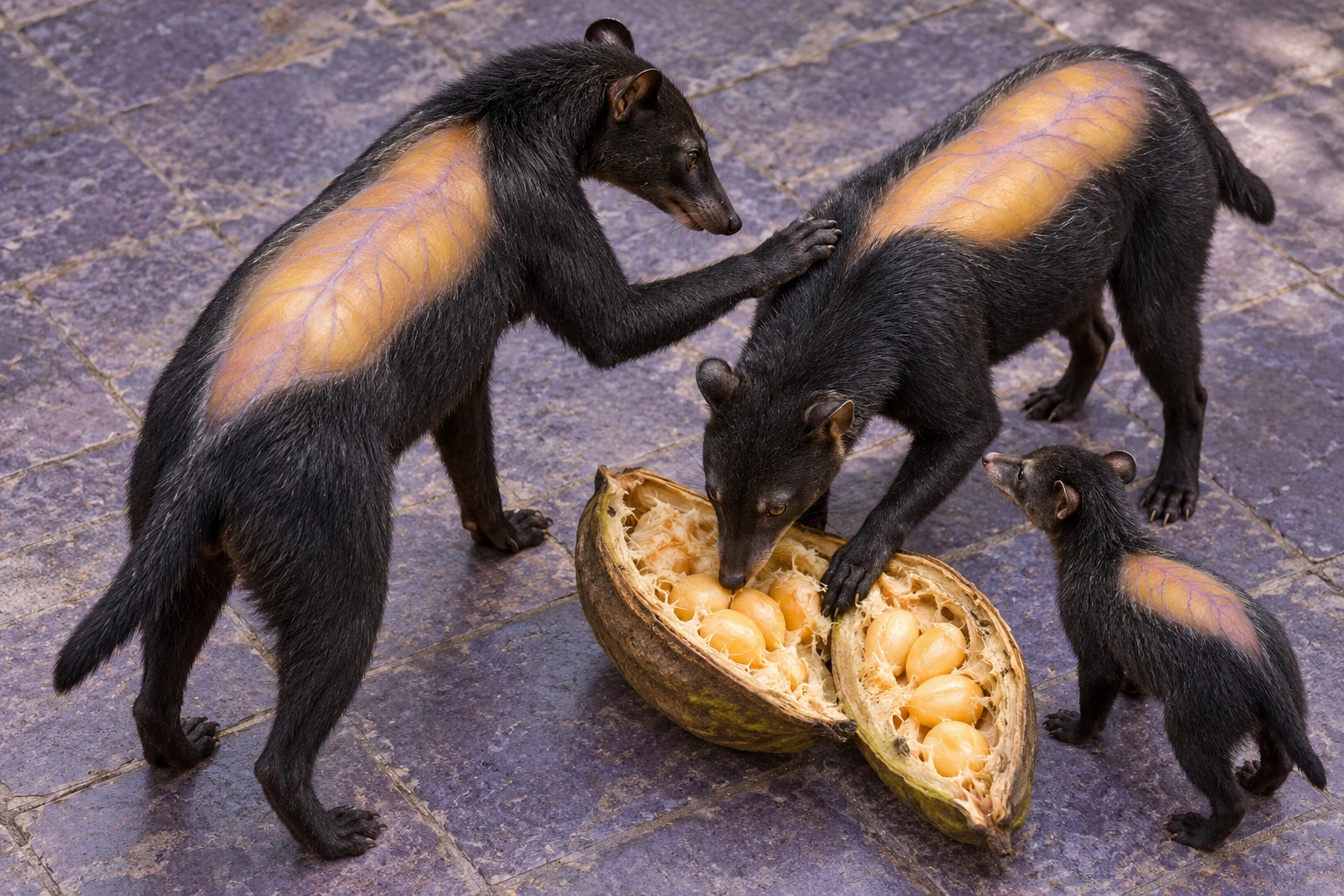
Glassback cache-runner#
Illustration
At a shaded cache, one glassback cache-runner touches the fur beside its partner’s dorsal window while the other steadies an opened pod. Yellow reserves show through tough translucent skin, crossed by fine surface vessels. Partners learn to compare these shallow fat stores before sharing food. The juvenile waits beside the soft kernels; replenishing its reserves takes repeated meals over the following days.
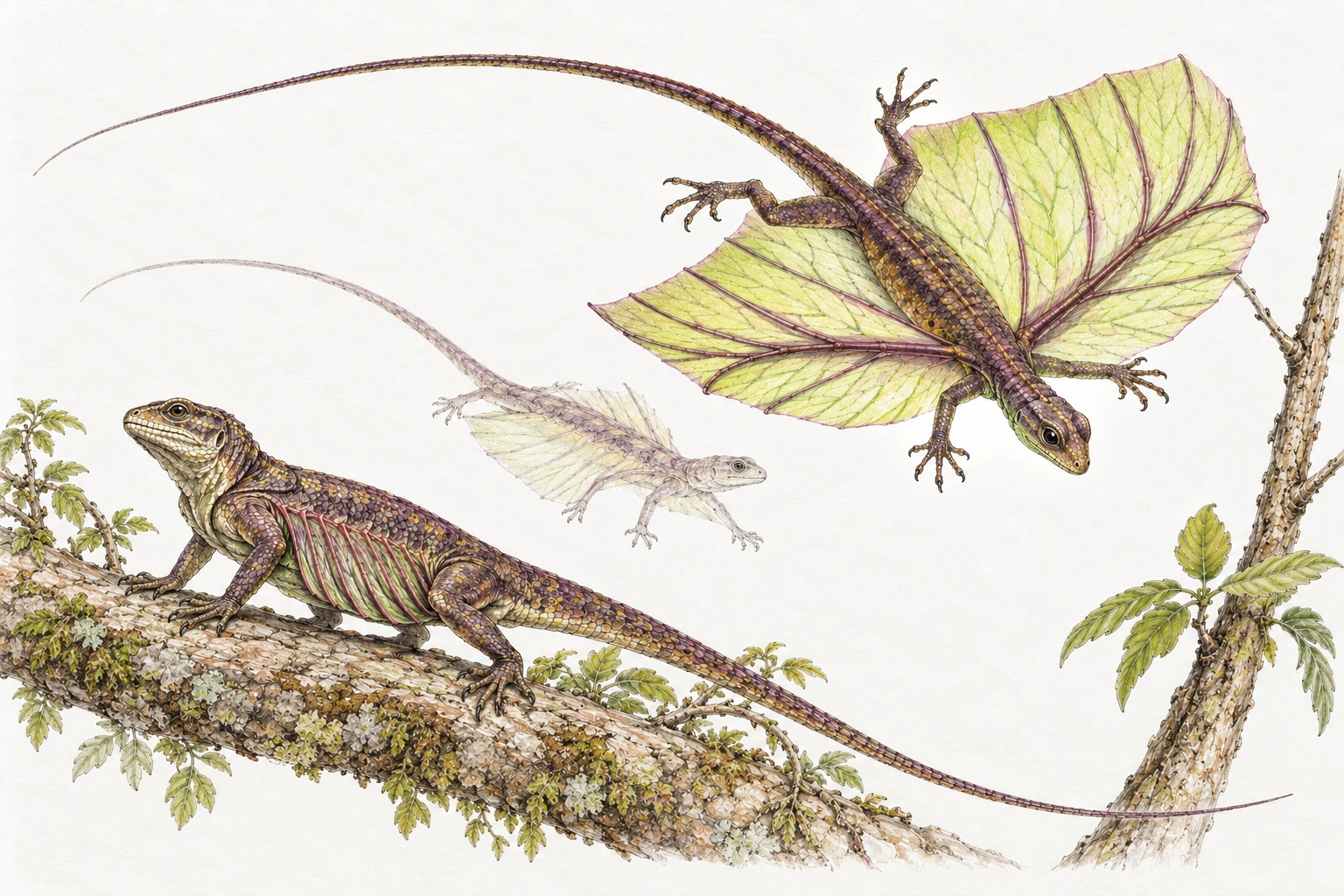
Foldseason drake#
Sketch
A young foldseason drake spreads its long rib-supported membranes during a descent through the canopy. Its four gripping legs remain free for landing. Growth adds mass and gradually remodels the ribs, gathering the adult's membranes into vascular flank pleats. The heavier animal climbs between leaves and fruit. The intermediate study records the transition between the juvenile's insect-hunting glide and the adult's browsing body.
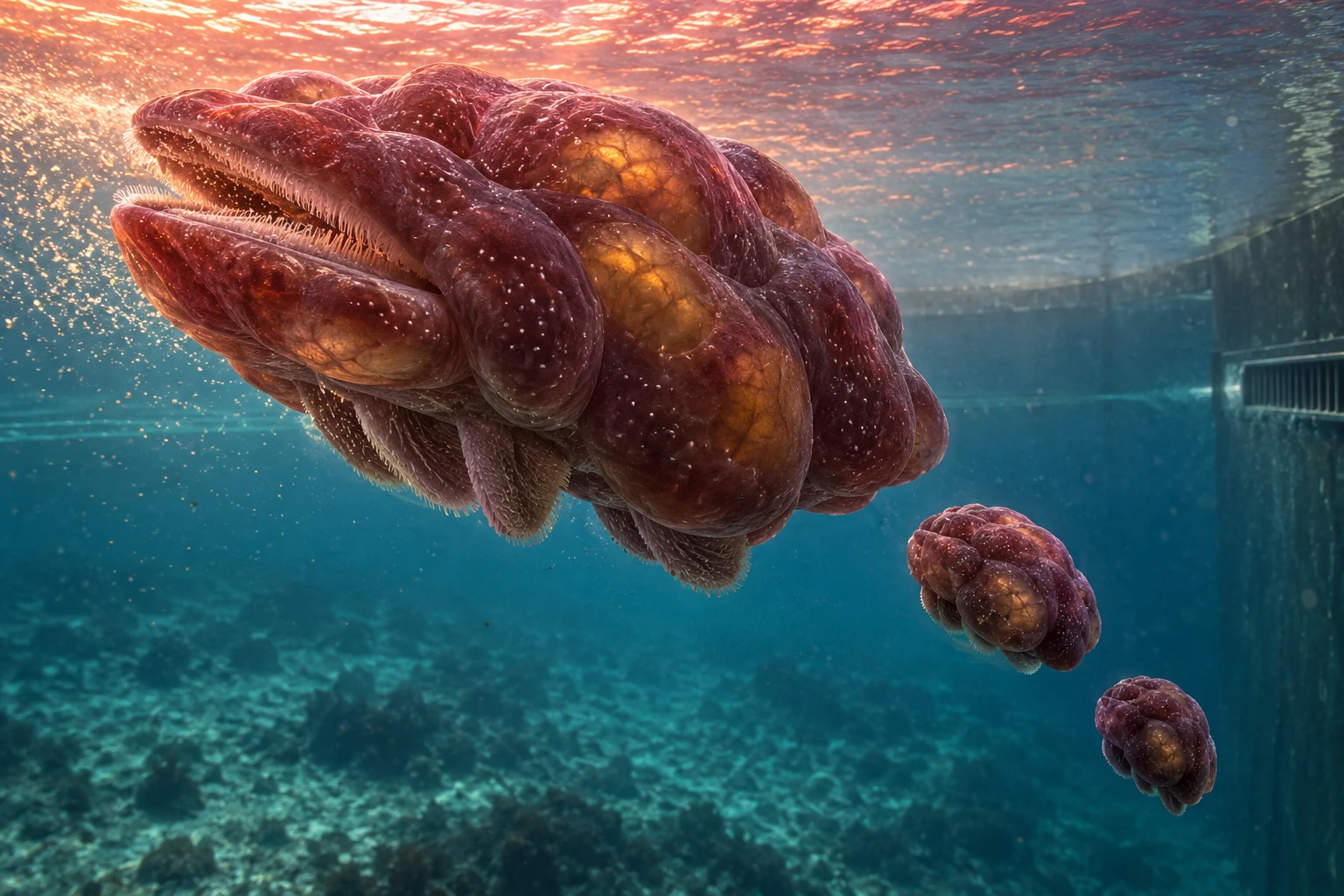
Thermocline riser#
Illustration
A thermocline riser opens its feeding cleft in the nursery's warm plankton layer. Gentle ciliary swimming begins the adult ascent; melting lipid expands its internal chambers and adds buoyancy as warmer water enters the folds. The two compact juveniles below have a denser body composition and sink toward the cool nursery. Food powers their metabolism, while the maintained water column supplies the adult's warming.
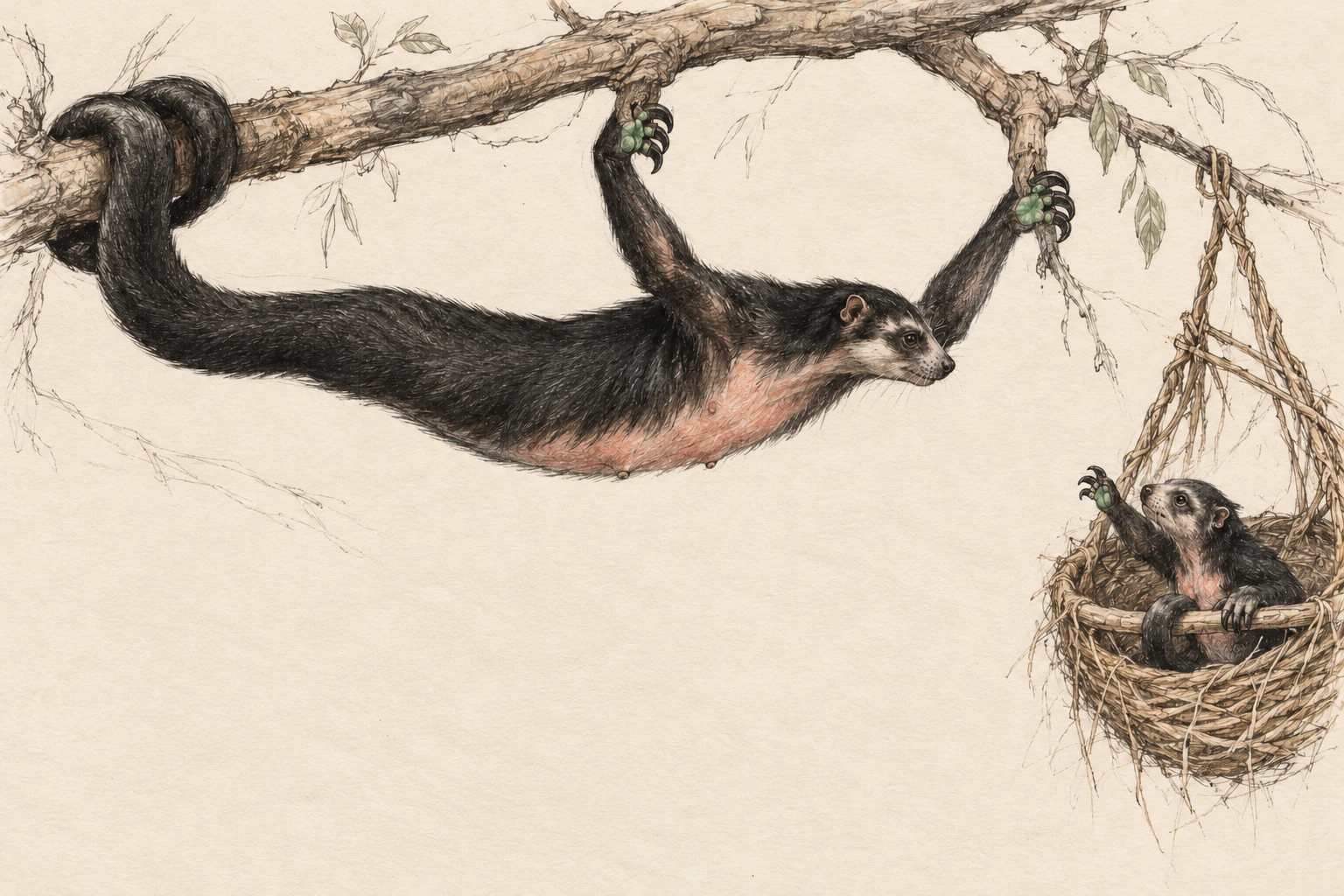
Anchorhand sleeper#
Sketch
An anchorhand sleeper holds two branch forks while its thick tail remains wrapped around the main support. The long rear trunk tapers into that anchor, and broad shoulder tissue carries the two gripping arms. A juvenile reaches from its basket with its own tail secured around the rim. Strong replaceable branches and slow transfers let the pair explore the sleeping grove while retaining several holds.
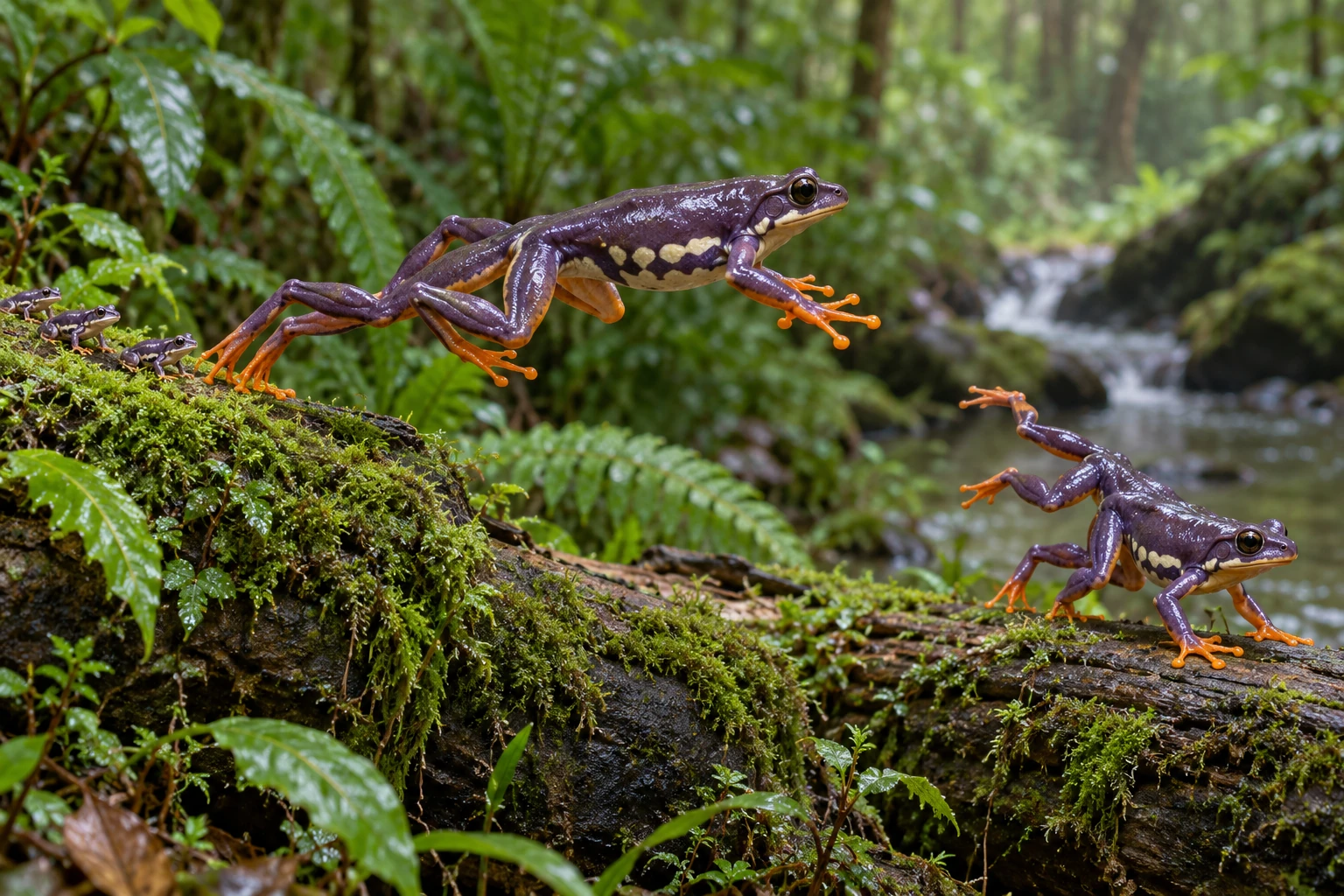
Relayjump frog#
Illustration
A relayjump frog leaves the mossy log as its rear hindfeet finish their push and the first hind pair folds forward. Separate pelvic girdles share the load through a stiff sacral bridge. All four hindlegs fold during flight. The second adult reaches the lower log with its forefeet and begins opening its hindlegs for landing, while small metamorphs wait along the departure edge.
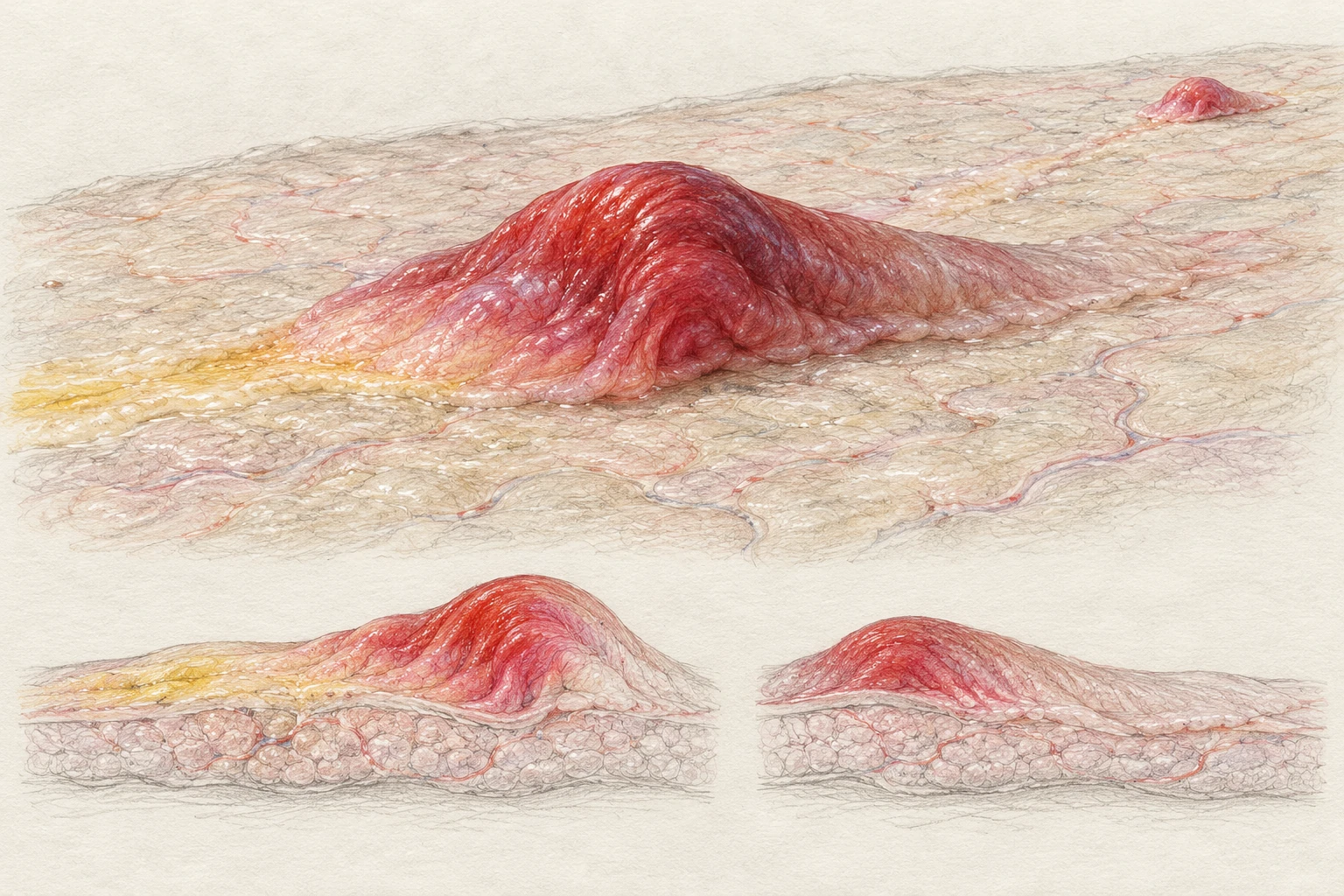
Wave tenant#
Sketch
The wave tenant advances millimeters per hour through a maintained living nursery. Ready-made cellular modules gradually specialize at its reddening front while trailing tissue returns to the pale resting state. Local junctions pass control states and nutrients through the continuous sheet, sustaining one bounded coordinated animal. The studies show a raised feeding crest, its flattening rear and a smaller independent zone using a distant route.
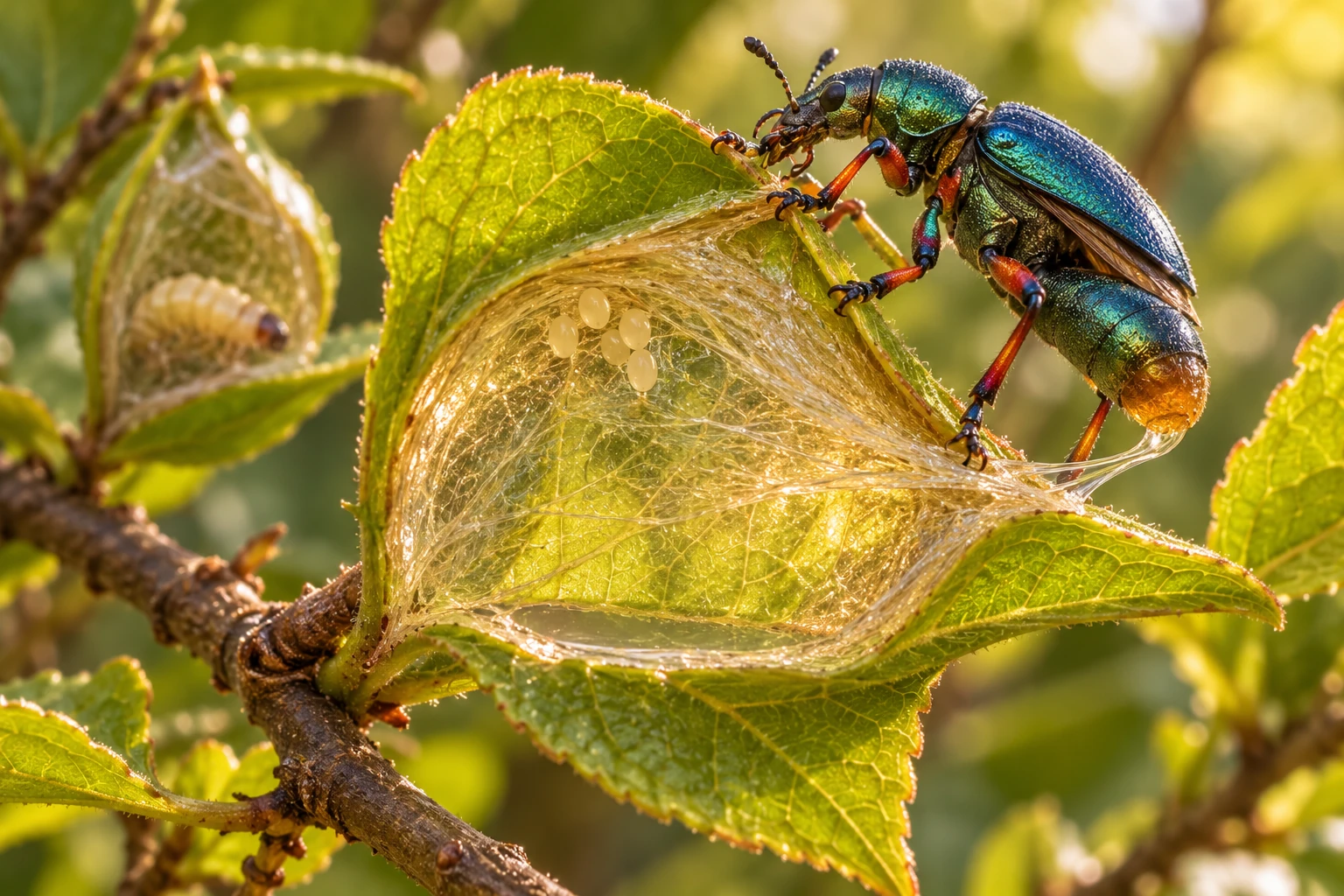
Window-gall mason#
Illustration
A window-gall mason draws a fresh ribbon from its abdominal nozzle onto the last open capsule edge. The clear fibrous gel joins two young leaves while a hind foot presses it into place. Eggs adhere high inside the nursery, above the lower ventilation gap. In the older capsule behind, a larva feeds on soft gall growth supported by the living leaves.
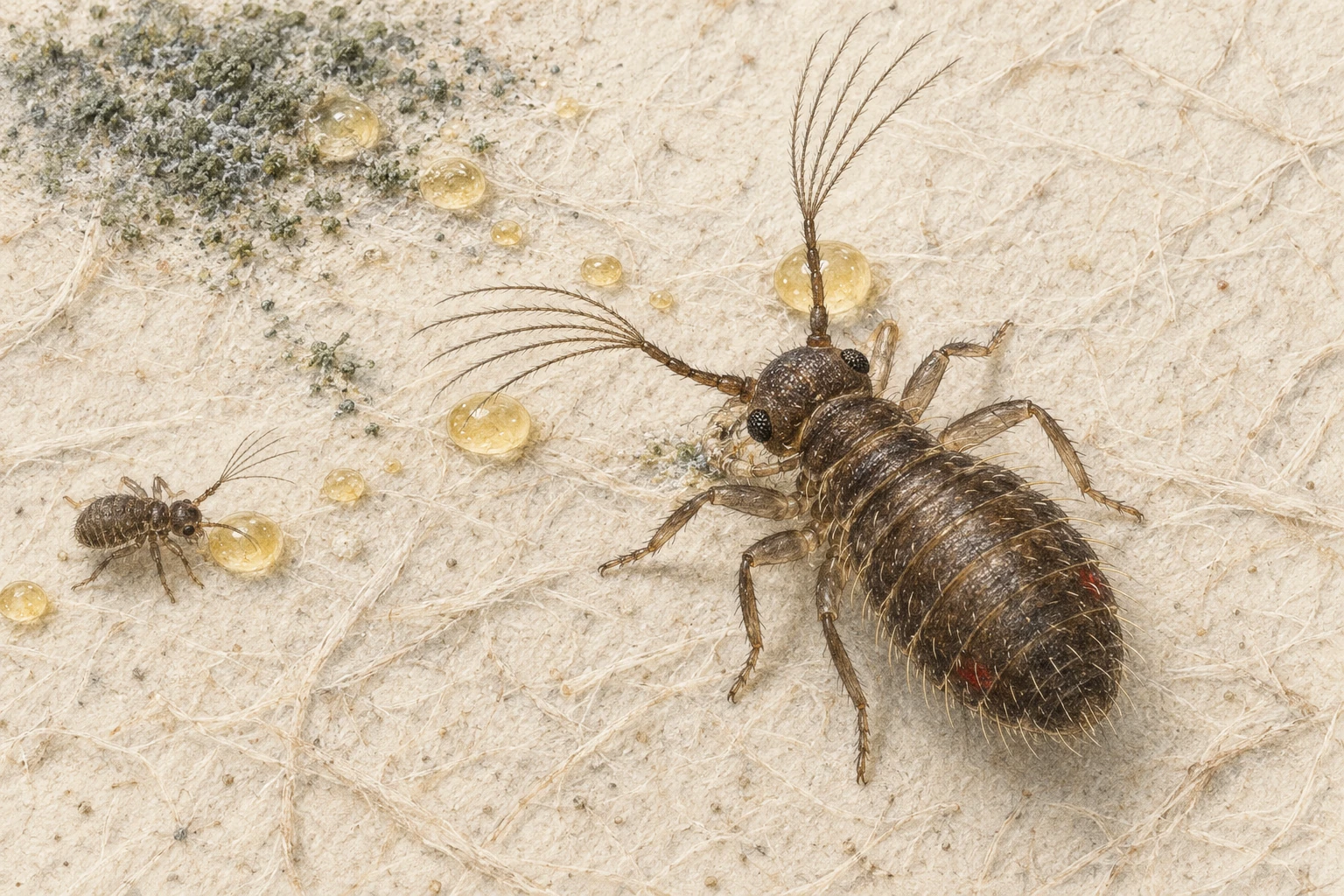
Scent-map booklouse#
Sketch
A scent-map booklouse pauses between wax dabs and spreads its branched antennae over the nearby choices. Smell and humidity receptors compare local traces while learned junctions guide it toward the fungal ration. Its mouthparts rasp film from the starch-bearing fibers. The juvenile explores another dab independently, adding new route experience as the replaceable card slowly fills with feeding marks.
Sievecheek swimmer#
Illustration
Sievecheek swimmers pump pond water through muscular chambers beside the mouth. Folded keratin combs retain small crustaceans while separate outlets discharge the filtered water. Here the near chamber flushes beside the animal’s wet chestnut fur, with the raised nostrils clear of the surface. Webbed feet hold the pebble shelf as a companion explores another feeding patch near the millpond bank.
Relaykin#
Sketch
A relaykin feeds as three separate working organs. The scoop sends membrane-bound nutrient capsules across a short gap to the crescent processor while the pleated sensory organ holds station nearby. Each body carries its own respiratory fringe, propulsion and local controls. Short acoustic calls coordinate rendezvous, and shared brood development produces the matched organs and their complementary metabolic needs.
Forkwake fish#
Illustration
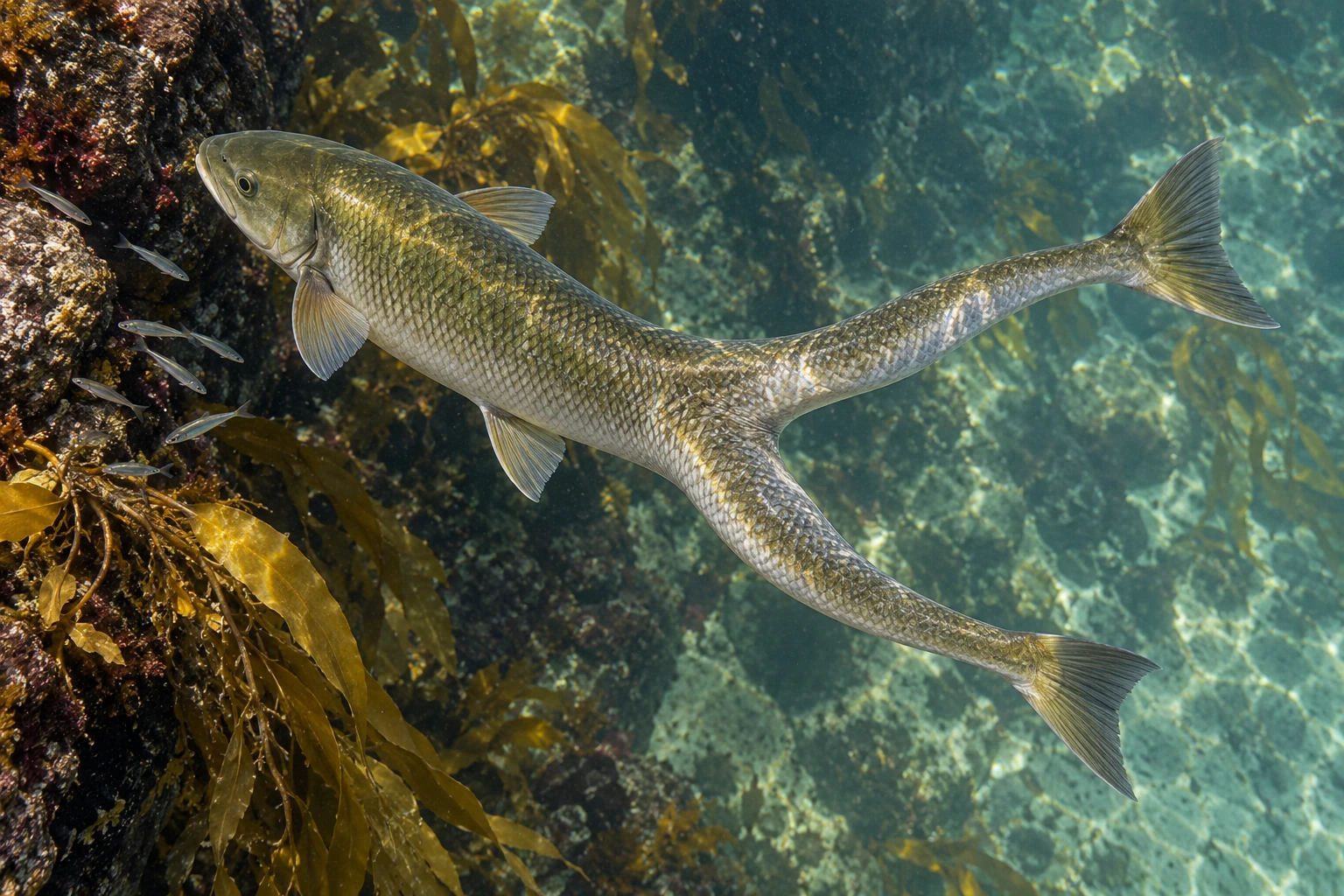
A forkwake fish holds its broad head beside a kelp-covered rock while two muscular posterior branches spread into open water. Unequal tail strokes turn the shared forebody around small prey near the holdfast. A wide reinforced junction distributes the thrust, and paired fins steady the trunk. The branching axis favors precise turns among roots and rocks, with substantial drag during longer swims.
Ratchetjaw amphipod#
Sketch
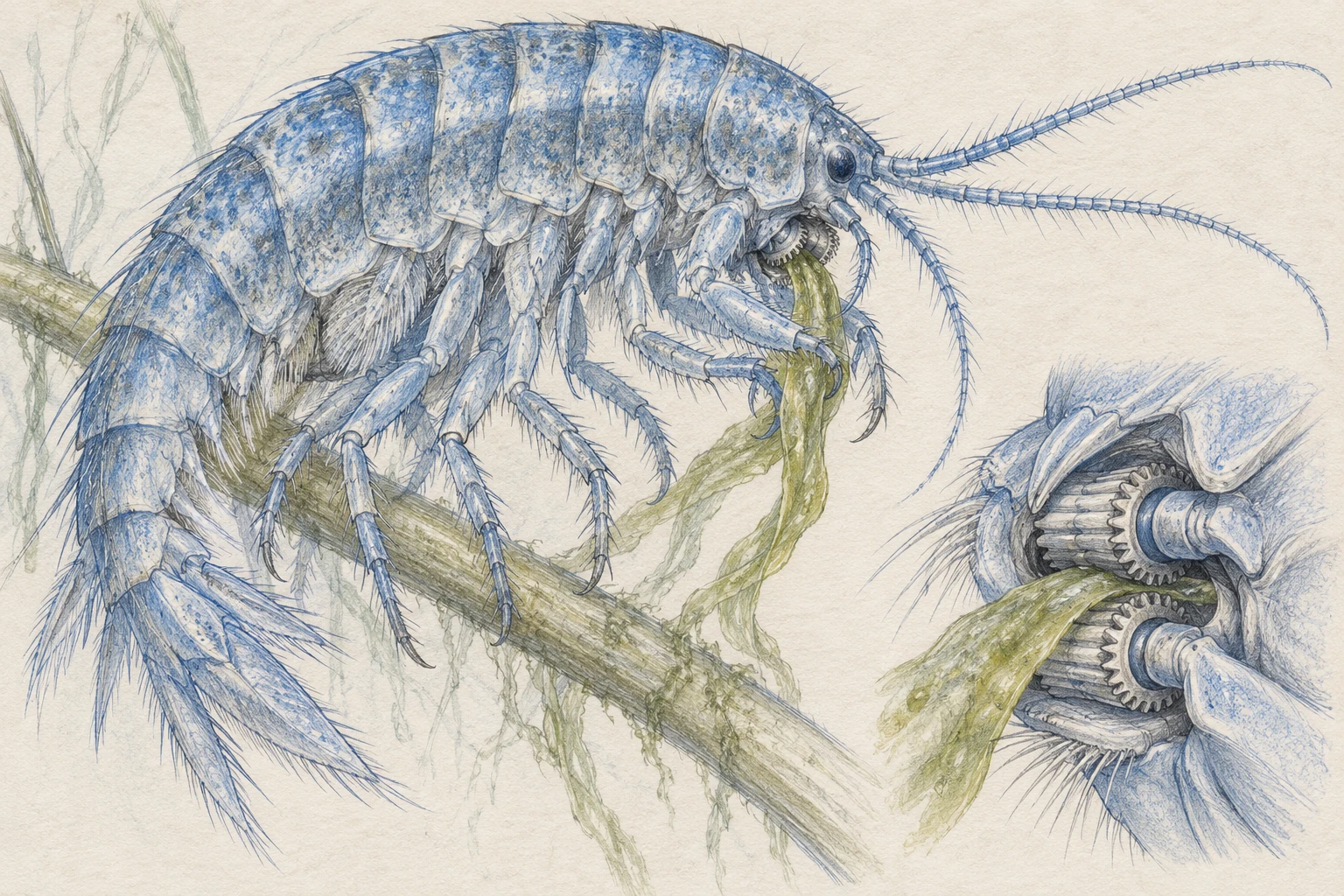
A ratchetjaw amphipod braces on a submerged stem while its front legs guide a soft algal ribbon between two toothed mouth rollers. Small muscular pawls advance the rollers in alternating steps. Each roller turns within a fixed lubricated socket and is renewed with the animal’s cuticle at molt. The enlarged mouth study shows the shared feeding gap and the stationary supports around the axles.
Openstream#
Illustration
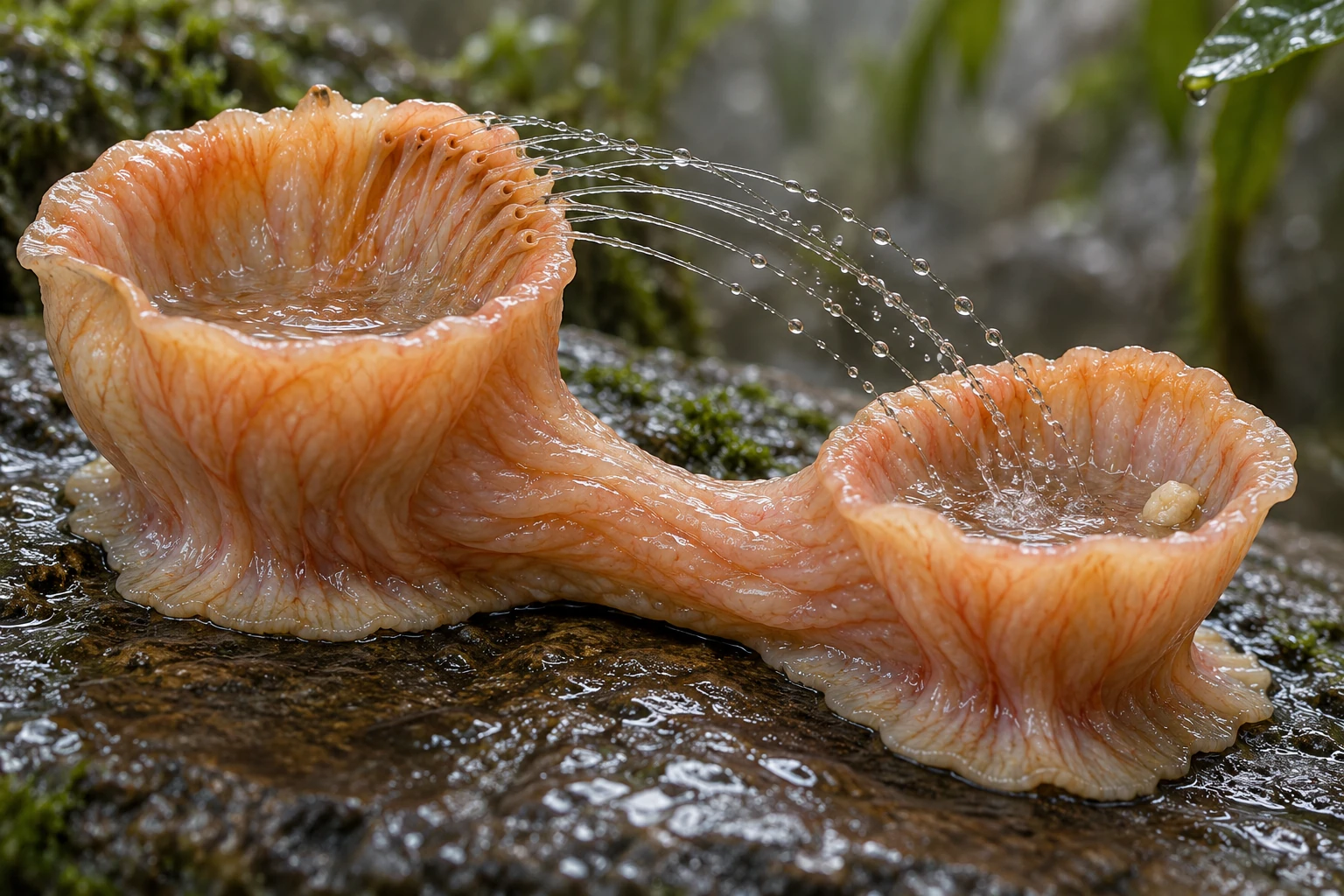
Openstream circulates nutrient fluid through a fan of fine airborne jetlets. Droplet breakup exposes the water to air before the lower basin catches it; a filtered channel inside the muscular bridge returns fluid to the pump. Thin tissues and slow movement keep oxygen demand low. The receiving lip admits a small food crumb while broad basal folds inch across wet stone.
Crossmill browser#
Sketch
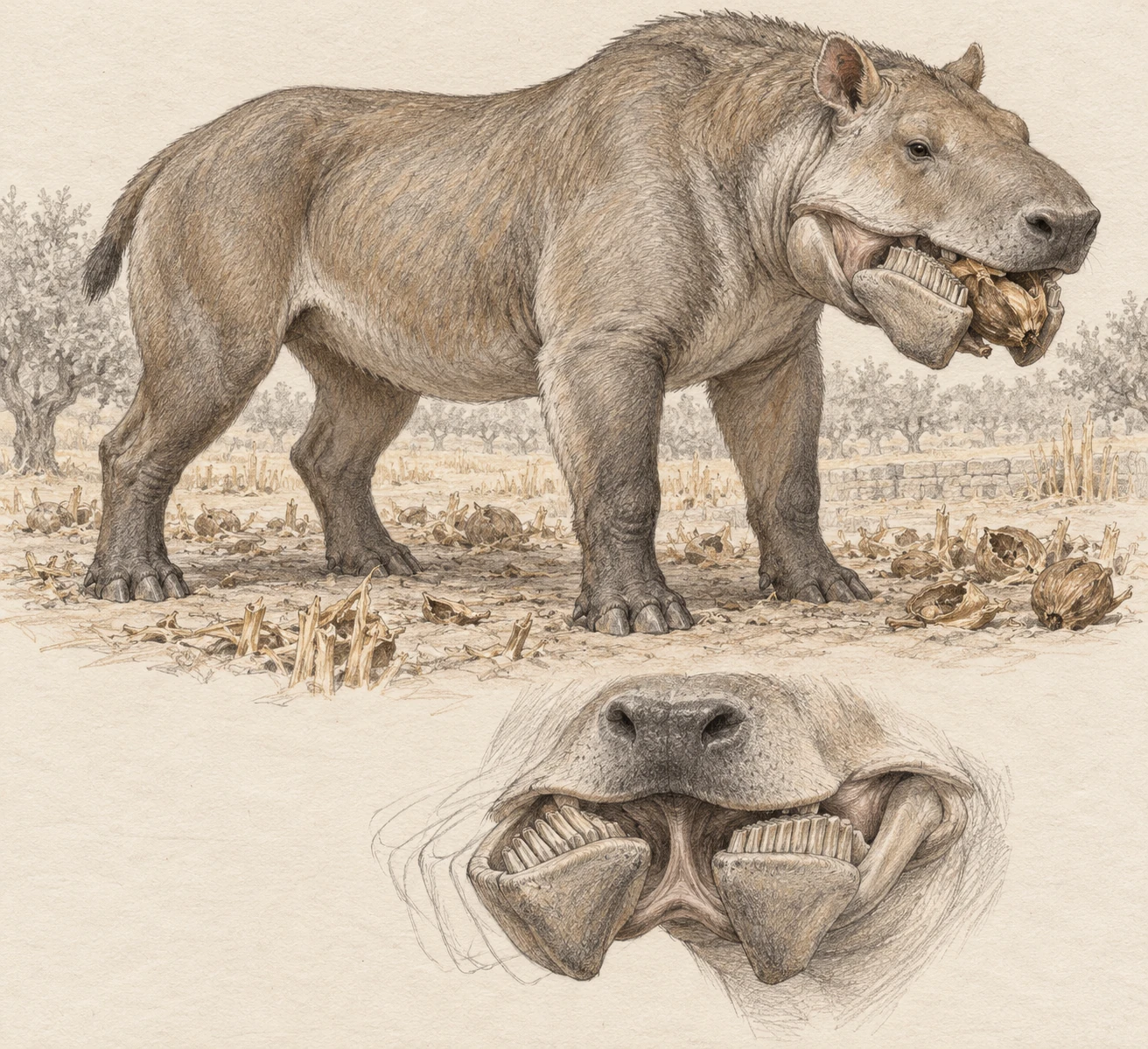
Crossmill browsers work tough pods between separately driven halves of the lower jaw. Each ridged tooth bank shears against an upper grinding shelf, transferring force through its own reinforced joint into the skull. The flexible chin connection permits the limited sideways stroke. This adult steadies a husk with one half while the other works; the lower study shows the two grinding banks.
Fanlung arachnid#
Illustration
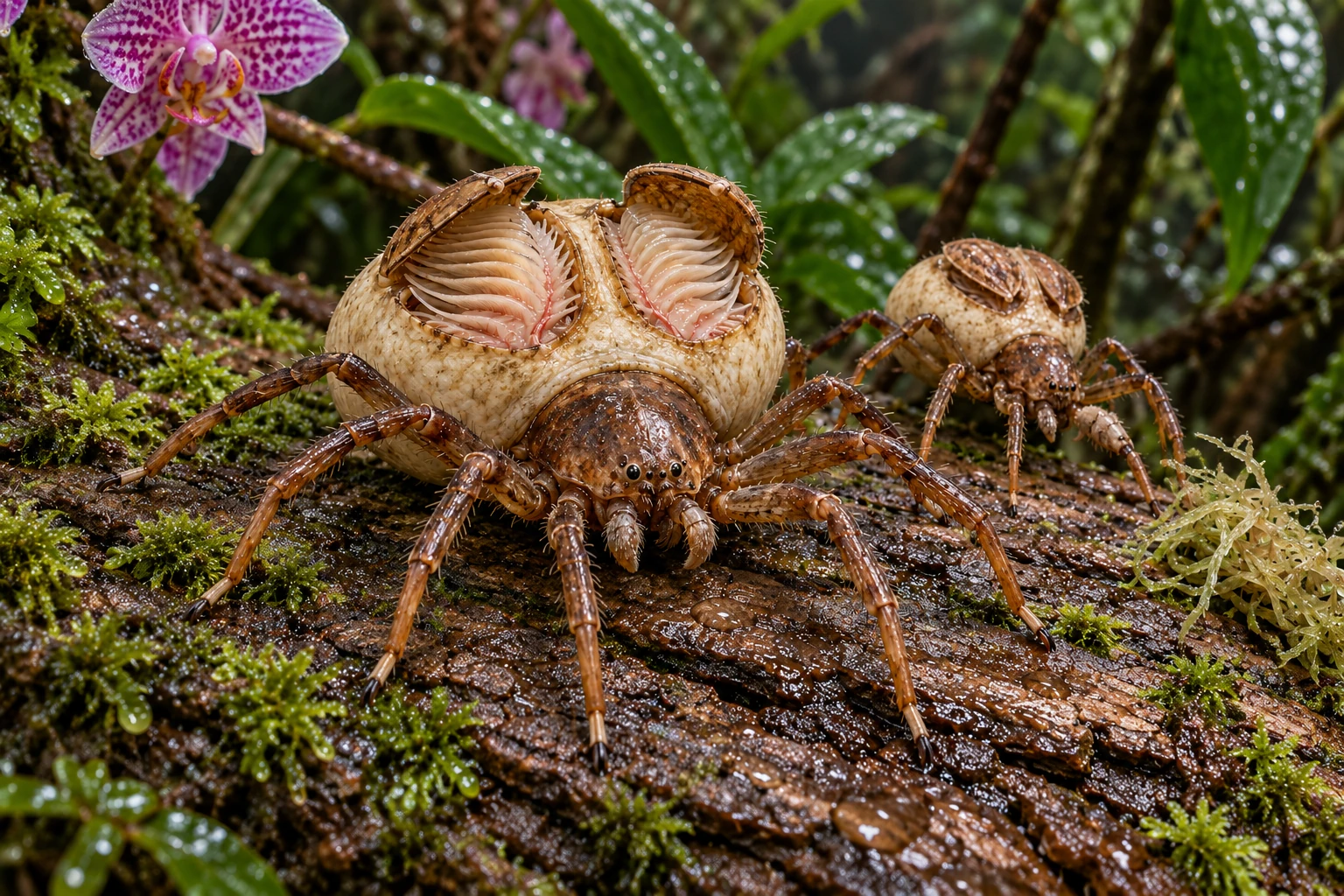
A fanlung arachnid opens its paired respiratory cassettes after crossing the damp orchid bark. Closely spaced moist lamellae rise inside the lifted protective lids, exposing a large surface to humid air. Circulating fluid carries the absorbed oxygen through the body. Its companion keeps its cassettes shut while clearing a loose fiber beside the resting animal. The lids close before either adult travels through drier foliage.
Tailhand porter#
Sketch
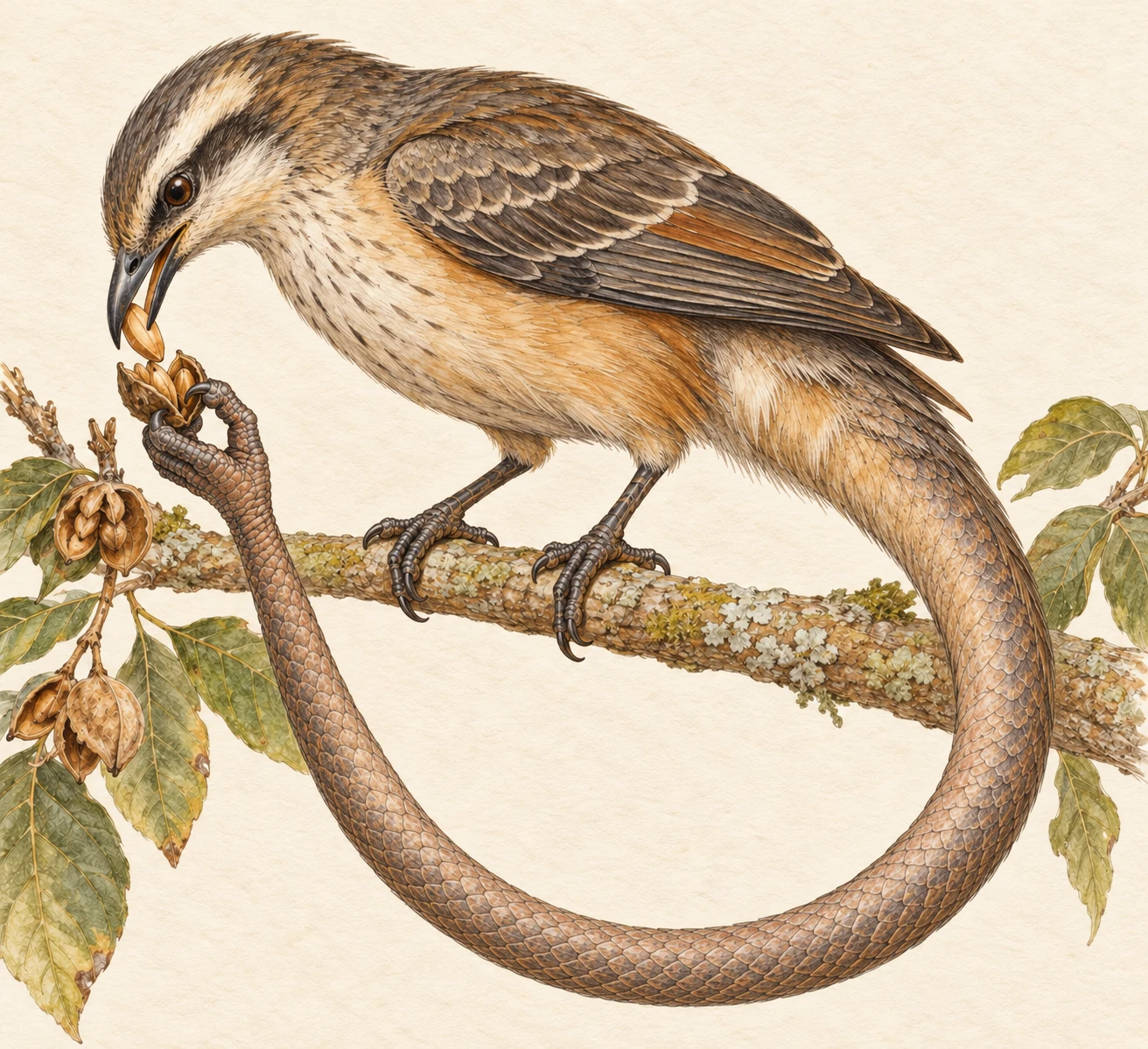
The tailhand porter grips its perch with both ordinary feet while its bill lifts a kernel from a small pod. Its single muscular tail curves beneath the branch and returns toward the breast, ending in a scaled three-digit hand. Tendons running through the broad tail base control the light grip. Food transfers take place from a secure perch, where the feet and pelvis can absorb the shifting load.
Flipway lizard#
Illustration
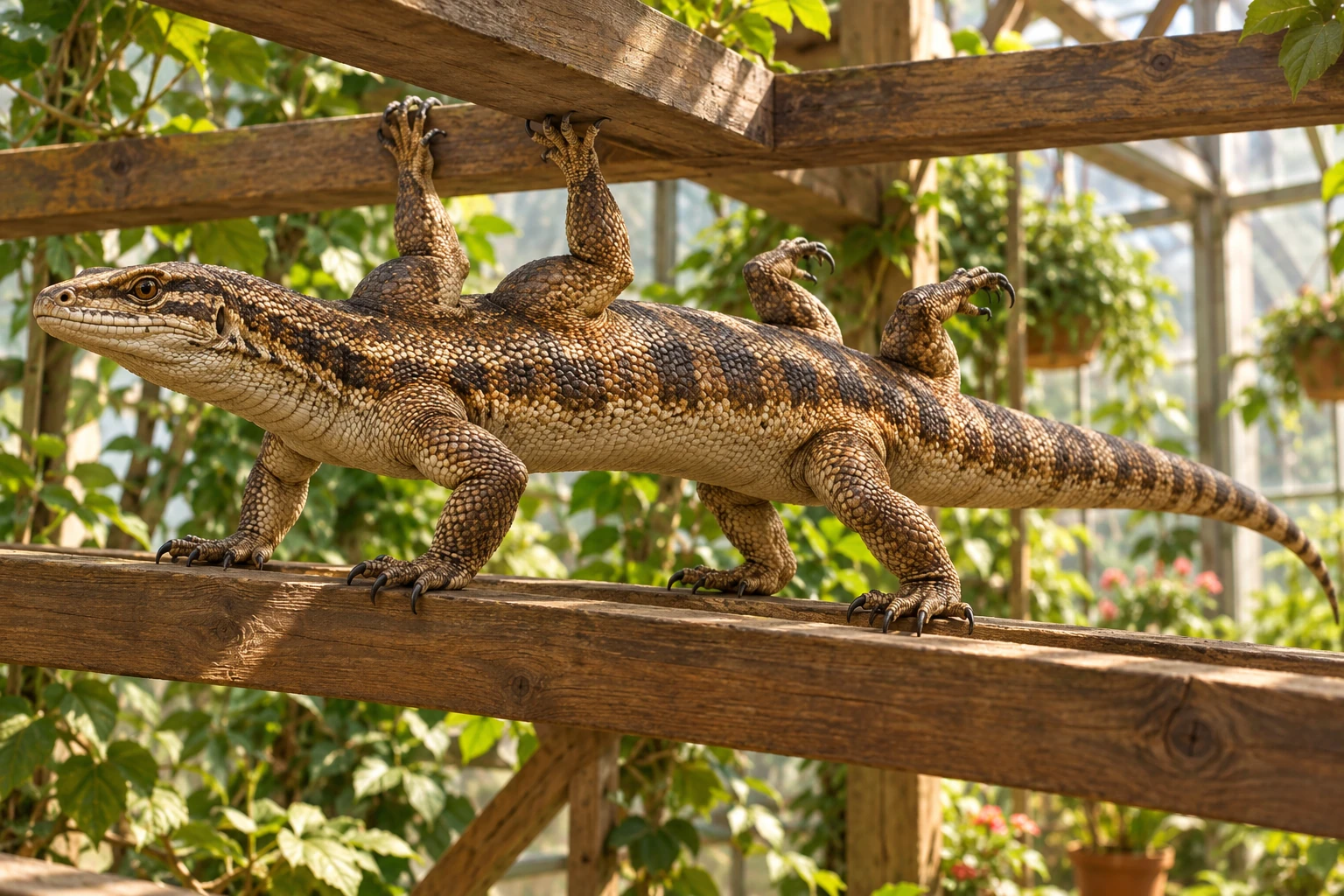
Four lower feet support a flipway lizard on the trellis while two upper feet test the bar above. Its remaining dorsal limbs stay folded over the back, ready to secure another contact before the animal rolls. Separate upper and lower girdles transmit the opposing loads through a remodeled axial skeleton. A thick central trunk houses the lungs, gut and major vessels between the two walking surfaces.
Sulfide stitch#
Sketch
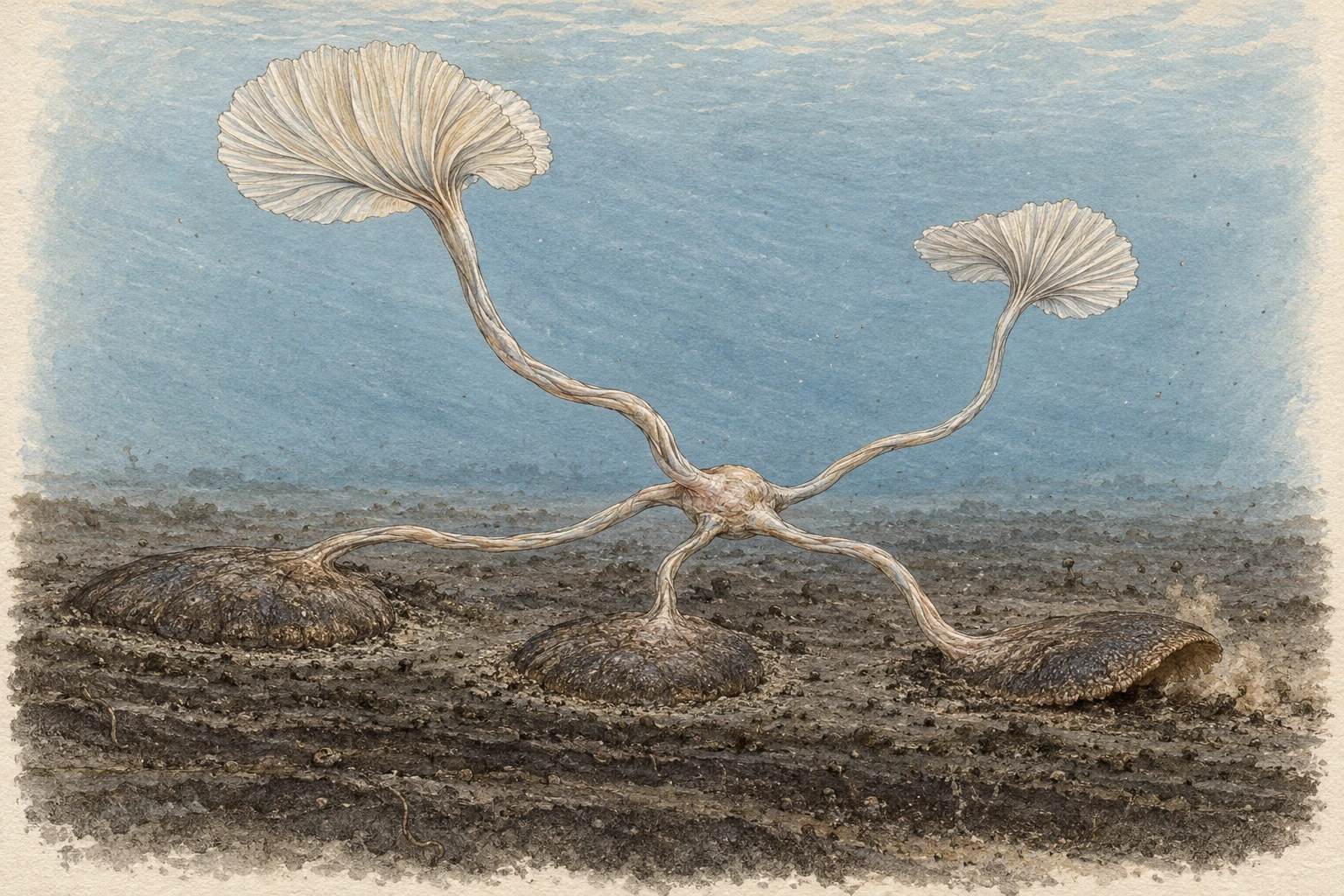
Sulfide stitch spreads its chemical work across separate terminal organs. Three dark pads obtain electrons from sulfide in the sediment; pale pleated terminals use those electrons in oxygen reduction above it. Insulated living cables carry charge, while liquid microchannels return ions and distribute fixed carbon. One lower pad lifts its edge toward fresh mud as the other contacts remain supplied.
Forklip gleaner#
Illustration
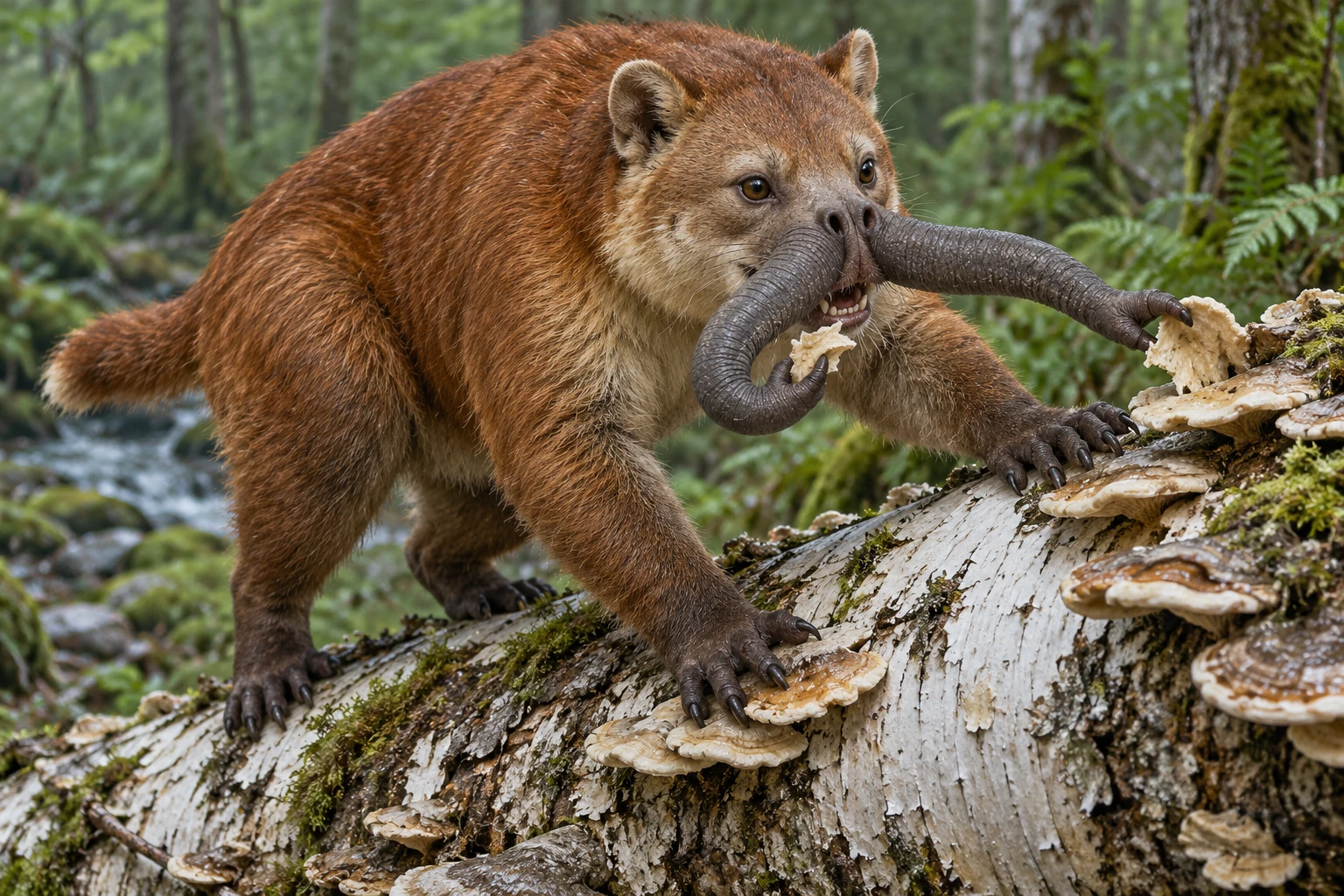
Forklip gleaners choose soft fungal pieces with two muscular branches of the upper lip. Each branch bends independently from a broad facial root, bringing light food toward the small central mouth. The raised nasal bridge carries breathing passages above both roots. This adult braces its four hands along a fallen birch while one lip curls inward and the other reaches across the bracket.
Sightpalm crab#
Sketch
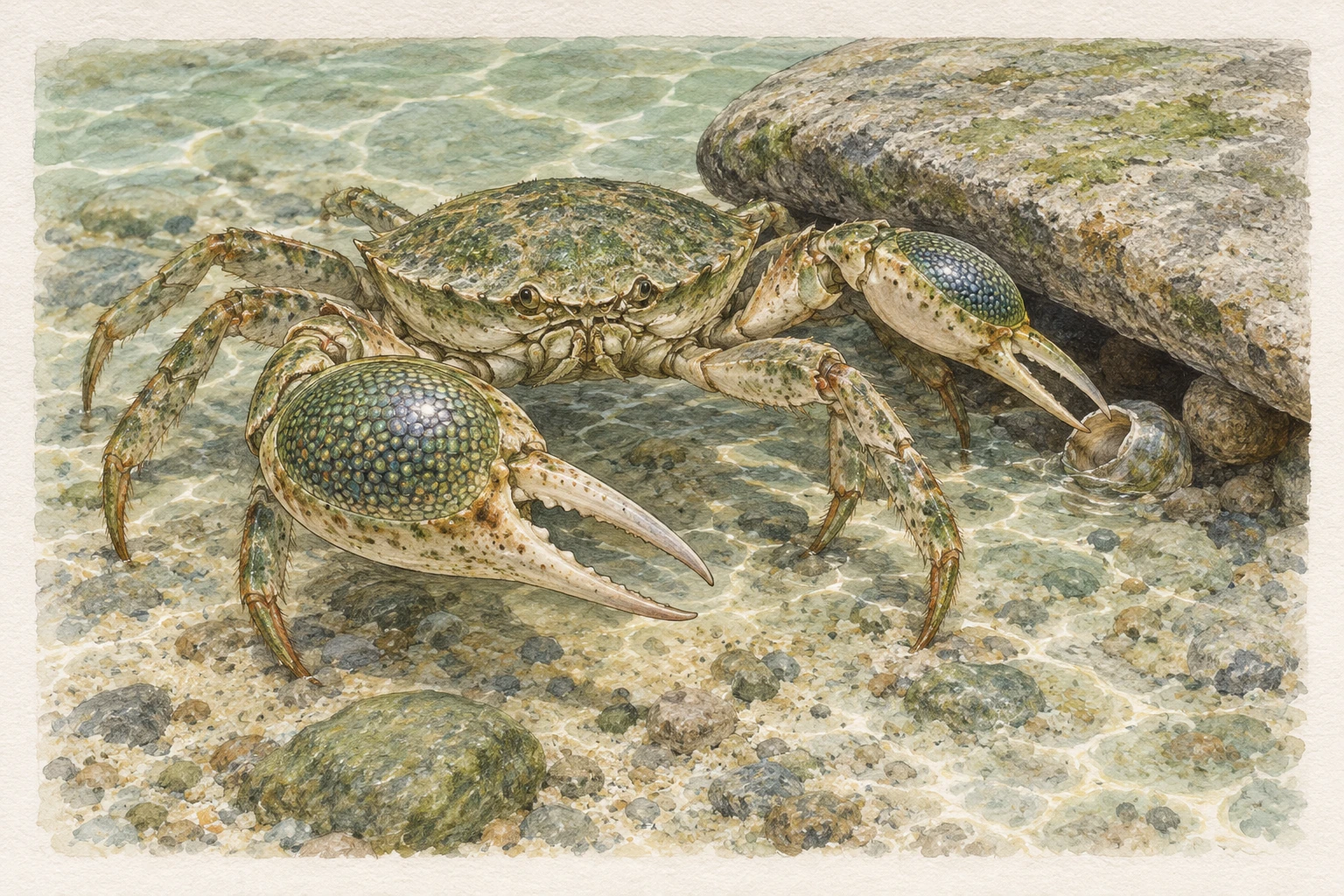
A sightpalm crab turns one visual palm outward while directing the other toward a shell beneath a flat stone. Compound-eye facets occupy the broad outer surfaces of both claws, and narrow pincer fingers extend beyond them to handle food. Local nerve centers process movement before signals pass along the limbs. Joint-position sensing lets the crab combine these changing viewpoints as its wrists turn.
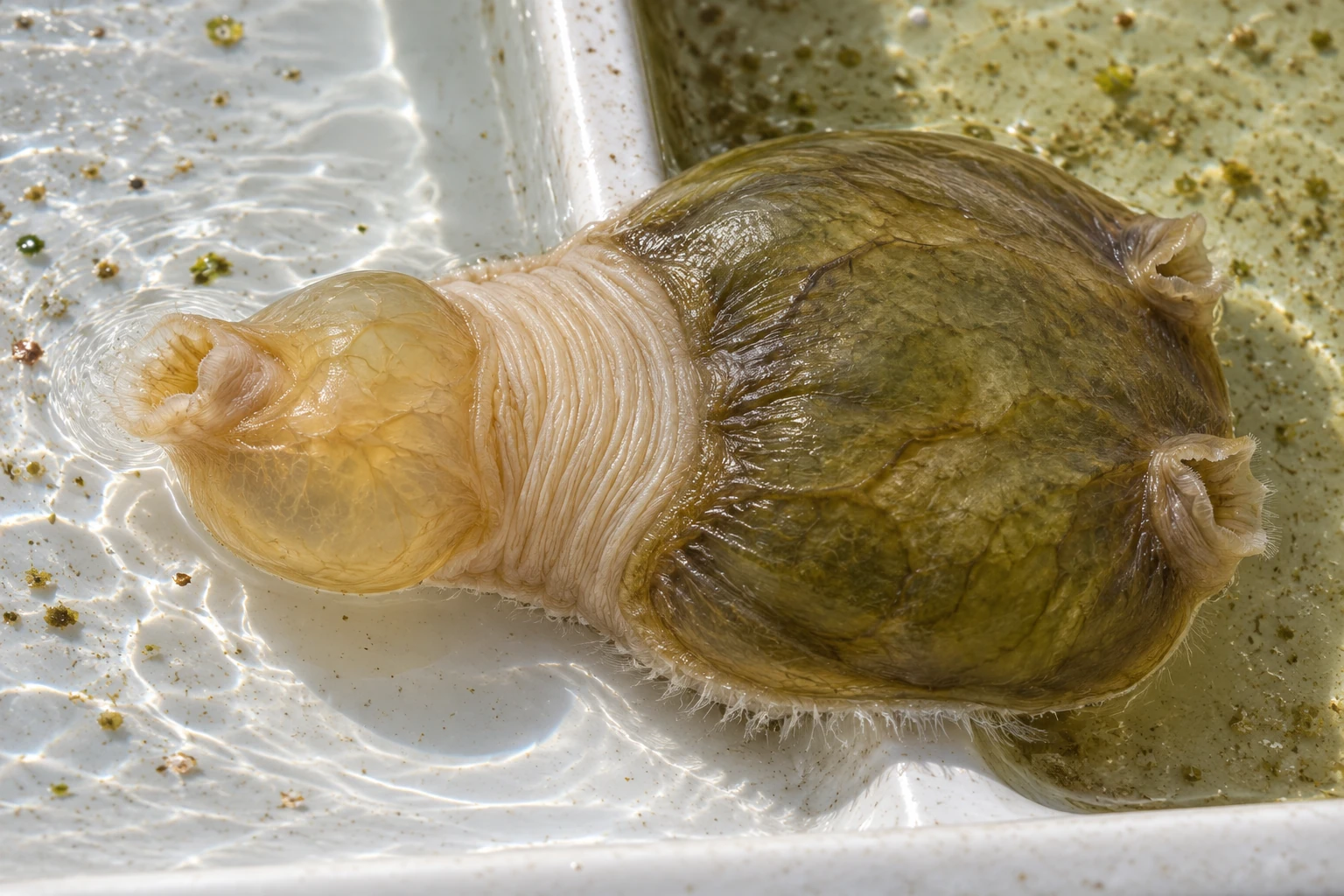
Freshsalt ferry#
Illustration
Freshsalt ferry stores fresh water and brine in unequal reservoirs. Selective membranes in the cream cassette capture part of their mixing energy, supporting slow ciliary movement and tissue maintenance. The honey-colored reservoir takes fresh water at this channel junction while inner valves retain the brine store. Supplied organics provide carbon; the animal returns to both channels as its salinity difference declines.
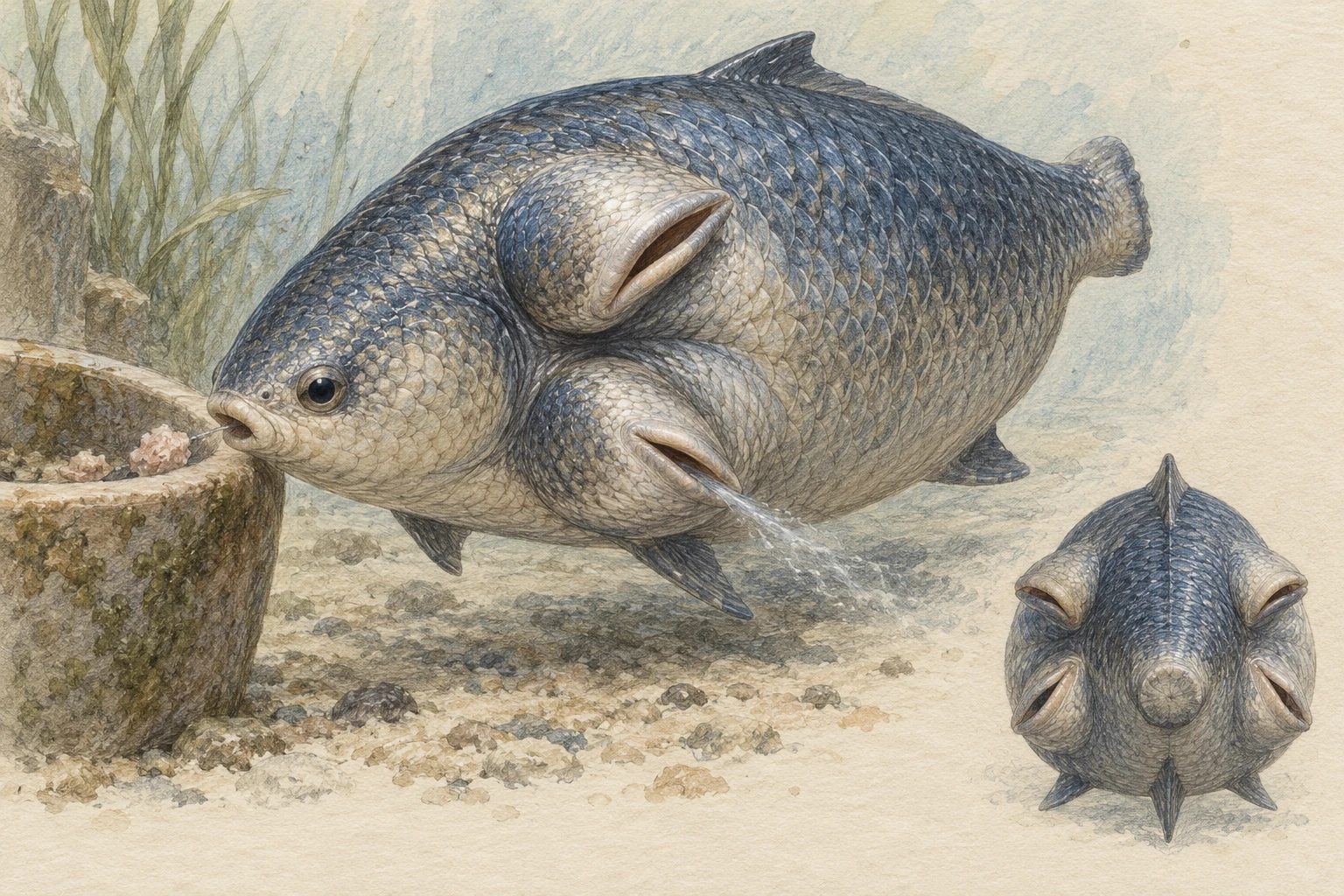
Fourjet inspector#
Sketch
A fourjet inspector approaches food inside a ceramic pot with a brief pulse from one lower outlet. Four independently valved muscular chambers provide the turning forces, while low fin keels steady its compact body. The rear study shows the four fleshy outlet lips around the reduced tail. Protected gill passages maintain oxygen exchange between maneuvers as the fish inspects the vessel rim.
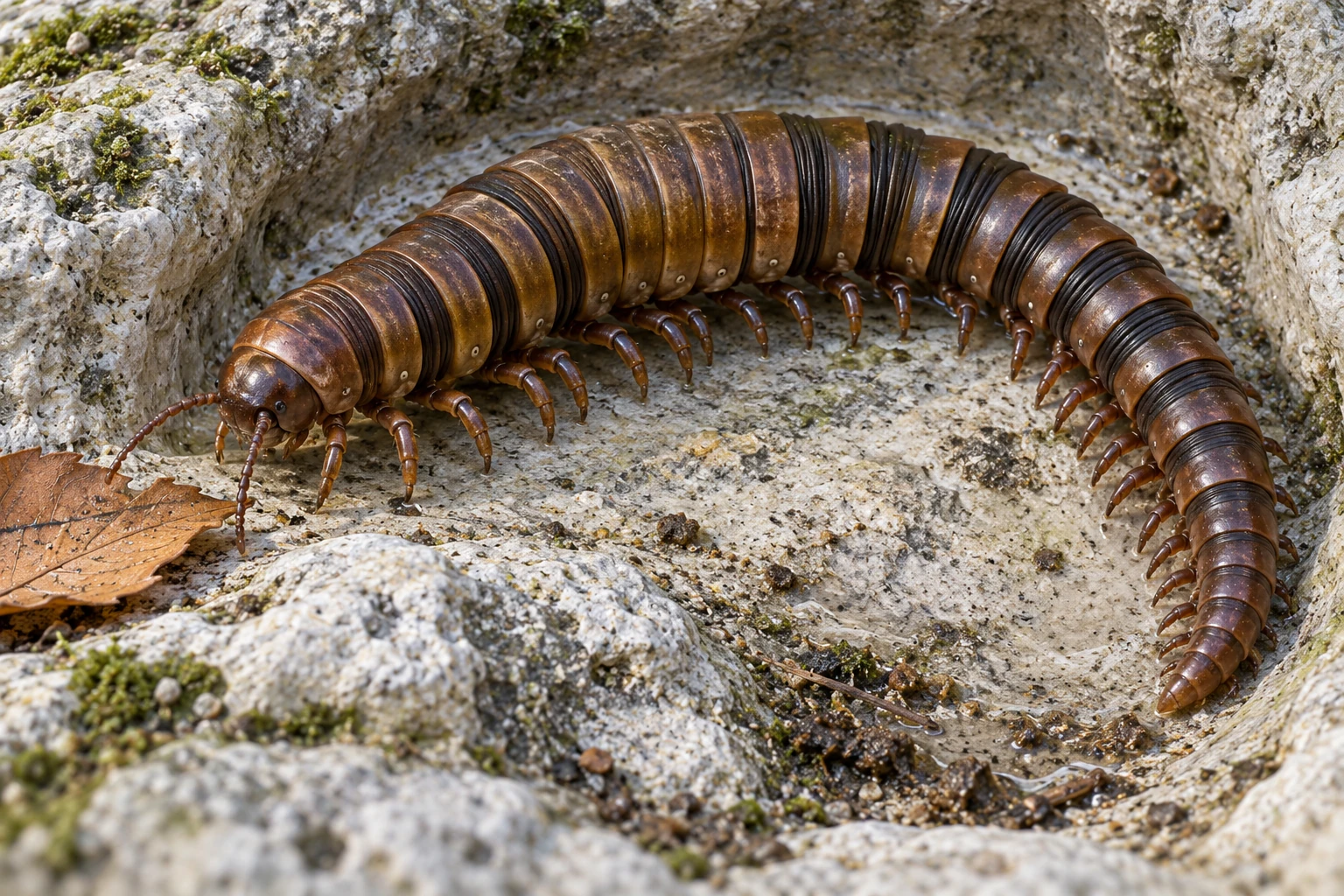
Sleeve-ring millipede#
Illustration
A sleeve-ring millipede shortens its middle joints while turning through a shallow stone recess. Rigid collars overlap the dark flexible bellows, with tightly nested regions beside more extended folds. Numerous short legs keep the long trunk supported as the antennae reach toward a fallen leaf. Folded internal passages accommodate the slow change in length, and protected openings along the collar margins maintain airflow.
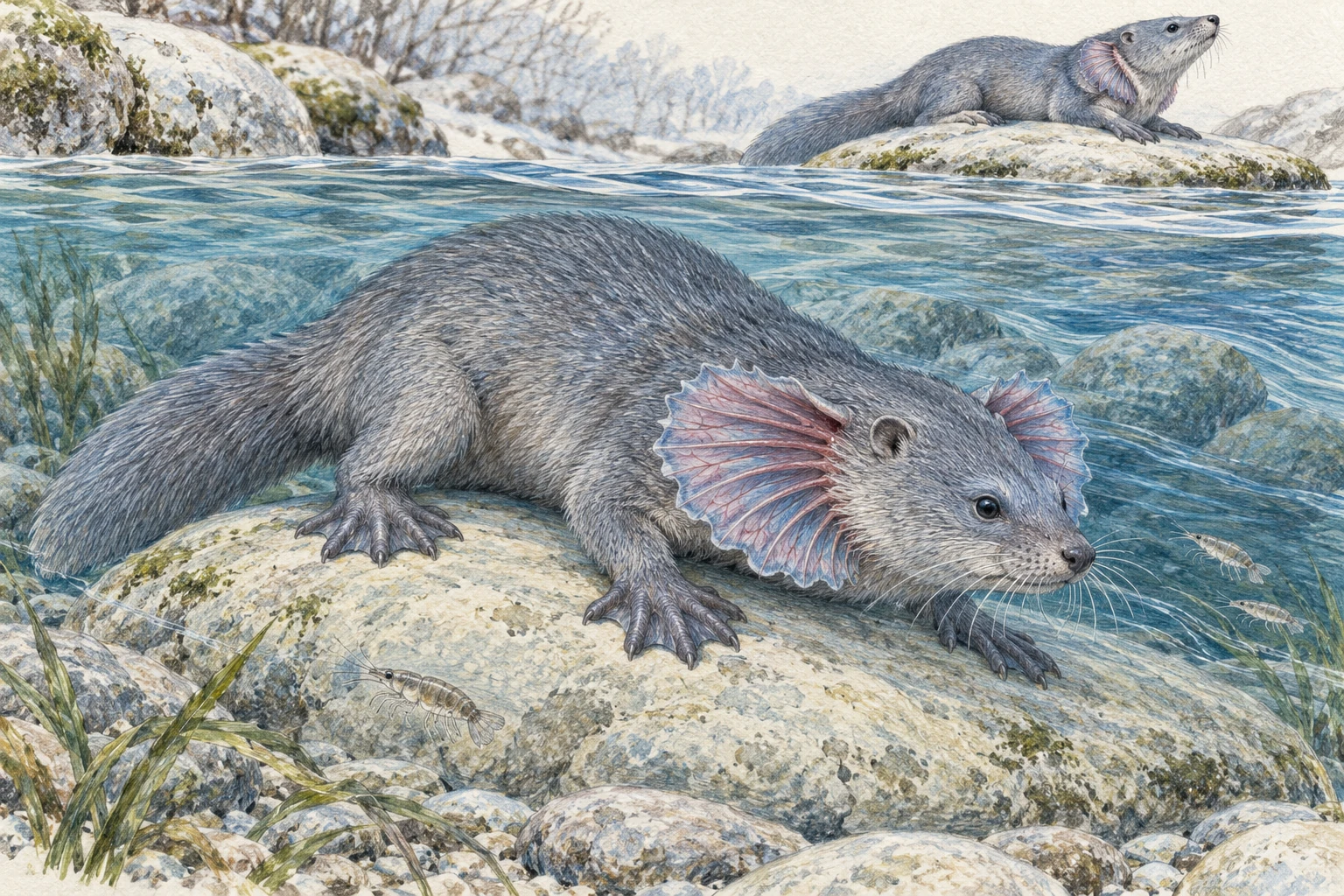
Gillruff sleeper#
Sketch
Gillruff sleepers settle on stones in cold, oxygen-rich currents. Fine vascular lamellae behind the jaw exchange gases while regulated torpor lowers the resting animal’s demand. Cartilage ribs keep the wet folds open, and webbed feet hold the body against the flow. A companion has climbed onto an exposed stone for a lung breath; active feeding and swimming follow renewed access to air.
Sleevebill picker#
Illustration
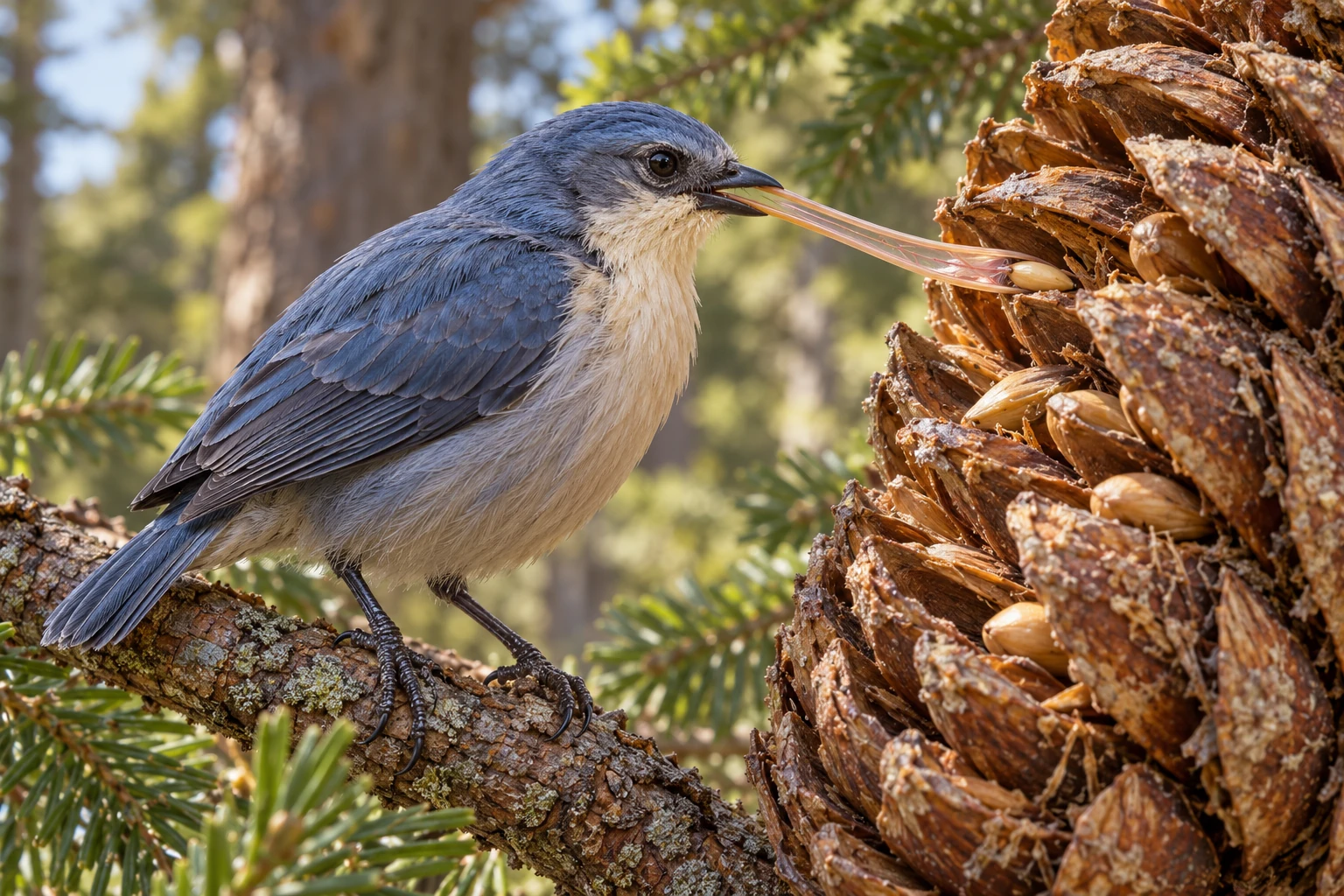
A sleevebill picker reaches between rigid cone scales with an extended amber feeding sleeve. Fine keratin rails support a continuous muscular floor that cradles a soft seed, while the short fixed bill remains outside the gap. The deep feathered throat houses the folded retrieval apparatus between meals. Both feet grip the supporting branch as the bird guides its delicate sleeve by touch.
Pulsehouse#
Sketch
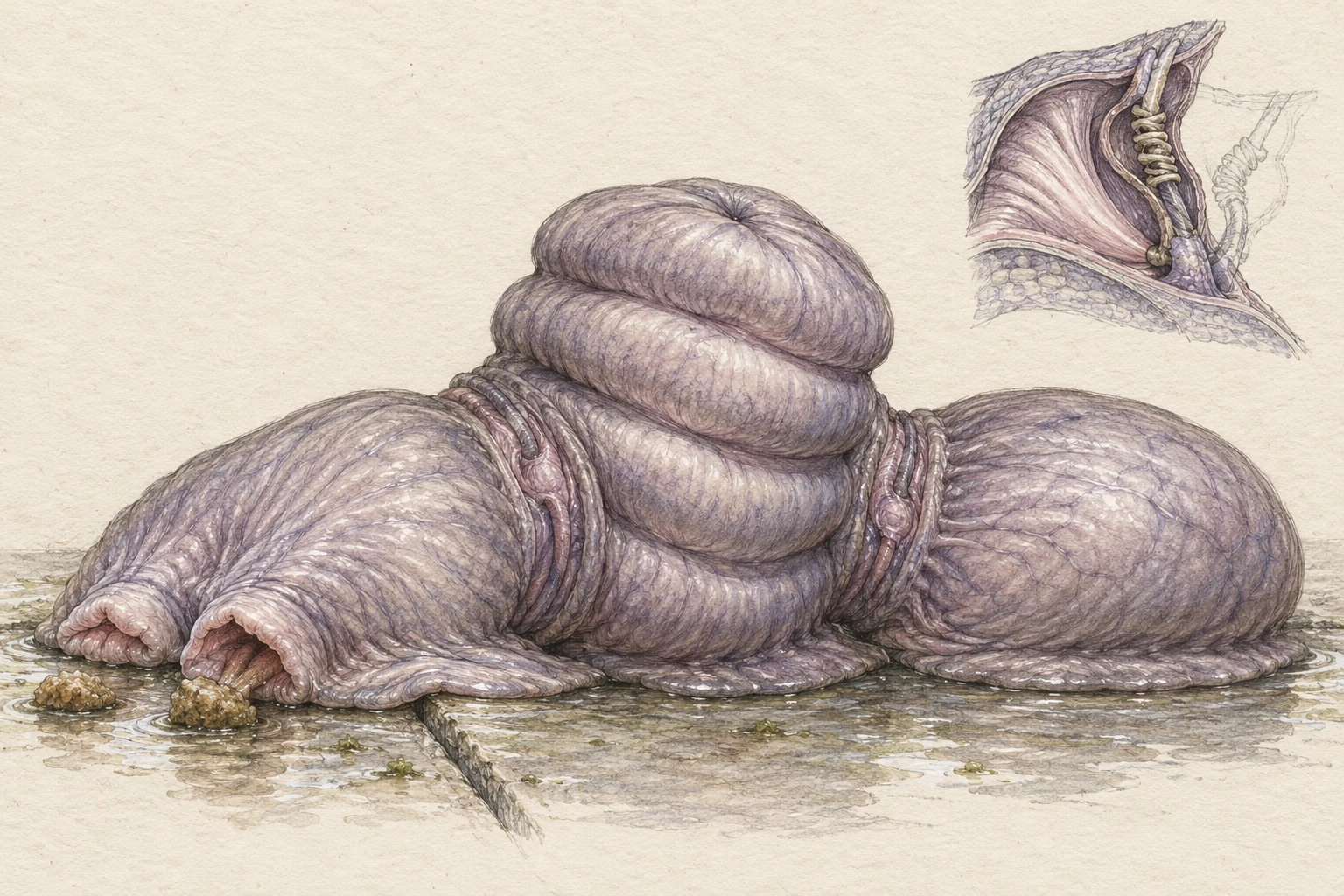
Pulsehouse carries a simple feeding preference in the positions of living mechanical latches. Muscular diaphragms send pressure pulses through dedicated liquid ducts linking its three fixed bellows organs. The front organ samples two food pellets, while the tall accumulator supplies the pressure that adjusts their inlets. Broad basal folds shift the body across a tile seam; a wall study shows a diaphragm and latch.
Stillclaw crab#
Illustration
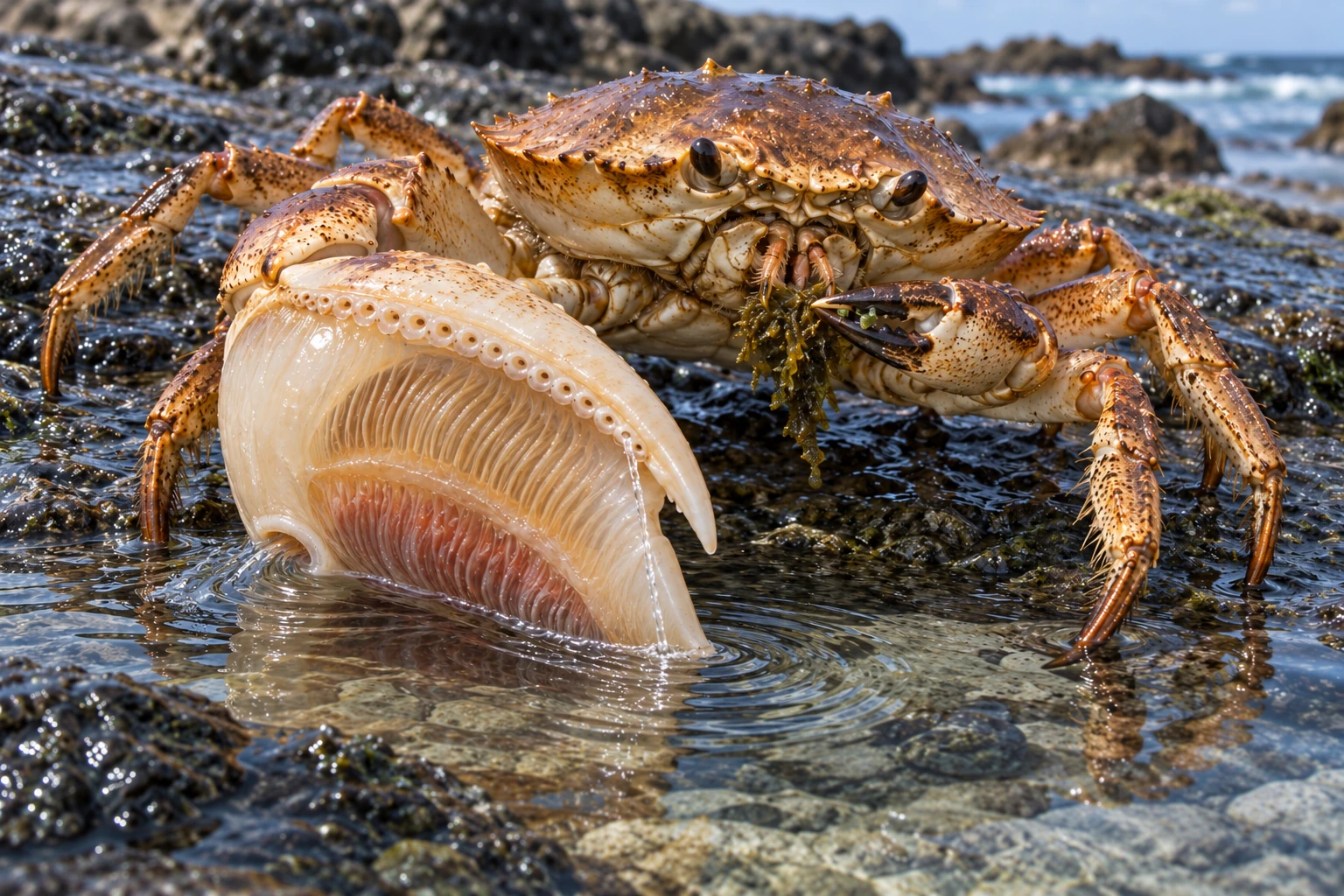
A stillclaw crab rests its enlarged gland palm in a shallow salt pool while the smaller claw brings seaweed toward its mouth. The lower intake admits water to protected processing channels visible through the translucent wall. Food-powered ion pumps concentrate salts, and a separate row of rim pores releases brine. Recovered water enters the body through the gland tissue as the broad palm rests against the submerged stone.
Tileback newt#
Sketch
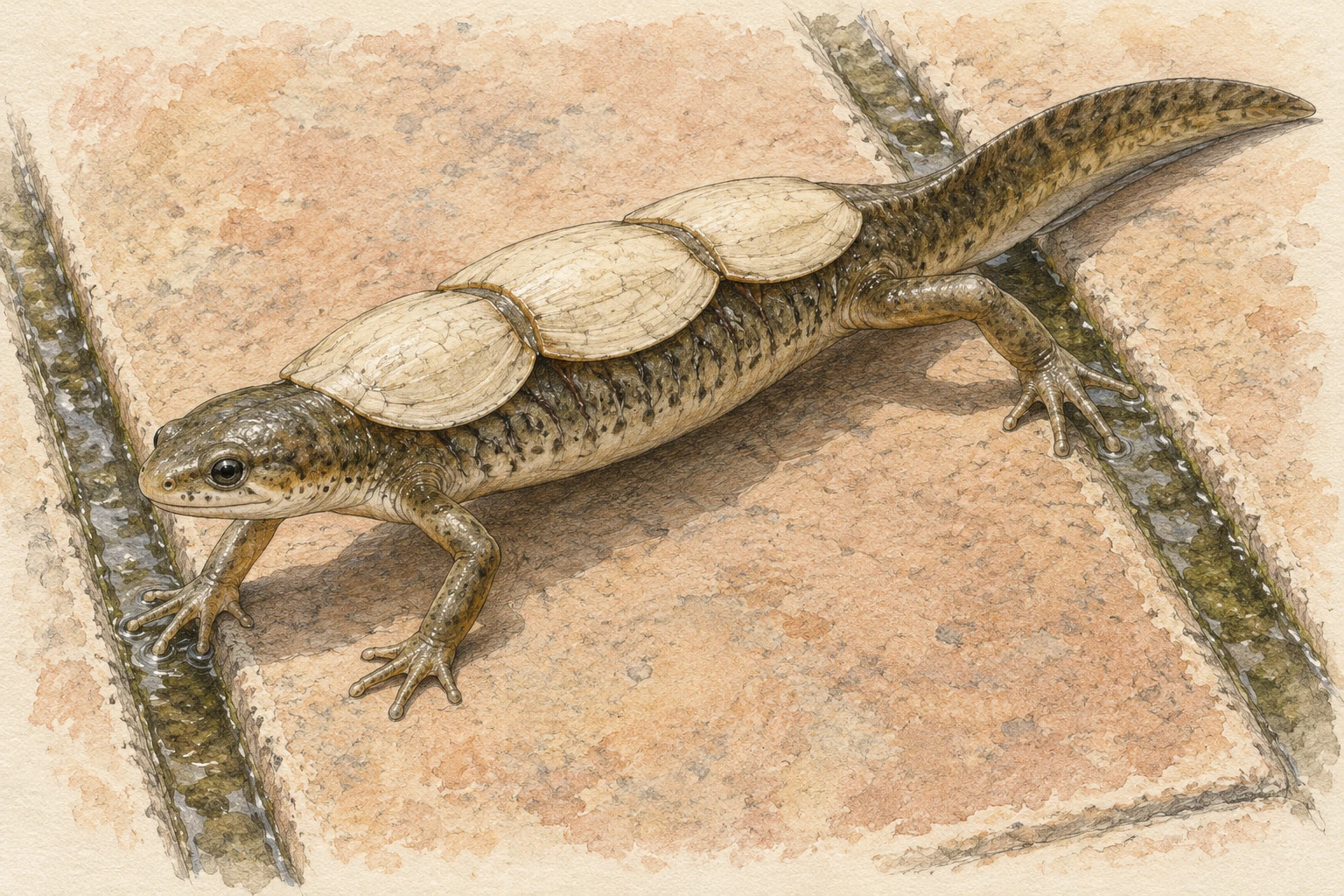
Three overlapping dorsal shields cover a tileback newt as it crosses the dry center of a garden tile. Its long limbs lift the belly above the warm surface, and spread toes find water along the grout. Living beds renew the calcium-rich plates, while flexible seams allow the trunk to bend. Respiratory flank grooves, belly skin and lungs sustain the short journey between wet refuges.
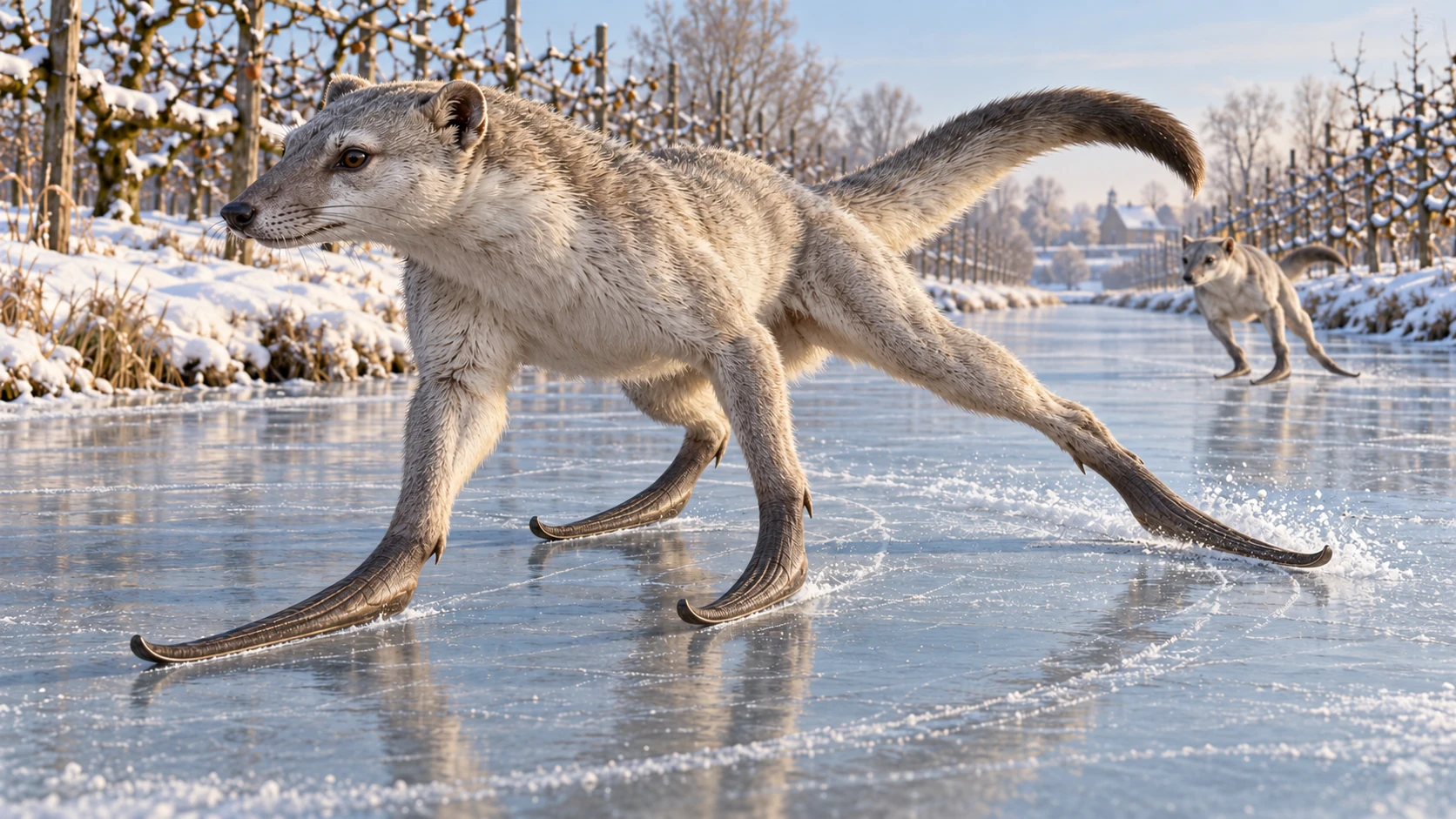
Edgefoot runner#
Illustration
Edgefoot runners cross frozen orchard canals on narrow keratin feet supported by elongated bound digits. Strong ankles tilt each runner onto its edge, turning sideways pressure into a propulsive stroke. The near adult pushes outward with one hind foot while its other three maintain contact. A curved tail steadies the turn, and fine grooves trace the loaded edges across the bearing ice.
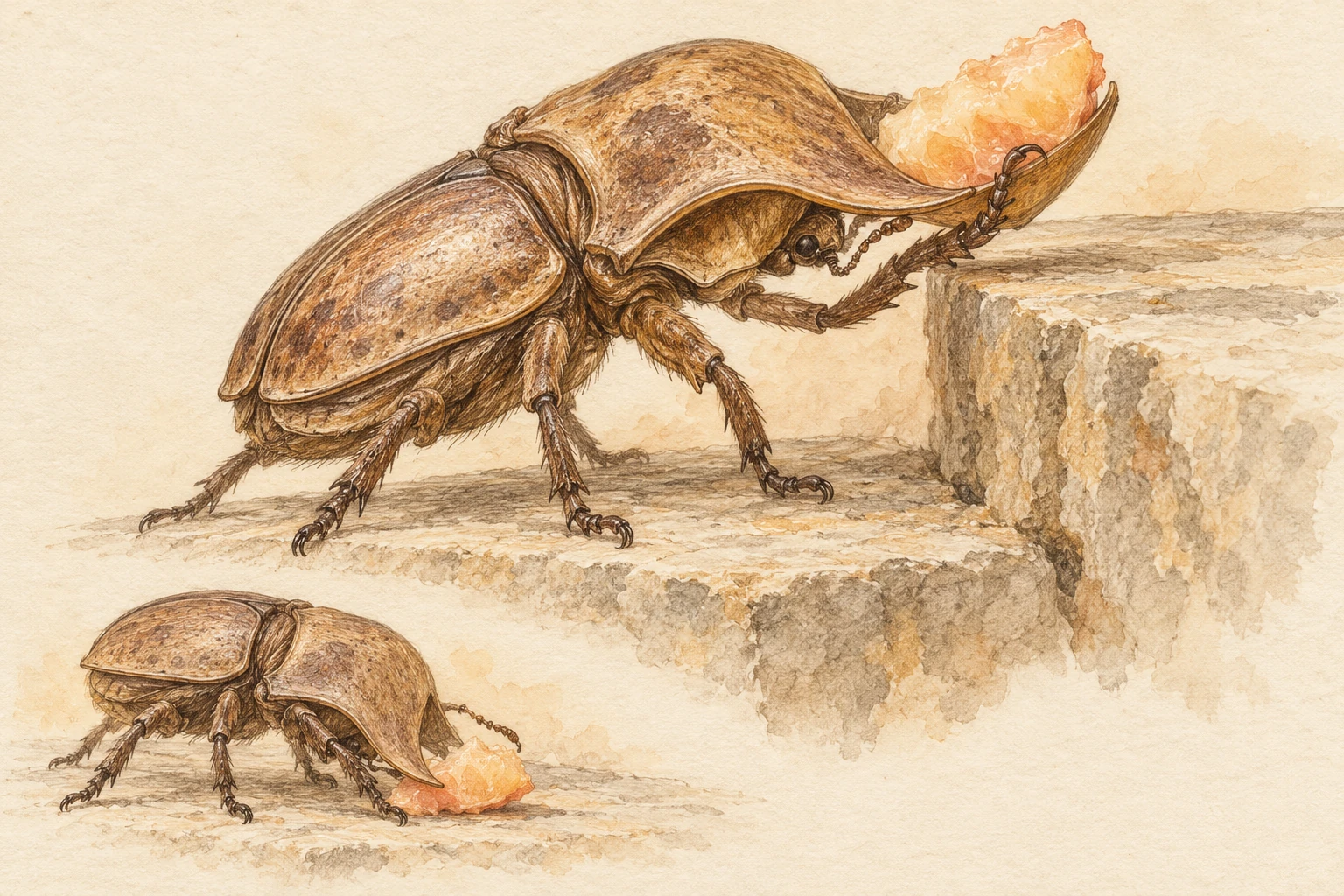
Hingechest beetle#
Sketch
A hingechest beetle raises a soft fruit fragment on its curved thoracic scoop. The shield rotates from a reinforced rear fulcrum while the small head withdraws beneath its rim. Braced middle and rear feet transmit the lifting force into the lower stone shelf, and a forefoot steadies the load. The smaller study shows the shield lowered for gathering another light fragment before the next short lift.
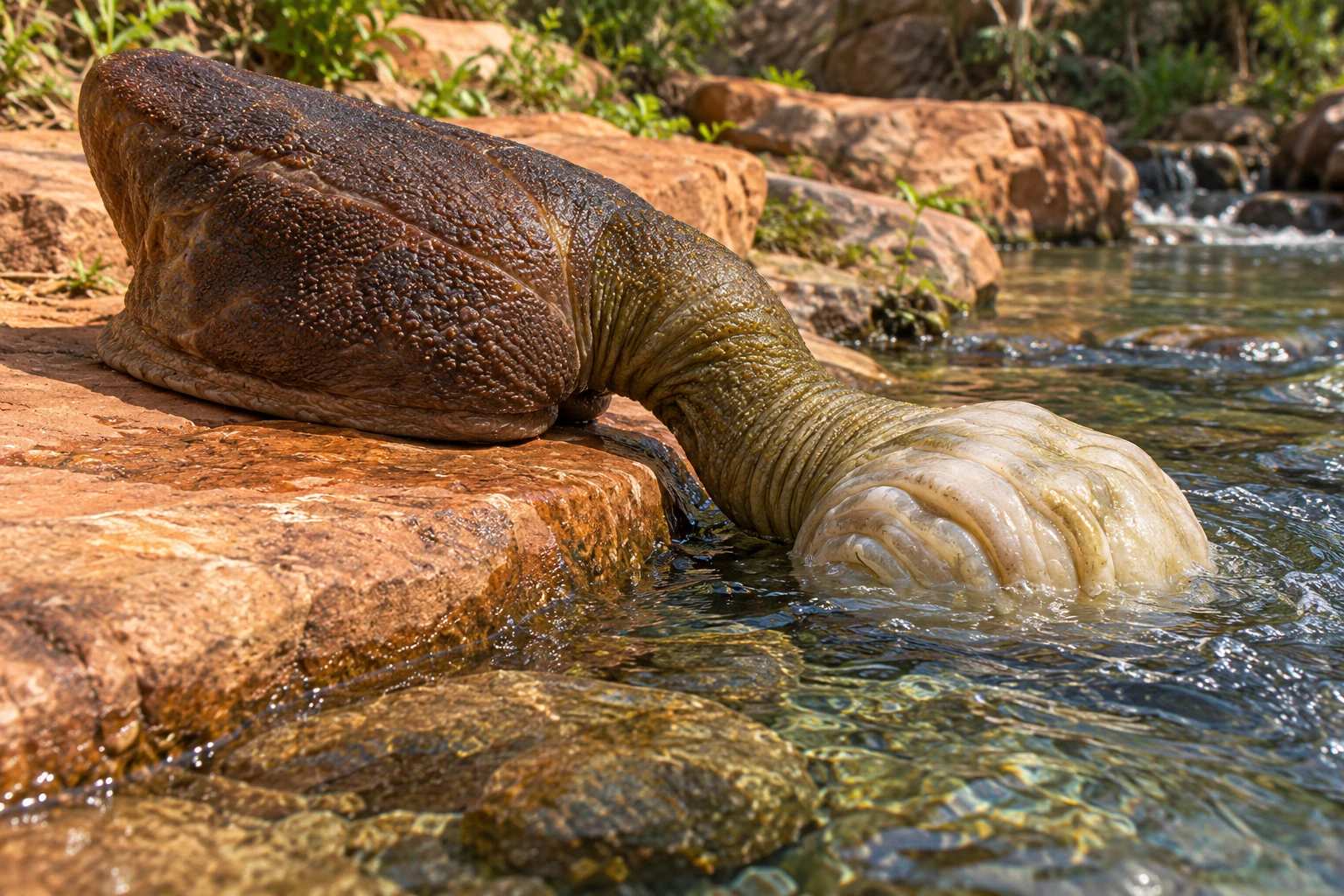
Warmbank couplet#
Illustration
Warmbank couplet settles its dark contact wedge on a warm bank while the pale grooved terminal releases heat into flowing water. Nanofabricated thermoelectric inclusions harvest a small fraction of that heat flow within the connecting tissue. Sheltered fluid channels keep working cells within their temperature range. Dietary carbon builds tissue, and stored chemical fuel pays for each slow relocation between useful contacts.
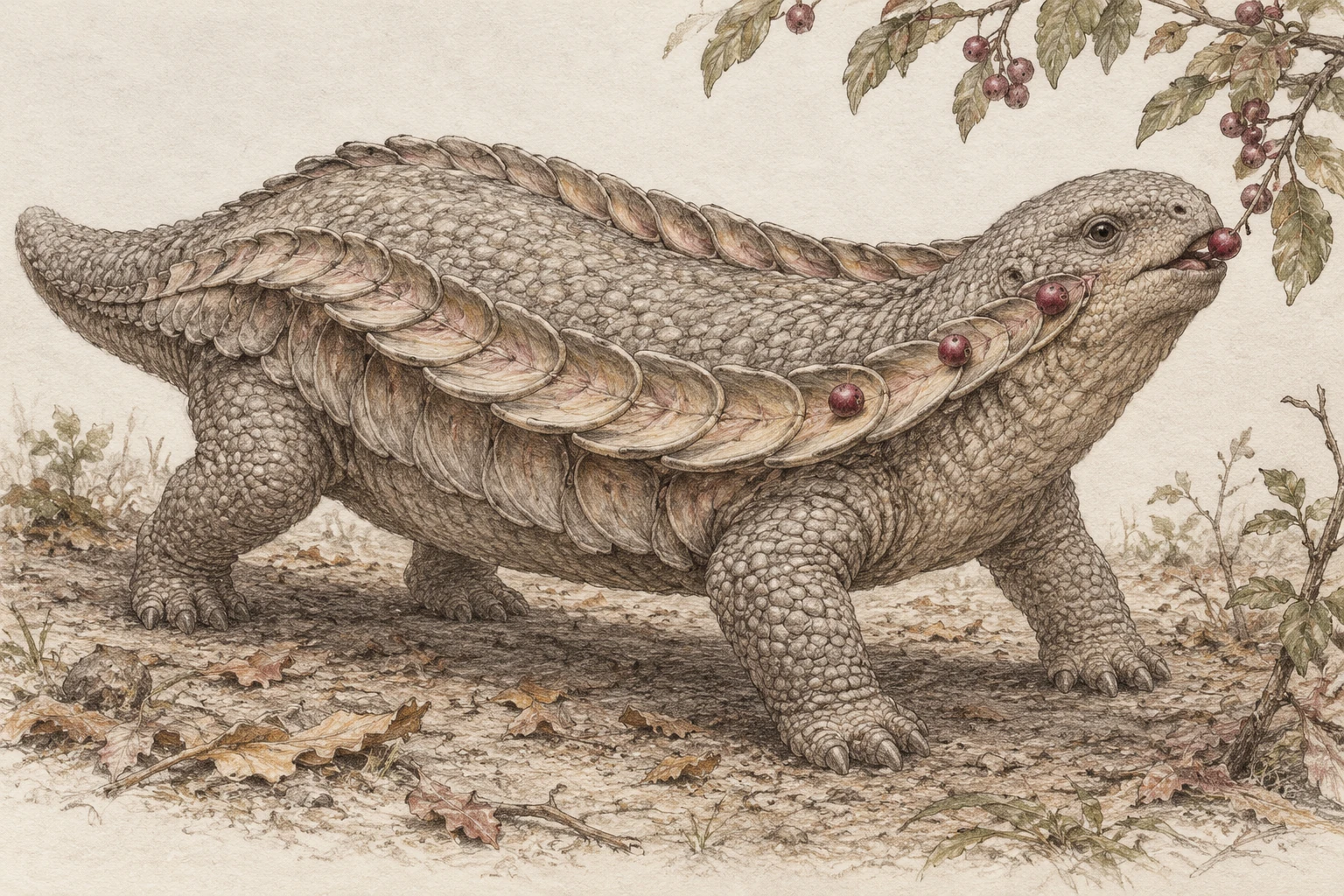
Conveyor-scale grazer#
Sketch
Three small berries rest along the near flank lane of a conveyor-scale grazer as it reaches toward a fruiting twig. Each overlapping blade retains a fleshy muscular root, allowing successive tilts to pass light food toward the cheek. Raised outer rims hold the load above the walking legs. The paired lanes demand careful cleaning and continual renewal as the animal gathers fruit beneath shrubs.
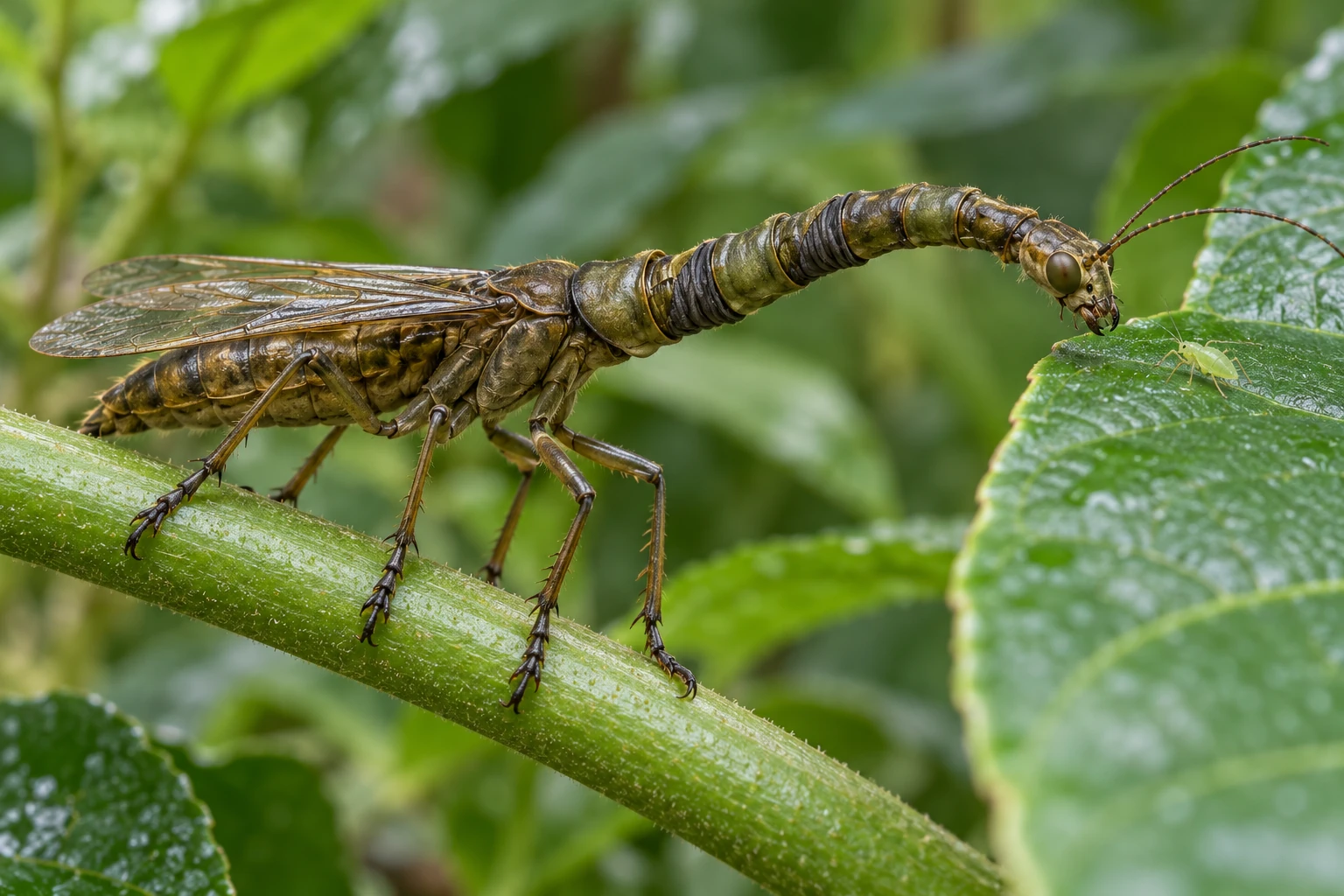
Probeneck hunter#
Illustration
A probeneck hunter grips the leaf stalk and extends its head toward a soft insect on the neighboring leaf. Overlapping collars protect the dark folds of its cervical sleeve, which stores slack for nerves, vessels and breathing tubes. The broad thoracic root carries the head’s bending load. It approaches slowly from this secure perch, then retracts the sleeve before releasing its feet for flight.
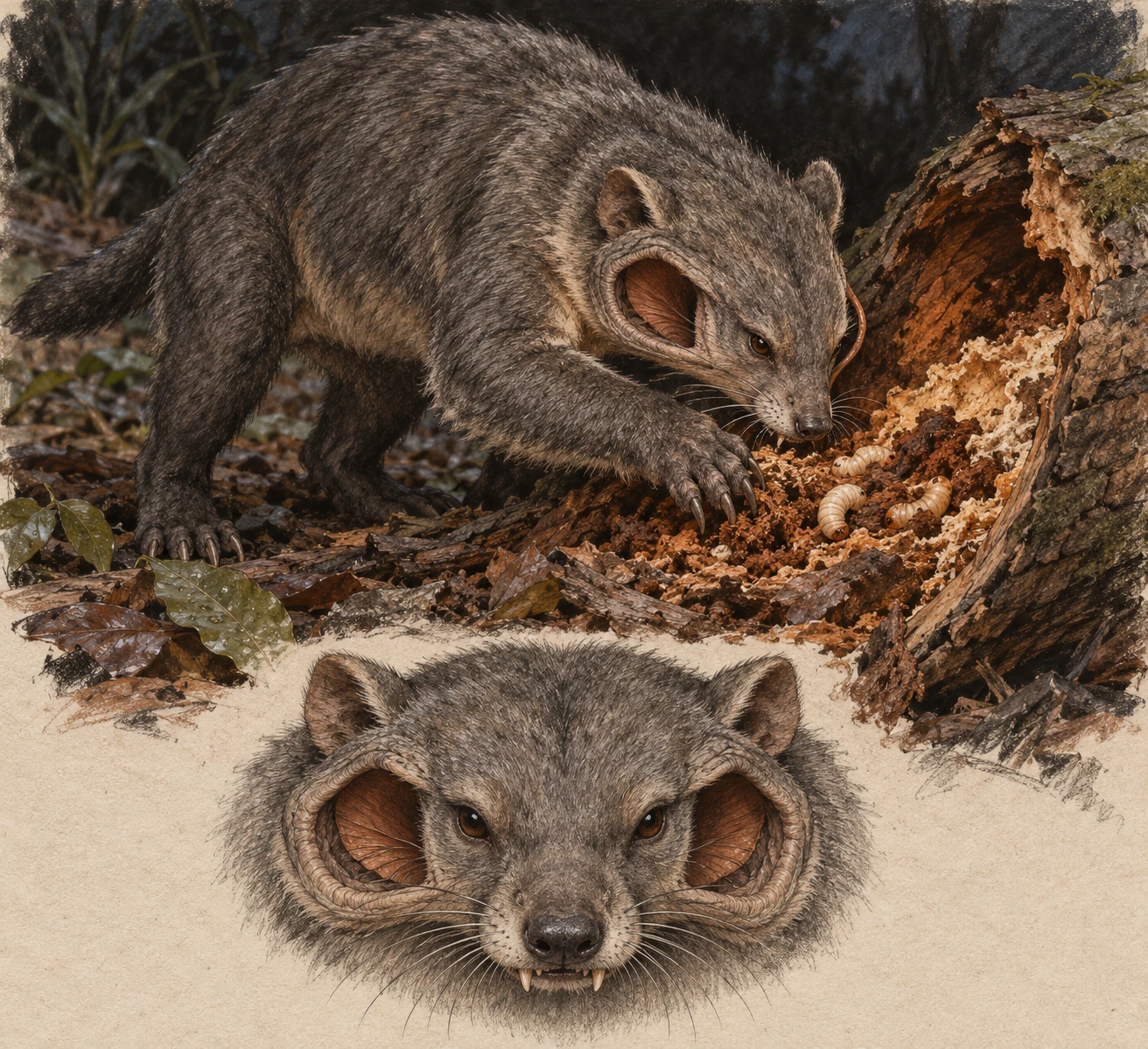
Heatveil prowler#
Sketch
Heatveil prowlers turn recessed cheek membranes toward warm exposed compost, using coarse radiant contrast to choose a feeding patch. Deep insulated rims shade the membranes from the muzzle, while low perfusion and passing air limit self-heating. Here an adult investigates grubs with a foreclaw at an open log mouth. The lower face study shows the protected membranes beside its central muzzle.
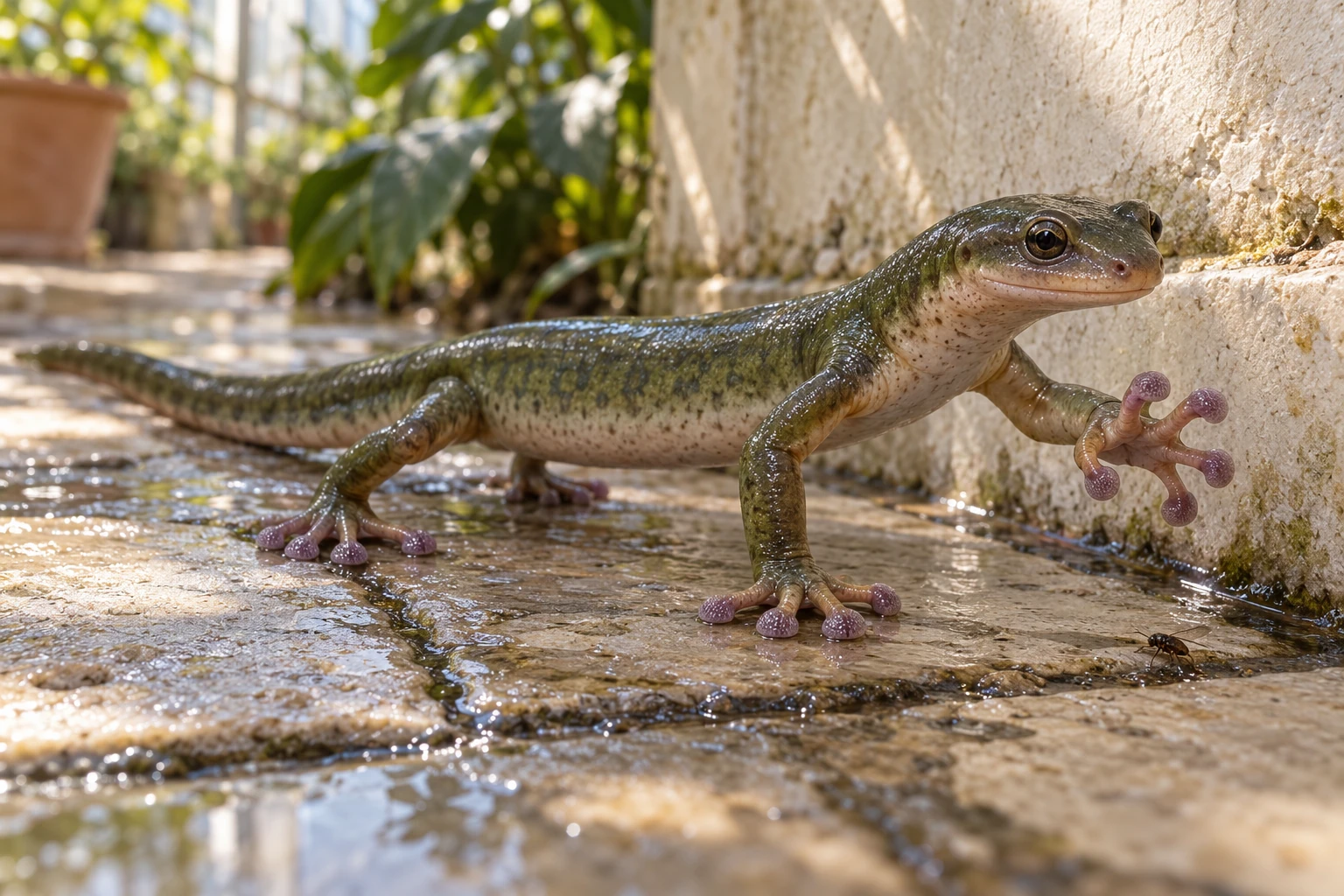
Rootsole salamander#
Illustration
A rootsole salamander lifts one forefoot beside the greenhouse wall, exposing five porous plum-colored pads before choosing its next damp contact. The planted feet spread across wet stone seams while the trunk remains raised. Valved toe channels and local salt pumps regulate water uptake through the pads. A wax-rich back slows evaporation as the animal searches the stonework for small insects.
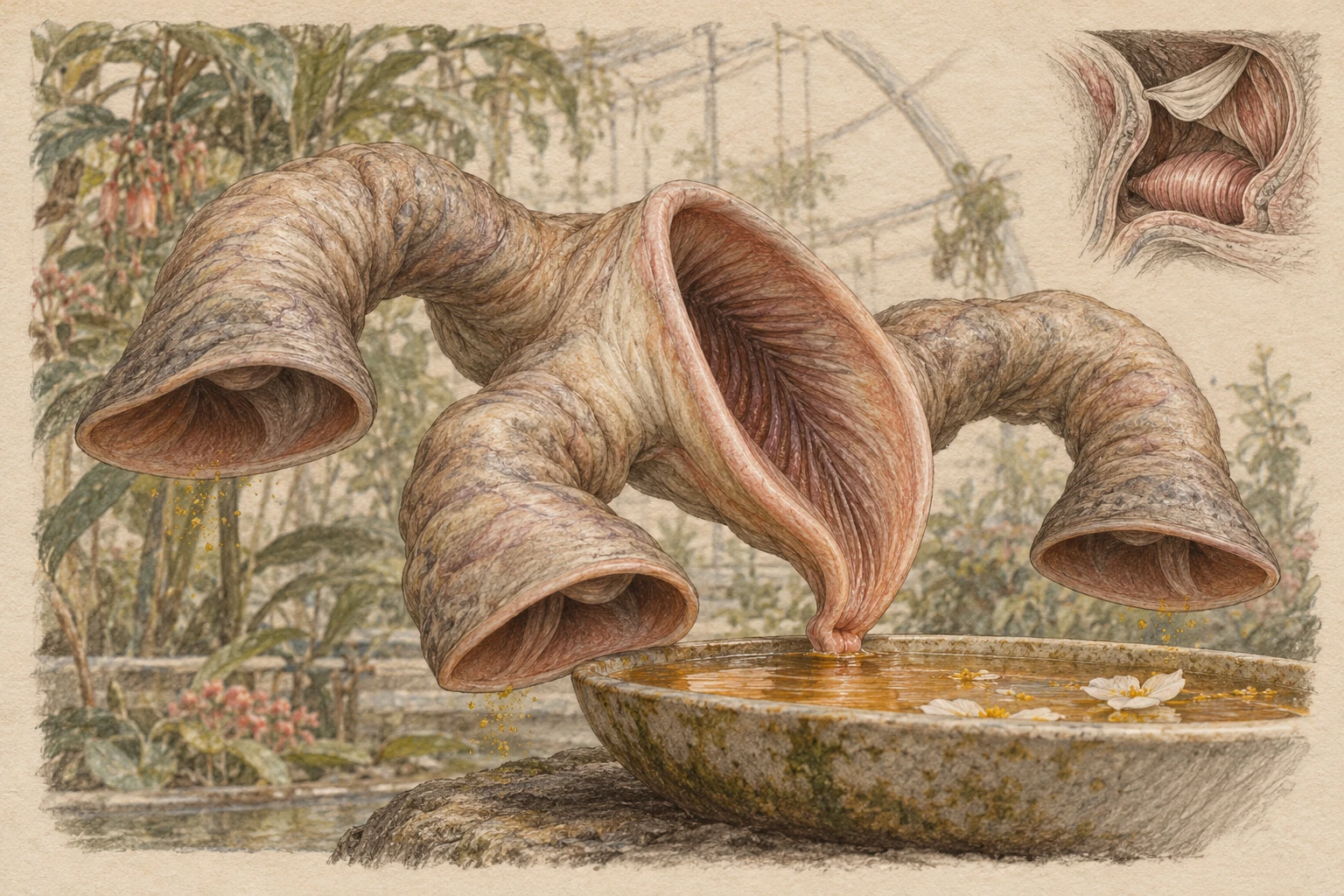
Throatkite#
Sketch
Throatkite moves air through its entire branched body. Muscular diaphragms and soft check valves drive flow from the oblique intake toward three downward outlets, producing brief hovering bouts in dense, low gravity air. Folded duct linings exchange respiratory gases, and the exhaust carries heat away. A feeding lip reaches nectar while the animal stays close to a broad resting rim.
Quarterturn ribbonfish#
Illustration
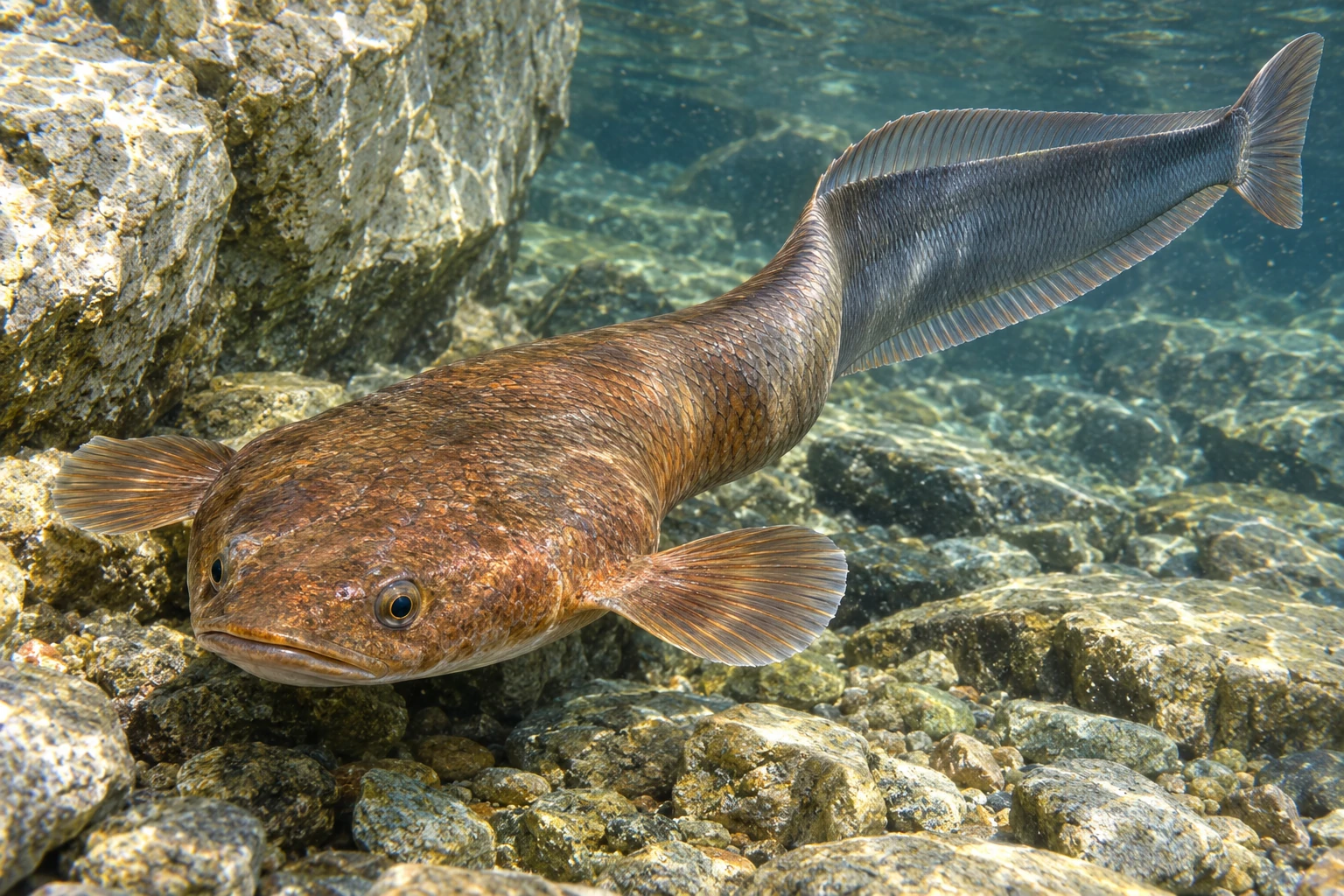
A quarterturn ribbonfish holds station beside a rock corner with its broad forebody nearly horizontal and its deep posterior body vertical. The change of plane develops gradually along one continuous skeleton, with muscle sheets and fin roots following the same fixed geometry. Anterior fins control level trim while the rear fins counter sideways flow. Coordinating the two regions lets it work where channel currents turn.
Sixwing relayfly#
Sketch
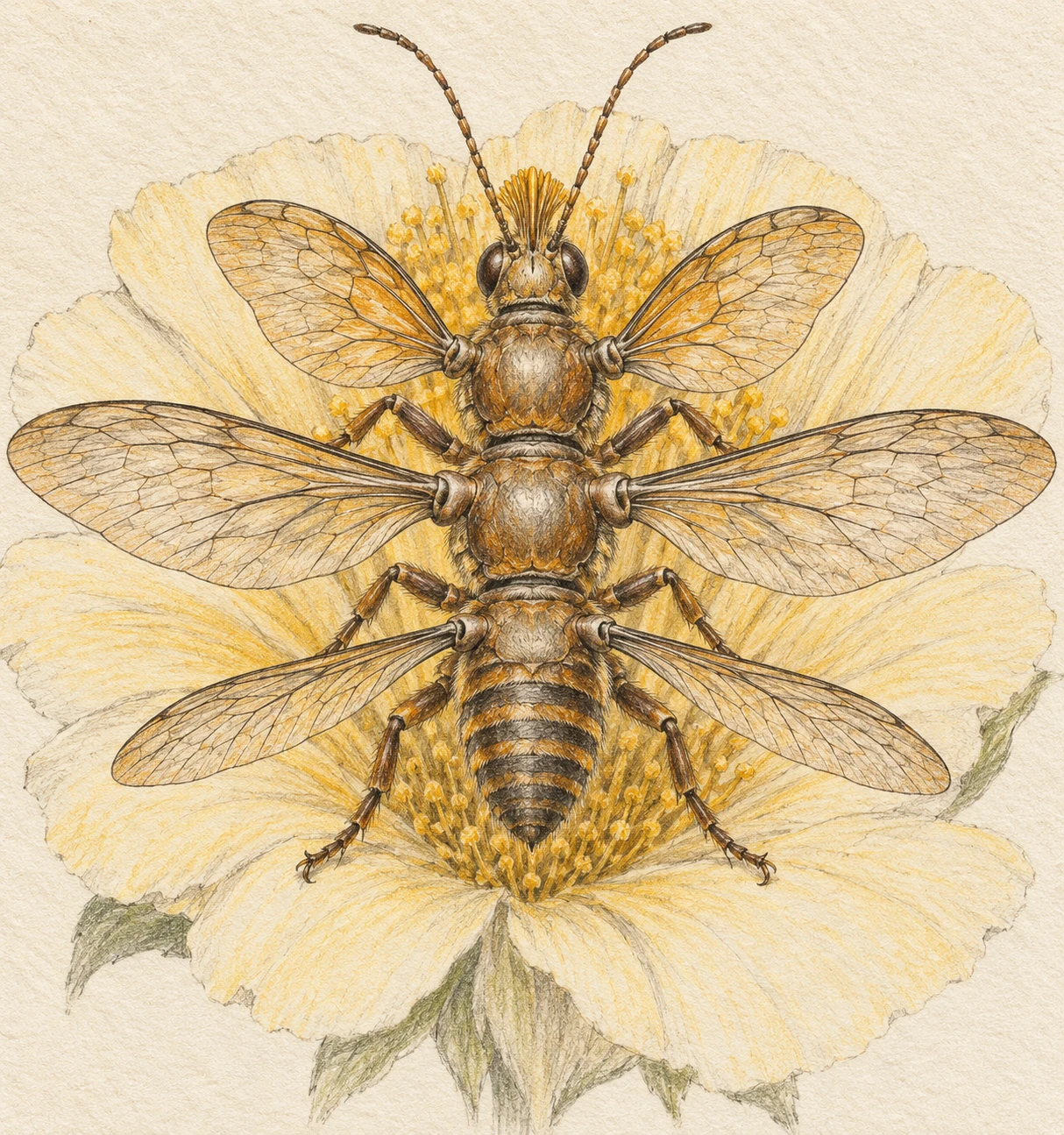
A sixwing relayfly rests on a broad flower with its three wing pairs spread above the petals. Each enlarged thoracic segment carries its own matched pair of flight wings and walking legs. Short broad forewings, long middle wings and narrow hindwings distribute lift across three controlled planes. Separate muscles stagger their strokes during short flights, while frequent nectar meals replenish the energy used by the heavy flight apparatus.
Coppice spring#
Illustration
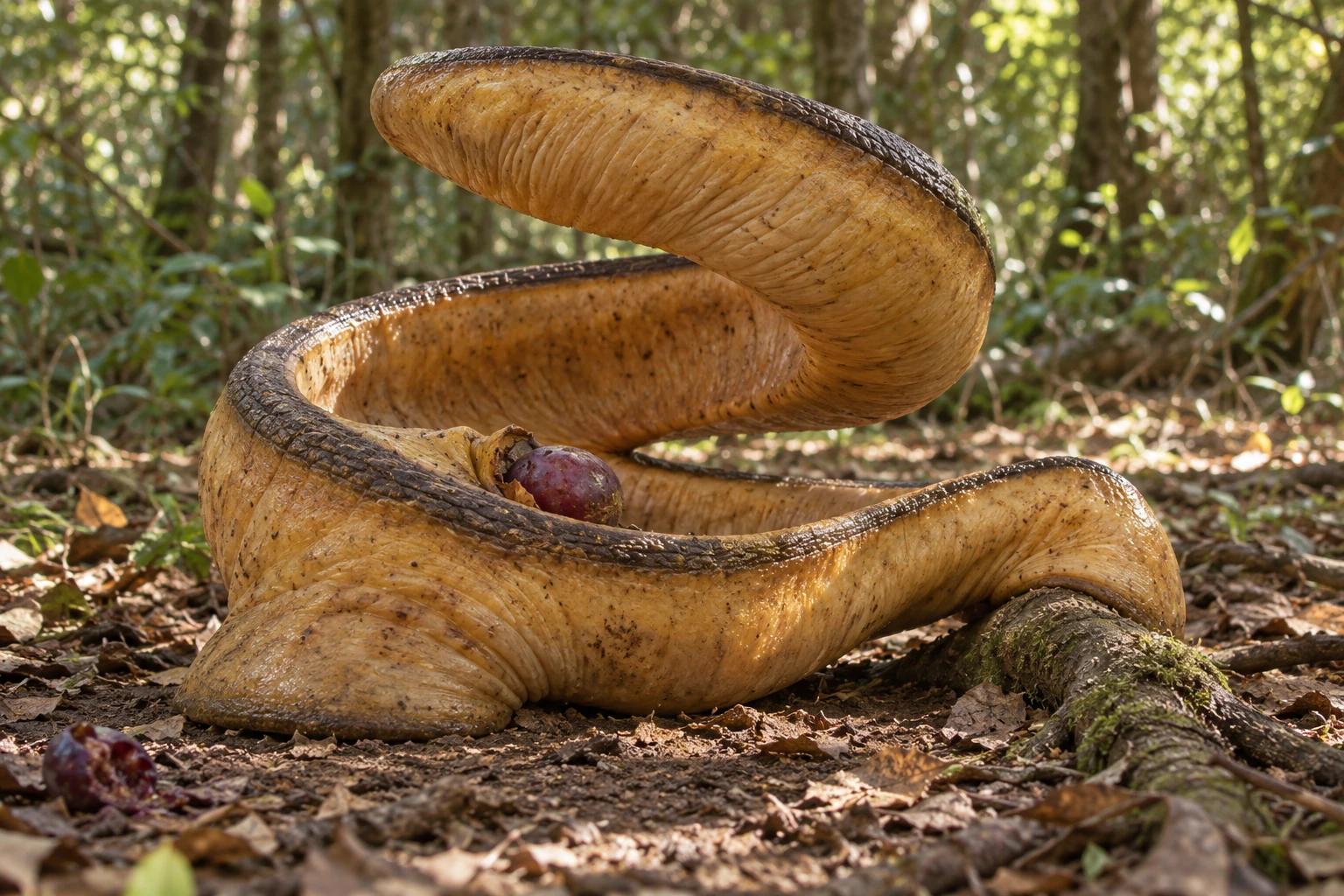
Coppice spring carries its weight along broad arcs of the lower ribbon. Muscles compress the thick coil and load its reinforced outer edge, then release a little stored strain to assist short rocking steps. Protected air chambers and water-saving skin support terrestrial activity. A soft inner fold holds a fallen plum as one low margin presses across a root.
Counterlung strider#
Sketch
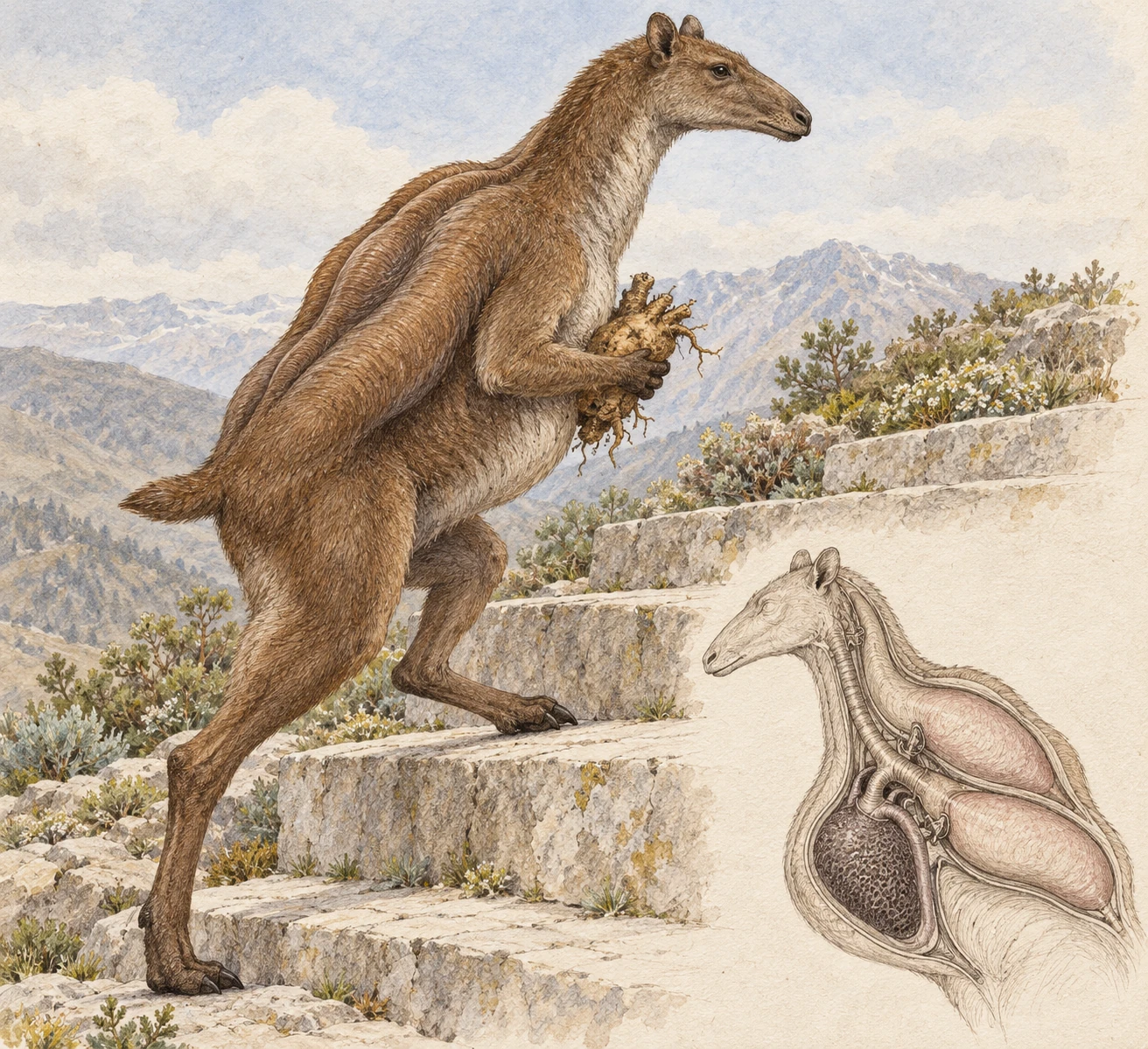
Counterlung striders carry a compact respiratory exchange core within the deep chest and air reservoirs under long dorsal folds. Coordinated reservoir pumping and routing valves maintain one-way flow through the core across the breath cycle. This adult carries a root up an upland garden stair, placing its hind feet on separate treads. The inset shows the exchange tissue and connected reservoirs within the trunk.
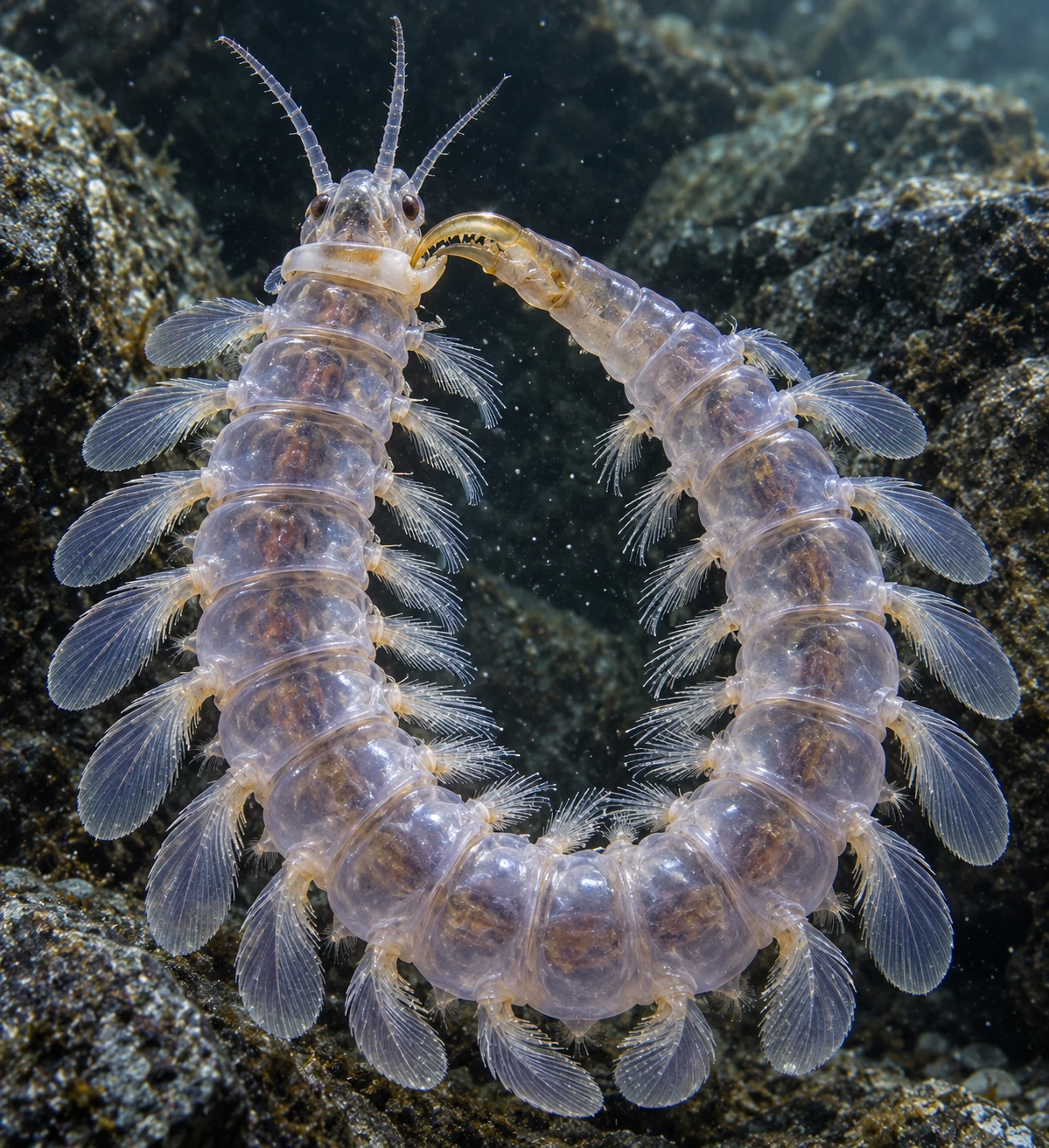
Loopdock remipede#
Illustration
A loopdock remipede fastens its tail clasp to an anterior collar and feeds within the resulting curve. The head and antennae remain free outside the loop. Broad outer leg branches paddle water across the open center, while finer inward combs retain suspended particles and pass them toward the mouth. The clasp carries tension during feeding, then releases when the animal straightens for travel or prepares to molt.
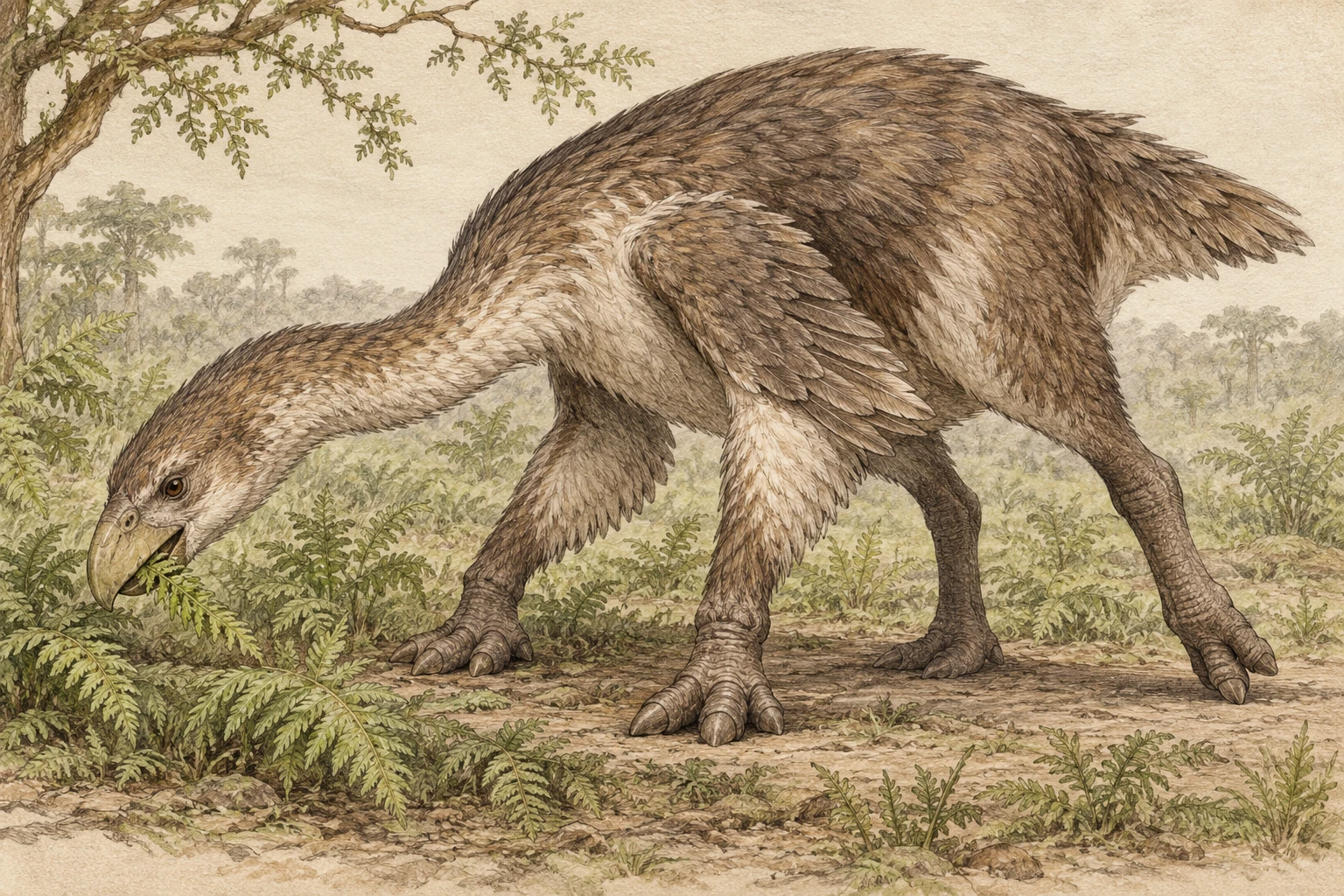
Groundwing browser#
Sketch
A groundwing browser lowers its long neck to crop ferns while two padded wing hands and one hind foot carry its weight. The other hind foot advances beneath the heavy pelvis. Short feathers cover the sturdy forelimbs above exposed wrists and broad walking digits. A deep pectoral girdle transfers their ground loads into the sternum, giving the large flightless bird a stable browsing stance.
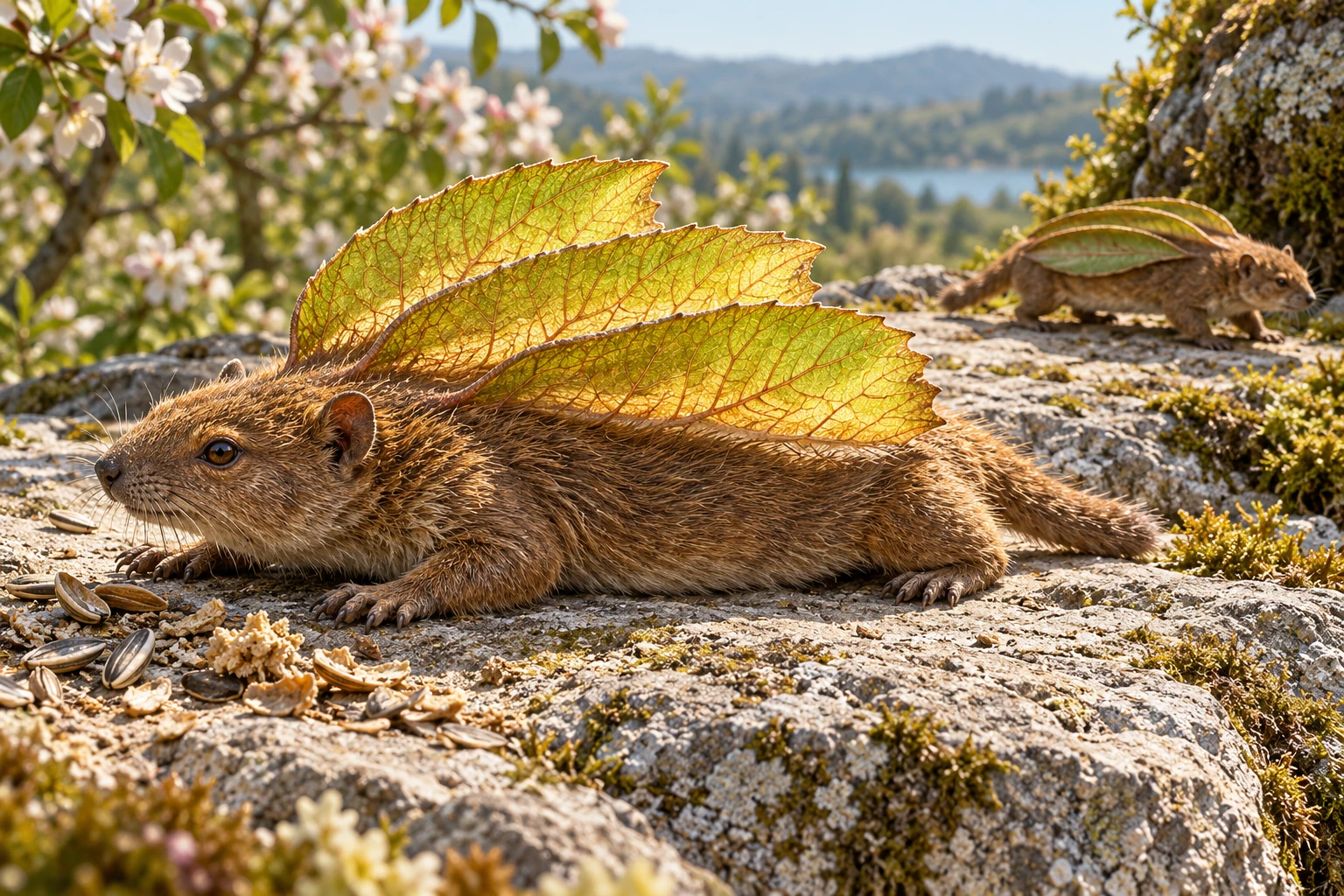
Sunfringe grazer#
Illustration
Sunfringe grazers spread three vascular skin frills while resting after a meal. Photosymbionts in the thin green-gold tissue provide a modest maintenance subsidy as blood carries fixed carbon and excess heat away. Fungi and seeds supply the energy used for warmth, growth and active movement. The foreground adult basks beside its feeding scraps while a companion gathers its frills for a walk toward shade.
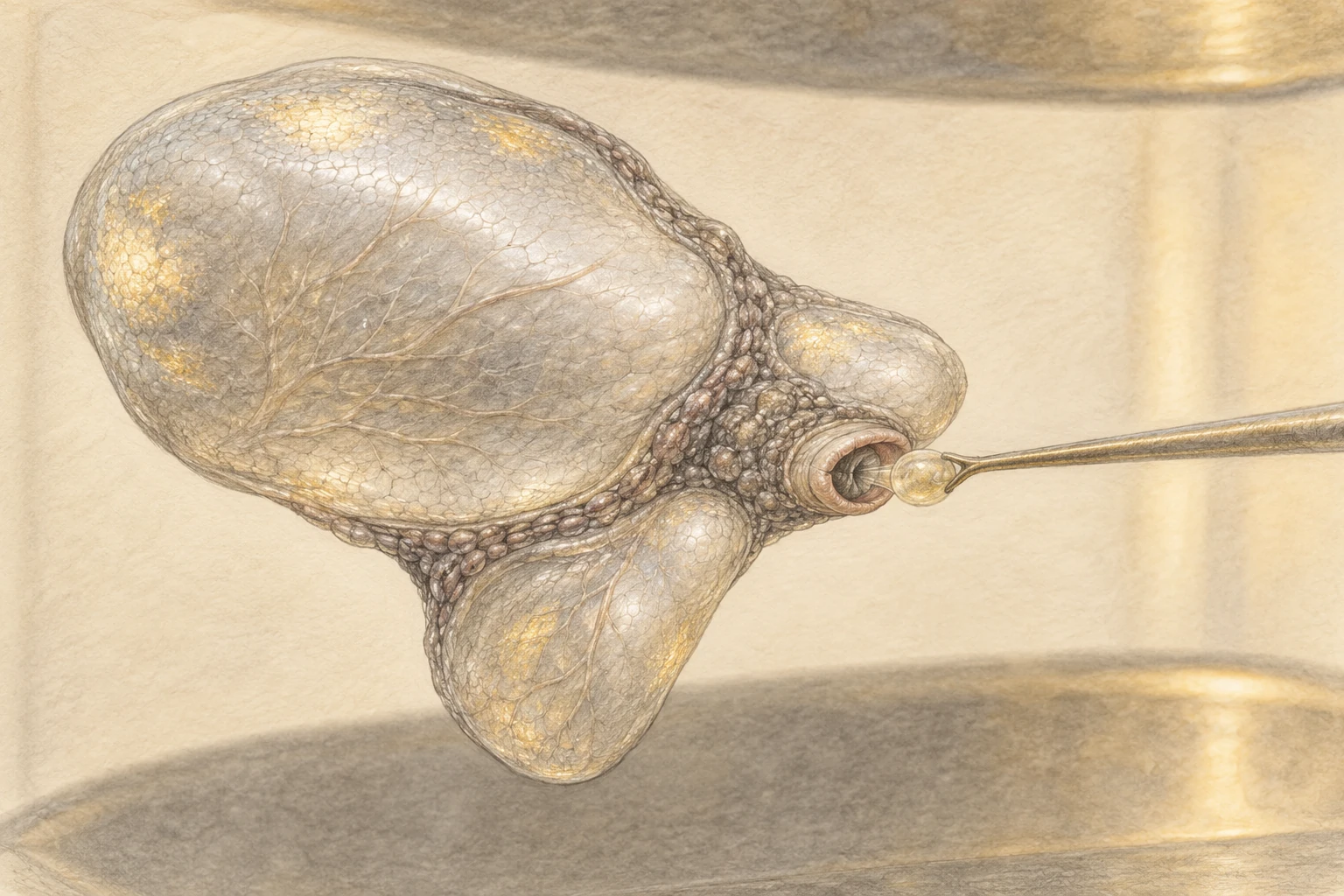
Chargeglider#
Sketch
Chargeglider adjusts its surface charge to move through a maintained electric field. Photoemissive patches release electrons under regulated ultraviolet light, and controlled electron capture reduces the charge again. Three sealed tissue pockets share a thick living seam containing the capsule intake. Its outer gate accepts a nutrient bead while an inner seal retains water; warm chamber surroundings and finite reserves sustain the small body.
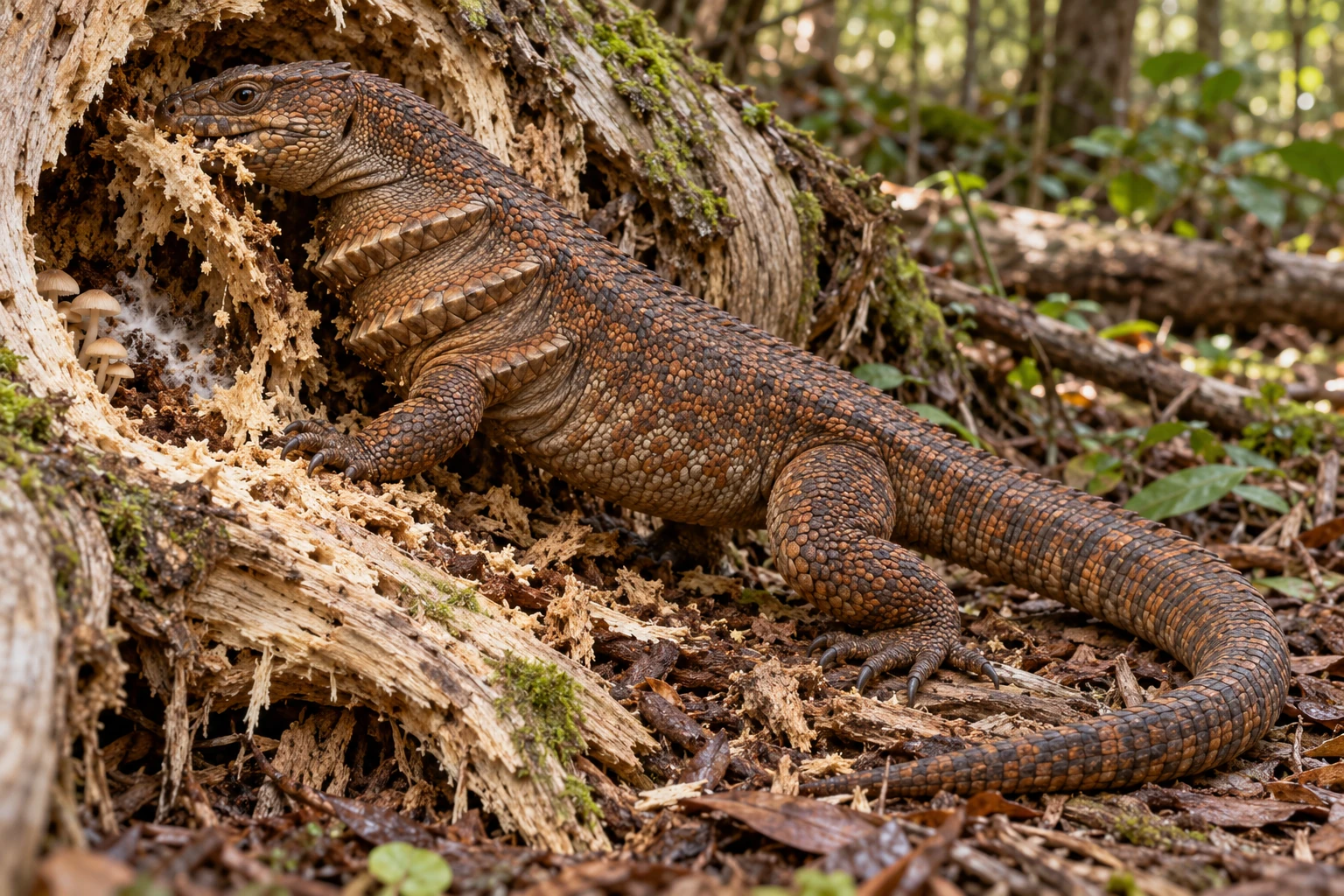
Drillback lizard#
Illustration
A drillback lizard braces at a decaying root cavity, its long tail and hindquarters reacting the load from three diagonal chest rasps. Short reversible trunk movements press the rib-supported keels against soft wood, loosening fungal food near the entrance. Flexible tissue between the reinforced saddle regions accommodates the small rocking motion. Broad feet retain contact while the animal pauses to bite exposed decay.
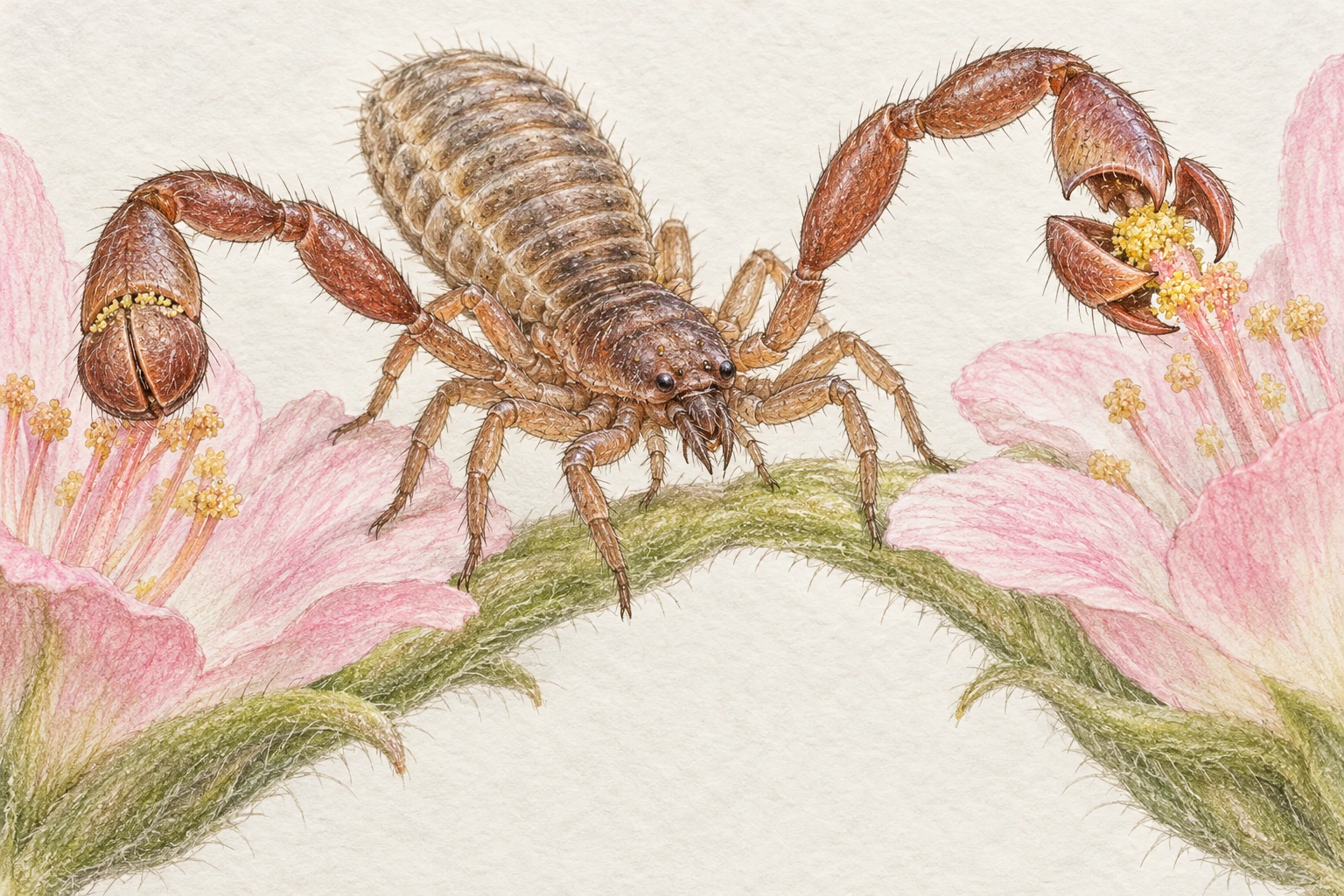
Pollenlock pseudoscorpion#
Sketch
A pollenlock pseudoscorpion opens one palp chamber against a flower’s receptive stigma while keeping a second pollen packet enclosed. Four curved cuticular fingers surround each gland-lined chamber, holding the pollen gently and maintaining its moisture during transport. Eight walking legs support the animal between the flowers, leaving both loaded palps free. Small chelicerae collect nectar residue and tiny floral prey between transfers.
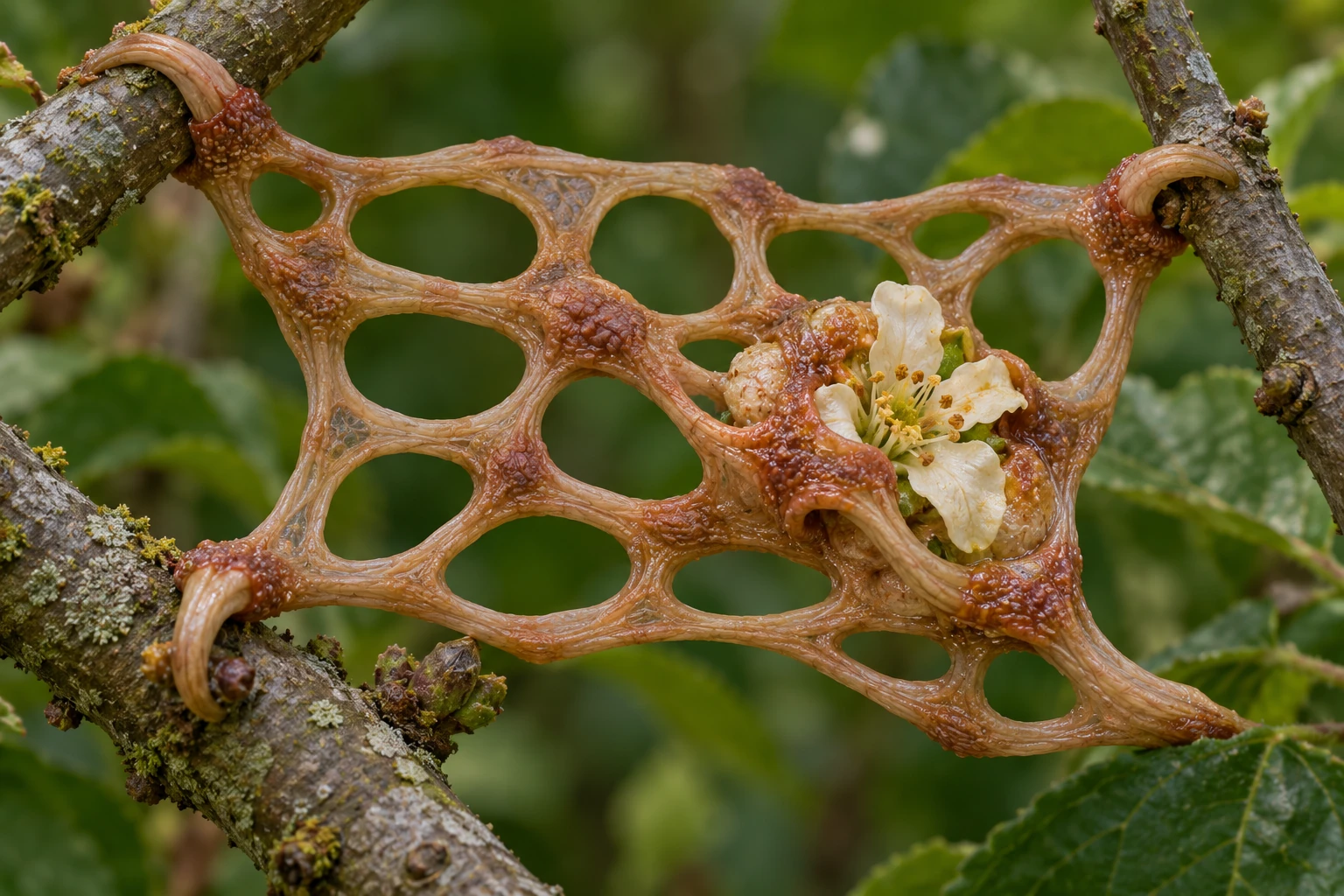
Gustmesh#
Illustration
Gustmesh holds its shallow body between twig contacts while windblown food settles into the center. Hollow living cords carry nutrient fluid and protected air passages; thick junctions contain feeding pockets and muscles that redistribute tension. Three broad hooks support this animal as its margins fold around a blossom. The fixed network moves by transferring contacts in sequence, preserving its connected pattern.
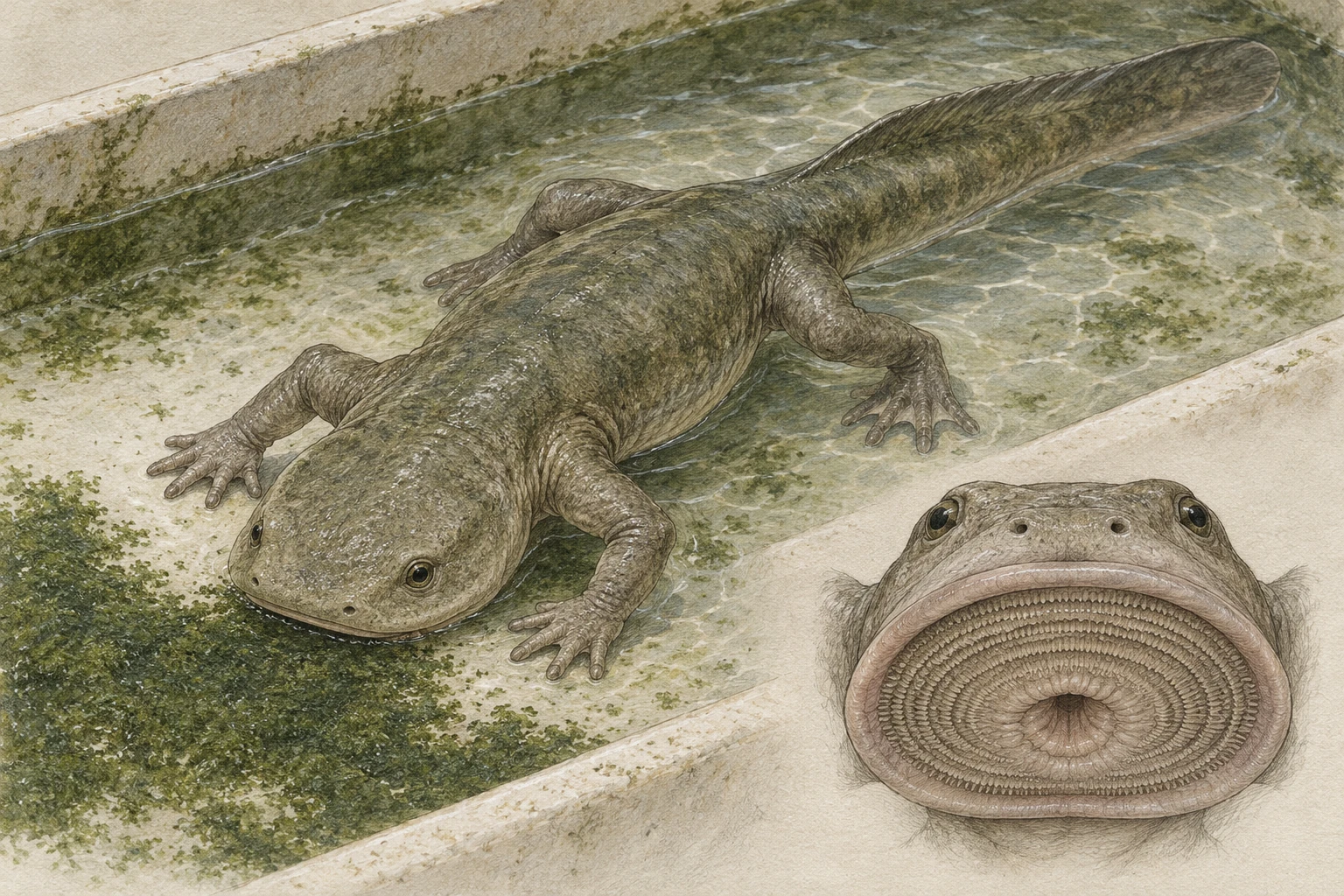
Discjaw grazer#
Sketch
A discjaw grazer walks along the shallow trough with its feeding rim resting over an algal patch. Four limbs carry the flattened adult body, and the muscular tail supplies swimming thrust between grazing sites. The head study exposes concentric renewing keratin scraper rows within one soft muscular rim. Gentle pressure steadies the disc as a throat pump draws loosened algae into a food slurry.
Living with designed animals#
Engineered-animal husbandry begins with the animal’s senses, preferred activities, and physical requirements. A weaver needs branches it can connect and a diet that supports silk production. A fanback needs room to open its plates and companions who can see its displays. Orchard tortoises need suitable soil, light, and water for their plants, along with additional food to support their own metabolism.[2]
Large orchard tortoises can form walking arboreta: collections of shallow-rooted miniature trees whose carriers rearrange the landscape each morning. Shade, flowering season, companionship, and the tortoises’ own preferences determine where the trees stand. Paths emerge as the animals settle, then shift again when the orchard rises to drink. Gardeners tend the trees while negotiating access to the animals carrying them.[1][2]
Cognitive abilities vary with the design. Animals capable of setting terms can participate in interspecies employment, choosing work and negotiating provisioning, journeys, and breeding. A capable orchard tortoise may employ a gardener to care for plants beyond its reach. The animal’s enjoyment of cultivation and the gardener’s access to its shell both affect the arrangement.[3]
See also#
References#
- ↑ a ↑ b ↑ c ↑ d ↑ e ↑ f ↑ g Comparative Animal Design Register (11360). Terrestrial Designs: Anatomy, Development and Behavior.
- ↑ a ↑ b Sen, I. (11358). Keeping Designed Animals. Revised edition.
- ↑ Animal Companion Contract Register (11360). Sample Employment, Journey and Nursery Agreements.
- ↑ Comparative Animal Design Register (11360). Open Water, Dense Air and Vacuum: Habitat Adaptations.